When you're ready to hire a digital marketing agency, the pricing conversation can feel deliberately opaque. Some agencies quote hourly rates, others pitch monthly retainers, and a few refuse to talk numbers until they've run discovery. This isn't just confusing, it's frustrating when you're trying to budget and compare options. Understanding digital marketing agency pricing means cutting through the noise and seeing what you're actually paying for. The right pricing model aligns with your growth goals, not just the agency's preference for billing.
How Agencies Actually Structure Their Fees
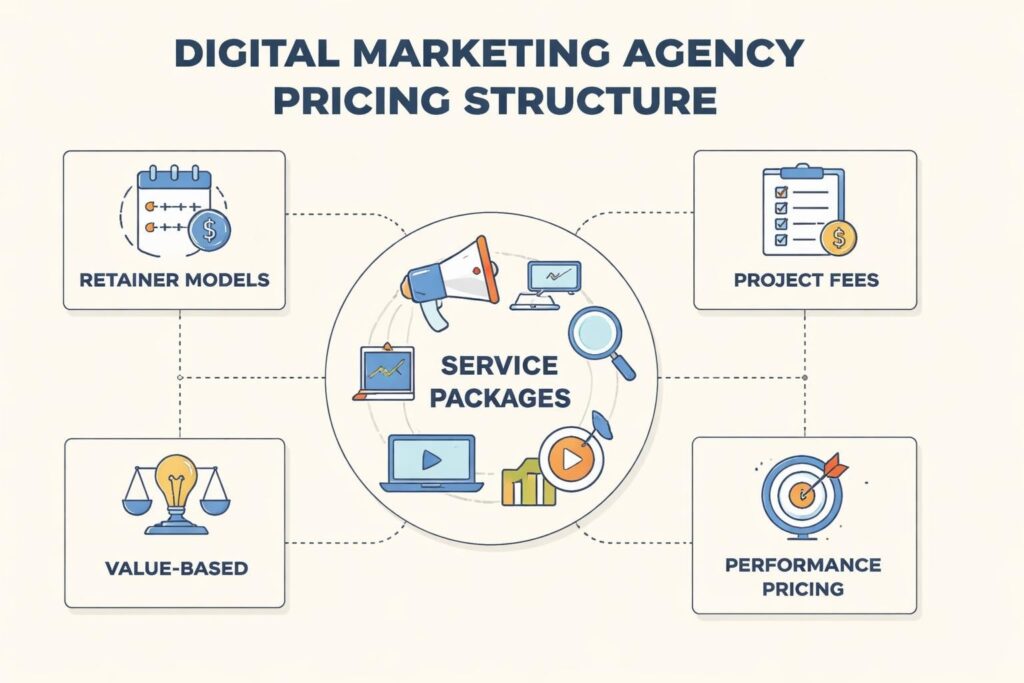
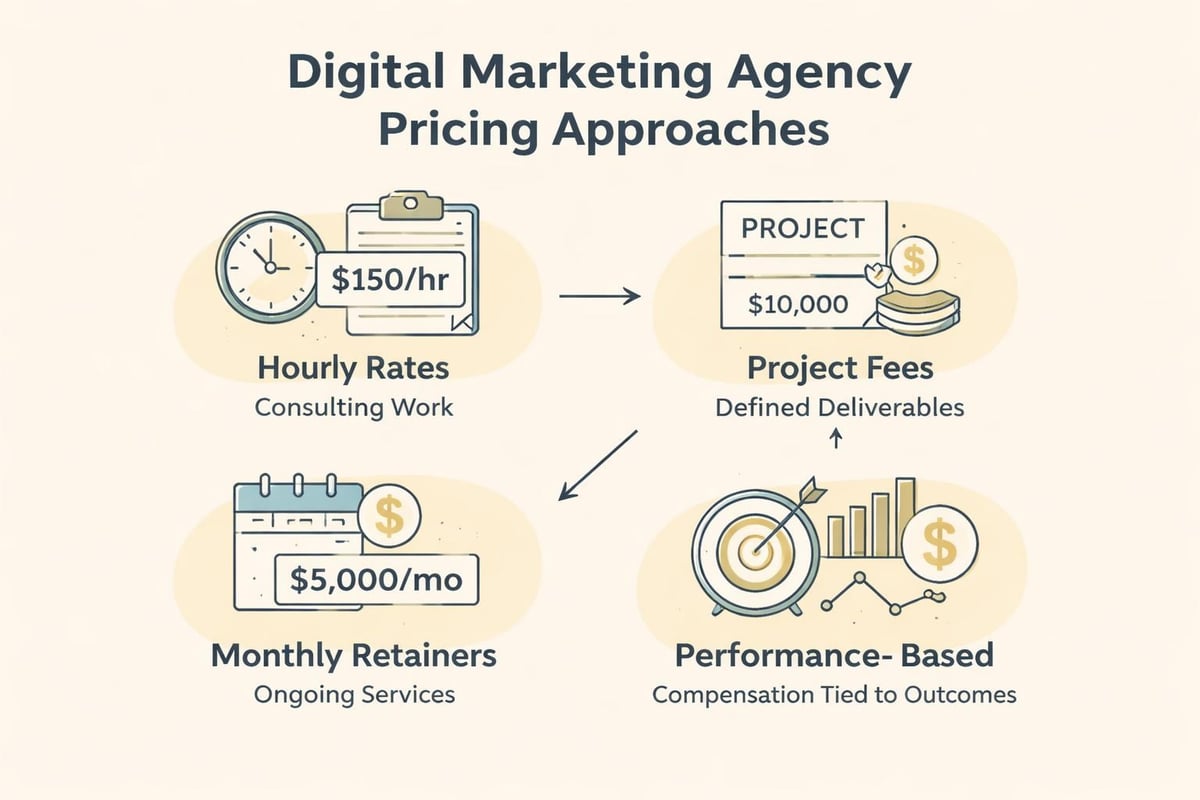
Digital marketing agencies typically use four core pricing models, and each has a different logic behind it. The model an agency defaults to tells you a lot about how they operate and what they prioritize.
Hourly pricing is straightforward but rarely sustainable for ongoing work. Agencies charge between $100 and $300 per hour depending on expertise and location. This works for one-off consultations or small tactical projects, but it creates weird incentives. The faster they work, the less they earn, which doesn't reward efficiency.
Project-based fees bundle everything into a fixed cost. You pay a set amount for a website redesign, a campaign launch, or a rebrand. According to recent agency growth statistics, this model helps agencies improve profitability when scoped correctly. The challenge is scope creep. If requirements shift mid-project, you're either paying more or compromising on deliverables.
Monthly retainers are the most common model for ongoing marketing work. You pay a fixed monthly fee for a defined set of services: content creation, ad management, SEO, reporting. Retainers typically range from $3,000 to $20,000+ per month depending on scope and agency size. This creates predictable costs for you and stable revenue for the agency.
Performance-based pricing ties fees to specific outcomes: leads generated, revenue driven, cost per acquisition. This sounds ideal, but it requires clear attribution, agreed-upon metrics, and trust on both sides. Few agencies offer pure performance pricing because marketing results depend on factors outside their control, like your sales process and product-market fit.
What You're Actually Paying For
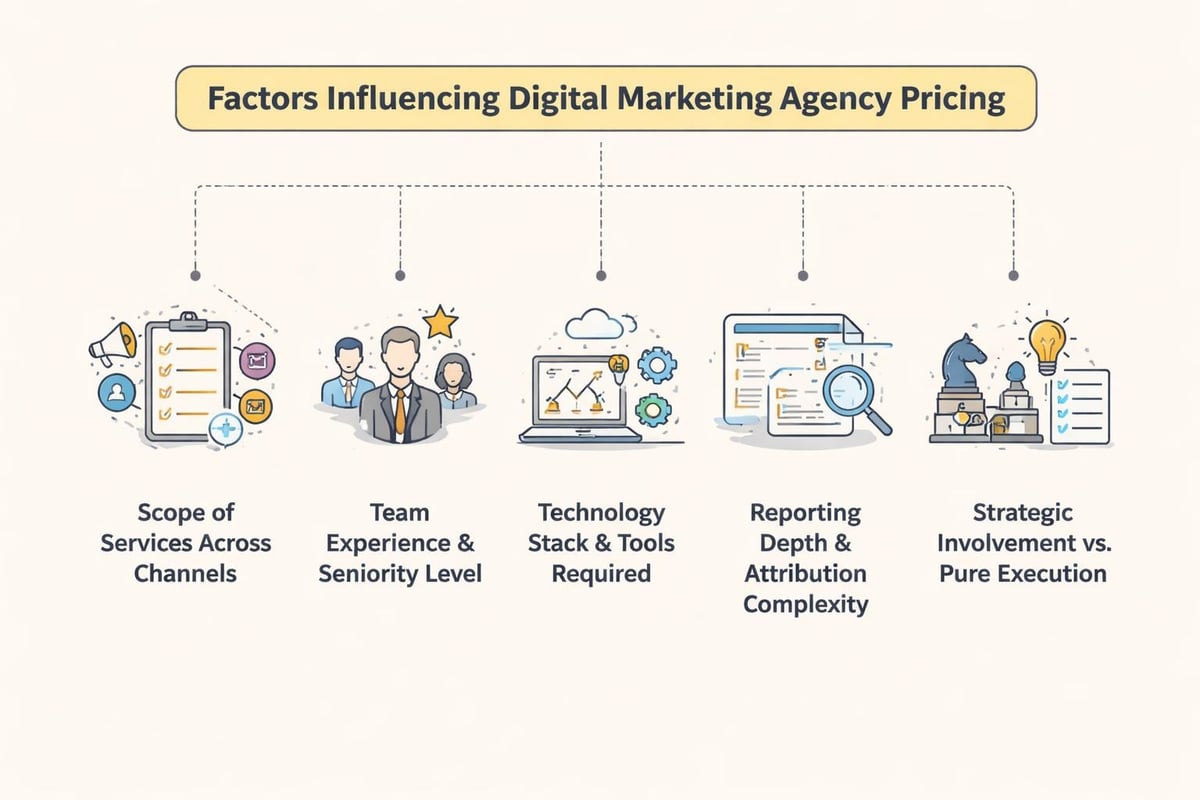
Digital marketing agency pricing isn't just labor hours. You're paying for systems, expertise, tools, and the infrastructure that makes marketing scalable.
A competent agency brings specialized knowledge that would take years to build in-house. They've tested campaigns across industries, know which platforms convert for different business models, and can avoid expensive mistakes you'd make learning solo. That expertise costs money because it saves you time and failed experiments.
You're also paying for technology and tools. Professional agencies use platforms for CRM automation, analytics, ad management, SEO tracking, and project management. These subscriptions add up to thousands monthly. When you hire an agency, you get access to their tech stack without buying each tool yourself.
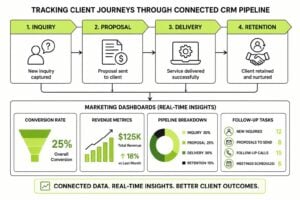
Processes and systems are what separate professional agencies from freelancers duct-taping projects together. Marketing and business development requires structured workflows: how leads get tracked, how campaign data flows into reporting, how creative gets approved and deployed. These systems protect your investment and create consistency.
Finally, accountability and reporting matter. A good agency doesn't just run campaigns, they show you what's working with clear metrics. Monthly reports, dashboard access, and regular strategy calls ensure you understand where budget goes and what returns you're generating.
The Real Cost Breakdown by Service
Different marketing services carry different price points. Here's what businesses typically pay in 2026:
| Service Type | Monthly Retainer Range | Project-Based Range |
|---|---|---|
| SEO | $2,500 – $10,000 | $5,000 – $30,000 |
| PPC Management | $1,500 – $8,000 + ad spend | N/A (ongoing) |
| Content Marketing | $3,000 – $15,000 | $1,500 – $8,000 per piece |
| Social Media Management | $1,000 – $8,000 | $500 – $3,000 per campaign |
| Email Marketing | $500 – $5,000 | $2,000 – $10,000 setup |
| Website Design | N/A | $8,000 – $50,000+ |
| Branding | N/A | $10,000 – $100,000+ |
These ranges reflect typical market rates, but digital marketing agency pricing varies significantly based on agency reputation, team size, and service depth.
How to Evaluate What Different Price Points Get You
Not all $5,000 monthly retainers deliver the same value. The question isn't just "how much" but "what exactly am I getting for this investment?"
Budget tier ($2,000-$5,000/month) typically gets you foundational work: basic SEO, limited content production, basic reporting, and support from junior team members. You're usually one of many clients managed by a small team. Services are standardized with minimal customization. This works if you need tactical execution and already have clear strategy.
Mid-tier ($5,000-$15,000/month) brings dedicated account management, senior strategist involvement, custom campaigns, integrated services across multiple channels, and more sophisticated reporting. The agency has time to understand your business model and adapt strategy based on performance data. This range works for businesses ready to scale systematically.
Premium tier ($15,000+/month) delivers executive-level strategy, fully integrated marketing systems, custom automation, advanced attribution modeling, and priority access to the agency's best talent. You're getting branding and advertising work that compounds over time, not just campaign execution.
The jump between tiers isn't just more hours. It's different caliber of thinking, better systems, and outcomes that create lasting competitive advantage.
Red Flags in Agency Pricing
Some pricing approaches signal problems before you even sign a contract:
- Guaranteeing specific results (first page rankings, exact lead numbers) without understanding your business
- Requiring 12+ month contracts before proving any value
- Refusing to explain their pricing structure or what deliverables you'll receive
- Charging percentage of ad spend without clear value beyond media buying
- Quoting far below market rates which usually means inexperienced teams or corner-cutting
Quality agencies price confidently because they deliver measurable value. If the pricing conversation feels evasive or packed with jargon, that's usually how the relationship continues.
Pricing Models for Different Business Stages
The right digital marketing agency pricing model changes as your business matures. What works when you're validating product-market fit won't serve you when you're scaling to multiple markets.
Early stage businesses (under $500K revenue) often need project-based work: a high-converting website, foundational brand positioning, initial automation setup. You're building infrastructure. A marketing website design project might cost $15,000-$30,000 but sets you up for months of lead generation without ongoing agency costs.
Growth stage businesses ($500K-$3M revenue) benefit from retainer relationships. You need consistent content, active campaign management, regular optimization, and integrated systems across your funnel. Monthly retainers of $5,000-$12,000 provide the sustained attention required to move from manual lead generation to predictable demand.
Established businesses ($3M+ revenue) often use hybrid models: core retainer for ongoing optimization plus project fees for major initiatives like rebrands, market expansion, or platform migrations. Total monthly investment might be $15,000-$30,000+ depending on revenue and marketing's role in growth.
According to detailed pricing model research, agencies increasingly customize pricing based on client maturity rather than offering one-size-fits-all packages.
Understanding Performance-Based and Value-Based Pricing
Two pricing approaches deserve special attention because they promise better alignment between what you pay and what you get.
Performance-based pricing means the agency's fees tie directly to results. You might pay a base retainer plus bonuses for hitting lead targets, or pure commission on revenue generated. This sounds perfect until you consider the complexity.
Marketing drives leads, but your sales team closes them. Your product quality affects conversion. Your pricing influences volume. Performance pricing only works when:
- Attribution is crystal clear
- The agency controls enough variables to influence outcomes
- Both parties agree on what constitutes success
- You have enough data to set realistic benchmarks
Most agencies avoid pure performance pricing because too many factors sit outside their control. But hybrid models (lower retainer + performance bonuses) can align incentives effectively.
Value-based pricing asks what the outcome is worth to your business, not what it costs the agency to deliver. If a rebrand positions you to charge 30% higher prices, the project value is far beyond the agency's labor hours. If digital branding solutions help you win enterprise clients, the value compounds annually.
This model requires agencies to understand your business economics deeply. Most can't or won't do that work, so they default to time-based pricing instead. But when it works, value-based pricing creates partnerships where success is genuinely shared.
How to Calculate Marketing ROI Against Agency Costs
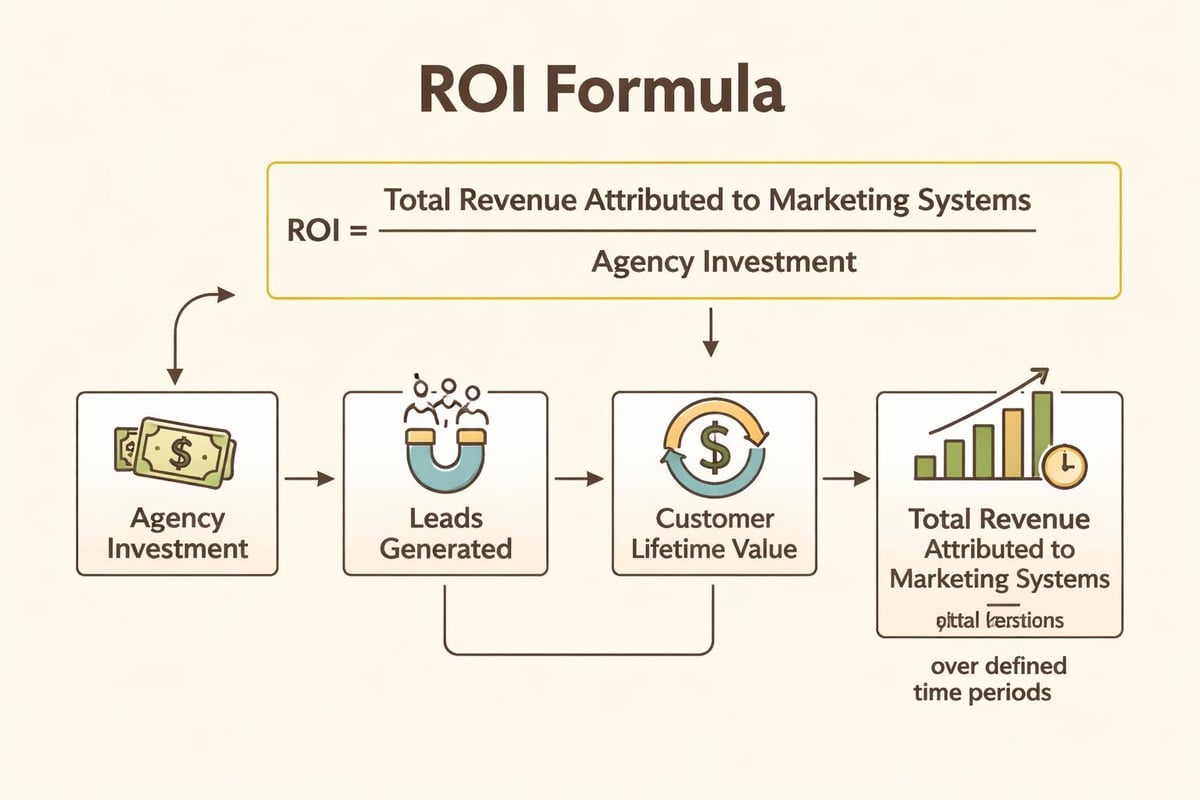
Digital marketing agency pricing only makes sense when compared to returns generated. Here's the framework:
Monthly agency investment: $8,000
New leads generated monthly: 40
Cost per lead: $200
Close rate: 15%
Average customer value: $12,000
New monthly revenue: $72,000
ROI: 9X
This simplified math shows why businesses tolerate seemingly high agency fees. If the system generates predictable returns above costs, the pricing is justified.
The calculation gets messier with longer sales cycles, brand-building work, and attribution across multiple touchpoints. But the principle holds: online marketing and branding should cost less than the value it creates, with enough margin to make the investment obviously worthwhile.
What Full-Service Agencies Include vs. Specialists
Digital marketing agency pricing also varies based on whether you're hiring a full-service shop or specialists. Each has different cost structures.
Full-service agencies handle everything: strategy, creative, media buying, content, automation, analytics. Their pricing tends higher because you're paying for coordination across disciplines. But you get integrated campaigns where brand, messaging, and execution align. Monthly retainers typically start around $8,000 and scale based on complexity.
Specialist agencies focus on one channel or service: just SEO, just paid media, just email automation. Their pricing can be lower because they're not managing cross-channel complexity. A specialist SEO agency might charge $3,000-$6,000 monthly compared to $10,000+ for full-service.
The trade-off is coordination burden. When you hire multiple specialists, you become the integrator. You ensure the PPC team and SEO team aren't working against each other. You make sure brand messaging stays consistent across content and ads. You consolidate reporting from four different dashboards.
According to comprehensive agency pricing guides, businesses save 20-30% on pure service costs using specialists but often spend that savings on internal coordination time.
How to Negotiate and Structure Agency Agreements
Digital marketing agency pricing isn't completely fixed. Professional agencies expect negotiation, and the structure of your agreement matters as much as the monthly number.
Start by understanding what's negotiable:
- Contract length: Shorter initial terms (3-6 months) with extension options reduce risk
- Service mix: Adjusting which services are included to hit your budget
- Payment terms: Monthly vs. quarterly billing, net-30 vs. net-60
- Performance milestones: Building in rate increases tied to hitting targets
What's rarely negotiable is hourly rates or significantly discounting established packages. Agencies that slash prices 40% to win business usually can't deliver at that rate and will either cut corners or create conflict when they realize they're underwater.
Better than discounts: Ask for value-adds. Additional reporting, quarterly strategy sessions, training for your team, or access to their tools. These cost the agency less than their billing rate but provide real value to you.
Contract Structures That Protect Both Sides
The best agency agreements create alignment without trapping either party in bad situations.
| Agreement Element | Client-Favorable Approach | Agency-Favorable Approach | Balanced Middle Ground |
|---|---|---|---|
| Contract Length | Month-to-month | 12 months minimum | 6 months with 60-day notice |
| Scope Changes | Unlimited revisions | Fixed scope, change orders | Defined revision rounds |
| Performance Metrics | Guaranteed results | Effort-based deliverables | Shared KPIs with transparency |
| Termination | Cancel anytime | Full contract paid | 30-60 day notice period |
| Rate Changes | Fixed for contract term | Quarterly adjustments | Annual review based on inflation |
The goal isn't extracting maximum advantage. It's creating terms both parties can live with so the relationship focuses on results, not contract disputes.
Hidden Costs in Agency Relationships
Beyond the quoted retainer, several additional costs show up in agency relationships. Understanding these upfront prevents budget surprises.
Media spend sits on top of management fees. If an agency quotes $4,000 monthly for PPC management, you'll also pay Google and Facebook directly for the ads. Budget total might be $4,000 agency fee + $10,000 media spend = $14,000 monthly total.
Third-party tools and platforms sometimes get passed through at cost. An agency might charge you for specific software licenses, premium stock photography, or conversion rate optimization tools. Clarify whether these are included in quoted pricing or additional.
Onboarding and setup often carries separate fees. Getting CRM automation configured, migrating from previous systems, or initial strategic planning might cost $3,000-$10,000 before regular monthly billing starts.
Overage charges apply when work exceeds agreed scope. If your contract includes four blog posts monthly but you request seven, expect additional fees. Make sure scope definitions are specific enough to avoid surprise charges.
Ask agencies for total first-year investment projections including all these elements. The monthly retainer might be $6,000, but total first-year costs could be $85,000 when you factor in setup, media spend, and tools.
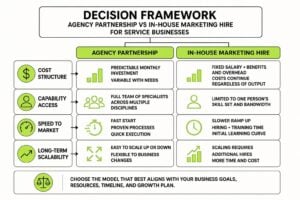
Comparing In-House Costs to Agency Pricing
Digital marketing agency pricing often seems high until compared to hiring internally. The math usually favors agencies for small to mid-size businesses.
A senior marketing manager costs $90,000-$130,000 annually in salary alone. Add benefits, payroll taxes, equipment, and software licenses, and you're closer to $120,000-$170,000 total compensation. That gets you one person with broad skills but limited depth.
A comparable agency retainer at $10,000 monthly ($120,000 annually) gives you access to an entire team: strategist, content creator, media buyer, designer, analyst. Each specialist has deeper expertise in their domain than one generalist employee could develop.
The break-even usually hits around $5-8 million in revenue. Below that, agencies deliver better value. Above it, hybrid models work well: in-house leadership plus agency execution.
There's also time to value. Hiring takes 2-4 months, then onboarding takes another 3-6 months before the employee operates independently. Agencies start delivering within weeks.
Questions to Ask Before Signing an Agency Contract
The right questions reveal whether digital marketing agency pricing aligns with value delivered. These should be answered before you commit:
- What exactly is included in the monthly retainer? Get specific deliverables, not vague promises.
- Who will actually do the work? Meet the team executing, not just the salesperson.
- How do you handle underperformance? What happens if campaigns don't hit projected returns?
- What does your reporting look like? Ask for sample reports from current clients.
- How do scope changes get handled? Understand the process for requesting work outside the agreement.
- What happens to assets if we part ways? Ensure you own website code, ad accounts, creative, and data.
- How often do we meet for strategy reviews? Quarterly, monthly, or only when you request?
- What results have you driven for similar businesses? Case studies with specific metrics, not testimonials.
Agencies confident in their value answer these directly. Evasive answers suggest they're more focused on closing deals than delivering results.
Understanding digital marketing agency pricing means looking beyond the monthly number to what you're actually building: systems that generate predictable demand, infrastructure that protects every lead, and marketing that creates compound growth over time. If you're ready to move from chaotic campaigns to structured growth, MDO Digital builds the marketing systems and brand clarity service businesses need to scale. We'll show you exactly what you're getting and what it costs, no discovery fees required.