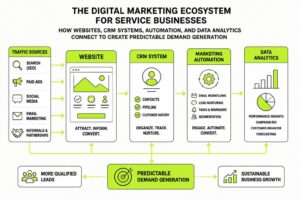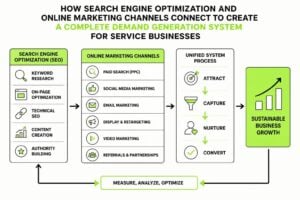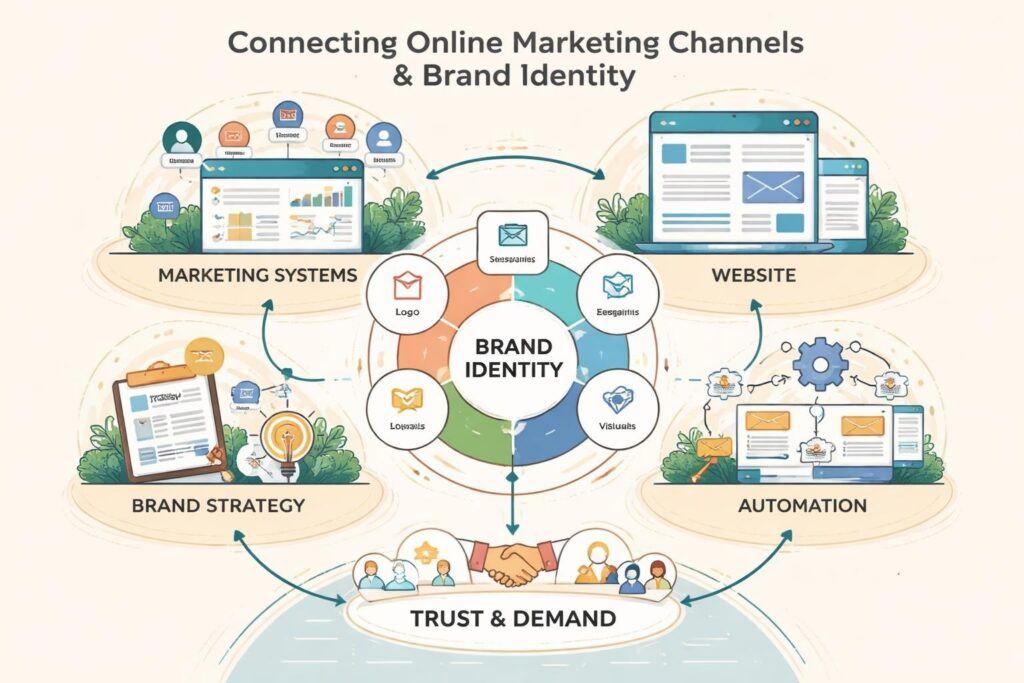
Most service businesses treat online marketing and branding as separate projects. Marketing runs campaigns to get leads. Branding makes things look nice. But when these two operate in silos, you end up with inconsistent messaging, wasted ad spend, and leads that don’t convert. The real work happens when online marketing and branding function as a single system, where every touchpoint reinforces trust and every campaign amplifies your positioning. This isn’t about choosing one over the other. It’s about building infrastructure that makes both more effective.
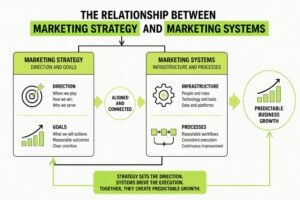
Why Online Marketing and Branding Must Work Together
You can run the best Google Ads campaign in your market, but if your website doesn’t match the promise in the ad, people leave. You can have beautiful branding, but if no one sees it, it doesn’t generate revenue.
Online marketing without branding creates short-term leads with no long-term equity. You’re constantly starting from zero, explaining who you are, justifying your price. Each campaign needs to do all the heavy lifting.
Branding without online marketing builds recognition with no mechanism to capture demand. You’ve got clarity on who you are, but no way to put that in front of people ready to buy.
When they work together:
- Your brand clarity makes your ads more relevant and your cost per click lower
- Your marketing channels distribute your brand consistently across every interaction
- Your positioning informs your targeting, so you attract better-fit clients
- Your infrastructure captures and nurtures leads with messages that reinforce trust
The businesses that scale predictably don’t separate these functions. They build systems where brand authority drives marketing performance and marketing proves brand value.
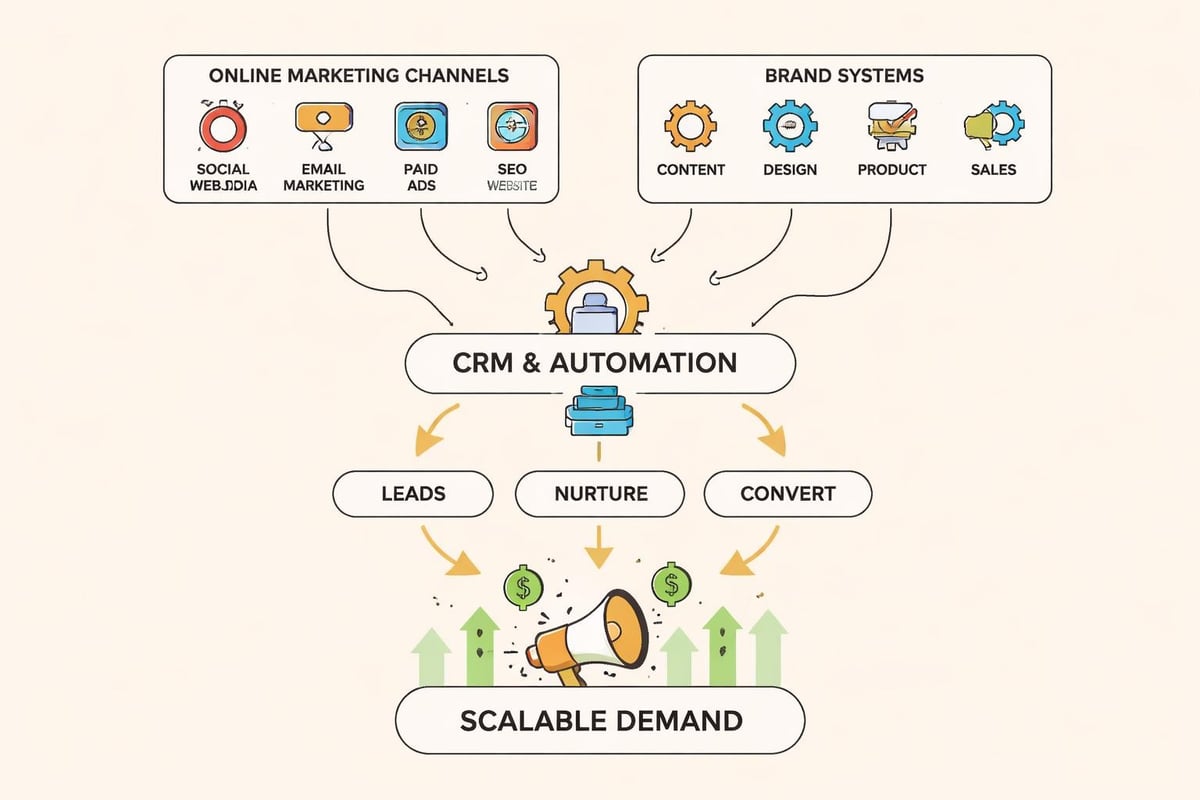
The Core Components of Online Marketing and Branding
Both disciplines have distinct jobs, but they share infrastructure. Here’s how the pieces fit together for service businesses.
Brand Foundation Elements
| Element | Purpose | Impact on Marketing |
|---|---|---|
| Positioning | Define who you serve and the transformation you deliver | Sharpens targeting and messaging in campaigns |
| Visual identity | Create recognition across touchpoints | Increases ad recall and website trust signals |
| Voice and tone | Establish how you communicate | Improves email open rates and engagement |
| Value proposition | Clarify why clients choose you over alternatives | Reduces cost per acquisition through message clarity |
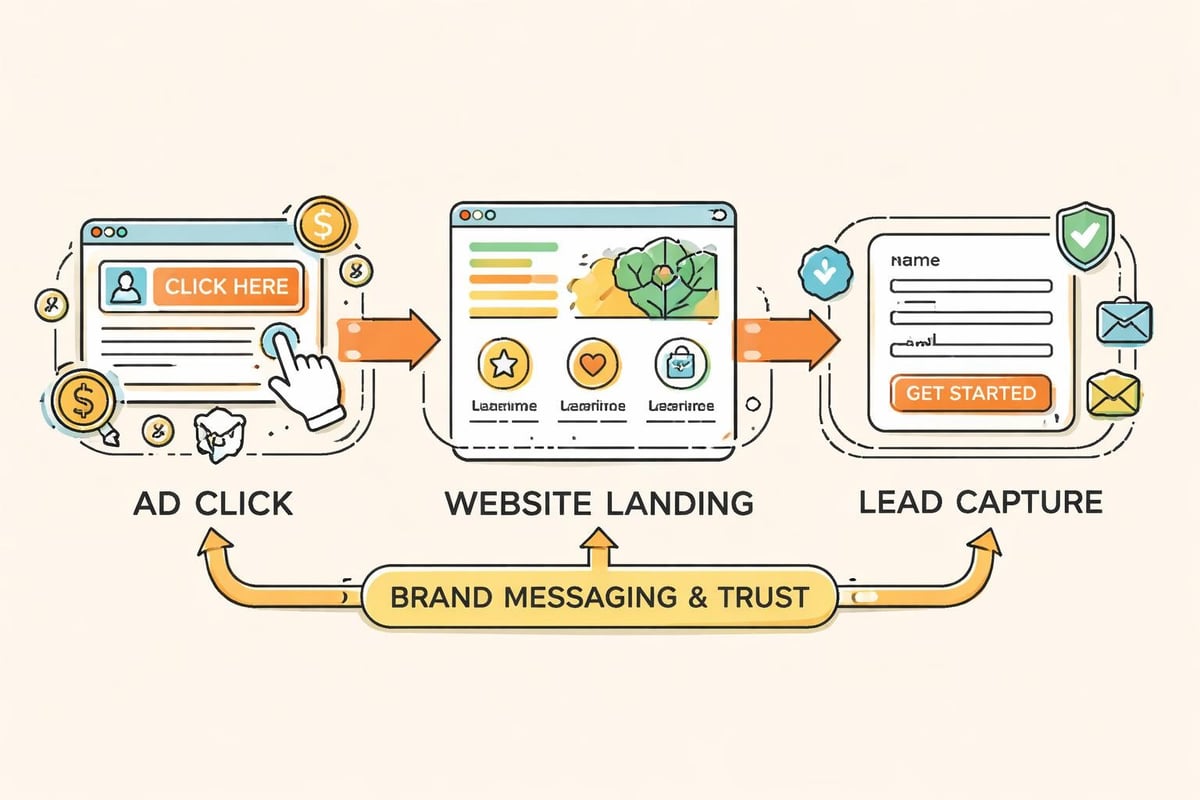
Your brand isn’t your logo. It’s the consistent experience people have with your business across every channel. When someone clicks an ad, lands on your website, receives an email, and books a call, they should feel like they’re dealing with the same business at every step.
Marketing Channel Infrastructure
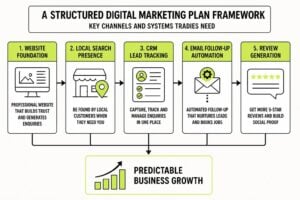
Online marketing for service businesses typically includes:
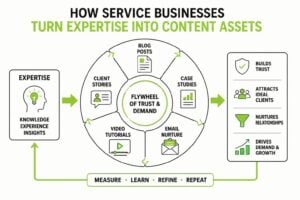
- Organic search through content that answers client questions and ranks for terms they’re searching
- Paid advertising on Google, LinkedIn, or Facebook to generate immediate demand
- Email marketing to nurture leads and stay top of mind with existing clients
- Social media to distribute content and build relationships before people are ready to buy
- Referral systems that turn happy clients into predictable lead sources
None of these channels work in isolation. Your SEO content supports your ads by providing proof. Your email sequences use brand messaging developed for your website. Your social posts reinforce the positioning in your paid campaigns.
At MDO Digital, we see the businesses that grow fastest treat this as one system, not five separate tactics.
Building a High-Trust Website That Converts
Your website is where online marketing and branding either align or fall apart. It’s the central node in your system. Every ad, every email, every social post eventually points here.
Most service business websites fail at conversion because they prioritize aesthetics over structure. They look nice but don’t guide visitors toward a decision. Or they’re packed with features and CTAs but feel generic and interchangeable.
A high-trust website does three things:
- Establishes authority immediately through clear positioning, social proof, and authoritative content that demonstrates expertise
- Matches visitor intent by speaking to the specific problem they arrived with
- Reduces friction in the path from visitor to lead with simple forms, clear next steps, and no unnecessary complexity
Website Structure That Supports Both Marketing and Brand
Your homepage should answer three questions in 10 seconds:
- What do you do?
- Who do you do it for?
- What should I do next?
Service pages should focus on outcomes, not features. Don’t list what’s included in your package. Explain the transformation clients experience and the system you use to deliver it.
Case studies and testimonials aren’t just trust signals for branding. They’re conversion tools for marketing. When someone lands on your site from an ad, they’re skeptical. Proof that you’ve solved this problem before removes the biggest objection.
This is why treating your website as just a branding asset or just a lead capture tool limits performance. It needs to do both. Our services focus on building this type of infrastructure because most agencies only solve half the problem.
CRM and Automation as the Backbone of Growth
You can have perfect branding and strong marketing, but if leads fall through the cracks, you’re pouring water into a leaky bucket. This is where most service businesses lose money.
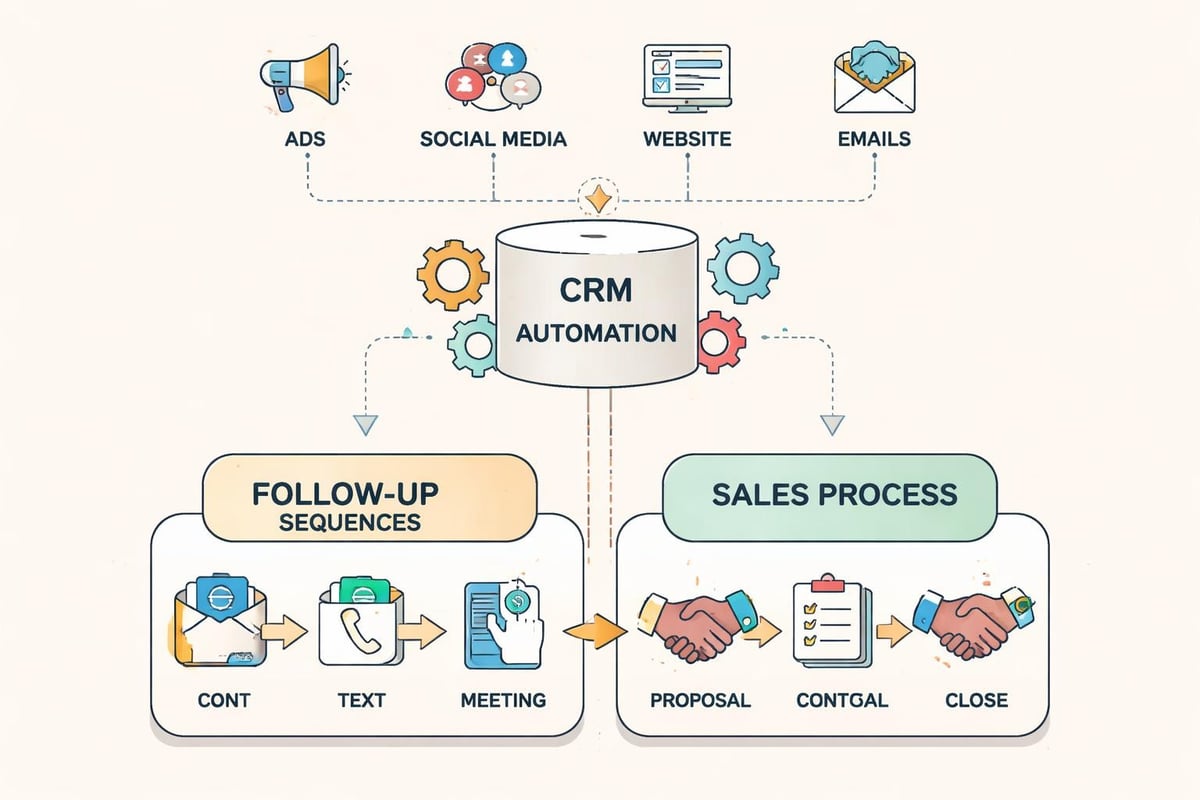
A CRM isn’t just a database. It’s the infrastructure that connects your marketing activity to revenue. It tracks where leads come from, what they’ve engaged with, and what happens next.
Automation ensures consistency. When someone books a discovery call, they get a confirmation email with your brand voice. When they don’t show up, they get a follow-up that reinforces your positioning. When they’re not ready to buy, they enter a nurture sequence that keeps you top of mind until they are.
What Actually Needs to Be Automated
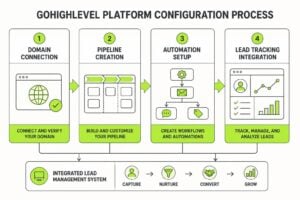
- Lead capture and tagging so you know which campaign or source generated each lead
- Follow-up sequences that run whether you’re available or not
- Appointment reminders that reduce no-shows and keep your calendar full
- Post-sale onboarding that starts the client relationship with clarity
- Re-engagement campaigns for leads that went cold
The brands that scale don’t rely on memory or manual processes. They build systems that protect every lead and deliver consistent experiences. This is what separates structured growth from chaotic growth.
Data-Driven Marketing That Compounds Over Time
Most service businesses run marketing like this: launch a campaign, see if it works, try something else if it doesn’t. There’s no baseline, no tracking, no iteration.
Online marketing and branding both improve when you measure what matters and refine based on evidence, not assumptions.
Metrics That Actually Inform Decisions
| Metric | What It Tells You | How to Improve It |
|---|---|---|
| Cost per lead | How efficiently your ads convert attention | Improve ad copy, targeting, or landing page clarity |
| Lead-to-client conversion rate | How well your sales process qualifies and closes | Refine messaging, tighten ideal client profile, improve follow-up |
| Customer lifetime value | How much revenue each client generates over time | Deliver better results, increase retention, add upsells |
| Traffic-to-lead conversion rate | How effectively your website turns visitors into leads | Improve trust signals, simplify forms, match message to source |
When you track these over time, patterns emerge. You see which campaigns generate the best-fit clients. You identify where leads drop off. You learn which brand messages resonate and which fall flat.
Identifying authoritative sources for your content also impacts how search engines and potential clients perceive your expertise. The stronger your content authority, the better your organic reach and the lower your reliance on paid channels.
Removing Chaos and Protecting Leads
The biggest constraint for most service businesses isn’t a lack of ideas. It’s too many of them. They’re running Facebook ads and Google ads and LinkedIn outreach and SEO and email and trying to post on three platforms daily. Everything is half-built. Nothing compounds.
Structured growth starts with focus. Pick the channels that match where your clients actually spend time. Build those properly. Track what works. Then layer in the next piece.
Your CRM should be your single source of truth. Every lead that enters your system should be tagged with its source, assigned a follow-up sequence, and tracked through to close or lost. When you can see this clearly, you stop guessing and start optimizing.
The businesses we work with at MDO Digital often come to us with five or six half-working systems. We consolidate, automate, and connect the pieces so marketing drives demand and branding builds trust without requiring constant manual input. You can explore how we approach this through recent client examples.
Practical Steps to Align Online Marketing and Branding
If you’re currently treating these as separate efforts, here’s how to start integrating them.
Step 1: Audit Your Current Messaging
Pull your website homepage copy, your best-performing ad, and your most recent email campaign. Read them side by side.
- Do they sound like the same business?
- Do they make the same promise?
- Do they speak to the same client?
If not, you’ve got a consistency problem. Fix this before spending more on marketing.
Step 2: Map Your Client Journey
List every touchpoint from first contact to signed client:
- Where they first hear about you
- What they see when they visit your website
- What happens after they submit a form
- How you follow up
- What the sales conversation looks like
- How onboarding begins
At each step, ask: does this experience reinforce trust or create doubt? Is the messaging consistent? Is the process smooth or does it require the client to chase you?
Step 3: Build One System at a Time
Don’t try to fix everything at once. Pick the biggest leak and solve it properly.
- If leads aren’t converting on your website, that’s your priority.
- If your follow-up is inconsistent, build automation.
- If your ads aren’t generating qualified leads, revisit your targeting and messaging.
Each improvement should connect to the others.
- Your website messaging should match your ads.
- Your email sequences should reinforce your website positioning.
- Your CRM should track everything so you can measure impact.
Step 4: Review and Refine Monthly
Set a recurring meeting to review:
- Lead volume and cost by source
- Conversion rates at each stage
- Client feedback and objections
- What’s working and what’s not
This is where data turns into strategy. The patterns you see this month inform what you test next month. Over time, small improvements compound into significant advantages.
Why Most Agencies Get This Wrong
Most marketing agencies are good at running campaigns. Most branding agencies are good at making things look sharp. Very few do both, and even fewer connect them to operational infrastructure like CRM and automation.
You end up hiring one agency for brand strategy, another for your website, another for ads, and you’re stuck in the middle trying to make them talk to each other. The handoffs break. The messaging drifts. The data lives in silos.
The businesses that scale with clarity work with partners who understand that building authoritative content and running effective campaigns and designing conversion-focused systems are all part of the same job. If your marketing doesn’t build brand equity, you’re renting attention. If your brand doesn’t drive demand, you’re admiring art.
What Gets Measured Gets Improved
The final piece is accountability. If you can’t track where your leads come from, which messages convert, and what your client acquisition cost is, you’re flying blind.
Your marketing platform, your website analytics, and your CRM should all feed into a single view of performance. You should be able to answer:
- How many leads did we generate this month?
- What did each lead cost?
- Which sources converted best?
- How long does it take to close a deal?
- What’s our current client lifetime value?
When you have this clarity, decisions become obvious. You double down on what works and cut what doesn’t. You stop wasting budget on channels that generate attention but not clients. You refine your brand messaging based on what actually resonates, not what sounds clever in a meeting.
This is the difference between online marketing and branding as expenses and online marketing and branding as growth infrastructure. One costs money. The other generates compounding returns.
Online marketing and branding aren’t competing priorities. They’re two sides of the same system, and when they align, you stop starting from zero with every campaign. MDO Digital builds the infrastructure that connects them: high-trust websites, CRM and automation that protects every lead, and data-driven marketing that turns attention into predictable demand. If you’re ready to remove the chaos and build something that compounds, let’s talk.