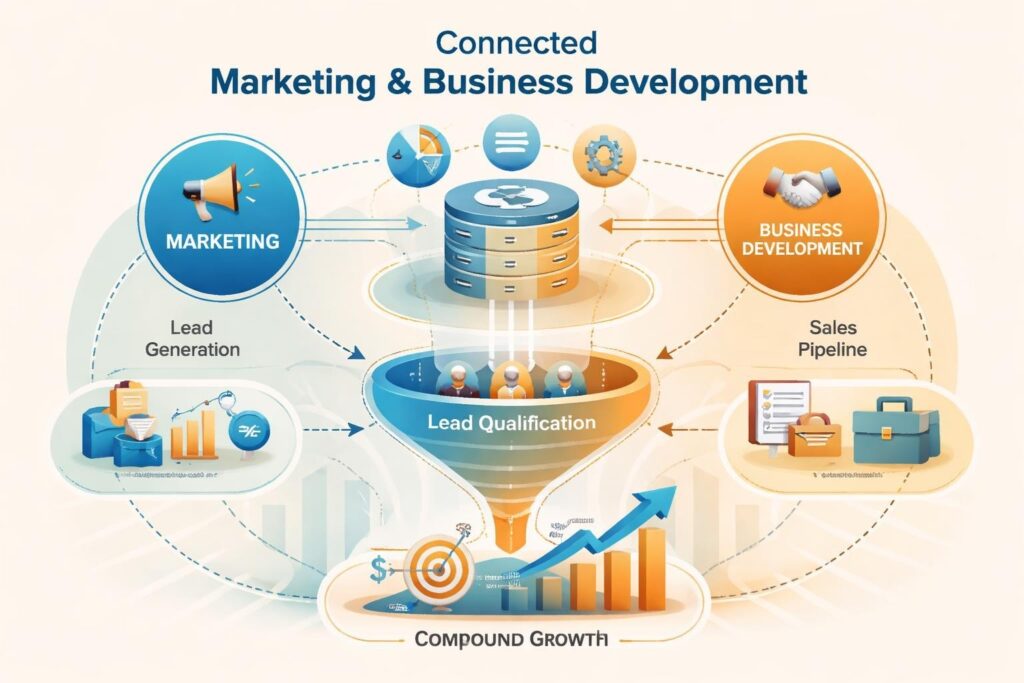
Most service businesses treat marketing and business development as separate jobs. Marketing brings in leads, then hands them off. Business development closes deals, then asks for more. This handoff mentality creates gaps where leads fall through, messages conflict, and growth stalls. The truth is simpler: marketing and business development are two sides of the same system. When they work as one connected process, you get predictable demand instead of chaos.
Why Marketing and Business Development Need Each Other
Marketing without business development is noise. You generate attention, but no one’s converting it into revenue. Business development without marketing is a grind. You’re always hustling for the next conversation because there’s no pipeline feeding you qualified prospects.
The split happens because teams operate in silos. Marketing measures clicks and impressions. Business development tracks meetings and close rates. Neither owns the full journey from stranger to client. This creates three common problems:
- Lost leads: Prospects enter the system but never get followed up properly
- Misaligned messaging: What marketing promises doesn’t match what sales delivers
- Wasted budget: Money goes to channels that don’t generate closeable opportunities
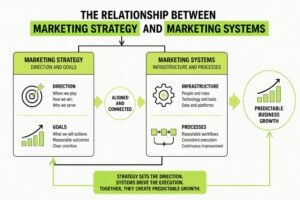
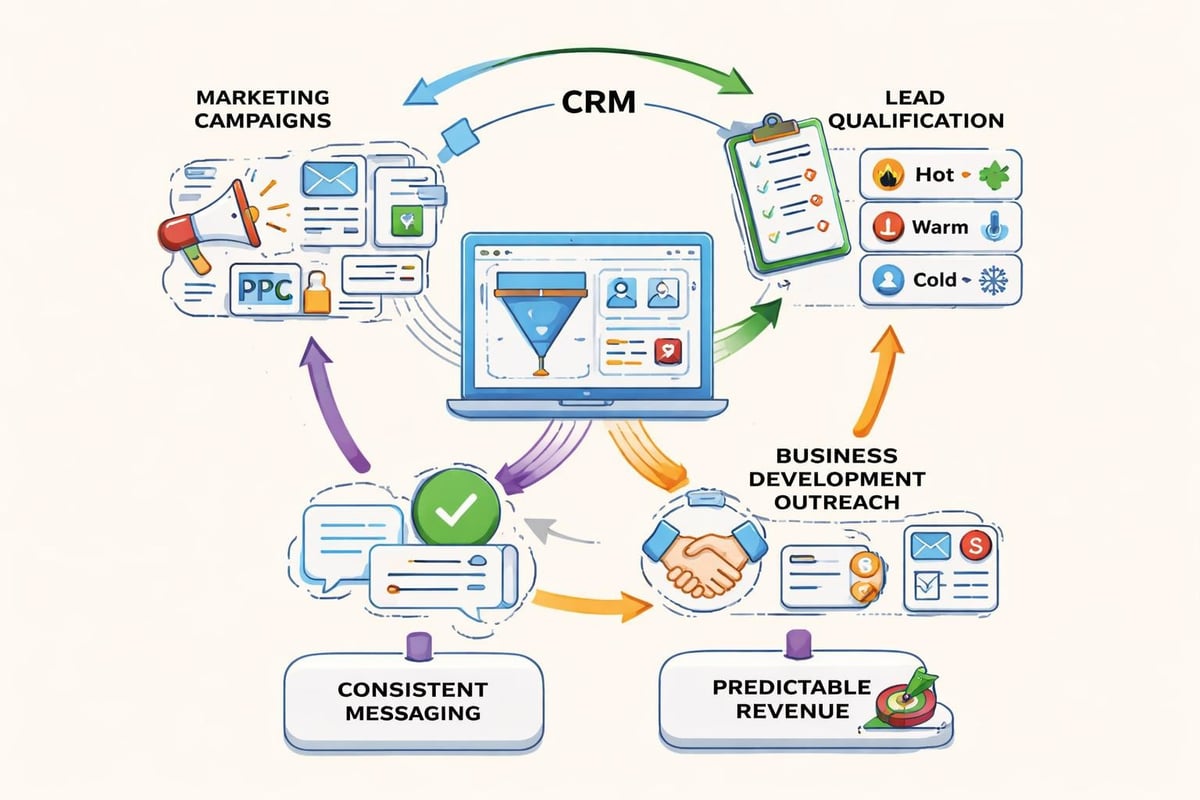
When marketing and business development share goals, infrastructure, and feedback loops, you remove friction. Marketing creates demand with the exact message that business development uses to close. Business development reports back what objections come up, so marketing can address them upfront. Both teams work from the same CRM, see the same data, and optimize for the same outcome: predictable revenue.
Building Systems That Connect Both Functions
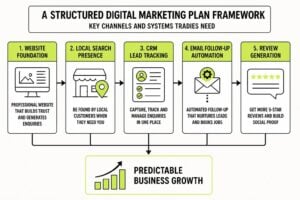
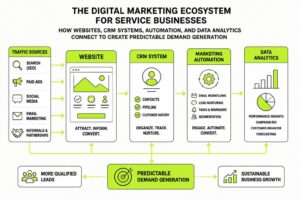
Systems thinking is what separates growth from guesswork. You need infrastructure that captures every lead, tracks every interaction, and surfaces the insights both teams need to improve.
Start With a Single Source of Truth
Your CRM isn’t just a database. It’s the spine of your entire revenue operation. Every lead from every channel should flow into one place. Email signups, contact form submissions, LinkedIn connections, referrals. If it’s a potential client, it’s in the system.
From there, you define stages:
- Awareness: They know you exist
- Interest: They’ve engaged with content or asked a question
- Consideration: They’re evaluating whether you’re the right fit
- Decision: They’re ready to buy or need one final push
Marketing owns awareness and interest. Business development owns consideration and decision. But both teams see the full pipeline and understand how their work affects the next stage. This visibility alone fixes most alignment problems. When marketing can see that 60% of leads from LinkedIn never make it past the first call, they adjust targeting. When business development sees that prospects who download a specific guide close twice as fast, they prioritize those leads.
Automate the Handoff
The moment a lead moves from marketing to business development is where most businesses lose momentum. Someone fills out a form. Marketing gets the notification. They manually enter it into a spreadsheet. Three days later, someone from business development sends a generic email. The lead’s already cold.
Automation removes the delay. When a prospect takes a high-intent action (books a call, requests pricing, downloads a case study), the system should:
- Tag them in the CRM with relevant context
- Notify the right person on your business development team
- Send an immediate confirmation email
- Add them to a nurture sequence if they’re not ready yet
Marketing automation infrastructure doesn’t have to be complex. It just has to be reliable. The goal is zero manual steps between a lead raising their hand and someone responding.
Creating a Shared Content Engine
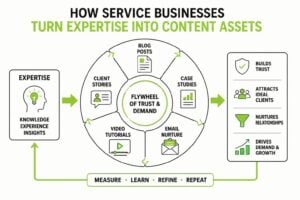
Content is where marketing and business development overlap most visibly. Marketing creates it. Business development uses it. When both teams collaborate on what gets made, the output becomes far more effective.
High-converting content types for service businesses:
| Content Type | Marketing Use | Business Development Use |
|---|---|---|
| Case studies | Traffic and SEO | Social proof in proposals |
| Email templates | Nurture sequences | Outreach and follow-up |
| One-pagers | Lead magnets | Leave-behinds after calls |
| FAQ docs | Website content | Objection handling |
The best process is simple. Business development tracks every objection, question, and concern that comes up in conversations. Once a month, they hand that list to marketing. Marketing turns it into content. A blog post addressing a common fear. A comparison guide for prospects evaluating competitors. A calculator that demonstrates ROI.
This feedback loop ensures marketing isn’t guessing what prospects care about. They’re building assets that directly support the close. Meanwhile, business development has a library of credible, on-brand materials they can send at exactly the right moment.
Use Your Website as a Qualification Tool
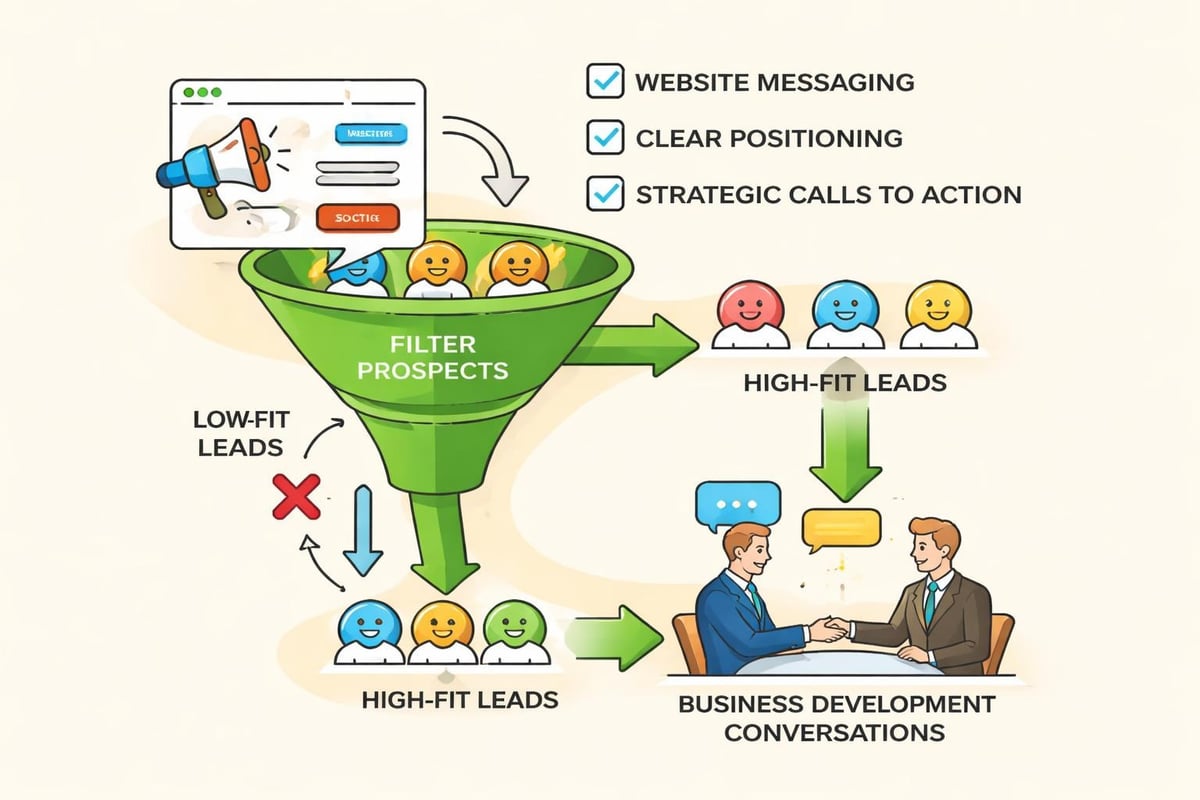
Your website isn’t a brochure. It’s the first filter in your business development process. When designed properly, it attracts the right people and repels the wrong ones. This makes every conversation that follows more productive.
High trust websites do three things well:
- Clarify who you serve: Be specific about your ideal client. If you work with B2B service businesses doing $2M to $10M in revenue, say that. Generic positioning attracts generic leads.
- Show proof, not promises: Case studies, testimonials, and specific results matter more than claims. “We helped Company X increase qualified pipeline by 40% in six months” beats “We drive growth.”
- Make the next step obvious: Every page should have a clear call to action. Book a call. Download a guide. See pricing. Don’t make people hunt for how to engage.
When your website does the heavy lifting, business development spends less time qualifying and more time closing. According to research on marketing knowledge for small business decision-makers, clarity in positioning directly impacts conversion rates across all stages.
Measuring What Actually Matters
Vanity metrics kill alignment. Marketing celebrates 10,000 new followers. Business development complains there are no good leads. Both are looking at the wrong numbers.
The metrics that connect marketing and business development are simple:
Pipeline Metrics That Both Teams Should Track
| Metric | What It Tells You | Who Owns It |
|---|---|---|
| Marketing Qualified Leads (MQLs) | How many leads fit your ideal client profile | Marketing |
| Sales Accepted Leads (SALs) | How many MQLs business development agrees to follow up | Both |
| Opportunity Conversion Rate | Percentage of SALs that become real opportunities | Business Development |
| Cost Per Opportunity | How much marketing spend it takes to generate a closeable deal | Both |
| Win Rate by Source | Which channels produce clients that actually close | Both |
When both teams report on the same metrics, accountability becomes shared. Marketing can’t just send junk and call it success. Business development can’t ignore good leads and blame marketing. You’re either moving the same numbers together or you’re both failing.
The Marketing Accountability Standards Board has established frameworks for exactly this kind of measurement. Their focus on tying marketing activity to financial outcomes is the standard every service business should aim for.
Use Data to Improve Both Functions
Tracking metrics is pointless if you don’t act on them. Set up a monthly review where marketing and business development sit down together. Look at:
- Which campaigns generated the most opportunities
- Which lead sources had the highest close rates
- Where leads are getting stuck in the pipeline
- What objections came up most often
Then make changes. If webinar attendees close at twice the rate of cold form fills, run more webinars. If prospects from a certain industry never convert, stop targeting them. If business development is losing deals because pricing isn’t clear upfront, add a pricing page to your website.
This ongoing optimization is what compounds over time. Small improvements each month add up to a completely different growth trajectory over a year.
Aligning Messaging Across the Entire Journey
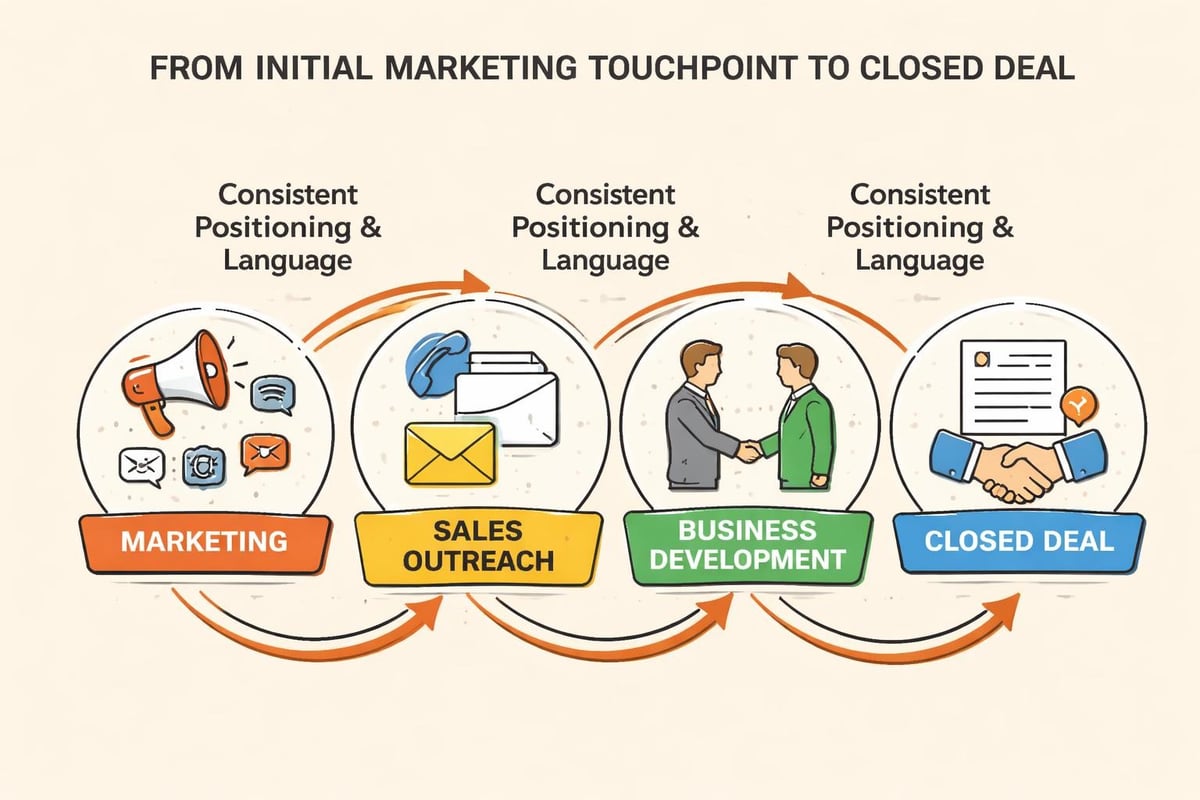
Nothing erodes trust faster than inconsistent messaging. Marketing promises one thing. Business development says something different. The client gets confused and bails.
Your messaging should be a single thread that runs from the first ad someone sees to the proposal they receive. This requires deliberate coordination.
How to create messaging alignment:
- Define your core positioning in one document (who you serve, what problem you solve, how you’re different)
- Train both marketing and business development on that positioning
- Use the same language in ads, website copy, email sequences, and sales calls
- Review all customer-facing materials quarterly to ensure consistency
When a prospect hears the same story from every touchpoint, it builds credibility. They’re not wondering if they’re talking to the right company. They’re deciding when to move forward.
This is especially critical for service businesses where the sales cycle is longer. You’re not selling a $50 product someone buys on impulse. You’re earning trust over weeks or months. Every interaction either reinforces your message or creates doubt.
Structuring Your Team for Integration
You don’t need a massive team to make marketing and business development work together. You need clear roles and regular communication.
Small Team Structure (Under 10 People)
- One person owns revenue operations: They manage the CRM, track metrics, and ensure nothing falls through the cracks
- Marketing focuses on demand generation: Content, ads, SEO, email nurture
- Business development focuses on conversations: Demos, proposals, closing
Everyone meets weekly to review pipeline, share feedback, and adjust tactics. The key is that no one operates in isolation.
Growing Team Structure (10-50 People)
As you scale, you can specialize:
- Marketing splits into content, paid acquisition, and automation
- Business development splits into inbound (responding to leads) and outbound (proactive prospecting)
- Revenue operations expands to include analytics and process optimization
But the principle stays the same. Shared goals, shared data, continuous feedback. The Ehrenberg-Bass Institute for Marketing Science has extensively researched how marketing systems scale, and the consistent finding is that integration beats specialization every time.
Building Compound Growth
Most businesses chase linear growth. They spend $10,000 on ads, generate 50 leads, close five clients. Next month, they need to spend $10,000 again to get the same result. That’s not scaling, it’s treading water.
Compound growth happens when your marketing and business development systems build on themselves:
- Referrals: Happy clients become a source of new qualified leads
- Content: Every piece you publish continues to attract prospects months later
- Brand recognition: People who’ve seen your name multiple times close faster
- Data: Every campaign teaches you what works, so the next one performs better
This compounding only works when your systems are designed to capture and leverage every interaction. If leads leak out of your pipeline, if you’re not tracking what drives results, if marketing and business development aren’t learning from each other, you’ll stay stuck in linear mode.
Avoiding Common Pitfalls
Even with good intentions, most businesses make predictable mistakes when trying to align marketing and business development.
Top mistakes to watch for:
- Over-relying on one channel: If 80% of your leads come from LinkedIn, you’re vulnerable. Diversify early.
- Ignoring lead quality: Volume means nothing if business development can’t convert them. Focus on fit, not quantity.
- Failing to nurture: Not every lead is ready to buy today. Build sequences for people who need 3, 6, or 12 months.
- Skipping attribution: If you don’t know which efforts drive revenue, you can’t make smart budget decisions.
The Data & Marketing Association has published extensive guidelines on marketing effectiveness, and their core principle is simple: test, measure, optimise. Don’t assume. Know.
Making It Work in Your Business
You don’t need a complete overhaul to start seeing results. Pick one area where marketing and business development are currently misaligned and fix it.
Maybe that’s implementing a shared CRM. Maybe it’s creating a weekly sync meeting. Maybe it’s building one high-quality lead magnet that business development can actually use in conversations.
Start small, measure the impact, then expand. The businesses that win in 2026 won’t be the ones with the biggest budgets. They’ll be the ones with the tightest systems. Where nothing is wasted. Where every lead is protected. Where growth compounds because the whole machine is designed to learn and improve.
Your marketing and business development teams are either working as one system or they’re working against each other. There’s no middle ground.
Marketing and business development alignment isn’t optional anymore. It’s the difference between chaotic growth and structured scale. When your systems connect, your messaging aligns, and your teams share goals, you turn attention into predictable demand. If you’re ready to remove the chaos and build infrastructure that compounds, MDO Digital designs exactly these kinds of systems for service businesses. Let’s build something that works.