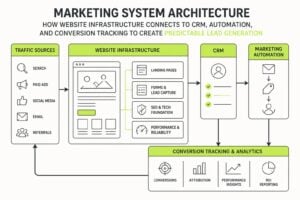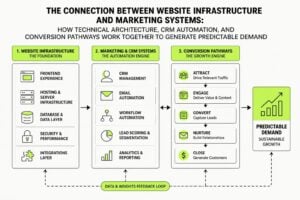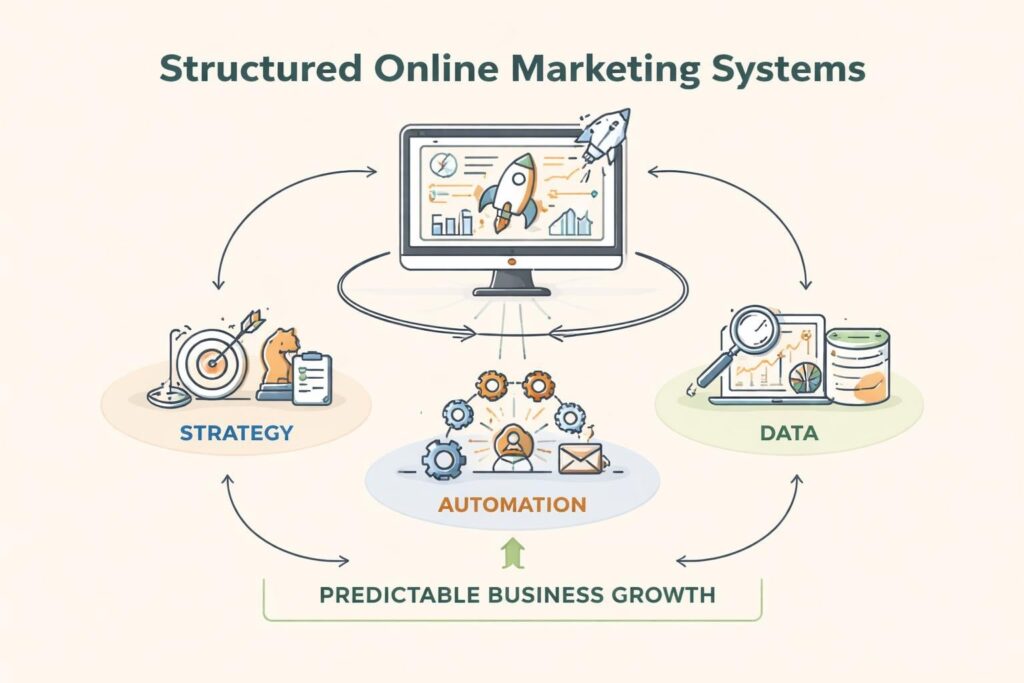
When you hear someone say "online marketing marketing," it sounds like a mistake. But it's actually closer to the truth than most business owners realize. Online marketing isn't just a tactic or channel anymore. It's marketing for your marketing itself. The infrastructure, the systems, the data flows that make your campaigns compound rather than just exist. Service businesses that scale without burning out understand this distinction. They don't just run ads or post content. They build marketing ecosystems that protect leads, automate follow-up, and create structured demand that feeds their pipeline predictably. That's the shift from doing online marketing to actually marketing your marketing properly.
What Online Marketing Marketing Actually Means
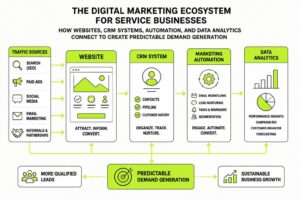
Online marketing marketing is the practice of treating your marketing infrastructure as a product that needs its own strategy. Most businesses focus on individual tactics: run Facebook ads, write blog posts, send newsletters. But effective online marketing strategies require a layer above tactics. You need systems that capture intent, nurture attention, and route leads to the right place at the right time.
Think of it this way. Your website converts at 2%. Your email sequences run on a basic template. Your CRM doesn't talk to your website forms. Each piece works, sort of, but nothing compounds. That's marketing without the infrastructure. Online marketing marketing fixes this by designing the ecosystem first, then layering tactics on top.
The Infrastructure Problem Most Businesses Ignore
Service businesses often grow despite their marketing, not because of it. Someone refers a client. A prospect stumbles on your site. You close a deal through a conversation. It feels like momentum, but it's chaos disguised as growth.
Here's what breaks when you scale without systems:
- Lead leakage: Inquiries fall through gaps between platforms
- Manual handoffs: Every lead requires someone to copy-paste data
- No attribution: You can't tell which efforts actually drive revenue
- Inconsistent follow-up: Some leads get five emails, others get forgotten
- Data silos: Your website, CRM, and email platform don't share information
The businesses that scale past seven figures don't have better tactics. They have better infrastructure. Their online marketing marketing creates a container where tactics can actually work. When you understand how digital growth systems compound, you stop chasing the next hack and start building assets.
Building Systems That Make Tactics Work
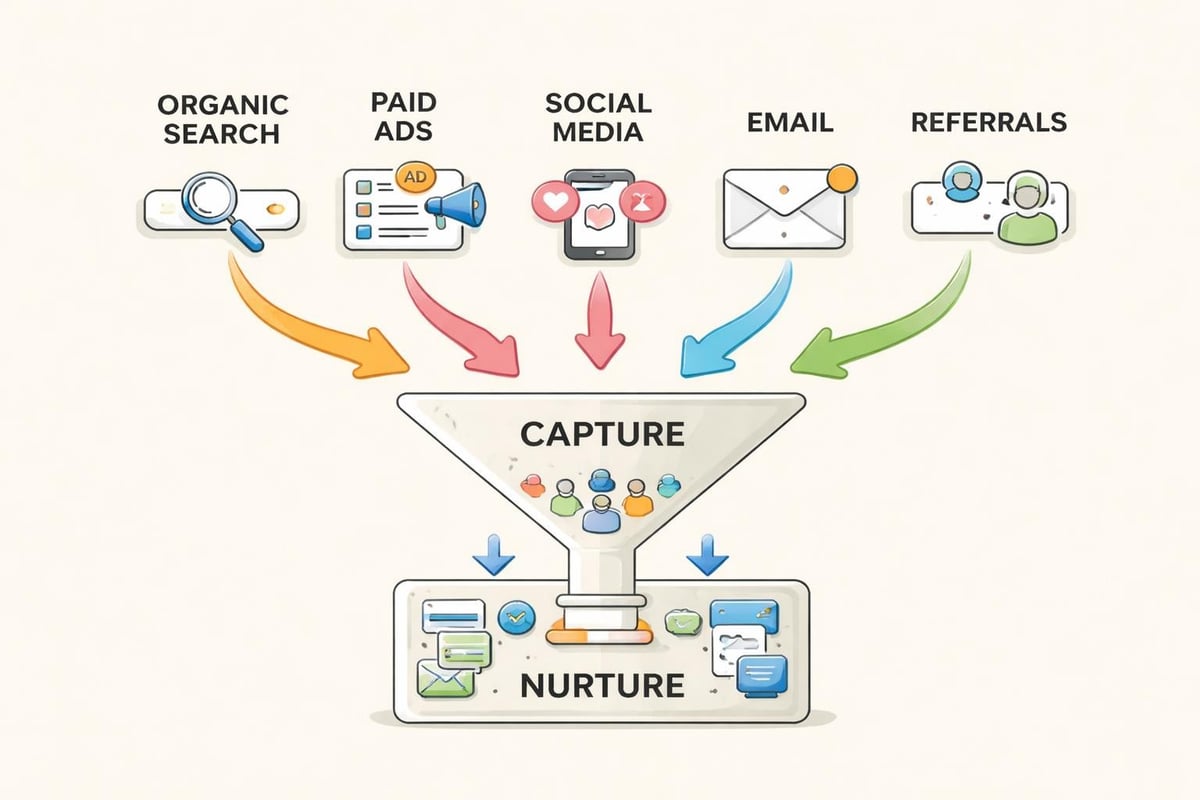
Online marketing marketing starts with three core systems: capture, nurture, and attribution. Each one supports the next. Skip one, and the whole structure wobbles.
Capture Systems: Where Leads Actually Land
Your capture system determines whether attention becomes a lead or just traffic that evaporates. Most websites treat forms like an afterthought. A contact page. Maybe a newsletter signup. But structured capture means every page has a job.
| Page Type | Capture Goal | Data Collected |
|---|---|---|
| Homepage | Qualify intent | Name, email, business type |
| Service Pages | Book consultation | Name, email, phone, timeline |
| Content/Blog | Build nurture list | Email, topic interest |
| Case Studies | Warm lead qualification | Name, email, company, current challenge |
When your CRM talks to your website, every form submission creates a contact record, tags based on source, and triggers the right sequence. That's infrastructure. The integration between web development and marketing systems determines whether you're building an asset or just another leaky bucket.
Nurture Systems: Turning Attention Into Trust
Most online marketing marketing fails in the middle. You capture leads, then… nothing. Or worse, you blast everyone with the same weekly newsletter regardless of where they are in their journey.
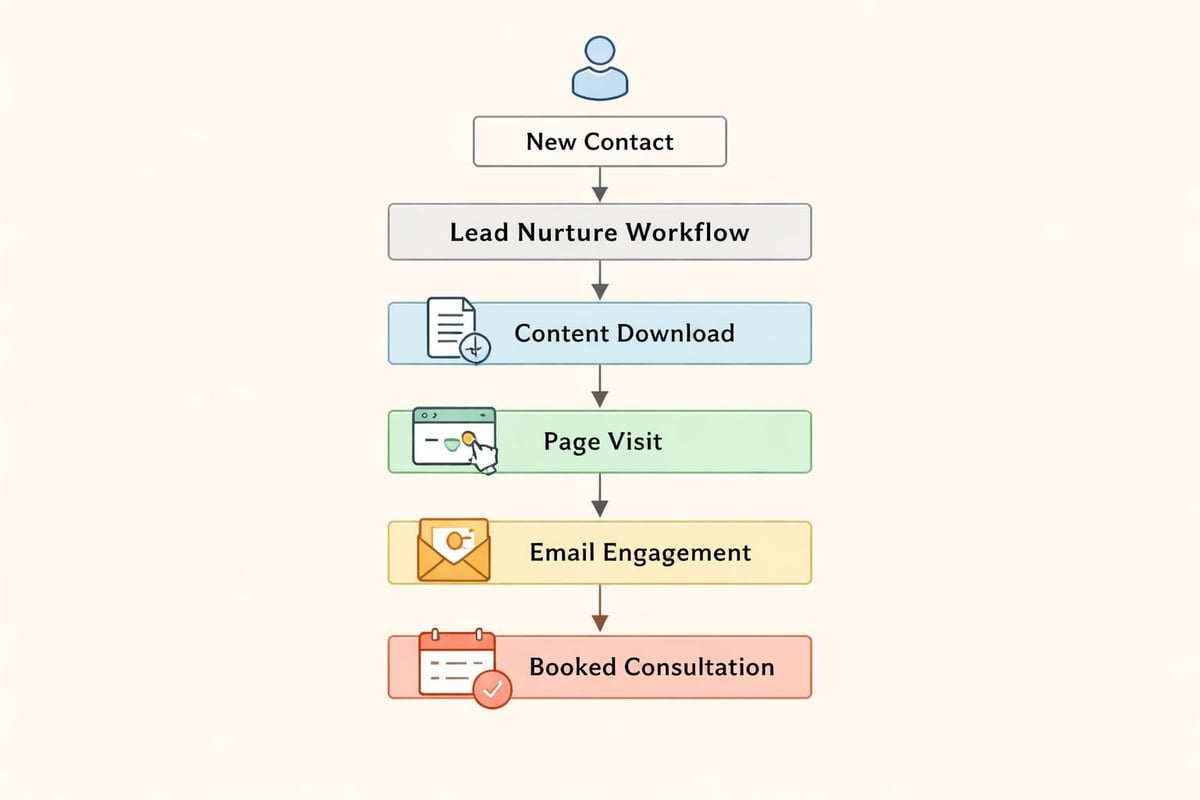
Nurture infrastructure segments by behavior:
- Content consumers get educational sequences that build authority
- Service browsers get case studies and proof points
- Consultation bookers get preparation materials and next steps
- Past clients get retention and upsell content
The key is automation that feels personal. Not because you fake it, but because the system routes people based on what they've shown interest in. When someone downloads your guide on CRM setup, they shouldn't get generic marketing tips. They should get a sequence about automation, integrations, and implementation. That's how content marketing builds real connections instead of just noise.
The Role of Data in Online Marketing Marketing
Data isn't just reporting. It's the feedback loop that tells your infrastructure what's working. Service businesses often track vanity metrics: website visits, email open rates, social followers. But online marketing marketing requires operational metrics that show system health.
Metrics That Actually Matter
Lead velocity tells you if your capture systems are growing your pipeline or just collecting names. It's not about volume. It's about qualified leads entering your system at a predictable rate.
Conversion path length shows how many touchpoints someone needs before they book. If it's taking 15 interactions, either your positioning is unclear or your nurture isn't doing its job.
Attribution by source reveals which channels feed your pipeline and which just burn budget. Not every traffic source should be optimized for volume. Some channels exist to qualify, others to convert.
System lag time measures the gap between capture and first human contact. If leads sit for 48 hours before anyone reaches out, you're losing deals to competitors who respond in 20 minutes.
When you track operational metrics, your marketing systems become predictable. You can forecast pipeline, allocate budget to channels that work, and fix breaks before they leak revenue.
Connecting Data Across Platforms
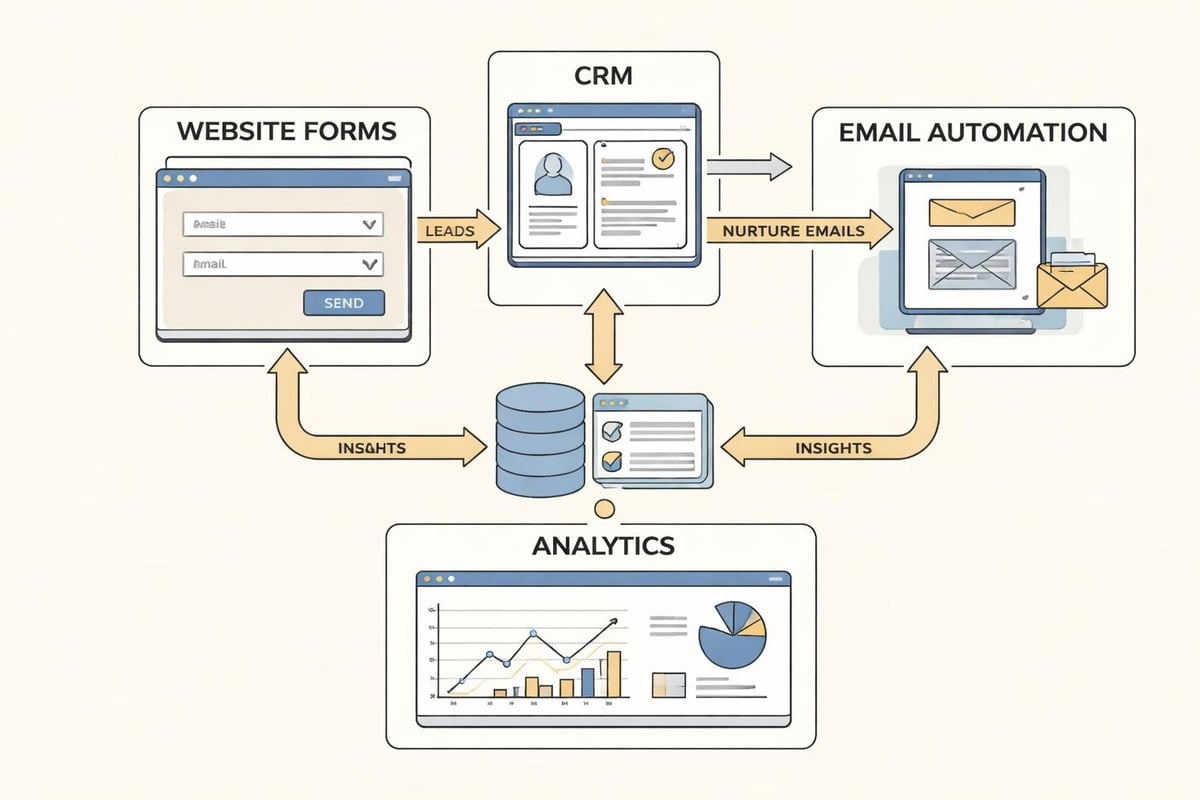
The hardest part of online marketing marketing isn't running campaigns. It's making platforms talk to each other. Your analytics platform shows traffic. Your CRM shows leads. Your email tool shows engagement. But none of them share context.
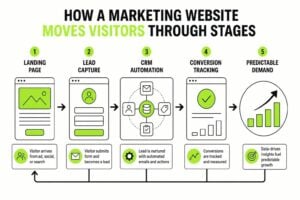
Here's what integration actually looks like:
- Someone visits your service page from organic search
- Your analytics tool fires an event to your CRM
- The CRM creates a contact record and tags them "Organic – Service Interest"
- They fill out a consultation form
- The form data updates the existing contact, adds "Consultation Requested" tag
- An email sequence starts, personalized to their service interest
- A task gets created for your sales team with full context: source, pages viewed, content downloaded
- Every email open, link click, and page revisit updates the contact record
That's infrastructure. And when it works, your online marketing marketing runs like a machine. According to recent trends in digital marketing, businesses that integrate their tech stack see conversion rates jump 30-40% without changing their front-end tactics.
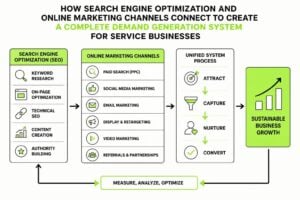
Channels That Feed the System
Online marketing marketing doesn't mean using every channel. It means picking channels that feed your infrastructure and ignoring the rest.
Organic Content as System Fuel
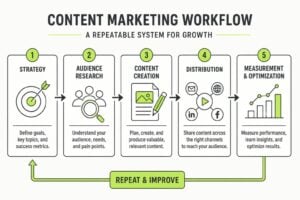
Content isn't just blog posts. It's the fuel that makes your nurture sequences valuable. When you build an organic marketing strategy, each piece serves multiple functions.
A single guide on "CRM Implementation for Service Businesses" can:
- Rank for search terms your prospects actually use
- Serve as a lead magnet on service pages
- Feed into email sequences as educational content
- Qualify leads based on download behavior
- Provide talking points for sales conversations
The content works because it plugs into infrastructure. Without capture systems, it's just another blog post. With them, it's an asset that compounds.
Paid Channels as Accelerators
Paid traffic isn't the foundation. It's the accelerant. When your capture, nurture, and attribution systems work, paid channels let you pour gasoline on what's already burning.
But here's the trap: most businesses run ads before their infrastructure is ready. They send traffic to a homepage with one generic form. No segmentation. No personalized follow-up. No attribution beyond "form submitted."
Paid works when:
- Your landing pages are built for conversion, not just information
- Your forms feed directly into segmented nurture sequences
- Your CRM tracks source and lets you measure CAC by channel
- Your sales team gets notifications with full context
That's why online marketing and branding need to work together. Brand clarity tells people why they should care. Systems capture that attention and turn it into pipeline.
Common Infrastructure Failures
Even businesses with decent tactics struggle when their infrastructure has gaps. Here are the breaks we see most often.
| Problem | Symptom | Fix |
|---|---|---|
| Form data doesn't sync to CRM | Leads get lost, manual data entry required | API integration or native platform connection |
| No lead scoring | All leads treated equally | Behavior-based scoring that prioritizes hot leads |
| Generic nurture sequences | High unsubscribe rates, low engagement | Segment by interest and behavior |
| No attribution tracking | Can't identify profitable channels | UTM parameters, CRM source tracking |
| Manual follow-up required | Slow response times, inconsistent outreach | Automated task creation and notification systems |
These aren't small problems. Each one leaks revenue. But they're also fixable with the right infrastructure choices. When you treat marketing systems as the foundation for growth, these gaps become obvious and solvable.
Automation Without Losing the Human Touch
The biggest fear with online marketing marketing is that automation makes everything feel robotic. But the opposite is true. Good automation frees your team to be human where it matters.
Where Automation Belongs
Automation should handle:
- Data routing and contact creation
- Tag application based on behavior
- Sequence enrollment and progression
- Task creation for sales follow-up
- Reminder emails and check-ins
- Analytics tracking and reporting
These are the things that break when humans do them manually. Someone forgets to tag a lead. A follow-up email gets delayed. A prospect's browsing behavior never makes it to the sales team.
Where Humans Belong
Humans should focus on:
- Discovery calls and consultations
- Custom proposal creation
- Relationship building and nurturing
- Strategic account planning
- Problem-solving and implementation
When your infrastructure handles the mechanical parts, your team can focus on the work that actually requires judgment, empathy, and expertise. That's how service businesses scale without losing quality. The systems protect the leads. The humans close them.
Building vs. Buying Marketing Infrastructure
Most businesses face a choice: build their marketing infrastructure in-house or work with specialists who've done it before. There's no universal answer, but there are clear factors to consider.
Building in-house makes sense when:
- You have technical team members who understand integrations
- Your business model is simple and doesn't need complex automation
- You have time to learn, test, and iterate without revenue pressure
- Your existing tools already talk to each other
Working with specialists makes sense when:
- You need infrastructure running this quarter, not next year
- Your team's time is better spent delivering client work
- You're scaling and can't afford lead leakage
- You want proven systems, not experiments
The businesses that succeed with online marketing marketing aren't necessarily the ones with the biggest budgets. They're the ones who recognize that marketing infrastructure is a competitive advantage. When you can capture, nurture, and convert more efficiently than competitors, you win on economics, not just creativity.
What Changes When Infrastructure Is Right
Once your online marketing marketing infrastructure works, the business feels different. Growth stops being chaotic. You can forecast pipeline because you know how many leads you need at each stage. You can scale ad spend because attribution is clear. Your team focuses on high-value work because systems handle the mechanical parts.
Here's what compounds:
- Trust: Prospects get consistent, relevant communication
- Efficiency: Leads move through your pipeline faster with less manual work
- Attribution: You know exactly which efforts drive revenue
- Quality: Your team spends time on qualified prospects, not chasing cold leads
- Predictability: Revenue becomes forecastable based on pipeline metrics
This is what separates businesses that scale from businesses that just get busier. The tactics might look similar from the outside, but the infrastructure underneath creates completely different outcomes. According to research on effective online marketing strategies, businesses with integrated systems see 50% faster growth than those running disconnected tactics.
Testing and Iteration at the System Level
Online marketing marketing isn't a one-time build. It's a system that evolves as your business grows and your market shifts. The best businesses test at the infrastructure level, not just the tactical level.
What to Test in Your Systems
Instead of just testing ad copy or email subject lines, test:
- Form placement and fields: Does asking for phone number up front increase or decrease qualified leads?
- Nurture sequence length: Do shorter, focused sequences convert better than long educational ones?
- Segmentation rules: Does segmenting by industry or company size improve conversion rates?
- Response time impact: How much does first-response time affect booking rates?
- Attribution models: Which attribution method best represents your actual buyer journey?
These tests improve the entire system, not just individual campaigns. And the improvements compound because they apply to every lead that flows through your infrastructure.
The Path Forward for Service Businesses
Service businesses face a specific challenge with online marketing marketing. Unlike ecommerce or SaaS, you're not selling a product someone can buy instantly. You're selling expertise, relationships, and transformation. That means your infrastructure needs to support longer sales cycles, multiple touchpoints, and relationship building.
The integration of branding and digital systems becomes critical here. Your brand clarity determines whether someone pays attention. Your systems determine whether that attention becomes a relationship and eventually revenue.
Most service businesses have the tactics figured out. They know they need content, a decent website, maybe some ads. But they're missing the layer that makes it all work together. That's the gap online marketing marketing fills. It's not about doing more. It's about connecting what you're already doing into a system that protects leads, nurtures relationships, and creates predictable growth.
When your infrastructure works, marketing stops feeling like a gamble. You know how many leads you need to hit revenue targets. You know which channels deliver qualified prospects. You know how long it takes for someone to move from first touch to closed deal. That clarity changes everything.
Online marketing marketing is the difference between running tactics and building systems that compound. When capture, nurture, and attribution work together, your marketing becomes an asset instead of an expense. If your current infrastructure leaks leads, requires manual work, or can't tell you what's actually driving revenue, it's time to rebuild the foundation. MDO Digital helps service businesses design the marketing systems and automation infrastructure that turn attention into predictable demand, without the chaos.