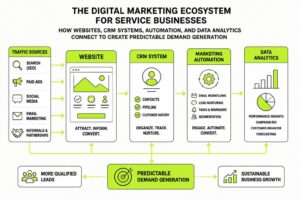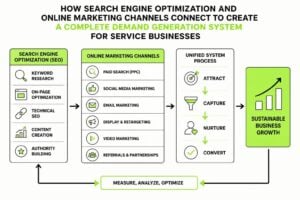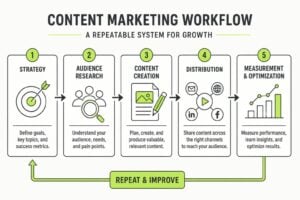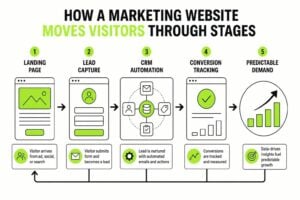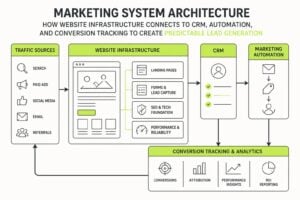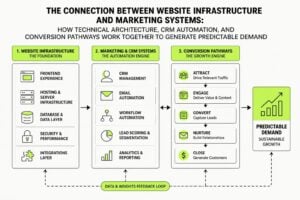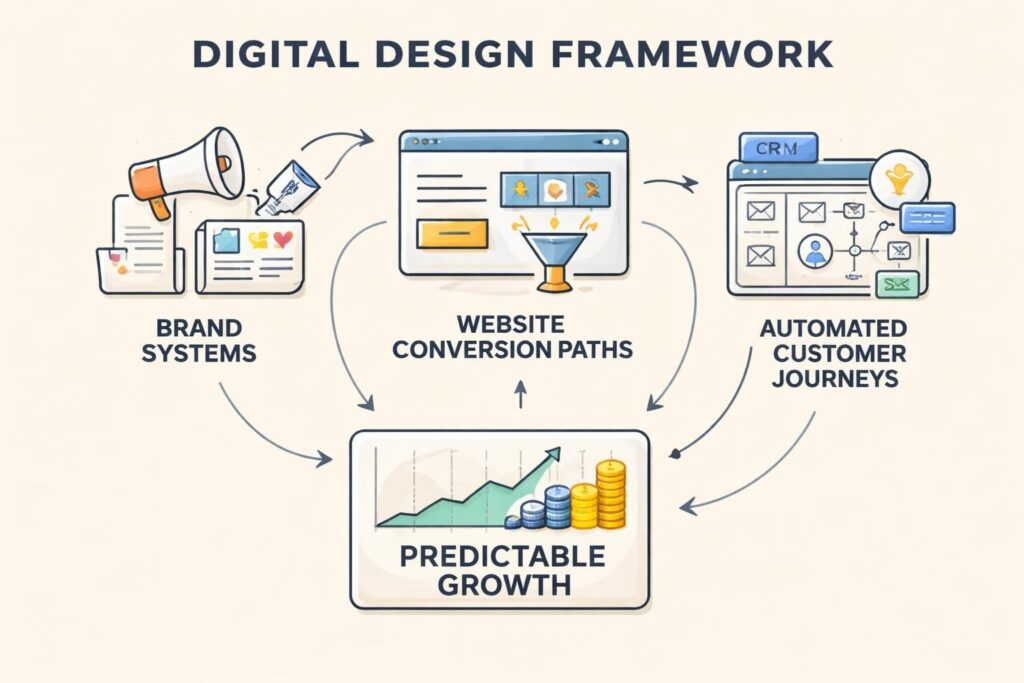
Marketing digital design isn't about making things look pretty. It's the strategic framework that connects your brand identity to conversion systems that actually work. For service-based businesses trying to scale, the gap between a nice-looking website and one that generates predictable demand comes down to how well your digital design serves both your brand and your business operations. When design decisions are tied to customer behaviour, CRM infrastructure, and clear conversion paths, you build systems that reduce chaos instead of adding to it.
What Marketing Digital Design Actually Means
Marketing digital design is the practice of creating visual and interactive systems that guide prospects through structured buyer journeys. It combines brand identity, user experience principles, and conversion architecture into cohesive digital properties that protect leads and compound growth over time.
Unlike traditional graphic design, which focuses on aesthetics and communication, marketing digital design must solve operational problems. Every design choice affects how leads flow through your system, how data gets captured, and whether your automation can do its job. The difference matters when you're trying to scale without hiring more people to manage the chaos.
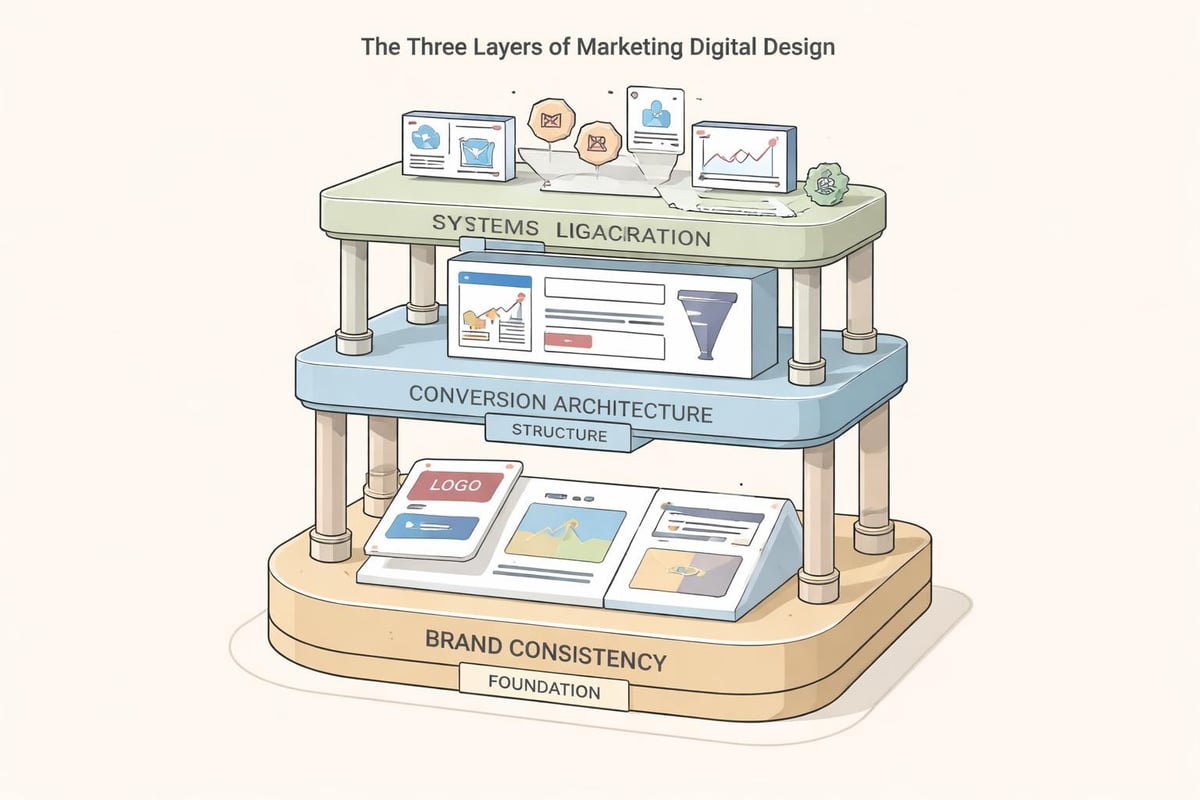
The Three Layers of Effective Digital Design
Brand consistency forms the foundation. Your visual identity should be recognizable across every touchpoint, from your website to your email sequences to your proposal templates. Inconsistency creates friction and erodes trust before prospects even speak to you.
Conversion architecture determines how effectively you move people from attention to action. This includes page layouts, CTA placement, form design, and the visual hierarchy that guides eyes toward the decisions you want them to make.
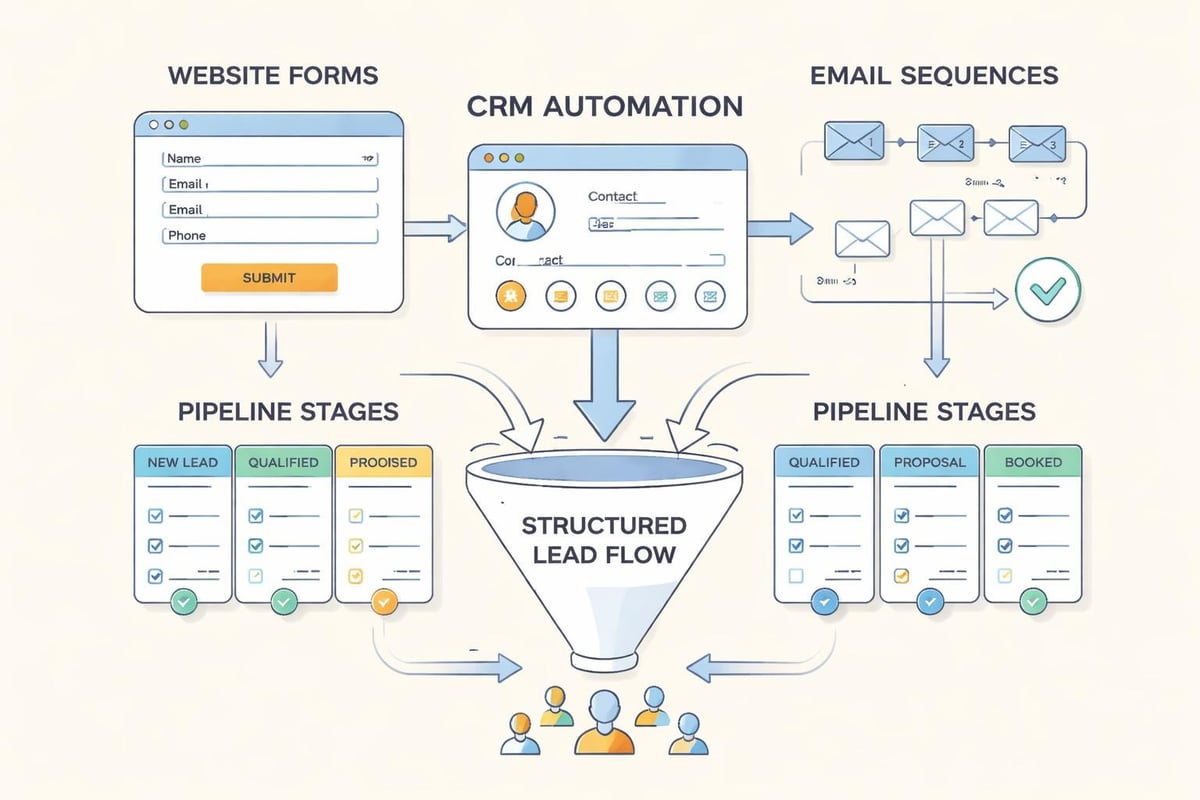
Systems integration ensures your design works with your CRM, automation tools, and reporting infrastructure. If your beautiful contact form doesn't talk to your pipeline, you've built something that looks good but doesn't compound value.
Design Principles That Actually Drive Results
The best marketing digital design follows user experience best practices while maintaining focus on business outcomes. Here's what separates design that converts from design that just exists.
Visual Hierarchy and Attention Control
You have about three seconds to communicate who you serve and what problem you solve. Visual hierarchy controls where attention goes first, second, and third.
Start with a clear value proposition positioned above the fold with sufficient contrast and size to be immediately scannable. Don't bury your main message in clever copy or abstract imagery.
Use size, color, spacing, and typography to create a natural reading flow. Primary actions should visually dominate secondary options. Information architecture should match how your prospects actually think about their problems, not how you've organized your service offerings internally.
Best practices for graphic design in digital marketing emphasize purposeful design over decorative elements. Every visual choice should support either comprehension or conversion.
Mobile-First Execution
More than 60% of web traffic comes from mobile devices in 2026. Designing for mobile first isn't optional, it's operational reality.
This means:
- Touch targets minimum 44×44 pixels
- Single-column layouts for core content
- Simplified navigation that doesn't hide critical paths
- Forms optimized for mobile completion
- Page speed under 3 seconds on 4G networks
Desktop designs should enhance the mobile experience, not the other way around. When you design mobile-first, you're forced to prioritize what actually matters. That discipline improves your desktop experience by default.
Building Marketing Digital Design That Scales
Scalable marketing digital design creates reusable systems rather than one-off assets. For service businesses, this means building design frameworks that can expand with your offer without requiring complete rebuilds.
Template Systems and Component Libraries
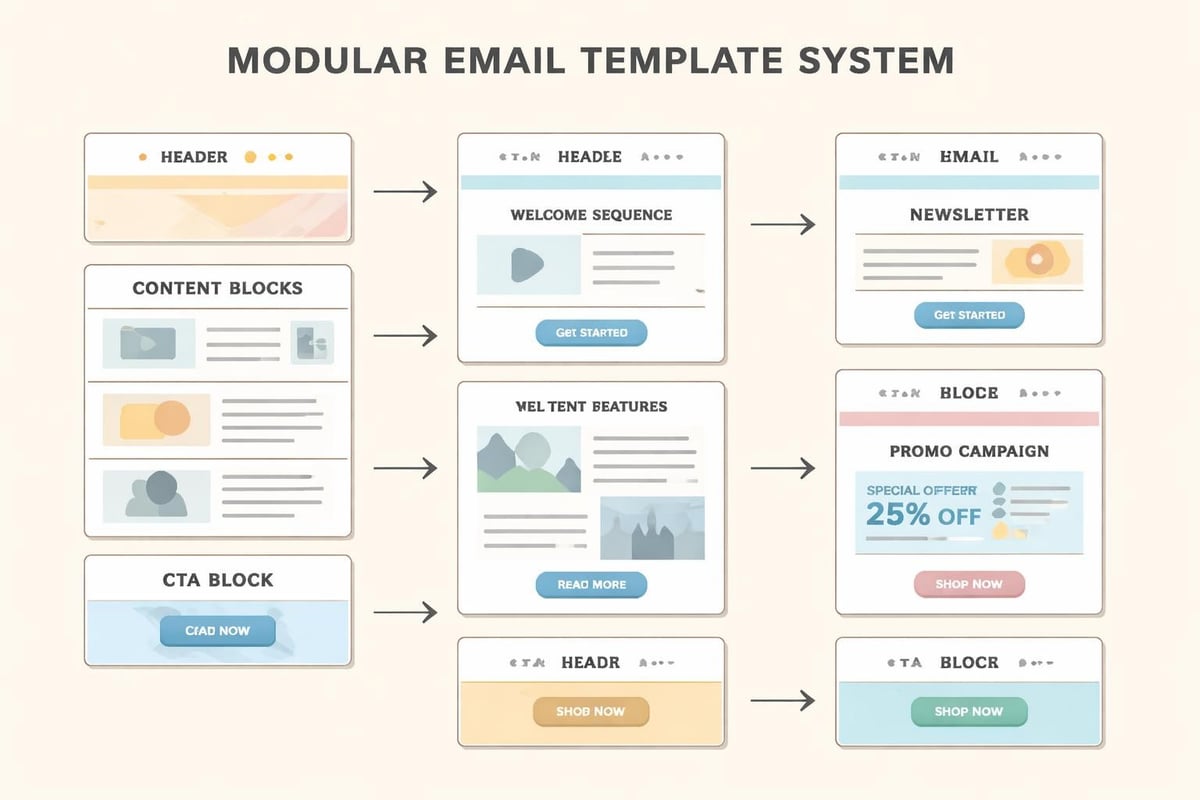
Design systems consist of reusable components like buttons, forms, content blocks, and page templates that maintain consistency while allowing flexibility. When you need to launch a new service page or campaign landing page, you're assembling proven components rather than starting from scratch.
This approach matters for website development and marketing because it reduces production time while maintaining quality. Your team can execute faster, test more variations, and scale content production without designer bottlenecks.
| Component Type | Purpose | Reuse Frequency |
|---|---|---|
| Hero sections | Capture attention, state value | Every landing page |
| Form blocks | Lead capture, qualification | Multiple per page |
| Testimonial cards | Social proof, trust building | Service pages, case studies |
| CTA modules | Conversion points | Throughout site |
| Content blocks | Information delivery | Blog posts, resources |
Integration With Marketing Infrastructure
Your marketing digital design must integrate with your operational systems. Beautiful websites that don't connect to your CRM create manual work and data gaps.
Form design should include progressive profiling that captures essential information without creating friction. Your forms need to pass data cleanly to your CRM with proper field mapping and lead routing.
Tracking implementation should be built into design from the start. Know which elements need event tracking, what conversion actions matter, and how design choices affect data quality. Design decisions that break analytics create blind spots in your growth system.
Digital marketing business strategy depends on clean data flows between your public-facing design and your back-end infrastructure.
Common Design Mistakes That Kill Conversion
Most marketing digital design problems stem from prioritizing creativity over clarity or aesthetics over architecture. Here's what breaks conversion systems.
Design Complexity That Creates Friction
Overcomplicated navigation forces prospects to think instead of act. If someone needs to decode your menu structure or hover through multiple layers to find your contact page, you've added unnecessary friction.
Visual clutter competes for attention and dilutes your message. Every additional element on a page reduces the effectiveness of your primary call to action. Digital creative design best practices emphasize simplicity as a conversion tool, not a creative constraint.
Unclear conversion paths leave prospects uncertain about next steps. Every page should have an obvious primary action and a clear reason to take it. If you're asking people to "learn more" without explaining what they'll learn or why it matters, you're relying on curiosity instead of intent.
Brand Inconsistency Across Touchpoints
When your website uses different fonts, colors, or messaging than your email sequences or proposal templates, you create subconscious doubt. Prospects notice inconsistency even if they can't articulate it.
This extends to branding and advertising across all channels. Your LinkedIn presence should feel connected to your website, which should feel connected to your sales collateral. Disconnected brand experiences suggest disconnected operations.
Ignoring Performance and Speed
Beautiful design that loads slowly loses conversions before anyone sees it. Page speed directly impacts both user experience and search rankings.
- Optimize images for web delivery (WebP format, proper compression)
- Minimize JavaScript and CSS bloat
- Use lazy loading for below-fold content
- Implement CDN delivery for static assets
- Test on real mobile connections, not just WiFi
Digital marketing best practices include maintaining technical performance alongside visual quality.
Design Systems for Different Marketing Functions
Marketing digital design serves multiple functions across your growth system. Each requires specific design considerations.
High-Trust Website Design
Your primary website needs to establish credibility while guiding different audience segments toward appropriate next steps. This means:
Clear positioning that immediately communicates who you help and how
Social proof placement that supports claims without overwhelming content
Segmented pathways that route different prospect types toward relevant information
Conversion architecture that makes contact feel like a natural next step
The best practices in user experience design emphasize putting customer needs ahead of company structure. Your navigation should reflect prospect questions, not your org chart.
Landing Page Design for Campaign Conversion
Campaign landing pages serve singular purposes and require focused design. Remove navigation, eliminate distractions, and align every element with campaign messaging.
Message match between ads and landing pages is non-negotiable. If your ad promises "marketing automation for accountants," your landing page headline should echo that specific promise.
Form optimization balances lead quality with conversion rate. Too many fields reduce conversions. Too few fields reduce lead quality. Test based on your specific funnel economics.
Email and Automation Design
Email design in 2026 needs to work across dozens of clients with varying support for modern CSS. Keep layouts simple, test extensively, and prioritize message clarity over design sophistication.
Responsive email templates should stack cleanly on mobile without horizontal scrolling or tiny text. Use large touch targets for buttons and links.
Template modularity lets you assemble emails from proven blocks rather than designing from scratch each time. This speeds production and maintains consistency across sequences.
Testing and Iterating Your Design Systems
Marketing digital design isn't a one-time project. It's a system that evolves based on performance data and changing business needs.
What to Test and Why
Headline variations often create the biggest conversion lifts. Test value proposition clarity, specificity, and urgency.
CTA design and placement directly affects conversion rates. Test button colors, text, size, and position on page. Don't assume your first choice is optimal.
Form length and field order impact both completion rates and lead quality. Progressive testing helps find the balance for your specific audience and economics.
| Test Type | Primary Metric | Secondary Metric | Test Duration |
|---|---|---|---|
| Headline | Engagement rate | Time on page | 2-4 weeks |
| CTA placement | Click-through rate | Conversion rate | 2-3 weeks |
| Form design | Completion rate | Lead quality score | 3-4 weeks |
| Page layout | Conversion rate | Bounce rate | 3-4 weeks |
Implementing Design Changes Systematically
Don't redesign everything at once. Systematic changes let you isolate what actually drives improvements versus what just feels different.
Prioritize high-traffic pages where design improvements have the biggest impact. Your homepage and primary service pages matter more than your archive pages.
Document baseline performance before making changes. You need clean before-and-after data to know if changes actually improved results.
Test one variable at a time when possible. Changing multiple elements simultaneously makes it impossible to know what drove the result.
Connecting Design to Business Outcomes
The point of marketing digital design isn't to win awards or impress other designers. It's to create predictable demand and reduce operational chaos.
Design Metrics That Matter
Conversion rate measures how effectively your design moves people toward desired actions. Track this by page type, traffic source, and audience segment.
Lead quality scores tell you if your design attracts the right prospects. High conversion rates with low-quality leads suggest messaging or targeting problems.
Time to value in your customer journey indicates how efficiently your design communicates and converts. Longer consideration cycles might suggest clarity issues or trust gaps.
System efficiency measures how well your design integrates with operations. If you're manually entering form submissions or can't track lead sources, your design hasn't solved the operational problem.
When you're working on marketing website design, these metrics determine whether you've built something that actually scales your business or just looks professional.
ROI Framework for Design Investments
Calculate design ROI by comparing the cost of implementation against the incremental revenue generated by improved conversion rates.
If a redesigned landing page costs $5,000 and improves conversion from 2% to 3% on 10,000 monthly visitors with a $2,000 average customer value, that's an additional 100 conversions per year worth $200,000. The ROI is clear.
This math works when you track properly and connect design changes to business outcomes. Without measurement infrastructure, you're guessing.
Design Tools and Workflow Considerations
Marketing digital design requires tools that support both creation and integration with your marketing stack. The specific tools matter less than the workflow they enable.
Essential Capabilities for Service Businesses
Design software should support component-based design and easy handoff to developers. Figma has become standard for web design in 2026 because it enables collaboration and maintains single sources of truth.
Prototyping tools let you test user flows and interactions before development. This reduces expensive revisions and helps identify UX problems early.
Version control for design files prevents lost work and enables rollback when needed. This matters more as your design system grows.
Integration capabilities with your CMS, CRM, and analytics tools determine how well design translates to functional systems. Understanding how website design integrates with digital marketing prevents disconnected implementations.
Building Internal Design Capabilities
Most service businesses don't need full-time designers. They need systems that enable consistent execution without constant custom work.
Document your design standards, component usage, and brand guidelines. This lets contractors or team members maintain consistency without requiring deep design expertise.
Create templates for common needs like landing pages, email sequences, and social graphics. This speeds production and reduces decision fatigue.
Know when to hire expertise versus when to use templates. Complex conversion optimization and brand positioning benefit from expert input. Routine execution can follow established systems.
Future-Proofing Your Marketing Design
Marketing digital design continues evolving as technology and user expectations change. Build systems that can adapt without requiring complete rebuilds.
Designing for Emerging Channels
New platforms and formats will emerge. Your design system should include principles and components that translate across channels rather than being optimized for specific platforms that might not matter in two years.
Core brand elements like logos, color systems, and typography should work at any size and in any context. Test on current platforms but design for flexibility.
Component thinking means building blocks that can be reassembled for new contexts. A well-designed testimonial card should work on your website, in an email, and in a PDF proposal.
Accessibility and Inclusive Design
Accessible design isn't just ethical, it's practical. Designs that work for people with disabilities tend to work better for everyone.
- Sufficient color contrast (4.5:1 minimum for body text)
- Keyboard navigation for all interactive elements
- Alt text for images that conveys meaning, not just description
- Clear focus states for form fields and links
- Logical heading hierarchy for screen readers
Digital design best practices emphasize analysis and data alongside creativity, and accessibility data shows clear business benefits in expanded reach and improved usability.
Marketing digital design works when it connects brand identity to operational systems that reduce chaos and create predictable demand. The visual polish matters, but the architecture underneath determines whether your design actually scales your business. If you're ready to build digital marketing systems that turn attention into structured growth, we can help you design infrastructure that compounds over time instead of creating more work.