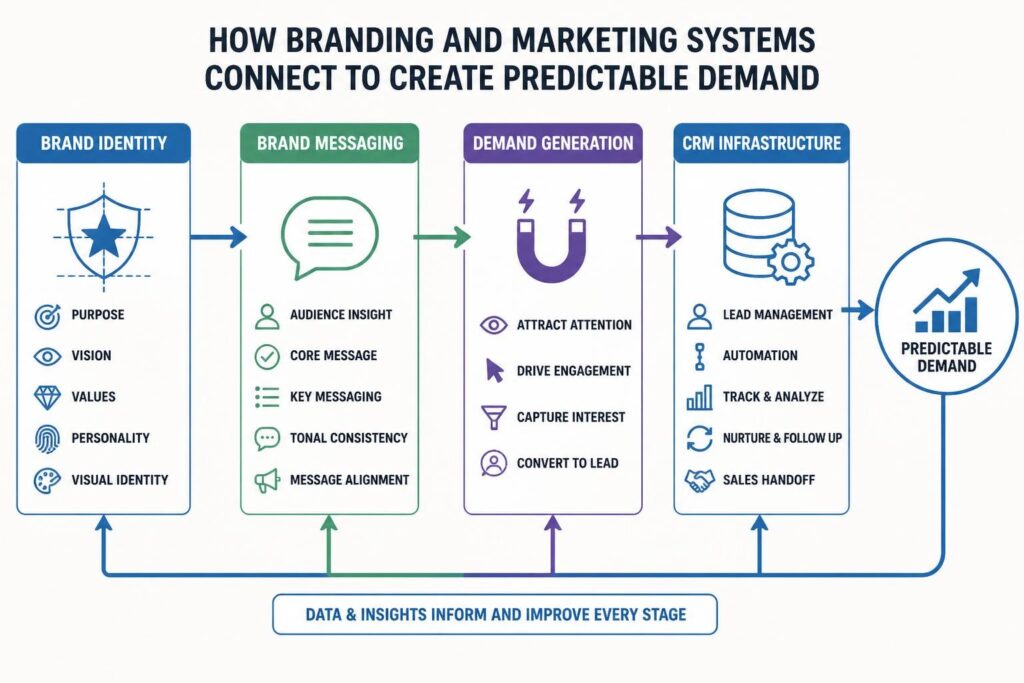
Most service businesses treat branding and marketing as separate tasks. Brand goes to the designer, marketing goes to the ads person, and nobody checks if they’re actually working together. The result is mixed messages, inconsistent touchpoints, and campaigns that burn budget without building anything lasting. Branding and marketing aren’t different departments. They’re two sides of the same system, and when you align them properly, you create compound growth instead of starting from zero every quarter.
Why Branding and Marketing Need Each Other
Marketing without branding is just noise. You’re shouting into a crowded room with nothing distinctive to say. Every competitor sounds the same, every ad blends together, and the only differentiator becomes price.
Branding without marketing is invisible. You might have a beautiful identity and clear positioning, but if nobody sees it or experiences it consistently, it doesn’t drive revenue.
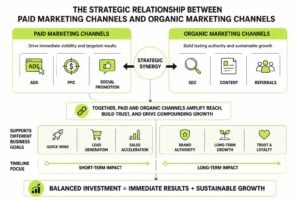
The relationship between branding and marketing is structural, not cosmetic. Your brand defines who you are, what you stand for, and why someone should care. Marketing amplifies that message, puts it in front of the right people, and converts attention into action. When they’re aligned, every touchpoint reinforces the same story. When they’re not, you’re wasting energy fighting yourself.
What Actually Counts as Branding
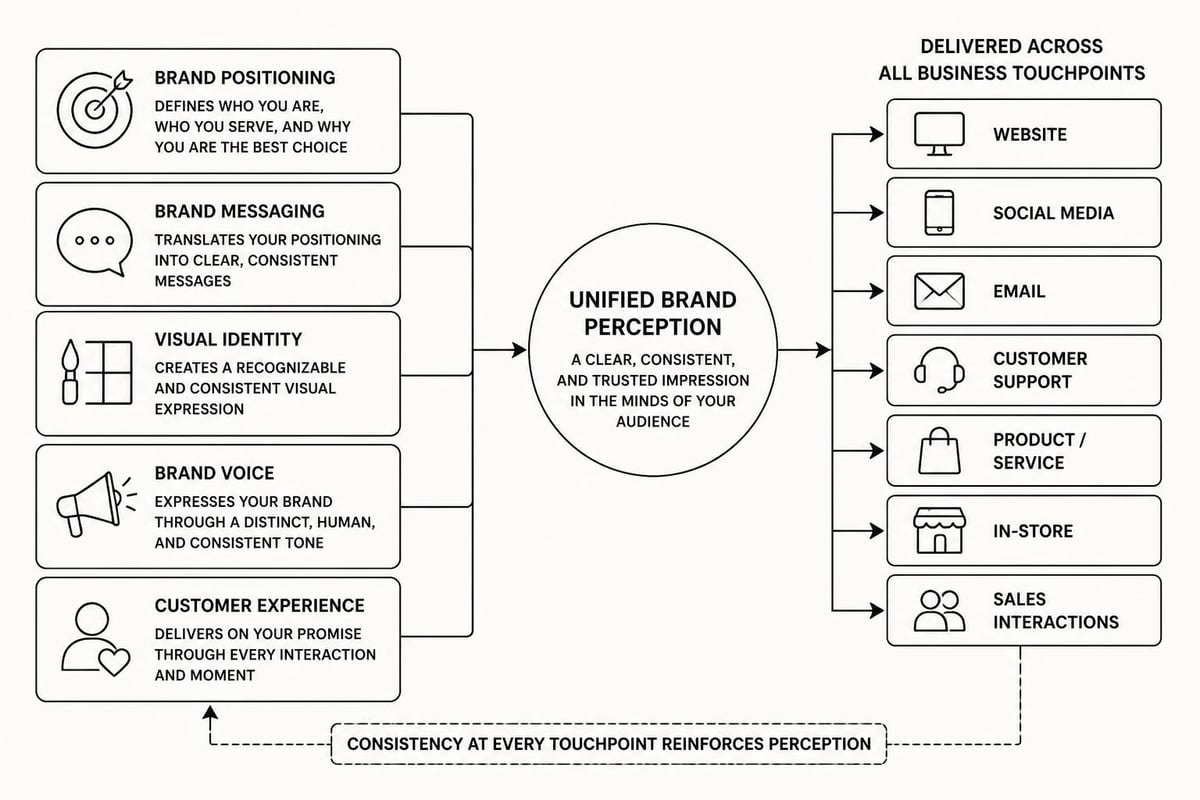
Branding isn’t your logo or your colour palette, though those are part of it. It’s the complete perception someone has of your business before, during, and after they work with you.
Core elements of effective branding include:
- Positioning: How you’re different from competitors and why that matters
- Messaging: The specific language and stories you use to communicate value
- Visual identity: Logos, typography, colours, and design systems
- Voice and tone: How you sound across every piece of content
- Customer experience: What it actually feels like to interact with your business
Brand management isn’t about protecting a logo file. It’s about controlling how your brand is perceived across every interaction, both tangible and intangible. That perception either compounds trust over time or erodes it.
What Actually Counts as Marketing
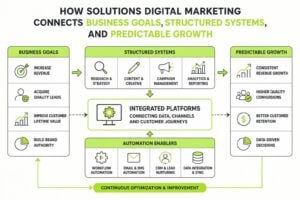
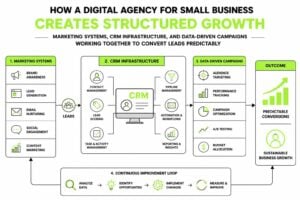
Marketing is the system that connects your offer to the people who need it. It’s not just ads or social posts. It’s the entire infrastructure that turns strangers into leads, leads into clients, and clients into repeat buyers.
Effective marketing systems include:
- Demand generation: Content, ads, and campaigns that create awareness
- Lead capture: Opt-ins, landing pages, and forms that collect contact information
- Nurture sequences: Emails and touchpoints that build trust over time
- Conversion mechanisms: Calls, demos, and sales processes that close deals
- Retention and referral: Systems that keep clients engaged and generate word-of-mouth
The fundamentals of marketing haven’t changed, but execution has. In 2026, the businesses winning aren’t running random tactics. They’re building repeatable systems where every step feeds the next.
If you’re looking for a structured approach to building that system, the 7-Step Marketing Plan walks through exactly how to set goals, define your buyer, choose platforms, create opt-ins, build nurture campaigns, deliver experiences, and generate referrals. Each step compounds the one before it.
How Branding and Marketing Align in Practice
Alignment starts with clarity. If your brand positioning is vague, your marketing messages will be vague. If your marketing promises something your brand doesn’t deliver, trust breaks down fast.
Messaging Consistency Across Channels
Your website says one thing. Your LinkedIn says another. Your email nurture sequence uses different language entirely. This isn’t diversity, it’s confusion.
Branding defines the core message. Marketing adapts that message for different channels and audiences, but the underlying story stays consistent. When someone moves from an ad to your website to a sales call, they should feel like they’re dealing with the same business.
| Touchpoint | Branding Role | Marketing Role |
|---|---|---|
| Website | Communicates positioning and builds trust | Converts visitors into leads through clear CTAs |
| Email nurture | Reinforces brand voice and values | Moves leads through decision stages with targeted content |
| Social media | Demonstrates brand personality and expertise | Drives awareness and engagement with strategic content |
| Sales calls | Delivers on brand promise through experience | Closes deals by addressing specific pain points |
Consistency doesn’t mean repetition. It means every piece reinforces the same core truth about who you are and what you solve.
Visual Identity as a Marketing Asset
Your visual identity isn’t decoration. It’s a functional tool that makes your marketing more effective. Strong branding makes your ads more recognisable, your emails more professional, and your content more trustworthy.
Digital branding brings this into sharper focus. Every digital touchpoint, from your website to your CRM emails to your LinkedIn posts, either strengthens or weakens your brand. Inconsistent visuals dilute recognition. Consistent ones compound it.
This doesn’t mean everything needs to look identical. It means your design system should be flexible enough to adapt across contexts while maintaining a clear throughline. Same fonts, same colour applications, same design principles, different formats.
Data-Driven Branding Decisions
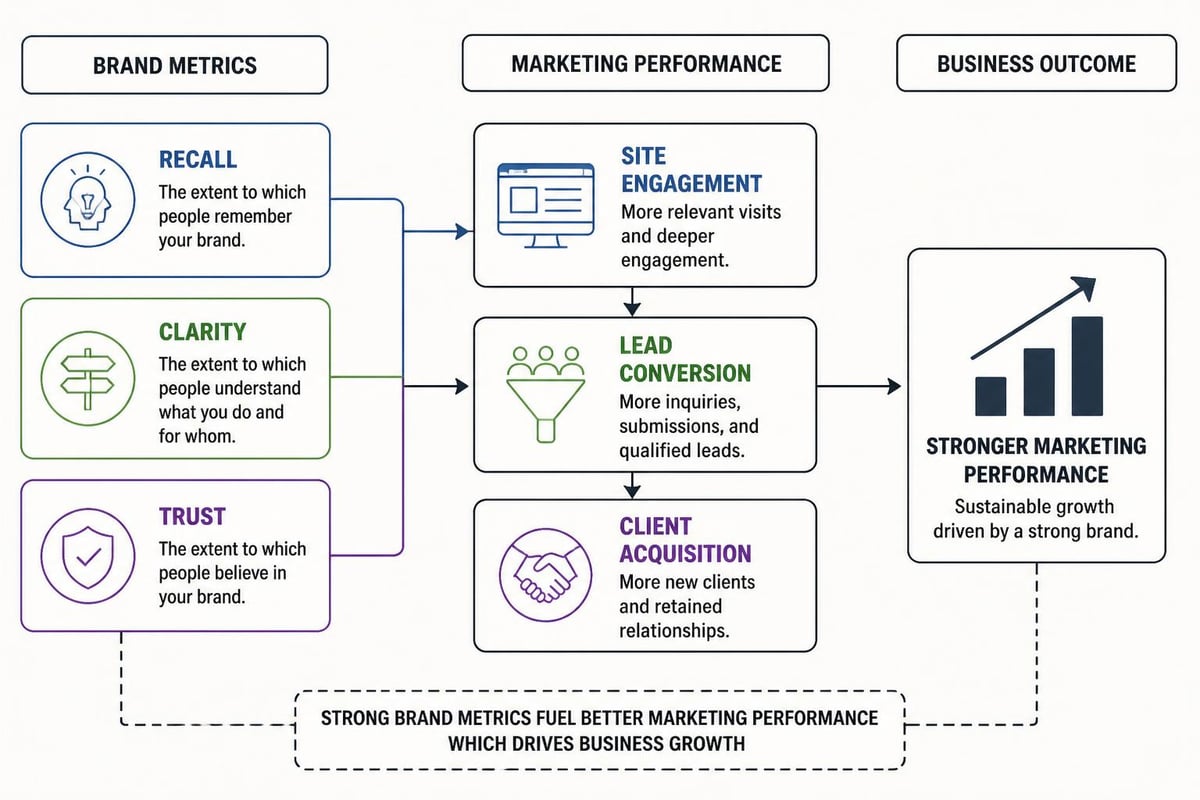
Branding used to be entirely subjective. Someone’s opinion about fonts and feelings. That’s changed. In 2026, you can measure how branding affects marketing performance and adjust accordingly.
Metrics that connect branding to results:
- Brand recall: Do people remember you after seeing your content?
- Message clarity: Do people understand what you do within seconds?
- Trust indicators: How long do people stay on your site? How many pages do they visit?
- Conversion consistency: Do leads from different channels convert at similar rates, or does messaging misalignment kill certain sources?
If your branding and advertising efforts aren’t translating into measurable marketing outcomes, something’s misaligned. Either the brand positioning is off, the marketing execution is weak, or the two aren’t talking to each other.
Building Systems That Scale Both
Most businesses grow their marketing but never grow their brand. They add more channels, more campaigns, more spend, but the brand stays static. Eventually, they hit a ceiling because there’s no foundation strong enough to support the scale.
Start with Positioning, Then Build Around It
Your positioning statement should answer three questions clearly:
- Who do you serve?
- What problem do you solve for them?
- Why are you different from alternatives?
Once that’s locked in, every marketing decision becomes easier. You know which channels to prioritise, what content to create, which leads to pursue, and which opportunities to ignore.
Positioning isn’t a tagline. It’s the strategic foundation that makes marketing and business development actually coherent instead of reactive.
Design for Repetition, Not Novelty
Service businesses often chase novelty. New campaigns, new creative, new angles every month. That’s expensive and exhausting, and it never builds brand equity.
Better approach: design one strong system, then repeat it with small variations. Same core message, same visual language, same funnel structure. Optimise the details, but don’t reinvent the foundation every quarter.
Repetition builds:
- Recognition (people remember you)
- Trust (consistency signals professionalism)
- Efficiency (you’re not starting from scratch)
- Compounding results (each campaign builds on the last)
This is where branding content marketing becomes powerful. You’re not just creating content. You’re systematically reinforcing your position through every piece.
Invest in Infrastructure, Not Just Campaigns
Marketing campaigns end. Infrastructure compounds. If you’re spending all your budget on ads and none on the systems that convert them, you’re renting attention instead of building assets.
Infrastructure includes:
- A high-trust website that actually converts
- CRM systems that track every lead and interaction
- Automated nurture sequences that build relationships at scale
- Clear offer stacks and pricing that make buying easy
- Data dashboards that show what’s working and what’s not
Marketing systems and branding work together when infrastructure supports both. Your CRM should reinforce your brand voice. Your website should deliver on your marketing promises. Your nurture emails should sound like the ads that brought people in.
Common Mistakes That Break Alignment
Even businesses that understand the relationship between branding and marketing still make structural mistakes that sabotage results.
Mistake 1: Treating Brand as a One-Time Project
You hire a designer, get a logo and some guidelines, call it done. Two years later, your messaging has drifted, your visuals are inconsistent, and nobody remembers what the brand was supposed to stand for.
Branding is continuous. As your business evolves, your market shifts, and your customers change, your brand needs to adapt. Not wholesale reinvention, just ongoing refinement and reinforcement.
Mistake 2: Running Marketing Without Clear Brand Guidelines
Your ads team doesn’t have access to brand assets. Your content writer doesn’t know the voice and tone. Your sales team uses different language than your marketing emails. Every touchpoint feels like a different company.
This isn’t a training problem. It’s a systems problem. If your brand guidelines aren’t accessible and enforceable, they’re useless. Build them into your templates, your CRM, your content briefs. Make consistency the default, not an extra step.
Mistake 3: Ignoring Customer Perception
Your internal view of your brand and your customers’ experience of it are often completely different. You think you’re premium and professional. They think you’re confusing and slow to respond.
Regular feedback loops, client interviews, and perception audits keep you honest. What you intend to communicate and what actually lands are often miles apart. Brand audits and equity assessments help you close that gap before it becomes a revenue problem.
Mistake 4: Optimising for Vanity Metrics
Your brand looks great on Instagram. Your engagement is high. Your content gets shares. None of it converts into clients.
Pretty content that doesn’t generate demand is a hobby, not a business strategy. Every branding decision should support a marketing outcome. Every marketing campaign should strengthen brand equity. If it doesn’t do both, cut it.
What Works in 2026
The fundamentals haven’t changed, but execution standards have risen. Buyers expect more clarity, faster responses, and better experiences. Businesses that win are the ones building systems, not running tactics.
Clarity Beats Cleverness
Clever taglines and abstract positioning might win design awards, but they don’t win clients. People buy from businesses they understand quickly. If your homepage requires three paragraphs to explain what you do, you’ve already lost.
Strong branding in 2026 means blunt clarity. Who you serve, what you solve, why you’re the right choice. No fluff, no jargon, no cleverness that obscures the point.
Systems Beat Campaigns
One-off campaigns still work, but they don’t compound. Systems do. A well-built marketing and web development infrastructure turns every lead into data, every campaign into learning, and every client into a referral source.
The businesses pulling ahead aren’t spending more. They’re building better systems that make every dollar work harder.
Integration Beats Isolation
Your branding, your marketing, your sales process, and your delivery all need to feel like parts of the same machine. When they’re isolated, you’re fighting friction at every handoff. When they’re integrated, momentum builds naturally.
This requires deliberate design. Your CRM should reflect your brand voice. Your onboarding should deliver on your marketing promises. Your client experience should reinforce why they chose you in the first place.
| Element | Isolated Approach | Integrated Approach |
|---|---|---|
| Brand and marketing | Different teams, different goals, inconsistent messages | Shared strategy, unified execution, compounding recognition |
| Website and CRM | Static site with no lead tracking | Every visitor tracked, tagged, and nurtured automatically |
| Sales and delivery | Promises made in sales, reality delivered differently | Consistent experience from first touch to final delivery |
| Data and decisions | Siloed metrics, gut-feel strategy | Unified dashboard, data-driven iteration |
Building Trust Through Consistency
Trust isn’t built through individual moments of brilliance. It’s built through consistent, reliable execution across every touchpoint. Your brand sets the expectation. Your marketing creates the first impression. Your delivery proves whether the promise was real.
When branding and marketing are aligned, trust compounds. People see your ad, visit your site, read your emails, take a call, and every step feels coherent. They’re not questioning whether you’re legitimate or trying to figure out what you actually do. They’re moving forward with confidence.
When they’re misaligned, trust erodes. Mixed messages create doubt. Inconsistent experiences create friction. Every mismatched touchpoint is a reason to hesitate, reconsider, or choose someone else.
Insights on branding in competitive markets consistently show that trust and clarity drive decisions more than features or pricing. Service businesses compete on perception as much as performance. Get the perception right, and performance gets easier to prove.
The Long Game
Branding and marketing aren’t quarter-to-quarter tactics. They’re infrastructure that either compounds over time or decays from neglect. The businesses still winning in five years are the ones treating both as long-term systems, not short-term campaigns.
Build once, optimise forever. That’s the approach that scales.
Branding and marketing aren’t separate efforts. They’re two parts of the same growth system, and when you align them properly, everything gets easier. If you’re ready to remove the chaos, protect your leads, and build structured growth that actually compounds, MDO Digital can help. We design the systems, build the infrastructure, and run the marketing that turns attention into predictable demand.