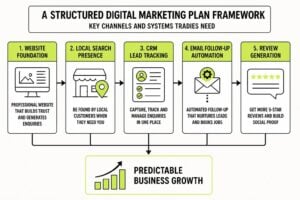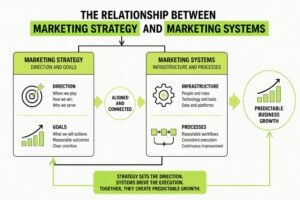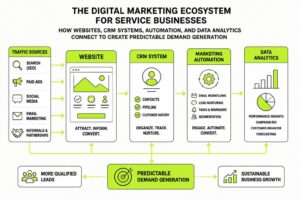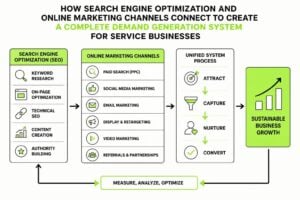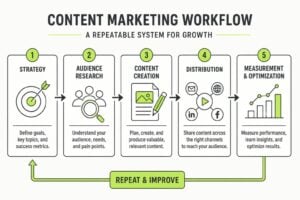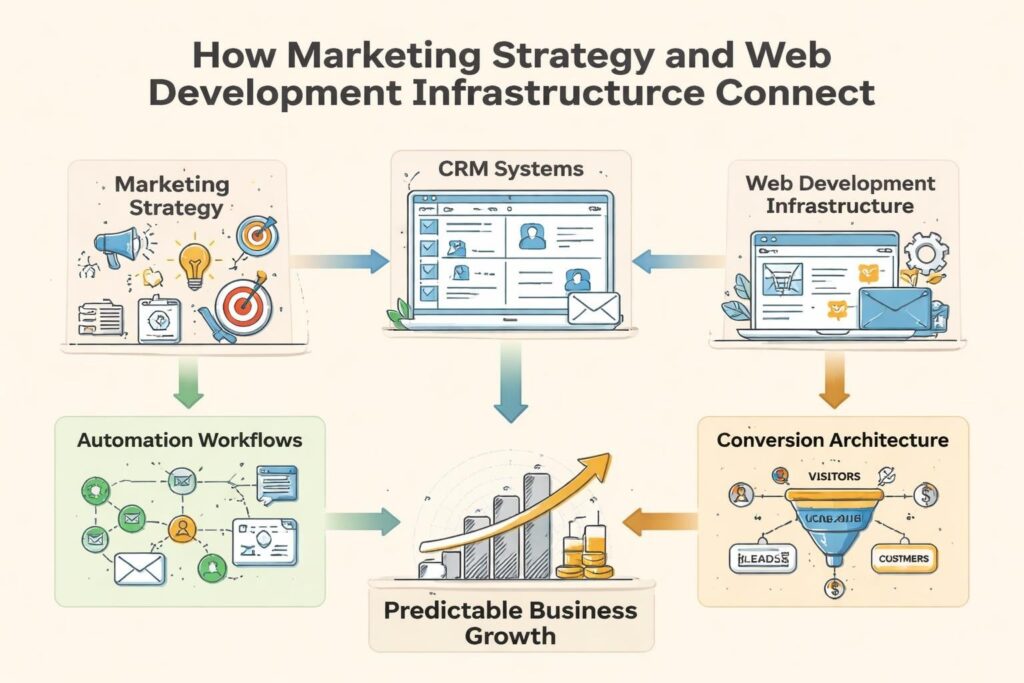
Most businesses treat marketing and web development as separate projects. Marketing runs campaigns. Developers build websites. They work in parallel, occasionally bumping into each other when something breaks or a landing page needs updating. This approach creates friction, wasted budget, and websites that look good but don't convert. The truth is simpler: marketing and web development need to function as a single system. When they do, you get infrastructure that captures demand, protects leads, and scales without constant manual intervention.
Why Marketing and Web Development Belong Together
The separation between marketing and web development isn't natural. It's historical. Different teams, different skill sets, different timelines. But your customers don't experience your business in silos. They see one thing: your digital presence.
When marketing campaigns drive traffic to websites that can't handle the load, you burn money. When developers build beautiful sites without conversion architecture, you get admiration but no customers. Effective marketing systems require both disciplines working from the same blueprint.
The integration creates value in three ways:
- Speed to market – Changes happen faster when marketers and developers share tools and processes
- Data continuity – Customer behaviour flows from ads through forms into your CRM without manual handoffs
- Conversion optimization – Design decisions reflect actual campaign performance, not aesthetic preferences
This isn't about making developers learn Facebook Ads or forcing marketers to write code. It's about shared goals and connected infrastructure.
The Technical Foundation
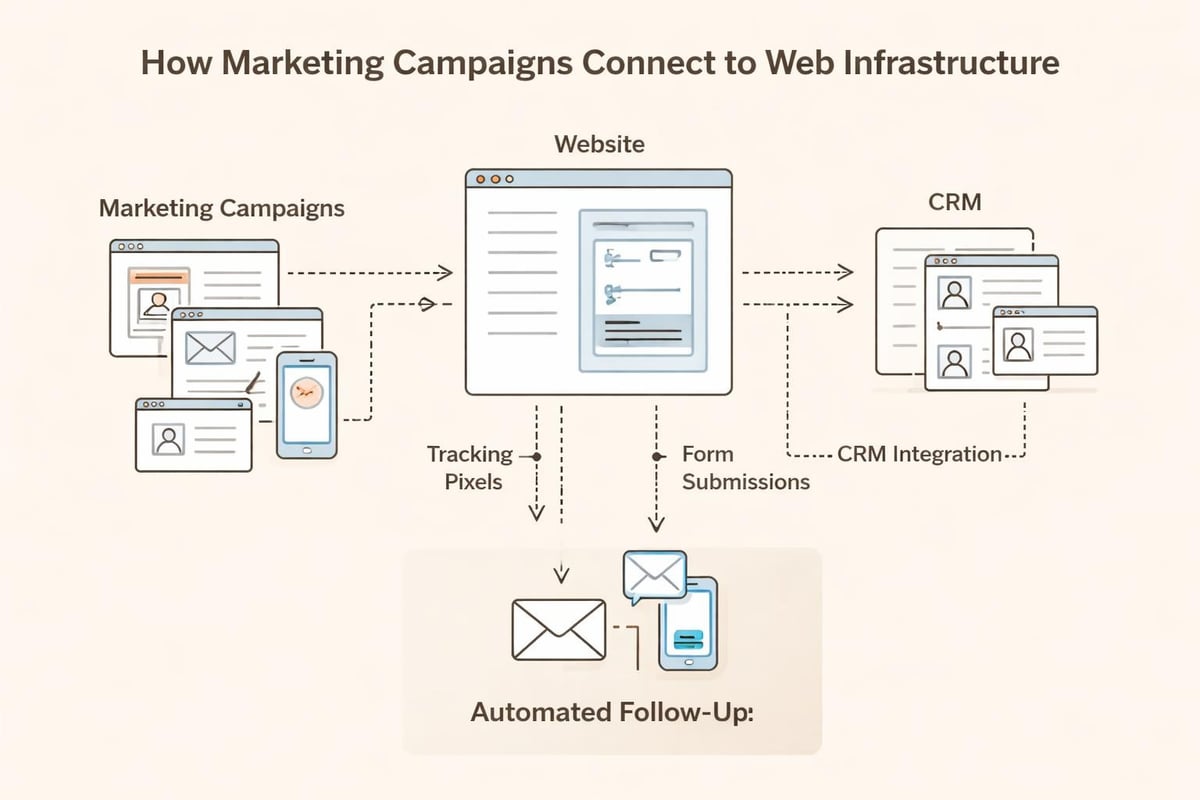
Marketing and web development converge at the infrastructure layer. Your website isn't just a brochure. It's the central node in your demand generation system.
Start with tracking. Every campaign needs to know what happens after the click. That requires proper implementation of analytics, event tracking, and conversion pixels. Not just Google Analytics installed via a plugin. Actual structured data collection that tells you which traffic sources produce customers, not just visitors.
| Infrastructure Layer | Marketing Function | Development Function |
|---|---|---|
| Analytics & Tracking | Campaign performance measurement | Event implementation, data layer configuration |
| Form Architecture | Lead capture, segmentation | Validation, CRM integration, error handling |
| Content Management | Campaign landing pages, A/B tests | Template systems, dynamic content, performance |
| Automation Triggers | Email sequences, nurture workflows | Webhook configuration, API connections |
Your CRM integration matters more than most businesses realize. When someone fills out a contact form, that data needs to flow into your customer management system instantly. No CSV exports. No manual data entry. Direct API integration that captures lead source, campaign details, and behavioral data.
According to Search Engine Watch, the most successful digital marketing strategies are built on reliable data infrastructure. Without it, you're optimizing campaigns based on incomplete information.
Building Conversion-Focused Website Architecture
Marketing and web development intersect most clearly in conversion architecture. This is where design, copy, and technical implementation combine to move people from attention to action.
Core elements of conversion architecture:
- Clear value proposition – First screen communicates what you do and who you serve
- Friction-free forms – Minimum required fields, visible validation, mobile-optimized
- Trust signals – Social proof, credentials, case studies positioned strategically
- Single call-to-action per page – No competing objectives diluting focus
- Speed optimization – Sub-3-second load times on mobile and desktop
The technical side handles page speed, form functionality, and mobile responsiveness. The marketing side determines what to say, where to say it, and what action to request. Both need to work from conversion data, not assumptions.
Landing pages deserve special attention. When you're running paid campaigns, every landing page is a joint marketing and web development project. The page needs to load fast, match the ad messaging, capture the right data, and trigger appropriate follow-up sequences.
Website development and marketing shouldn't happen in sequence. They should happen together, with shared ownership of conversion rates.
Performance Optimization That Serves Marketing Goals
Page speed isn't just a development concern. It's a marketing cost driver. Slow pages increase bounce rates, kill mobile conversions, and raise your ad costs because platforms penalize poor user experience.
Google's Core Web Vitals measure three things: loading performance, interactivity, and visual stability. All three impact whether your paid traffic converts or bounces.
Optimizing for speed requires coordination:
- Marketers decide which tracking scripts are essential (most aren't)
- Developers implement lazy loading for images and third-party scripts
- Both agree on which features justify their performance cost
- Regular audits identify new bottlenecks as the site evolves
This is where businesses often struggle. Marketing wants more functionality. More live chat widgets, more social feeds, more "engagement tools." Development knows each addition slows the site. Without shared metrics, you get political decisions instead of data-driven ones.
CRM and Automation Infrastructure
Marketing and web development converge most powerfully in automation infrastructure. This is where captured attention becomes predictable revenue.
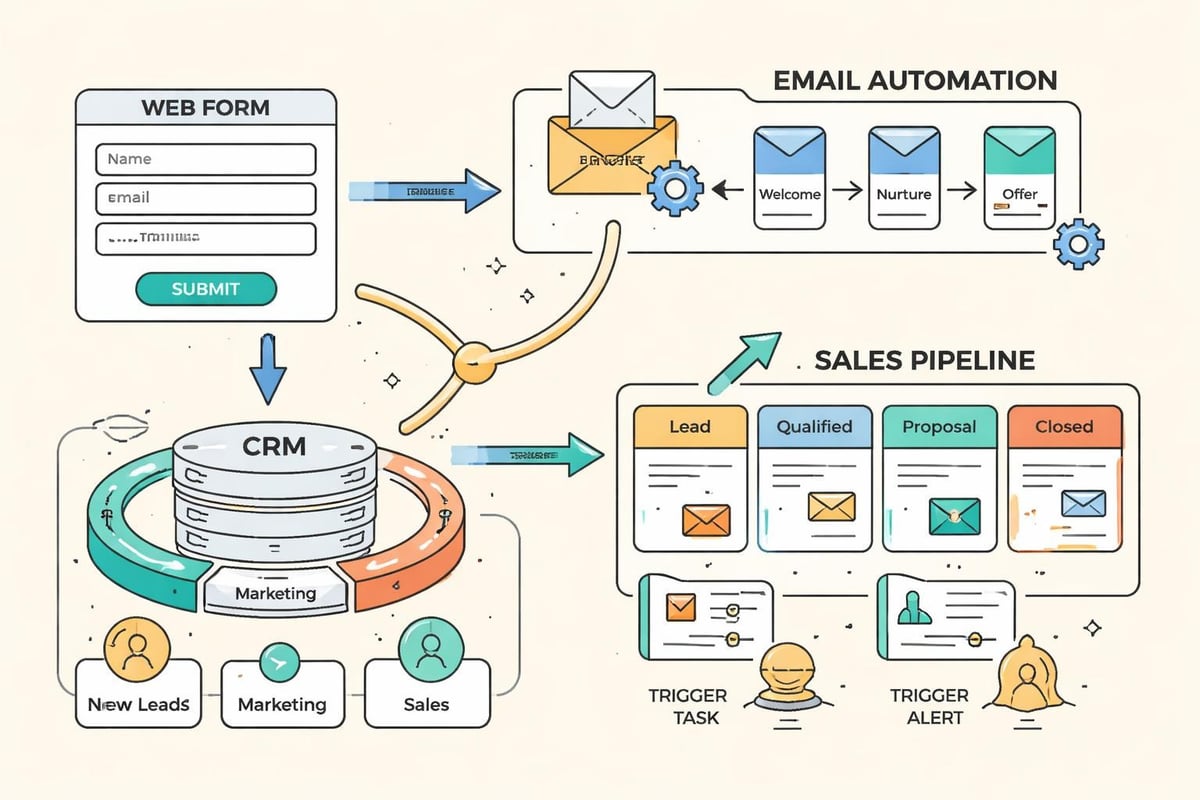
Your website captures leads. Your CRM organizes them. Your automation nurtures them. All three need to work as one system.
Key integration points:
- Form submissions trigger CRM contact creation with source attribution
- Behavioral tracking updates contact records (pages visited, content downloaded)
- Segmentation rules route contacts to appropriate nurture sequences
- Sales notifications fire when contacts hit qualification thresholds
The technical implementation requires API connections, webhook configuration, and error handling. The marketing strategy determines segmentation logic, sequence timing, and content personalization.
Most service-based businesses underinvest here. They'll spend $5,000 on a website but balk at $2,000 for proper CRM integration. Then they manually copy-paste form submissions into spreadsheets while wondering why growth feels chaotic.
Research from Adweek consistently shows that businesses with integrated marketing technology stacks outperform those with disconnected tools. The difference isn't small. It's measured in multiples, not percentages.
Data Flow and Attribution
Marketing and web development must solve attribution together. When someone becomes a customer, you need to know which marketing touchpoint started the relationship.
This requires tracking from first click through final purchase:
- Acquisition source – Which campaign, channel, or referrer brought the initial visit
- Engagement pattern – Which pages they viewed, content they consumed, forms they filled
- Conversion point – What action triggered their entry into your sales process
- Revenue attribution – Which customer acquisition source produced the sale
Implementing this needs both technical capability and marketing strategy. Developers build the tracking infrastructure. Marketers define what constitutes a meaningful touchpoint and how to weight multi-touch attribution.
| Attribution Model | Best For | Implementation Complexity |
|---|---|---|
| First-touch | Understanding top-of-funnel performance | Low |
| Last-touch | Measuring bottom-of-funnel effectiveness | Low |
| Linear | Giving equal credit across journey | Medium |
| Time-decay | Emphasizing recent interactions | Medium |
| Position-based | Crediting first and last touch heavily | High |
| Custom algorithmic | Complex, multi-channel businesses | Very High |
Content Strategy Meets Technical Delivery
Marketing and web development intersect in content delivery systems. Your content strategy determines what to publish. Your technical infrastructure determines how quickly you can execute and how well it performs.
Content marketing requires more than just writing blog posts. You need taxonomy structures, URL strategies, internal linking architecture, and schema markup. All of these require marketing understanding and technical implementation.
Technical elements that enhance content marketing:
- Dynamic content blocks that personalize based on visitor source or behavior
- Related content algorithms that keep visitors engaged longer
- Email opt-in triggers based on scroll depth or time on page
- Content upgrade delivery systems that capture emails for premium resources
The content calendar is a marketing document. The content management system is a development tool. They need to work together so you can publish quickly, optimize based on performance, and scale without technical bottlenecks.
Understanding authoritative sources in content creation helps ensure your content carries weight with both search engines and readers.
SEO as a Shared Responsibility
Search engine optimization lives at the intersection of marketing and web development. Content marketers need to understand keyword strategy and user intent. Developers need to implement proper technical SEO foundations.
Neither side can succeed alone. Great content on a technically broken site won't rank. Perfect technical SEO with thin content won't convert.
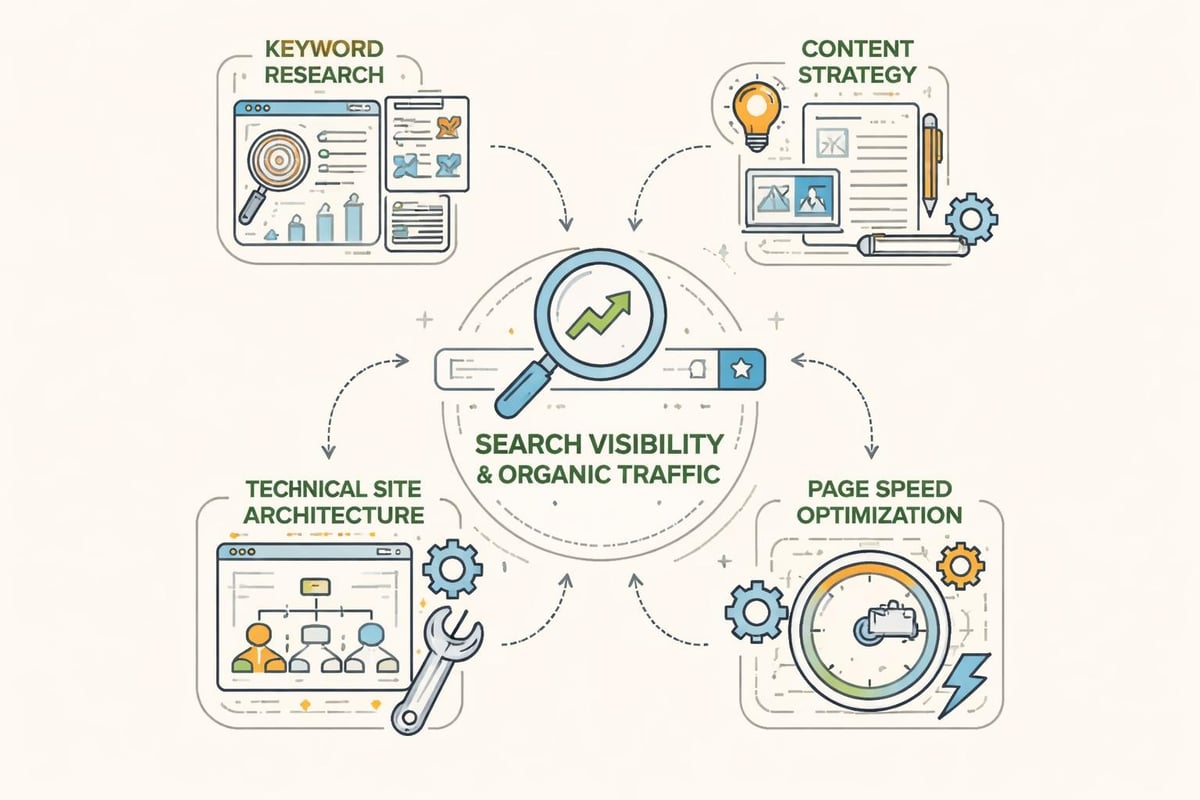
Marketing responsibilities in SEO:
- Keyword research and search intent analysis
- Content creation aligned with target queries
- Internal linking strategy and anchor text optimization
- Content refresh cycles based on performance data
Development responsibilities in SEO:
- Site speed optimization and Core Web Vitals
- Mobile responsiveness and accessibility
- Schema markup implementation
- XML sitemap and robots.txt configuration
- Proper heading hierarchy and semantic HTML
Both teams need access to the same data. When organic traffic drops, is it a content problem or a technical issue? You can't know without shared analytics and regular communication.
Using proper keyword focus and data sources ensures your content strategy aligns with actual search demand.
Campaign Landing Pages and Testing Infrastructure
Every marketing campaign needs dedicated landing pages. These pages live at the intersection of marketing and web development, requiring rapid iteration and conversion optimization.
The traditional waterfall approach fails here. Marketing briefs a landing page. Development builds it. Design reviews it. Development makes revisions. Two weeks later, the page launches. The campaign is already running, sending traffic to a generic page.
A better approach treats landing pages as collaborative builds:
- Marketing defines the campaign offer, target audience, and key message
- Development provides a template framework with proven conversion patterns
- Both iterate on copy and design together using real visitor data
- Testing infrastructure allows rapid deployment of variations
A/B testing exemplifies the need for integration. Marketing formulates hypotheses about what messaging will convert better. Development implements the test infrastructure and ensures statistical validity. Both analyze results and plan the next iteration.
| Test Type | Marketing Input | Development Input |
|---|---|---|
| Headline variations | Message positioning, value prop angles | Test implementation, traffic splitting |
| Form length | Lead qualification requirements | Field validation, user experience |
| CTA button design | Action-oriented copy | Visual prominence, interaction states |
| Social proof placement | Which testimonials to feature | Layout integration, mobile display |
The velocity of testing matters. Businesses that can launch, measure, and iterate weekly outpace those stuck in monthly release cycles. This requires marketing and web development working from shared tools and streamlined processes.
Infrastructure That Scales
Marketing and web development share one critical goal: building systems that grow without proportional increases in manual work. This is what separates businesses that scale from those that plateau.
Scalable infrastructure characteristics:
- Automated lead capture and routing (no manual data entry)
- Template-based content publishing (fast deployment of new pages)
- Integrated analytics (automatic reporting without manual compiling)
- Self-service resources (reduce support load as traffic grows)
The marketing question is always "how do we reach more people?" The development question is "how do we handle more traffic and leads?" Both need answers that work together.
Digital marketing and business development requires infrastructure that can handle growth spikes without breaking. Your website needs to process form submissions reliably at 10x current volume. Your CRM needs to manage thousands of contacts without performance degradation. Your email system needs to send segmented campaigns to growing lists.
Planning for scale from the start costs less than retrofitting later. When you're getting five leads per week, manual processes work fine. At 50 leads per week, you need automation or you'll drown.
Security and Compliance Considerations
Marketing and web development share responsibility for data protection and regulatory compliance. GDPR, CCPA, and similar regulations affect how you collect, store, and use visitor data.
Marketing wants to track everything. Development needs to ensure compliant implementation. The balance requires understanding both the business value of data and the legal requirements for protection.
Compliance requirements affecting both teams:
- Cookie consent implementations that don't break tracking
- Privacy policy accuracy reflecting actual data collection
- Data retention policies and automated deletion
- Third-party script auditing and vendor agreements
- Form consent language and opt-in mechanisms
The technical implementation of privacy controls is development work. The impact on marketing effectiveness is a marketing concern. Both teams need to solve for compliance without sacrificing conversion rates or campaign intelligence.
Measuring What Matters
Marketing and web development need shared metrics. Not separate dashboards with different numbers. One source of truth that both teams use to make decisions.
Essential shared metrics:
- Conversion rate by traffic source – Which campaigns produce leads that close
- Page load time – How technical performance impacts marketing results
- Form completion rate – Where visitors abandon the conversion process
- Cost per acquisition – What each customer costs across all channels
- Lead-to-customer ratio – How marketing quality affects sales outcomes
- Revenue per visitor – Overall effectiveness of traffic and conversion
These metrics require both marketing insight and technical measurement. You can't optimize what you don't measure. You can't measure what isn't properly instrumented.
The integration of marketing and web development creates accountability. When both teams own conversion rates, finger-pointing disappears. The focus shifts to solving problems together rather than defending departmental territory.
Regular performance reviews should include both perspectives. Marketing explains campaign performance and audience insights. Development reports on technical health and infrastructure capacity. Both discuss how their work impacts shared goals and what to prioritize next.
Moving Forward
Marketing and web development create the most value when they function as one integrated system. This doesn't mean everyone needs to know everything. It means shared goals, connected tools, and collaborative problem-solving.
The businesses that grow predictably in 2026 and beyond will be those that eliminated the artificial boundary between marketing and development. They'll ship faster, convert better, and scale without chaos because their infrastructure was built for it from the start.
Start by identifying where disconnection costs you money. Missed leads because forms don't integrate with your CRM. Slow campaign launches because landing pages take weeks to build. Marketing spend on traffic that bounces from slow-loading pages.
Then fix the connection points one at a time. Integrate your forms properly. Build a landing page template system. Optimize for speed. Each improvement compounds because the system gets stronger as a whole, not just in isolated parts.
Marketing and web development work best as an integrated system, not separate projects competing for budget and attention. When strategy, infrastructure, and execution align, you get predictable growth instead of constant firefighting. MDO Digital specializes in building these integrated systems for service-based businesses. We design high-trust websites, implement CRM and automation infrastructure, and run data-driven marketing that turns attention into consistent demand. If you're ready to remove chaos and build structured growth, we should talk.