Most service businesses treat paid search as a tap you turn on when you need leads. That's not how it works. A good search engine marketing agency doesn't just run ads. They build the infrastructure that turns clicks into predictable demand, protects every dollar spent, and creates a system that compounds over time. The difference between burning budget and scaling sustainably comes down to how well your paid search connects to the rest of your marketing system.
What a Search Engine Marketing Agency Actually Does
A search engine marketing agency manages your paid search presence across platforms like Google Ads and Microsoft Advertising. But the mechanics matter less than the outcome. The real work is understanding your buyer's intent at different stages, matching that intent to the right message, and ensuring every click has somewhere valuable to go.
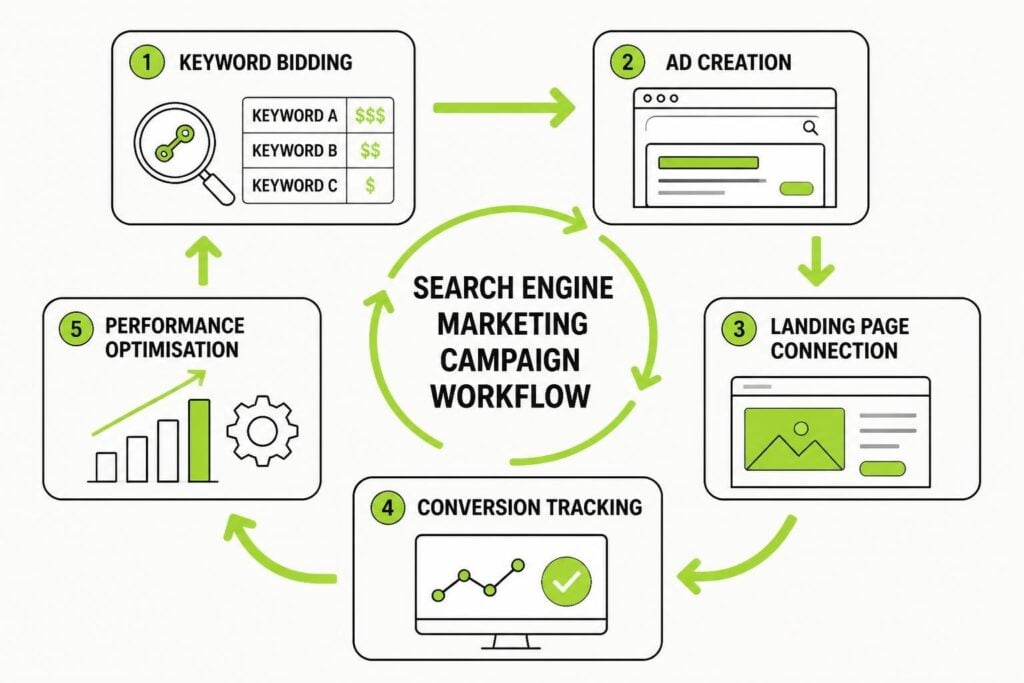
The Core Functions Worth Paying For
Here's what separates competent agencies from those just spending your money:
- Keyword strategy and intent mapping across awareness, consideration, and decision stages
- Ad copy and creative testing tied to actual conversion data, not vanity metrics
- Landing page coordination so the message continues from ad to page to offer
- Bid management and budget allocation based on customer acquisition cost and lifetime value
- Conversion tracking and attribution that shows which campaigns drive real business outcomes
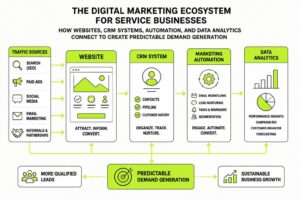
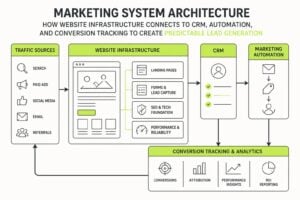
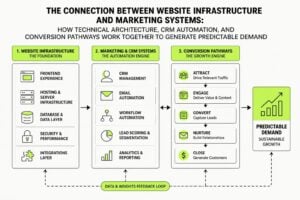
- CRM integration so leads don't vanish into a spreadsheet
The last point matters more than most businesses realise. If your paid search doesn't feed a structured CRM and nurture system, you're paying for leads that evaporate.
How Search Engine Marketing Fits Your Growth System
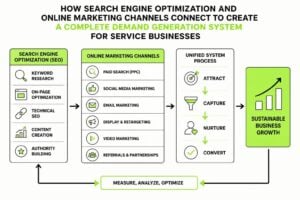
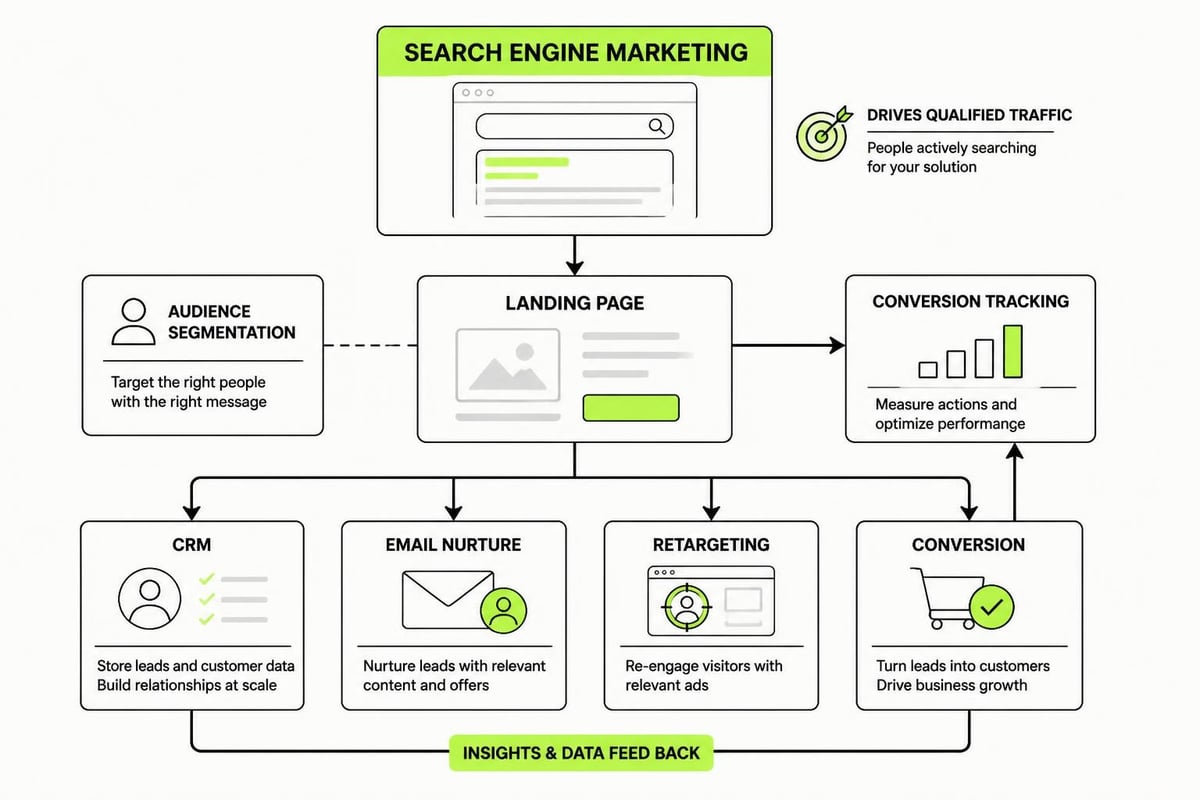
Paid search isn't a standalone channel. It's one component in a repeatable marketing system. When you're building a marketing funnel, paid search usually sits at the top (capturing new demand) and middle (re-engaging warm prospects). It works best when it connects cleanly to everything downstream.
The Pre-Requisites Most Agencies Won't Tell You
Before you spend a dollar on ads, you need:
- A clear buyer persona so you know what keywords matter and what messages convert
- A conversion-ready landing page that matches ad intent and captures the right information
- A CRM or database that tracks leads, stages, and outcomes (not just form fills)
- Defined goals and acceptable cost per acquisition based on actual customer economics, not guesses
If those aren't in place, an agency will still take your money. They'll run campaigns, send reports, and show you clicks. But without the foundation, you're not building a system. You're renting attention with no way to capture the value.
A solid 7-Step Marketing Plan helps you nail the fundamentals before paid search enters the picture. It ensures your CRM, nurture campaigns, and conversion tracking are ready to handle the leads you're paying for.

What to Look for in a Search Engine Marketing Agency
The agency landscape is cluttered with badge collectors and report generators. Here's how to separate signal from noise.
| What to Check | Why It Matters | Red Flags |
|---|---|---|
| Google Partner status | Shows commitment and minimum spend/performance thresholds | No certifications, vague credentials |
| Client retention | Long relationships mean results, not just promises | High churn, no case studies |
| Attribution model | Do they track beyond last-click? | Only report on platform metrics |
| Integration capability | Can they connect ads to your CRM and tech stack? | Operate in silos, no CRM experience |
| Transparency | Shared access, clear reporting, no locked-in platforms | Walled gardens, opaque fees |
The Google Partners program sets baseline standards for agencies managing client accounts. It's not a guarantee of quality, but it's a minimum filter. Look for Premier Partner status if the agency claims serious scale.
Questions That Reveal Real Capability
Ask these during your first conversation:
- How do you determine which keywords are worth bidding on?
- What's your process for testing ad copy and creative?
- How do you connect paid search to our CRM and sales process?
- What attribution model do you use, and why?
- How often do you optimise bids, and what triggers changes?
- What's your strategy for remarketing and sequential messaging?
Weak agencies give generic answers. Strong ones ask you questions first: about your customer economics, sales cycle, average deal size, and what happens after a lead converts.
The Real Costs and What You're Paying For
Search engine marketing agency pricing typically includes two components: the ad spend (what goes to Google, Microsoft, etc.) and the management fee (what the agency charges). The management fee structure varies widely.
Common Pricing Models
- Percentage of ad spend: 10-20% is typical, scales with budget but can misalign incentives
- Flat monthly retainer: Predictable, aligns agency effort with results, not just spend
- Performance-based: Tied to leads or conversions, requires solid tracking and trust
- Hybrid models: Base retainer plus performance bonuses
The right model depends on your business stage and how much infrastructure you already have. Early-stage businesses often benefit from flat retainers because you need strategic setup more than scale. Established businesses with proven economics can explore performance arrangements.
For transparency on how agencies typically structure their fees, check out our guide on marketing agency pricing.
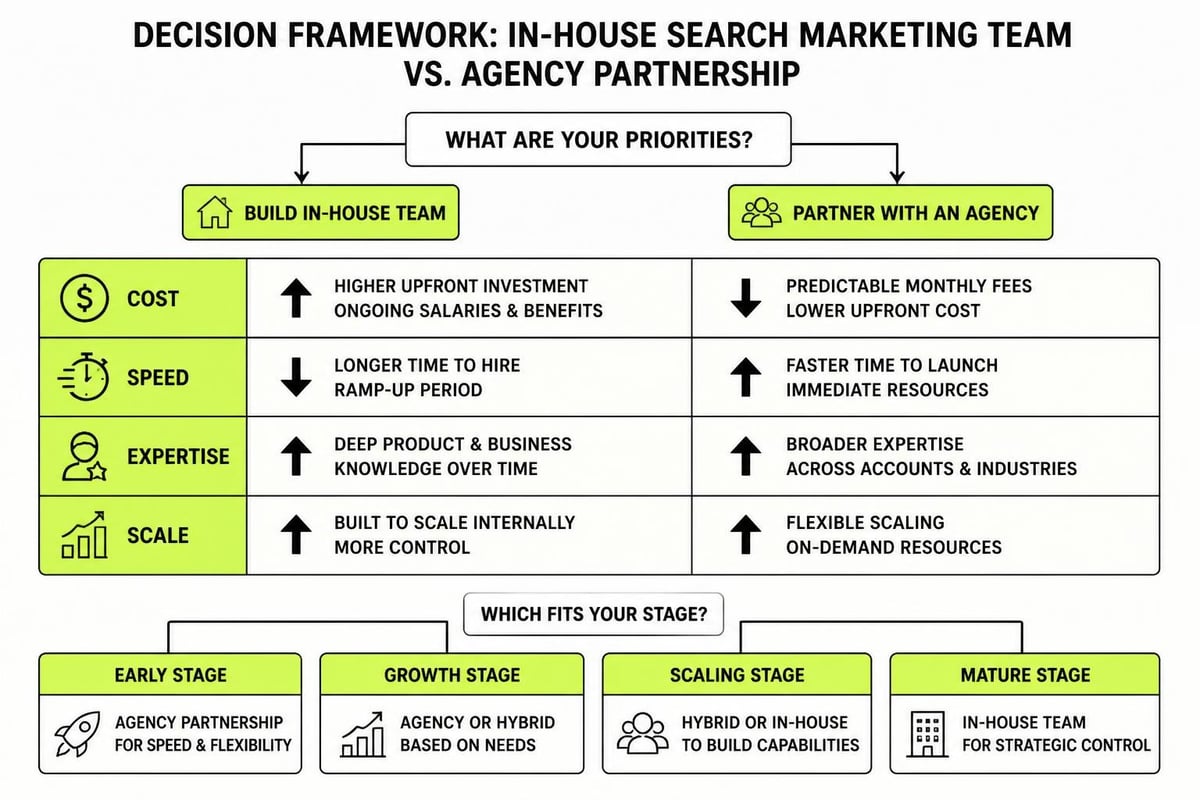
In-House vs. Agency: The Real Trade-Offs
The "should we hire or outsource?" question doesn't have a universal answer. It depends on where you are and what you're trying to build.
| Factor | In-House | Agency |
|---|---|---|
| Speed to competence | Slow, requires hiring and training | Immediate, expertise on day one |
| Cost at small scale | High, salary + tools + training | Lower, shared resources |
| Strategic alignment | Total, lives in your business daily | Good if agency understands your model |
| Flexibility | Limited by headcount | Scales up/down with budget |
| Platform access | Standard tools, need subscriptions | Enterprise tools, beta features |
Most service businesses under $2-3M in revenue are better off with an agency. The overhead of hiring, tools, and staying current with platform changes exceeds the value of in-house control. Above that threshold, a hybrid model works well: in-house strategy and oversight, agency execution.
Platform Selection and Where to Focus Budget
Not all search platforms deliver equal returns. Your buyer behaviour dictates where to invest.
Google Ads: The Default Starting Point
Google owns roughly 90% of search market share in Australia. For most service businesses, Google Ads is where you start. The platform offers:
- Search campaigns targeting high-intent keywords
- Display network for brand awareness and retargeting
- Performance Max for automated cross-channel reach
- YouTube ads for video-based education and trust building
The Semrush guide to search engine marketing covers platform-specific tactics in detail, including how to structure campaigns for different business models.
Microsoft Advertising: The Often-Overlooked Option
Microsoft Advertising (formerly Bing Ads) delivers better cost-per-click in many professional service categories. The audience skews older and more corporate. If your buyers are in enterprise, finance, or professional services, test Microsoft early. The platform's agency management tools make it easy to run parallel campaigns.
Budget Allocation Rules That Work
Start with 80% of budget on Google Search, 20% on testing (Microsoft, Display, YouTube). As you gather data, shift budget toward what converts. Don't spread thin across every platform in month one. Depth beats breadth early.
Integration: Where Most Agencies Fall Short
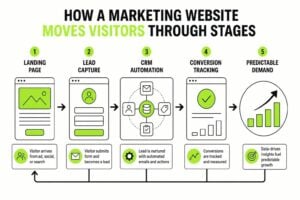
The biggest gap in search engine marketing agency work isn't ad performance. It's what happens after the click. Most agencies optimise for clicks or even form fills, but they have no visibility into what converts to actual customers. That's a structural problem.
The Minimum Integration Stack
Your search campaigns need to connect to:
- Landing pages with consistent messaging and clear conversion paths
- CRM or contact database that captures lead source, campaign, and keyword data
- Email nurture sequences triggered by campaign type and buyer stage
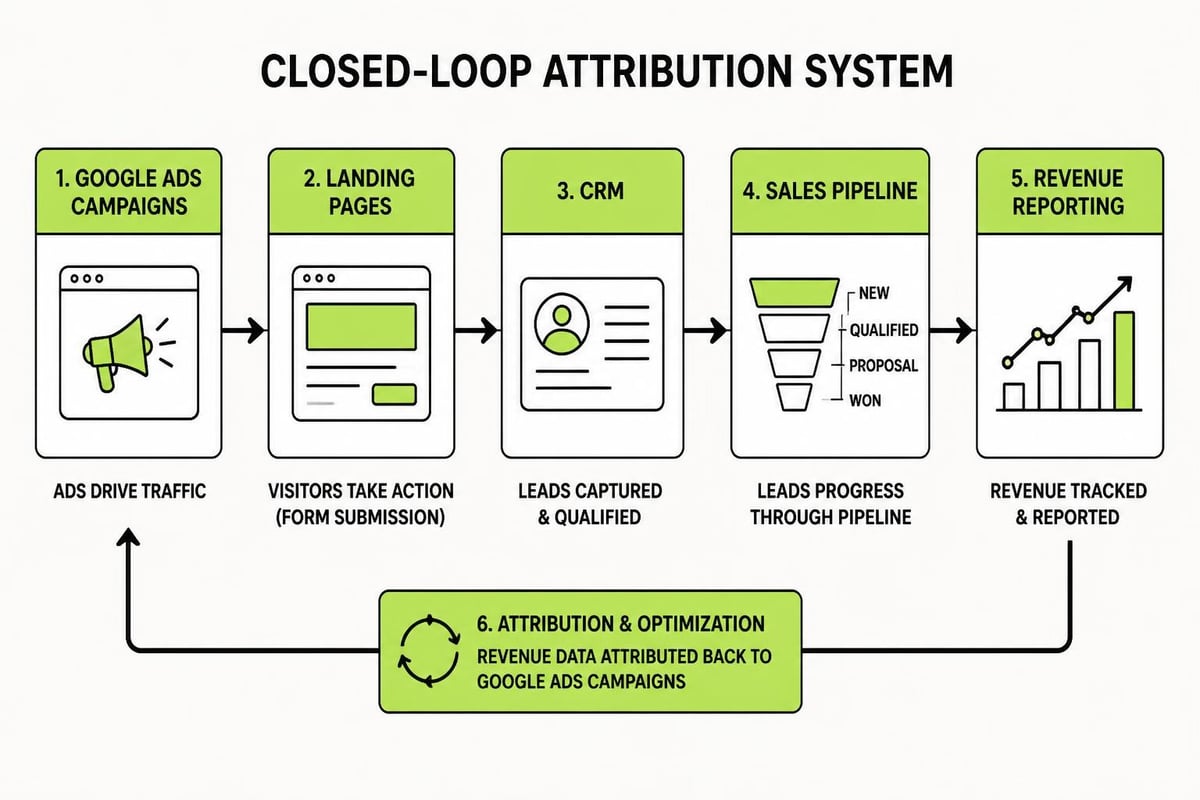
- Sales pipeline with closed-loop reporting back to ad performance
- Analytics platform that tracks beyond platform pixels (GA4, Segment, etc.)
Without these connections, you're optimising in a vacuum. The agency celebrates a low cost-per-click while your sales team complains about lead quality. Building this infrastructure is part strategy, part systems work. It's where marketing and business development converge.
Quality Score and the Compounding Effect
Google's Quality Score is the metric most businesses ignore and most agencies game. It's neither trivial nor the whole game. Quality Score affects your ad rank and cost-per-click. Higher scores mean lower costs for the same position.
What Drives Quality Score
Three factors matter:
- Expected click-through rate: Do people click your ad when it shows?
- Ad relevance: Does your ad copy match the keyword intent?
- Landing page experience: Does the page deliver on the ad's promise?
Agencies focused on short-term wins manipulate CTR with clickbait headlines. That works for a week until Google's algorithm adjusts. Sustainable Quality Score comes from genuine relevance: matching user intent, delivering value, and creating landing pages people actually want.
This is where organic search fundamentals inform paid strategy. The same principles that make content rank organically make landing pages perform in paid search: clear value, fast load times, mobile optimisation, and structured content.
Tracking, Attribution, and the Data You Actually Need
Most agencies send monthly reports full of metrics that don't matter. Impressions, CTR, even conversions can be misleading if they're not tied to business outcomes.
Metrics That Drive Decisions
| Metric | What It Tells You | Why It Matters |
|---|---|---|
| Cost per qualified lead | What you pay for leads that match ICP | Indicates targeting accuracy |
| Lead-to-customer rate | How many leads convert to sales | Shows quality, not just volume |
| Customer acquisition cost | Total cost to acquire one customer | Determines profitability |
| Return on ad spend (ROAS) | Revenue per dollar spent | Justifies budget and informs scaling |
| Lifetime value per channel | Long-term value by acquisition source | Guides strategic budget allocation |
To track these properly, you need closed-loop reporting. That means your CRM talks to your ad platforms, and your sales data flows back into campaign optimisation. Most agencies don't build this because it requires collaboration beyond the marketing silo.
The IAB and PwC’s advertising revenue report provides industry benchmarks on digital ad spend and performance trends. Use it to pressure-test your agency's claims about what's "normal" or "good."
When to Walk Away from an Agency
Not every relationship works. Here are the signs an agency isn't delivering value:
- Reports without insights: Dashboards that show what happened but not why or what to do
- No strategic input: They execute what you tell them but never challenge assumptions
- Siloed operation: No interest in CRM, sales process, or what happens after the lead
- Chasing vanity metrics: Celebrate traffic and clicks while conversions stagnate
- Locked-in platforms: You don't own ad accounts, audiences, or historical data
Good agencies act as strategic partners. They dig into your customer economics, challenge your targeting assumptions, and push you to improve landing pages and offers. If yours doesn't, you're paying for task execution, not growth.
Building vs. Renting: The Long-Term Play
Paid search is often called "renting" traffic. That's partially true. When you stop paying, the leads stop. But the infrastructure you build around paid search compounds. Audiences, conversion data, creative tests, landing page optimisation, and CRM workflows all persist.
A search engine marketing agency should help you build assets, not just spend budget. That means:
- Developing creative and messaging frameworks you own
- Building retargeting audiences segmented by behaviour and stage
- Creating landing page templates and testing protocols
- Establishing conversion tracking and attribution models
- Training your team to interpret data and make decisions
The agency that leaves you more capable, even if the relationship ends, is the one worth keeping.
The Agency You Actually Need
Most businesses don't need a search engine marketing agency that's everything to everyone. You need one that fits your stage, understands your buyers, and builds systems that work after the contract ends. Look for competence over credentials, integration over isolation, and strategic partnership over tactical execution.
For service-based businesses, the right agency doesn't just run ads. They connect paid search to your CRM, build nurture sequences that turn leads into customers, and create reporting that informs real decisions. When choosing an agency, ask not what they can do, but what they'll leave behind when you outgrow them.
The best search engine marketing doesn't exist in isolation. It's part of a connected system where every channel, message, and conversion point reinforces the next. If you're ready to build marketing infrastructure that scales with clarity and removes the chaos from lead generation, MDO Digital can help. We design the systems that turn attention into predictable demand.