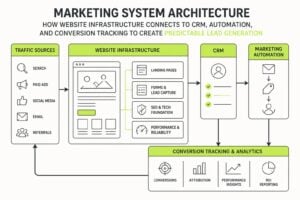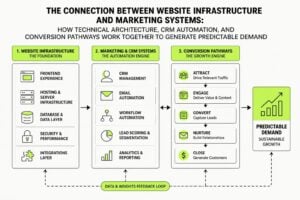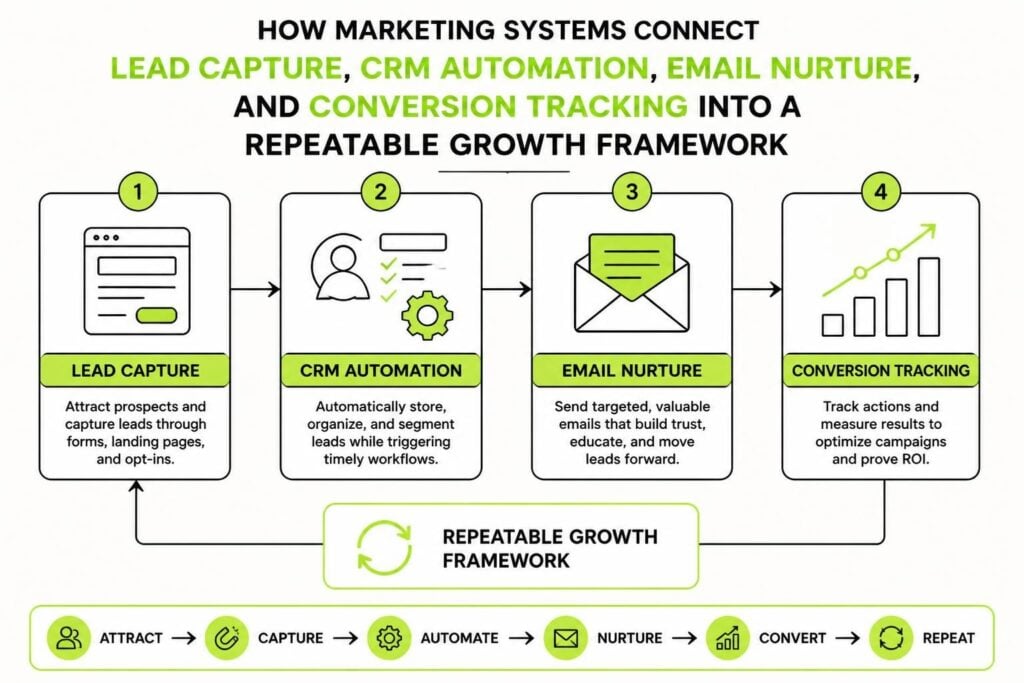
Most small businesses don't have a marketing problem. They have a systems problem. You might run brilliant campaigns, post consistently, or deliver excellent work, but without proper infrastructure to capture, nurture, and convert leads, most of that effort evaporates. Marketing systems for small business aren't about fancy software or complex funnels. They're about building repeatable processes that turn attention into revenue, consistently and predictably, without requiring you to reinvent the wheel every week.
What Marketing Systems Actually Are
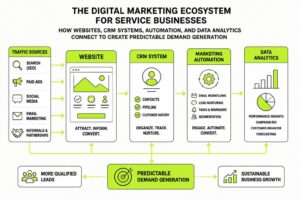
Marketing systems are the documented processes and connected tools that move prospects from first contact to paying customer. They're not individual tactics. A Facebook ad isn't a system. An email campaign isn't a system. But the documented workflow that captures a lead from that ad, adds them to your CRM, sends a welcome sequence, and books them into a discovery call? That's a system.
The core components of effective marketing systems include:
- Lead capture mechanisms (forms, landing pages, opt-ins)
- Customer relationship management (CRM) infrastructure
- Automated follow-up and nurture sequences
- Pipeline tracking and conversion monitoring
- Reporting and optimization frameworks
The difference between marketing activities and marketing systems is documentation and repeatability. When you can hand someone a process document and they can execute it without asking you ten questions, you've built a system.
Why Small Businesses Struggle Without Systems
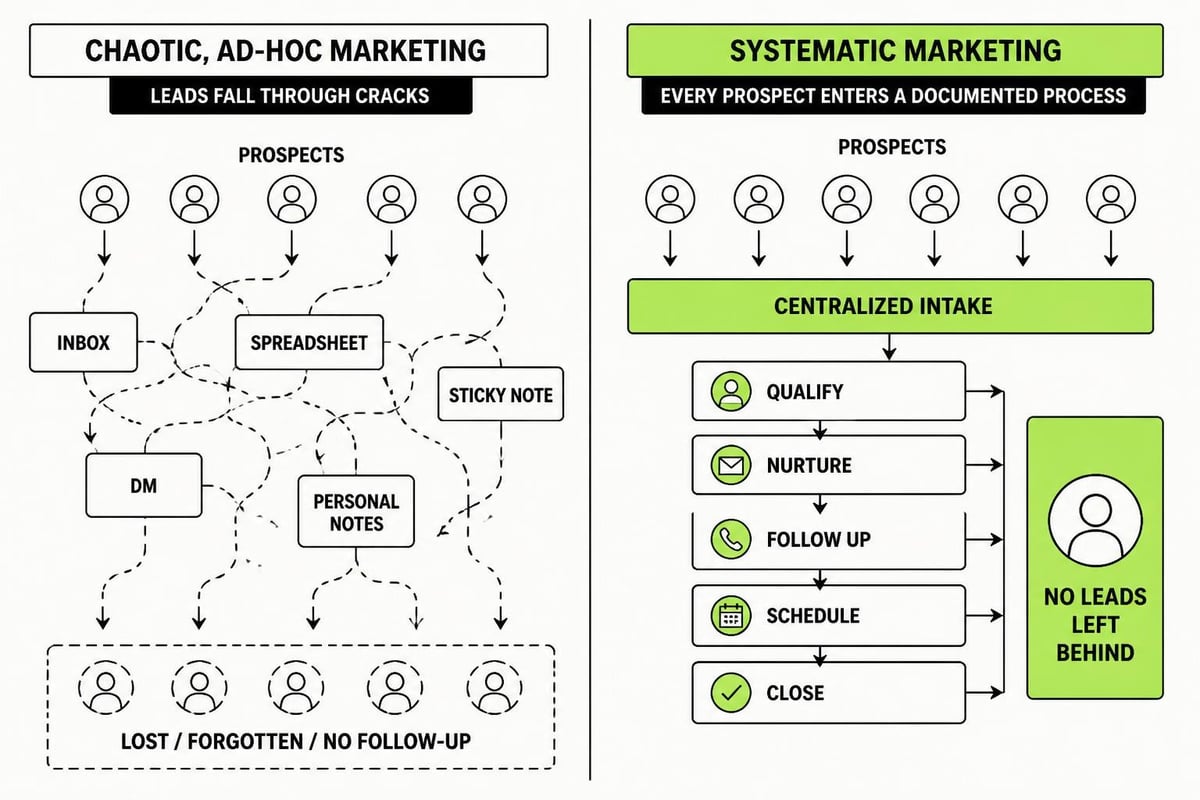
Without structured systems, every lead is handled differently. You might remember to follow up with one prospect but forget another. Your email responses vary based on how busy you are that day. There's no consistent way to measure what's working because the inputs keep changing.
This creates three specific problems. First, you can't scale. Your revenue ceiling is determined by how many hours you personally spend on marketing. Second, you lose leads. Studies show that effective CRM systems can increase conversion rates by 300% simply by ensuring consistent follow-up. Third, you can't improve what you can't measure, so you're constantly guessing which marketing activities actually generate revenue.
Building Your Foundation: CRM and Data Infrastructure
Marketing systems for small business start with one critical decision: where will you store, track, and manage customer data? Your CRM isn't just a contact database. It's the central nervous system of your entire marketing operation.
When evaluating CRM options, prioritize these features:
- Custom fields to track business-specific data
- Pipeline stages that match your actual sales process
- Integration capabilities with your existing tools
- Automation features for routine tasks
- Reporting that shows conversion rates at each stage
You don't need enterprise software. Many small businesses operate effectively on platforms like HubSpot's free tier, ActiveCampaign, or Pipedrive. The tool matters less than your commitment to using it consistently. Choose something you'll actually log into daily, not something that sits unused because it's too complex.
Setting Up Pipeline Stages That Reflect Reality
Your CRM pipeline should mirror how customers actually move through your business, not some theoretical ideal. For most service-based businesses, this looks like: Inquiry → Qualified → Proposal Sent → Negotiation → Won/Lost.
Each stage needs clear entry and exit criteria. What has to happen for a lead to move from "Inquiry" to "Qualified"? Define it. Document it. Then build automation around it. When a lead enters a new stage, what should happen automatically? Perhaps they receive a specific email sequence, or a task gets created for your team, or a notification goes to your sales channel.
This structured approach to business and marketing infrastructure removes the guesswork and ensures nothing falls through the cracks.
Creating Lead Capture and Nurture Systems
Once your CRM foundation exists, you need systematic ways to fill it with qualified prospects. Lead capture isn't about collecting as many email addresses as possible. It's about attracting the right people and moving them toward a buying decision.
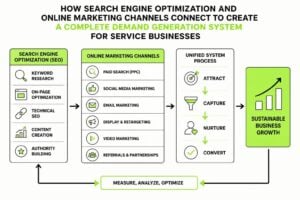
Effective lead capture systems have three components: the traffic source, the opt-in offer, and the post-conversion sequence. The traffic source is wherever attention lives (your website, social media, paid ads). The opt-in offer is what convinces someone to exchange their contact information. The post-conversion sequence is what happens immediately after they opt in.
Designing Opt-In Offers That Qualify Leads
Generic "newsletter" opt-ins don't qualify anyone. They just collect email addresses. Better opt-ins solve a specific problem your ideal customer has right now, filtering for intent and need.
Strong opt-in offers for service businesses include:
- Implementation checklists
- ROI calculators or assessment tools
- Case study libraries
- Strategy frameworks or planning templates
- Video training on a specific challenge
The 7-Step Marketing Plan is a good example of this approach. It provides immediate value while naturally identifying prospects who are serious about building systematic marketing infrastructure.
| Opt-In Type | Qualification Level | Conversion Rate | Sales Readiness |
|---|---|---|---|
| Generic newsletter | Low | 2-5% | Very Low |
| Resource library | Medium | 5-10% | Low |
| Assessment/Calculator | High | 8-15% | Medium |
| Strategy framework | Very High | 10-20% | High |
Automating Your Nurture Sequences
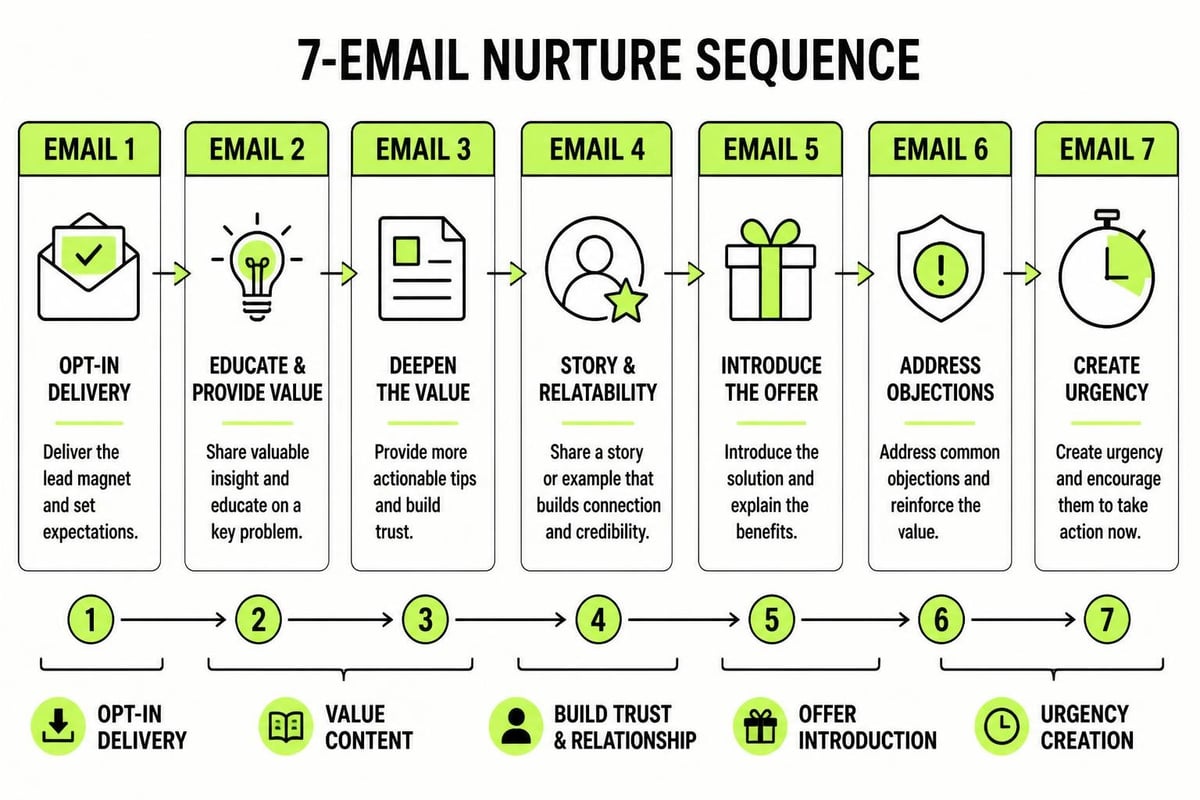
Once someone opts in, what happens next? Without a system, probably nothing, or sporadic emails when you remember. With a system, they enter a documented sequence designed to build trust, demonstrate expertise, and move them toward a buying decision.
Your initial nurture sequence should run 5-7 emails over 10-14 days. Email one delivers the promised opt-in and sets expectations. Emails two through five provide additional value, case studies, and educational content. Email six introduces your core offer. Email seven creates urgency or provides a final resource.
Don't write these emails from scratch every time. Template them. Store them in your CRM or email marketing software. Update them quarterly based on performance data, but the core structure remains consistent.
Tracking, Measurement, and Optimization Systems
Marketing systems for small business only work if you can measure what's happening and make data-driven improvements. This doesn't require complex analytics platforms. It requires defining clear metrics and reviewing them consistently.
The five metrics that matter most:
- Lead volume: How many new contacts enter your system weekly?
- Lead source: Which channels generate the most qualified prospects?
- Conversion rate: What percentage move from lead to customer?
- Time to conversion: How long does the average sale cycle take?
- Customer acquisition cost: What do you spend to acquire each customer?
Track these weekly in a simple spreadsheet or dashboard. The tool doesn't matter. The habit does. Every Friday, review your numbers. What improved? What declined? Why?
Creating Your Optimization Rhythm
Systems don't improve through occasional attention. They improve through consistent iteration. Establish a monthly optimization meeting where you review performance data and implement one meaningful change.
Month one, you might test different subject lines in your nurture sequence. Month two, you might adjust your pipeline stages based on where leads are getting stuck. Month three, you might experiment with a new lead magnet. Small, measured changes compound over time.
This approach to marketing and business development ensures you're always improving without constantly chasing new tactics.
Integrating Content and Distribution Systems
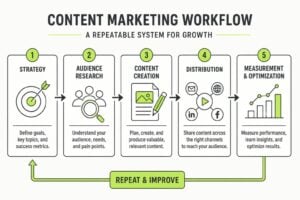
Marketing systems need fuel, and that fuel is content. But content creation can't be random. It needs to be systematic, feeding your lead capture mechanisms and nurture sequences with consistent material.
Build a content production system with three elements: a topic bank, a production schedule, and distribution automation. Your topic bank contains ideas mapped to customer questions and pain points. Your production schedule defines when content gets created and by whom. Your distribution automation ensures finished content reaches every relevant channel without manual posting.
The Content-to-Conversion Pipeline
Every piece of content should have a job. Blog posts drive organic traffic to opt-in pages. Email newsletters nurture leads and promote core offers. Social content builds awareness and directs traffic to owned assets. Case studies overcome objections late in the sales cycle.
Map your content types to your customer journey stages. Awareness-stage prospects need educational content that builds trust. Consideration-stage prospects need comparison content and case studies. Decision-stage prospects need testimonials, guarantees, and clear next steps.
| Journey Stage | Content Type | Distribution Channel | CTA Goal |
|---|---|---|---|
| Awareness | Blog posts, guides | Organic search, social | Opt-in download |
| Consideration | Case studies, comparisons | Email nurture | Book consultation |
| Decision | Testimonials, pricing | Sales conversations | Sign contract |
This structured approach to content marketing and digital marketing ensures every piece of content serves a strategic purpose.
Connecting Paid Advertising to Your Systems
Paid advertising without systems is just expensive attention that goes nowhere. The ad generates a click, the click lands on a page, and then… nothing. No capture, no follow-up, no conversion tracking.
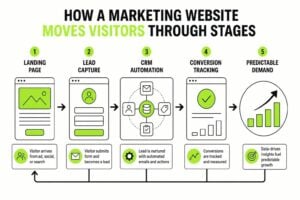
Effective paid campaigns integrate completely with your marketing systems. The ad targets a specific audience segment. The landing page offers a relevant opt-in. The form automatically adds leads to your CRM with proper source tracking. The nurture sequence begins immediately. Conversion tracking feeds data back to your ad platform to optimize targeting.
Building Landing Pages That Actually Convert
Your landing page is part of your system, not a separate marketing asset. It should have one job: capture qualified leads. That means removing navigation, minimizing distractions, and focusing entirely on the value proposition and opt-in form.
High-converting landing pages include:
- A clear headline stating the core benefit
- Supporting copy that addresses specific objections
- Social proof or credibility indicators
- A simple form (3-5 fields maximum)
- Clear expectations about what happens next
Test variations systematically. Change one element at a time (headline, image, form length) and measure the impact. Small improvements in conversion rate have massive downstream effects on your overall marketing ROI.
Building Review and Referral Systems
The best marketing systems don't end when someone becomes a customer. They extend into systematic ways to generate reviews, testimonials, and referrals.
Most businesses ask for reviews sporadically, when they remember, or when things go particularly well. Better businesses build it into their post-delivery process. When a project completes or a milestone is reached, an automated request goes out. Not generic. Specific, personalized, and making the process as simple as possible.
Systemizing Referral Generation
Referrals shouldn't rely on customers randomly remembering to recommend you. Build prompts into your system. After delivering exceptional results, send a specific ask: "We're looking to help three more businesses like yours this quarter. Who comes to mind?"
Provide referral tools that make it easy. Pre-written email templates customers can forward. A simple referral form on your website. Even a dedicated landing page explaining your ideal customer profile and the problems you solve.
The most sophisticated approach integrates referrals into your CRM. Track who referred whom. Send automated thank-you notes. Report on referral source revenue. When you measure it, you improve it.
Choosing and Implementing Your Tools
You don't need a huge tech stack to build effective marketing systems for small business. You need a few tools that integrate well and a commitment to using them consistently.
The essential stack includes:
- A CRM (HubSpot, Pipedrive, ActiveCampaign)
- Email marketing platform (often integrated with CRM)
- Landing page builder (Unbounce, Leadpages, or built into your website)
- Analytics (Google Analytics plus platform-specific tracking)
- Project management tool (Notion, Asana, Monday)
Choose tools that talk to each other. Native integrations beat manual data transfer every time. When your landing page automatically adds leads to your CRM which automatically triggers an email sequence, you've built a genuine system.
Many small business software tools now offer built-in automation features that previously required multiple platforms. Evaluate what you actually need versus what sounds impressive. Complexity is the enemy of execution.
Common System Failures and How to Avoid Them
Even well-designed marketing systems fail when implementation falters. The most common failure points are predictable and preventable.
Where systems typically break down:
- No owner: Every system needs someone responsible for monitoring and maintaining it
- Too complex: Systems with ten steps fail more often than systems with three steps
- Poor documentation: If it's not written down, it's not a system, it's just what you happen to remember
- No review cadence: Systems drift without regular check-ins and adjustments
- Technology over process: Buying software doesn't create a system, following a process does
Start simple. Build one system well before adding another. Document everything in a central location your whole team can access. Review weekly. Iterate monthly. Scale gradually.
The businesses with the best digital marketing and branding results aren't necessarily the ones with the biggest budgets. They're the ones with the most disciplined systems.
Integration: Making All Systems Work Together
Your lead capture system, CRM, nurture sequences, content production, and sales process shouldn't operate independently. They should function as one integrated machine where each component feeds the next.
This integration happens through deliberate connection points. When a blog post performs well in organic search, what happens? It should trigger a review of that topic for paid promotion. When a nurture sequence has low open rates, what happens? It should trigger a content review to refresh messaging. When a sales conversation reveals a new objection, what happens? It should feed back into your content production system to create materials addressing that concern.
Create monthly integration reviews where you specifically look for these connection points. Ask: "How did performance in system A affect inputs to system B?" This cross-system thinking is where sophisticated marketing operations emerge.
Marketing systems for small business aren't about perfection. They're about progress. Build infrastructure that captures leads reliably, nurtures them consistently, and converts them predictably. Document your processes, automate the repetitive work, and optimize based on data. If you need help designing systems that actually work in your business, MDO Digital specializes in building CRM infrastructure, automation workflows, and marketing systems that remove chaos and create structured growth.