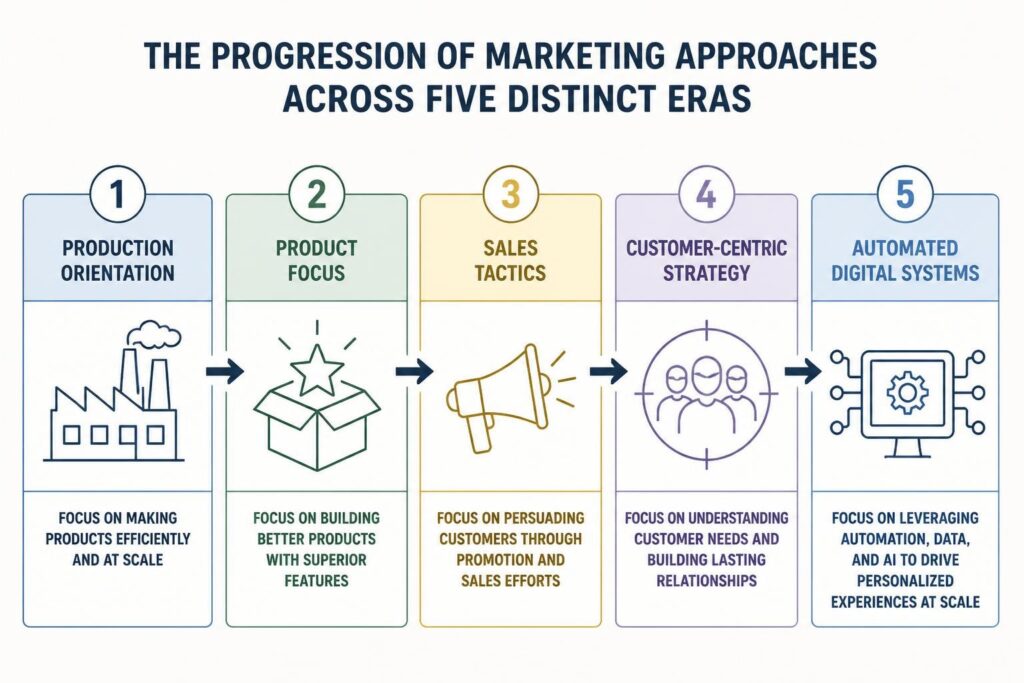
Marketing hasn’t always looked like what we see today. The evolution of marketing spans centuries, moving from simple transactions in town squares to sophisticated automation that predicts what someone needs before they ask. For service-based businesses trying to scale in 2026, understanding this journey isn’t just historical trivia. It’s the context you need to see where the gaps are in your own systems and why some approaches work while others burn cash. The way we market now is the result of deliberate shifts in thinking, technology, and what customers actually respond to.
The Production Era: Make It and They’ll Buy It
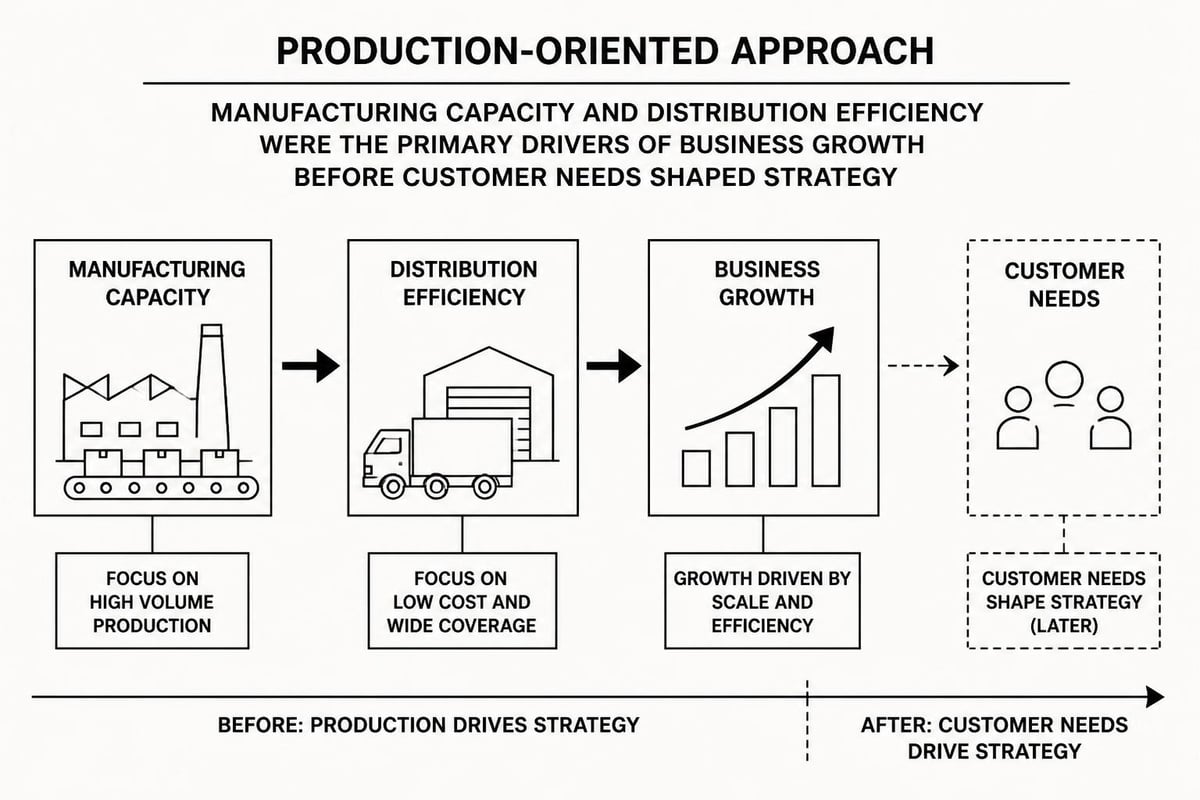
Back when marketing first emerged as a recognisable discipline, the focus was almost entirely on production capacity. From roughly 1860 to 1920, businesses operated under a simple assumption: if you could make something, people would buy it.
This made sense at the time. Demand outpaced supply for most goods. Factories were the competitive advantage. Marketing wasn’t really marketing yet. It was distribution and logistics.
The evolution of marketing during this period was less about persuasion and more about:
- Getting products to market efficiently
- Building manufacturing capacity
- Reducing the cost per unit
- Expanding distribution networks
For service businesses today, this era offers a useful reminder. Production capacity still matters. If you can’t deliver what you promise, no amount of clever marketing will save you. But relying solely on your ability to deliver, without a system to generate and nurture demand, leaves you at the mercy of whoever happens to find you.
The Product Era: Better Mousetrap Syndrome
The evolution of marketing shifted in the 1920s as supply started catching up with demand. Suddenly, having a product wasn’t enough. You needed a better product.
This era, running roughly through the 1940s, introduced the idea that superior features would win customers. Build the best mousetrap, and the world beats a path to your door. Except they don’t, because they don’t know your mousetrap exists.
Why Better Wasn’t Enough
Service businesses fall into this trap constantly. You invest in certifications, refine your methodology, develop proprietary frameworks, then wonder why clients aren’t lining up.
The product era taught us that quality alone doesn’t sell. You also need:
- Awareness of the solution
- Trust in the provider
- Clarity about the problem it solves
- A reason to choose you over alternatives
According to research on how marketing concepts evolved, this period marked the beginning of differentiation strategies, but they were still product-focused rather than customer-focused.
The lesson here isn’t to stop improving your service. It’s to recognise that improvement without communication is invisible to your market.
The Selling Era: Persuasion Over Everything
Post-World War II brought another shift in the evolution of marketing. With even more products competing for attention, businesses doubled down on persuasion. The selling era, from the 1940s through the 1960s, was about convincing people they needed what you had.
This is where advertising grew teeth. Salespeople became aggressive. The goal was to overcome objections and close deals, regardless of whether the product genuinely solved the customer’s problem.
| Selling Era Tactics | Modern Equivalents | Why They Backfire |
|---|---|---|
| Door-to-door sales | Cold outreach spam | No permission or context |
| Hard closes | Pressure funnels | Damages trust long-term |
| Limited-time offers | Fake scarcity tactics | Audience becomes immune |
| Feature dumping | Jargon-heavy websites | Confuses rather than clarifies |
For service businesses, this era’s legacy is still visible in tactics that prioritise short-term conversions over long-term relationships. You can push someone into buying once. You can’t push them into referring you or coming back.
The evolution of marketing here was less about evolution and more about escalation. Louder ads. Bolder claims. More interruptions. It worked until it didn’t.
The Marketing Era: The Customer Enters the Conversation
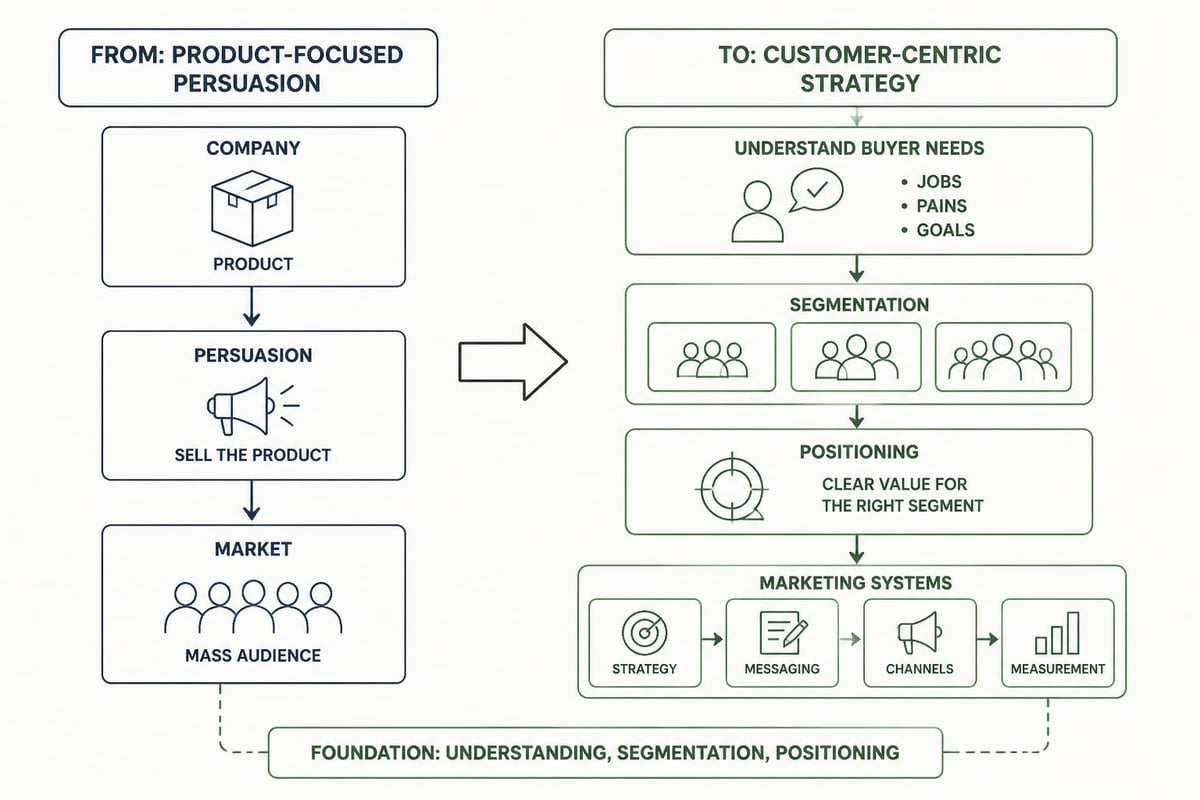
The real turning point in the evolution of marketing came in the 1970s when businesses started asking a different question: What does the customer actually need?
This shift, documented in studies on marketing’s transformation over time, moved focus from pushing products to understanding problems. Customer research became standard. Segmentation emerged. The goal was to identify needs and position your solution accordingly.
What Changed
The marketing era introduced concepts that now feel obvious but were revolutionary at the time:
- Market research to understand customer needs before building solutions
- Segmentation to target specific groups rather than everyone
- Positioning to occupy a distinct place in the customer’s mind
- The marketing mix (product, price, place, promotion) as a strategic framework
- Customer satisfaction as a metric that mattered
This is where branding and strategic marketing became separate disciplines from advertising. You weren’t just selling anymore. You were building relationships and reputation.
For service businesses in 2026, this era’s principles remain the foundation. You need to know who you’re talking to, what they struggle with, and how your service genuinely helps. Everything else is tactics.
The Relationship and Digital Era: Connection Meets Technology
The evolution of marketing accelerated dramatically in the 1990s and 2000s. Two forces converged: relationship marketing and digital technology.
Relationship marketing emphasised lifetime customer value over one-time transactions. It introduced loyalty programs, CRM systems, and the idea that keeping a customer costs less than acquiring one.
Digital marketing changed the playing field entirely. Suddenly, you could:
- Reach global audiences without massive budgets
- Track exactly what worked and what didn’t
- Personalise messages at scale
- Automate repetitive tasks
- Measure ROI with precision
The combination created what we now recognise as modern marketing. Email marketing emerged. Websites became essential. Search engines created new ways to be found. Social media turned customers into publishers.
The CRM Revolution
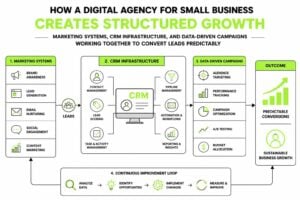
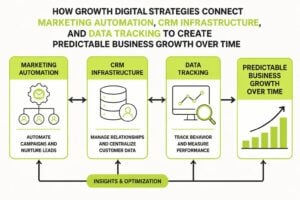
One of the most significant shifts in this period was the rise of customer relationship management systems. Marketing systems and automation infrastructure moved from luxury to necessity.
A proper CRM doesn’t just store contact details. It tracks:
- Every interaction a lead has with your business
- Where they are in the buying journey
- What content they’ve engaged with
- When to follow up and with what message
- Which marketing channels drive results
For service businesses, this era made predictable growth possible. You could finally see patterns in how people buy, build systems to nurture leads automatically, and scale without hiring an army.
The 7-Step Marketing Plan is built on this foundation. It takes the relationship marketing principles from this era and structures them into a repeatable system: defining your buyer persona, choosing platforms that reach them, creating valuable opt-in offers, building CRM infrastructure to nurture leads, delivering exceptional experiences, and generating reviews that fuel growth. Each step feeds the next, creating momentum that compounds.
The Data-Driven Era: Everything Becomes Measurable
The evolution of marketing in the 2010s and beyond is defined by one word: data. Every click, view, conversion, and dollar spent can be tracked. This changed everything.
According to analysis of recent marketing trends, data-driven marketing shifted from nice-to-have to competitive requirement. Businesses that measure and optimise outperform those that guess.
What Data-Driven Actually Means
It’s not just having analytics installed. It’s building a system where:
- You know the cost to acquire each customer
- You can predict conversion rates by channel
- You test variations and keep what works
- You identify drop-off points in your funnel
- You attribute revenue to specific marketing activities
This is where most service businesses still struggle. They have data, but it sits in disconnected tools. Google Analytics shows traffic. The CRM shows leads. The accounting software shows revenue. Nothing talks to each other.
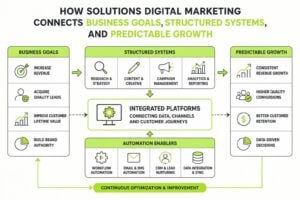
The evolution of marketing systems now prioritises integration. Your web development and marketing infrastructure needs to connect every touchpoint so you can see the full picture.
How integrated marketing systems connect website traffic, CRM data, email campaigns, conversion tracking, and revenue attribution into a single source of truth for decision-making
The Experience and Automation Era: Where We Are Now
In 2026, the evolution of marketing has reached a point where experience and automation define success. Customers expect personalised, frictionless interactions. They want information instantly. They’ll leave if your website loads slowly or your process is confusing.
At the same time, automation has made it possible to deliver this experience without manual effort for every interaction. The businesses winning right now have systems that:
- Automatically segment leads based on behaviour
- Sendpersonalisedd follow-up sequences
- Score leads to prioritising sales efforts
- Trigger actions based on specific events
- Deliver the right content at the right time
The Automation Paradox
Here’s what’s interesting about the current evolution of marketing: automation enables personalisation at scale, but only if you understand your customer deeply first.
You can’t automate what you haven’t defined. A nurture sequence only works if you know:
- What problem the lead is trying to solve
- What objections they have
- What information they need at each stage
- What language resonates with them
This is why the customer-centric approach from earlier eras still matters. Technology amplifies strategy, it doesn’t replace it.
The Content and Trust Era: What Actually Converts
The latest phase in the evolution of marketing is the realisation that attention without trust is worthless. You can drive traffic all day. If people don’t trust you, they won’t buy.
Research on modern marketing transformation shows that trust signals now outweigh promotional messages in effectiveness. Customers look for:
- Social proof (reviews, testimonials, case studies)
- Expertise demonstrated through content
- Transparency about pricing and process
- Consistent brand presence across channels
- Authentic communication that doesn’t oversell
Why Content Became Non-Negotiable
Service businesses used to be able to rely on referrals alone. In 2026, your potential customer has already done extensive research before they contact you. They’ve read articles, watched videos, compared options, and formed opinions.
If you’re not part of that research phase, you’re not being considered. That’s why content marketing and digital growth aren’t optional anymore.
Effective content in this era:
- Answers the actual questions your customers ask
- Demonstrates expertise without gatekeeping
- Builds authority through consistency
- Leads naturally to your service as the solution
- Creates touchpoints across the buyer journey
The evolution of marketing has made content creation easier with AI and tools, but it’s also raised the bar for quality. Generic content gets ignored. Helpful, specific, well-executed content builds the trust that converts.
The Integration Challenge: Putting It All Together
Here’s where the evolution of marketing gets practical. You can’t just pick one era’s approach and run with it. Modern marketing requires integration of all these phases.
You need:
- Production capacity to deliver what you promise
- Product excellence so you’re genuinely better
- Selling skills to articulate value and close deals
- Customer understanding to solve real problems
- Relationship systems to nurture leads over time
- Data infrastructure to measure and optimise
- Automation to scale without drowning
- Content and trust to be found and chosen
Most service businesses have some of these pieces. Few have all of them working together.
| Marketing Element | Common Gap | Impact of Gap |
|---|---|---|
| CRM system | Not integrated with the website or email | Leads fall through cracks |
| Content strategy | Inconsistent or nonexistent | Can’t be found during research phase |
| Lead nurture | Manual or missing | Low conversion from inquiry to client |
| Data tracking | Disconnected tools | Can’t identify what’s working |
| Positioning | Unclear or too broad | Lost to specialists |
The businesses that understand the full evolution of marketing recognise that each era is built on the last. You don’t choose between them. You integrate them into a cohesive system.
What the Evolution of Marketing Tells Us About 2026 and Beyond
The trajectory is clear. Marketing continues moving toward:
- More personalisation is enabled by better data and AI
- Faster automation that handles routine tasks
- Higher expectations for seamless experiences
- Deeper integration across channels and tools
- Greater emphasis on trust as competition increases
For service businesses, this means the gap between those with proper marketing systems and those winging it will only widen. You can’t manually manage what modern marketing requires.
According to insights into future marketing trends, the next phase will likely involve AI handling even more of the execution while humans focus on strategy, creativity, and relationship-building.
The opportunity is in building infrastructure now. CRM and automation that work together. Content that builds authority. Systems that protect leads and move them toward decisions. Data that shows what’s actually working.
The evolution of marketing hasn’t made it simpler. It’s made it more effective for those willing to build proper foundations. The tools exist. The frameworks are proven. What’s missing for most businesses is the integration and execution.
The evolution of marketing shows us that sustainable growth comes from systems, not tactics. Understanding your customer, building infrastructure that nurtures relationships, and using data to refine what works creates the kind of predictable demand that compounds over time. If you’re ready to move past reactive marketing and build systems that actually scale your service business, MDO Digital helps you design the infrastructure that turns attention into revenue. We’ll work with you to remove the chaos, protect your leads, and create structured growth you can count on.