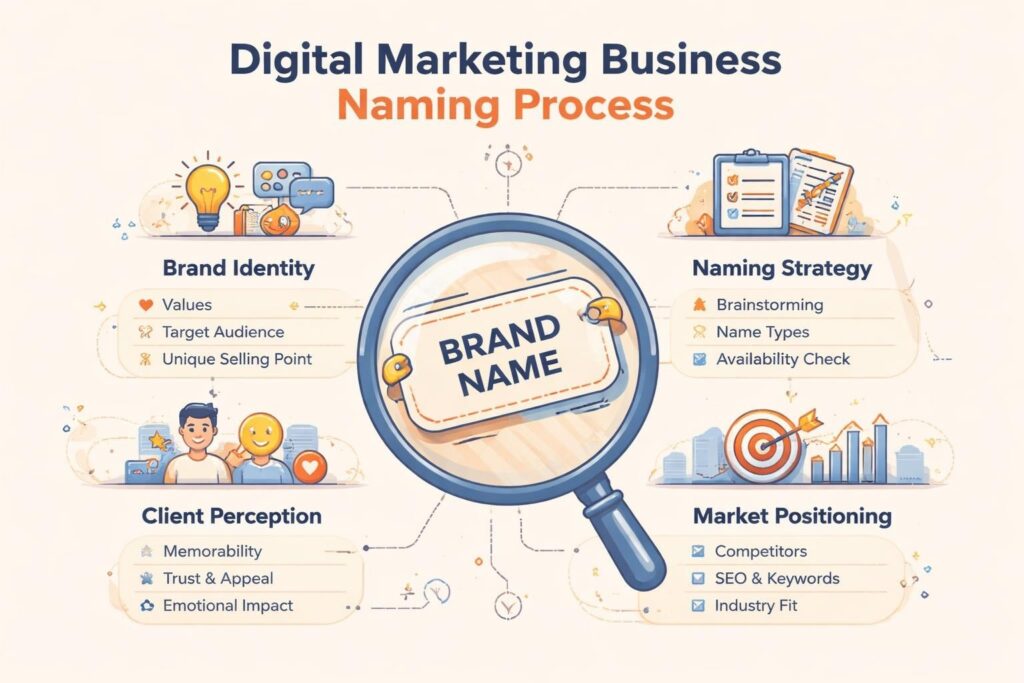
Your digital marketing business name is the first transaction with every future client. Before they see your portfolio, read your case studies, or hear your pricing, they form an impression based on what you’re called. That name either supports trust or creates friction. It positions you as premium or generic, specialized or scattered, intentional or thrown together. The gap between a strategic name and a rushed one compounds over years. The right digital marketing business name becomes an asset that clarifies your positioning, makes referrals easier, and supports every brand touchpoint that follows. Getting it right matters more than most founders realize.
What Makes a Strong Digital Marketing Business Name
A strong digital marketing business name doesn’t need to be clever. It needs to be clear, memorable, and strategically aligned with how you want clients to perceive your work.
The best names do three things well:
- They communicate what you do or who you serve without requiring explanation
- They’re easy to say, spell, and remember after one encounter
- They feel credible within your market tier and service category
Names that try to be everything to everyone usually end up meaning nothing to anyone. “Digital Solutions Pro” tells me you exist but gives me zero reason to remember you or understand what makes your approach different.
Clarity Beats Creativity
The digital marketing space is crowded with agencies named after abstract concepts, forced acronyms, and made-up words that sound tech-adjacent. Most of these names create confusion instead of clarity.
When someone asks what your company does, your name should make the answer obvious or at least easier. “Summit Digital Marketing” is more immediately useful than “Nexwave” or “Amplify Co.” You might sacrifice a bit of originality, but you gain speed to understanding.
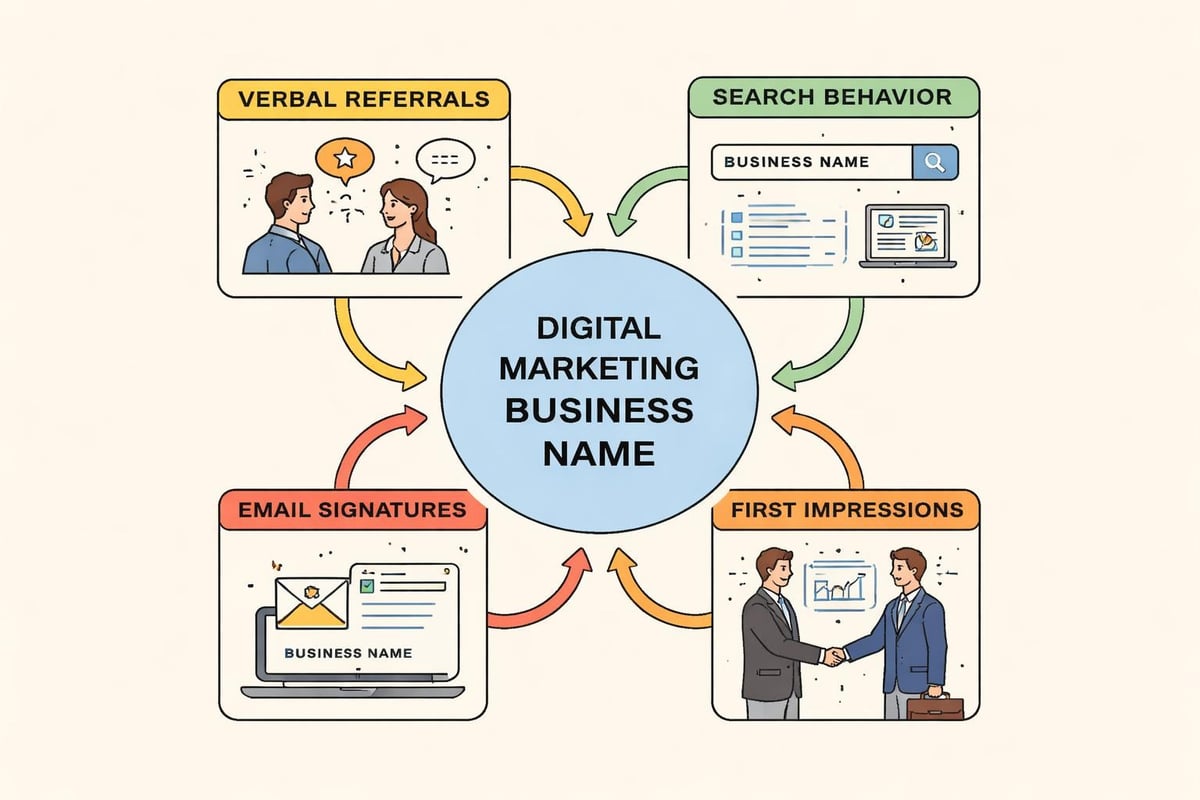
Consider how your name performs across these situations:
- Spoken in a loud coffee shop during a referral conversation
- Typed into Google by someone who heard about you secondhand
- Displayed in an email signature next to competitors
- Printed on a business card handed to a skeptical buyer
If your digital marketing business name requires spelling corrections or explanation in any of these contexts, it’s working against you.
Naming Strategies That Support Positioning
Your name should reinforce the market position you’re building, not contradict it. Different naming approaches signal different things about price, specialization, and client expectations.
| Naming Strategy | Best For | Perception Created | Example Context |
|---|---|---|---|
| Descriptive | Service-based agencies targeting specific industries | Clear, professional, straightforward | “Healthcare Marketing Partners” |
| Founder Name | Personal brands and consultancies | Trust-based, relationship-driven | “Chen Digital Strategy” |
| Invented Word | Venture-backed tech platforms | Innovative, scalable, modern | “Mailchimp”, “Hootsuite” |
| Metaphor/Concept | Creative agencies with distinct philosophy | Conceptual, memorable, interpretive | “Basecamp”, “Buffer” |
Each strategy has trade-offs. Descriptive names are immediately clear but harder to own uniquely. Founder names build personal equity but can limit exit options. Invented words are ownable but require more marketing investment to establish meaning.
The branding decisions you make around your name should align with whether you’re building a firm that can operate without you or a consultancy that trades on your personal reputation.
Geographic vs. Category Modifiers
Adding “Sydney” or “Melbourne” to your digital marketing business name can help if you serve local clients who value proximity. It can hurt if you want to work remotely with clients anywhere.
Category modifiers like “Agency”, “Studio”, “Partners”, or “Group” signal different scales and service models. “Agency” suggests a team and managed services. “Studio” skews creative. “Partners” implies senior-level relationships. “Group” can sound corporate or dated depending on context.
These modifiers aren’t decoration. They set expectations about how you operate, what clients will pay, and how formal your delivery model is.
Testing Your Name Against Business Reality
A digital marketing business name that sounds good in theory still needs to survive practical business use. Before you commit, run it through operational scenarios.
Domain and Social Handle Availability
Your name means nothing if the .com is parked by a domain squatter asking $15,000 or already owned by a bakery in Wisconsin. Check domain availability before you get attached. The .co or .io alternatives might work for tech startups, but for a marketing systems agency, a .com signals legitimacy.
Social handles matter less than they did five years ago, but you still want consistency. If your business name is available on LinkedIn and Instagram but Twitter is taken by an inactive account from 2011, decide whether that fragmentation is acceptable.
Use these tools to validate availability:
- Domain registrars (Namecheap, Google Domains) for URL options
- Ahrefs business name generator for availability checking and related ideas
- Social media directly to verify handle status across platforms
Trademark Conflicts
You don’t need a lawyer to do a basic trademark search. Visit your country’s intellectual property office website and search registered trademarks in your category. If someone already owns your exact name or something confusingly similar in marketing services, you’re building on unstable ground.
Filing your own trademark isn’t mandatory at launch, but knowing you have the option protects future equity. Some regions allow “common law” trademark rights just through consistent use, but registered trademarks give you stronger protection and recourse.
How Naming Affects Search and Discovery
Your digital marketing business name influences how people find you online, but not in the ways most founders assume.
Keyword-stuffed names don’t rank better. “Best Digital Marketing Agency Sydney Experts” won’t outrank competitors just because it’s crammed with search terms. Google understands brand entities. Your name is a signal, but it’s not a ranking factor by itself.
What your name does affect is what you’re known for. A name like “SaaS Growth Partners” tells Google (and humans) that you specialize. A name like “Elevate Digital” could be anything from web design to SEO to social media management.
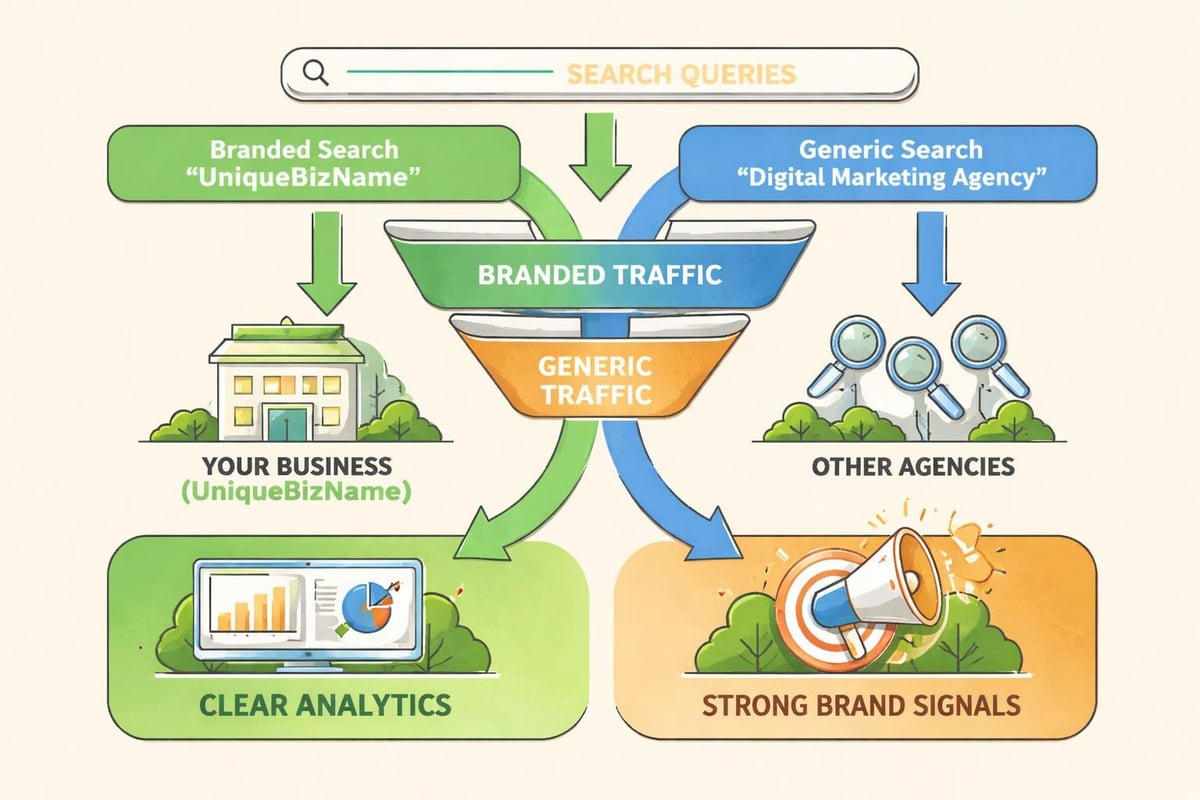
The Brand Search Factor
When your digital branding becomes recognizable, people search for you by name. That’s brand search, and it’s one of the strongest signals you can send to search engines about authority and demand.
A unique, ownable digital marketing business name makes brand search easier to track and less likely to be confused with generic terms. “Momentum Digital” competes with every article about momentum in digital transformation. “MDO Digital” owns its name outright.
Common Naming Mistakes Service Businesses Make
Most naming failures aren’t dramatic. They’re subtle misalignments that create friction over time.
Trying to Sound Bigger Than You Are
Solo consultants naming themselves “Global Digital Marketing Group” don’t sound impressive. They sound insecure or misleading. When you contact prospects and they realize you’re a one-person shop, the disconnect creates distrust.
Your name should match your actual delivery capacity. If you’re starting as a founder with a few contractors, own that. “Taylor Digital Consulting” is more honest and easier to grow from than pretending you’re an enterprise operation.
Ignoring How It Sounds Out Loud
You’ll say your business name hundreds of times: on sales calls, in Zoom intros, at networking events, in podcast interviews. If it’s awkward to pronounce or requires spelling out every time, that’s friction you’ll regret.
Read your shortlist of names out loud. Record yourself saying them. Ask someone unfamiliar with your business to repeat them back after hearing once. If they stumble or guess wrong, that’s real-world data.
Choosing Based on Available Domains Instead of Strategy
Just because “QuantumFlowDigital.io” is available doesn’t mean it’s a good name. Don’t let domain availability drive the decision. Let strategy drive it, then solve for domains.
If your ideal name’s .com is taken but not actively used, you might be able to acquire it. If it’s genuinely unavailable, slight variations often work: “GetMDO.com” or “TryMDO.com” instead of the exact match. The brand strength matters more than perfect domain symmetry.
Generators and Research Tools Worth Using
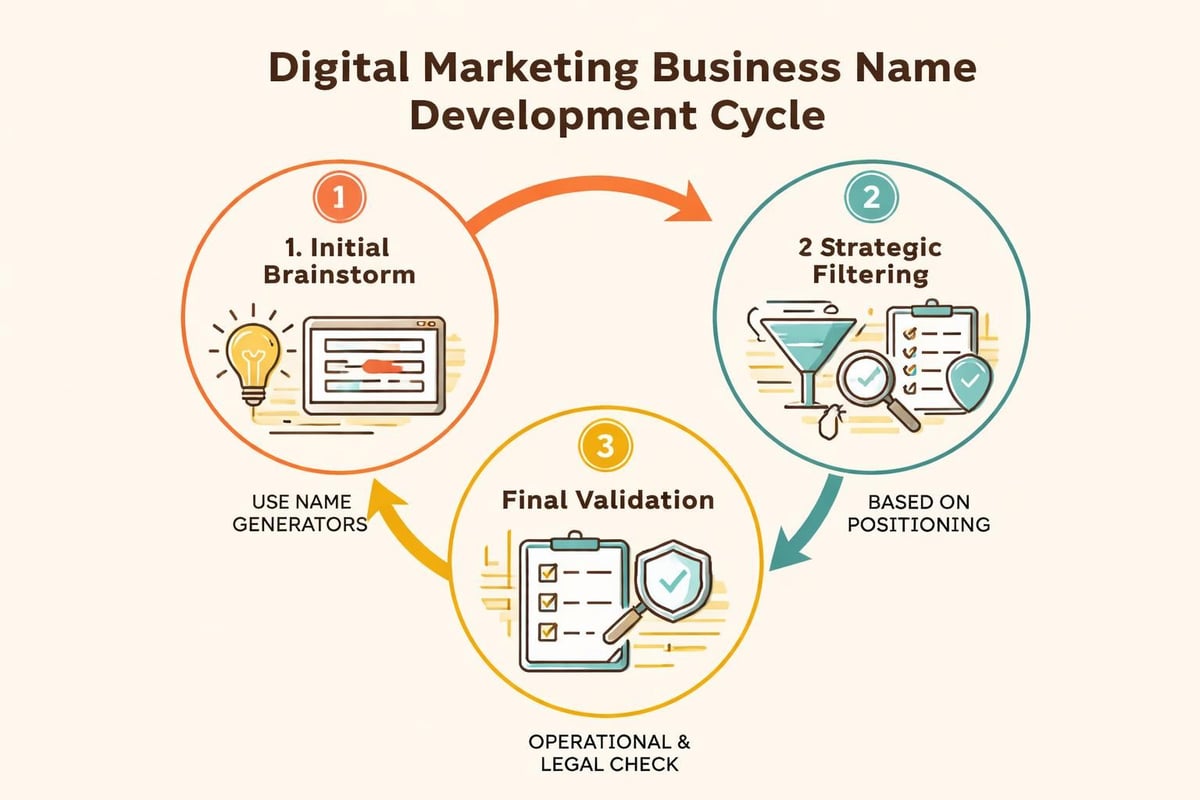
You don’t need to brainstorm in a vacuum. Name generators can surface combinations and patterns you wouldn’t have considered.
FounderJar’s digital marketing name generator and similar tools produce lists based on keywords and naming formulas. Most suggestions won’t be useful, but they help identify linguistic patterns and word pairings that resonate.
Better uses for generators:
- Exploring how certain prefixes or suffixes change perception
- Finding synonyms for overused words like “pro”, “solutions”, or “agency”
- Testing combinations of your service focus with different modifiers
Don’t pick a name straight from a generator. Use them as ideation fuel, then refine based on your specific positioning and market.
| Generator Tool | Primary Value | Best For |
|---|---|---|
| Ahrefs | Domain availability checking + AI suggestions | Validating practical viability |
| BrandCrowd | Visual identity preview alongside names | Seeing logo potential early |
| Shopify | Fast bulk generation for initial brainstorming | High-volume idea exploration |
Industry-Specific Considerations for Marketing Agencies
Digital marketing as a category spans everything from Facebook ad buyers to enterprise marketing automation consultancies. Your name should signal where you sit in that spectrum.
If you serve a specific niche, incorporating that into your name reduces ambiguity. “SaaS Marketing Lab” or “Legal Practice Digital” immediately tells prospects whether you’re relevant. Generic names force you to explain your focus every time.
If you offer a specific methodology or framework, consider whether your name can reference it. This works better for thought leaders and productized service models than for broad-service agencies. “StoryBrand Certified Guide” becomes part of the name structure. “Demand Generation Partners” signals a methodology focus.
How Service Scope Affects Naming
Full-service agencies can afford broader names because clients expect comprehensive offerings. Specialized firms benefit from names that narrow perceived scope.
If you only do paid advertising for e-commerce brands, “Commerce Ads Co.” is clearer than “Digital Growth Agency.” Clarity filters out bad-fit leads and attracts right-fit prospects who need exactly what you offer.
Building From Name to Visual Identity
Your digital marketing business name is the verbal half of your brand identity. The visual half (logo, colors, typography) should extend and reinforce what the name communicates.
A name like “Precision Digital” suggests clean, modern, technical design. A name like “Wildfire Marketing” suggests bold colors and energetic visuals. Fighting against those natural associations creates confusion.
When you move from name selection to design and branding work, the name sets guardrails for aesthetic decisions. That’s helpful. It narrows infinite options into a direction that feels coherent.
Your name influences:
- Typography choices (modern sans-serif vs. classic serif vs. custom)
- Color psychology alignment (trust blues vs. energy reds vs. growth greens)
- Logo style (wordmark vs. icon vs. combination)
These aren’t rigid rules, but working with your name instead of against it makes brand development faster and more consistent.
When to Rename an Existing Business
Not every digital marketing business name needs to be permanent. If your original name no longer reflects your positioning, serves your growth goals, or feels credible in the market you now occupy, changing it might be the right move.
Renaming makes sense when:
- Your service focus has shifted significantly from what the name implies
- You’re expanding beyond geographic limitations in the current name
- The name creates legal conflicts or trademark issues
- Market perception of the name actively hurts credibility
Renaming costs time, money, and some short-term brand equity. You’ll need to update websites, social profiles, contracts, banking details, and client communications. But carrying a misaligned name for years costs more in missed positioning and confused prospects.
If you’re considering a rebrand, the case studies approach helps demonstrate continuity. Show past work under the old name with clear transition messaging so credibility transfers to the new identity.
Your Name as a Long-Term Asset
A digital marketing business name isn’t just a label. It’s intellectual property, a searchable entity, and a container for reputation that accumulates value over time.
Every client success, published piece of content, speaking engagement, and partnership mention adds equity to your name. That compounds if the name is distinctive and consistently used. It fragments if you change names frequently or use different variations across platforms.
Protect the asset by:
- Registering the business name formally in your jurisdiction
- Securing relevant domains and redirecting variations to your primary site
- Using the exact same name format everywhere (not “MDO Digital” on LinkedIn and “MDO Digital Agency” on your website)
- Considering trademark registration once you have market traction
The goal isn’t perfection at launch. It’s choosing a digital marketing business name that can grow with you, support the market position you’re building, and become more valuable as you deliver consistent work under that identity.
Making the Final Decision
You’ve researched, tested availability, checked positioning alignment, and narrowed options. At some point, you need to choose.
Perfect names don’t exist. Every option has trade-offs. The name that feels exactly right today might feel less exciting in six months, and that’s fine. What matters is whether it clears the practical hurdles (legal, domain, pronunciation) and strategically supports how you want to be known.
Final validation checklist:
- Says it out loud confidently in a sales context
- Types easily without autocorrect fighting you
- Differentiates from direct competitors in your market
- Scales with your growth ambitions (not limiting or misleading)
- Feels aligned with your brand personality and client expectations
Once you choose, commit. Half the power of a digital marketing business name comes from consistent use over time. Launching, second-guessing, and changing course six months later wastes the equity you’ve started building.
Your name is the verbal foundation. Everything else, from your website design to your service positioning, builds on top of it. Choose strategically, then get back to the work that makes the name mean something.
Your digital marketing business name shapes perception, but execution builds reputation. The strongest names in the industry aren’t necessarily the cleverest ones. They’re the names attached to agencies that consistently deliver, solve real problems, and build systems that create compounding results for their clients. If you’re ready to build marketing infrastructure that matches the clarity of your brand positioning, MDO Digital helps service-based businesses scale with systems that remove chaos, protect leads, and create structured growth. Let’s build something that compounds.