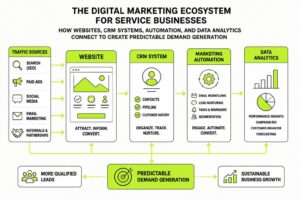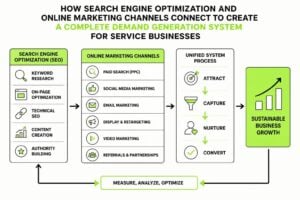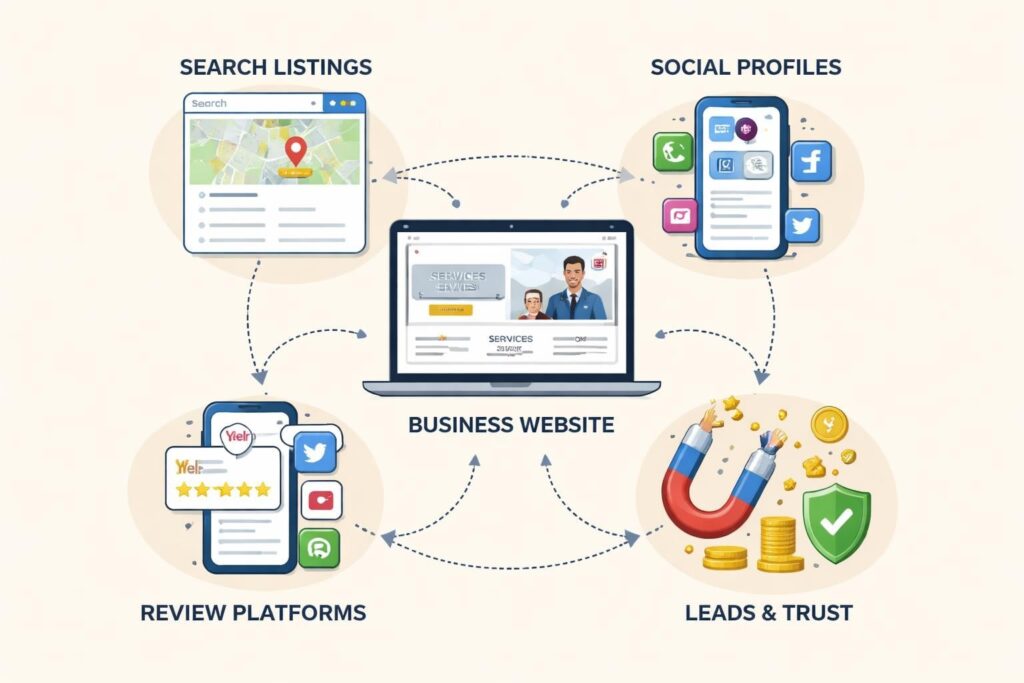
Your web presence isn't just your website. It's every digital touchpoint where someone might discover, evaluate, or decide to work with you. Think search results, social profiles, review sites, directories, email signatures, and anywhere your name appears online. When these pieces work together, they build trust and guide people toward buying. When they don't, you create friction, confusion, and lost opportunities. For service businesses trying to scale, a strong web presence is the foundation that makes everything else possible.
What Actually Counts as Web Presence
Most people think web presence means having a website and maybe a Facebook page. That's part of it, but it's not complete.
Your web presence includes every digital asset you own or influence:
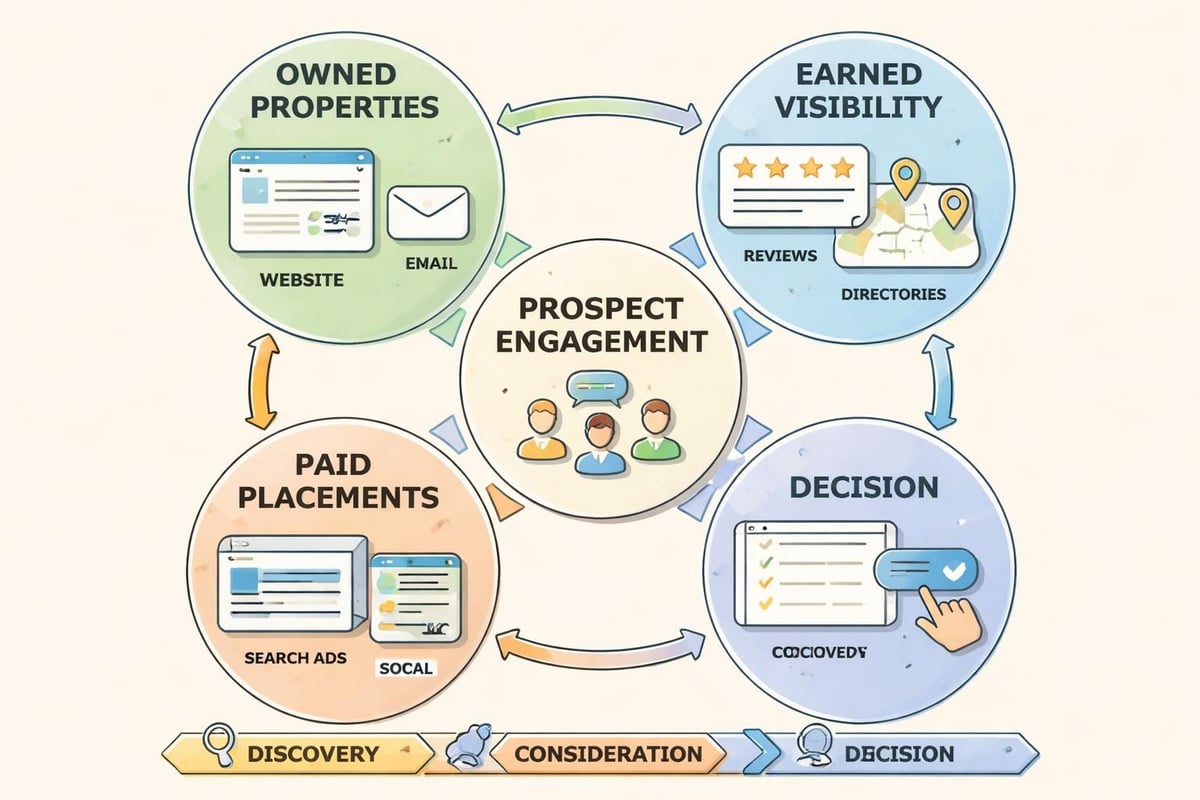
- Owned properties: Your website, blog, email list, branded social accounts
- Earned visibility: Google Business Profile, review sites, industry directories, mentions in articles or podcasts
- Paid placements: Search ads, social media advertising, sponsored content
- Community touchpoints: Forums, groups, comment sections, anywhere you engage
Each channel serves a different purpose. Your website converts. Reviews build credibility. Social platforms nurture relationships. Search listings capture intent. Understanding these elements helps you prioritize where to focus energy.
The Hub and Spoke Model
Think of your website as the hub. Everything else is a spoke that points back to it.
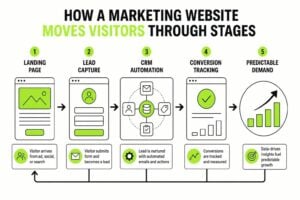
Someone finds you through search, reads a review, sees a social post, or gets a referral. Each channel has a specific job in moving people toward a decision. Your website is where they evaluate whether you're the right fit. It's where trust converts to action.
That means your web presence needs consistency. Same messaging, same visual identity, same tone. When someone moves from Google to your website to LinkedIn, they should feel like they're dealing with the same business. Gaps create doubt.
Why Web Presence Drives Business Growth
A scattered web presence costs you money. Not in obvious ways, but through missed opportunities and invisible friction.
Here's what happens when your web presence is weak:
- People can't find you: If you're not showing up in search results, directories, or social feeds, you don't exist to potential customers
- They find outdated information: Old addresses, disconnected phone numbers, conflicting service descriptions, broken links
- Competitors look more credible: They have reviews, case studies, clear positioning, while your digital footprint looks incomplete
- You waste ad spend: Paid traffic hits a weak website or incomplete profile and bounces
- Referrals don't convert: Someone recommends you, the prospect Googles your name, and finds nothing compelling
According to recent research, over 90% of consumers check online before making a purchase decision. Your web presence is the first impression, the due diligence check, and often the tiebreaker between you and a competitor.
Trust Compounds Over Time
A solid web presence doesn't just attract customers. It builds compounding trust.
When someone sees your Google Business Profile with 47 five-star reviews, then visits your website and finds clear case studies, then checks LinkedIn and sees you posting useful insights, they're not just convinced. They're pre-sold. The sale becomes a formality.
This is especially critical for service-based businesses where trust precedes transaction. You're not selling a product someone can return. You're selling expertise, reliability, and results. Your web presence is the proof.
Building a Web Presence That Works
You don't need to be everywhere. You need to be strategic about where you show up and consistent about how you show up there.
Start With Your Foundation
Before you worry about social media or ads, get these core elements right:
| Element | Purpose | Priority |
|---|---|---|
| Website | Convert visitors into leads | Critical |
| Google Business Profile | Capture local and service-based search | Critical |
| Email infrastructure | Nurture leads, retain customers | High |
| Key directory listings | Support search visibility and citations | Medium |
| LinkedIn presence | Professional credibility and networking | Medium |
Your website should load fast, communicate clearly, and make it obvious what you do and who you help. Web design statistics show that 94% of first impressions are design-related, and 38% of people will stop engaging if the layout is unattractive. This isn't about looking fancy. It's about looking competent and trustworthy.
Set up your Google Business Profile completely. Photos, hours, services, categories, regular posts. Incomplete profiles rank worse and convert poorly. Same with email infrastructure. If your emails land in spam or your domain isn't authenticated, you're invisible.
Map Your Customer Journey
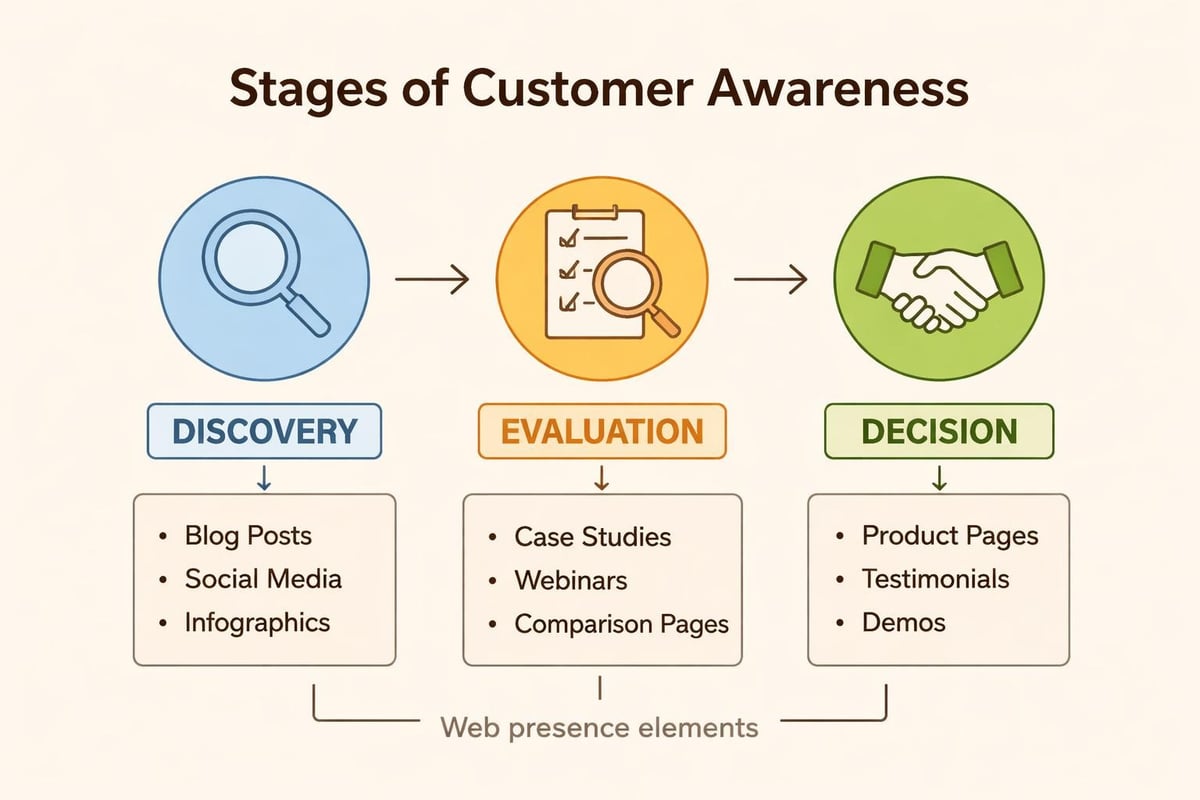
Different channels serve different stages of awareness and intent.
Awareness stage: Blog content, social media, organic search, podcast appearances. People don't know they need you yet. Your web presence here educates and builds familiarity.
Consideration stage: Case studies, reviews, comparison content, detailed service pages. They're evaluating options. Your web presence proves you can deliver.
Decision stage: Pricing transparency, testimonials, guarantees, clear calls to action. They're ready to buy. Your web presence removes final objections and makes buying easy.
Most businesses pile everything into one stage. They run ads to cold traffic pointing at a "Book Now" page. Or they write blog content that never asks for the sale. Your web presence should guide people through this journey deliberately.
Maintain Consistency Across Platforms
Consistency isn't about being identical everywhere. It's about being recognizable.
Your name, address, and phone number (NAP) should match exactly across every listing. Google, Yelp, industry directories, your website footer. Inconsistencies confuse search engines and hurt local rankings.
Your messaging should feel coherent. The value proposition on your homepage should align with your LinkedIn headline and your Google Business description. People bounce between platforms. If your story changes, they notice.
Visual identity matters too. Same logo, similar color schemes, consistent imagery style. This doesn't require expensive brand guidelines. It just requires intention. When someone moves from Instagram to your website, they should recognize you immediately.
The Technical Side of Web Presence
A strong web presence requires technical infrastructure most business owners ignore until something breaks.
Website Performance and Security
Speed matters. A one-second delay in load time can reduce conversions by 7%. Your web presence includes how fast your site loads, whether it works on mobile, and if it's secure.
Basic technical requirements:
- SSL certificate: The padlock in the browser. Non-negotiable for trust and search rankings
- Mobile responsiveness: Over 60% of searches happen on mobile. Your site needs to work perfectly there
- Page speed: Compress images, minimize code, use proper hosting. Aim for under three seconds
- **Security protocols**: Regular updates, backups, malware scanning
These aren't optional extras. They're foundational to a professional web presence. Visitors judge quickly. Slow, broken, or insecure sites destroy credibility faster than you can rebuild it.
Search Visibility and Structured Data
Your web presence relies heavily on being found through search. That means technical SEO and structured data.
Search engines read your content differently than humans. They look for clear signals about what you do, where you serve, and why you're relevant. Structured data (schema markup) helps them understand and display your information correctly.
For marketing and business development firms, this includes organization schema, local business schema, service schema, and review schema. When implemented correctly, you get rich results in search. Star ratings, business hours, pricing ranges, FAQs. These make you more visible and clickable.
Managing and Protecting Your Web Presence
Building a web presence is one thing. Maintaining and protecting it is another.
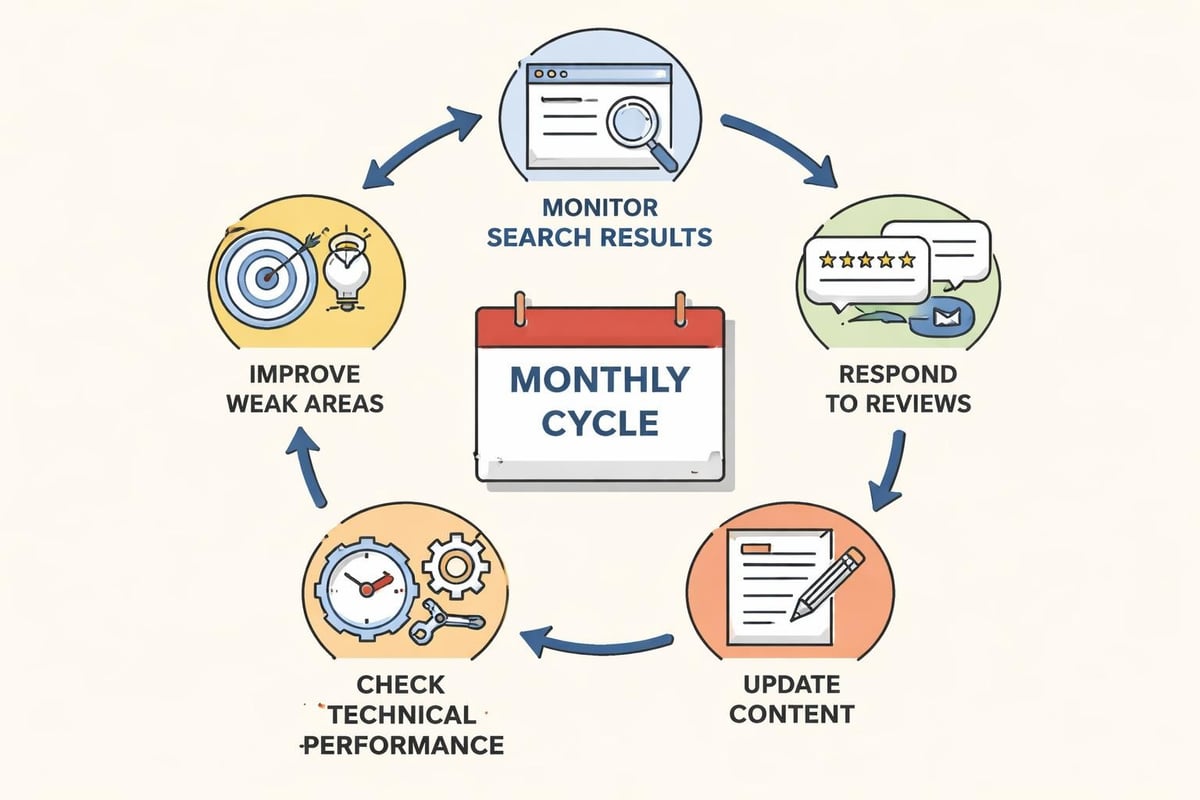
Monitor What People See
You can't fix what you don't know is broken. Set up monitoring for:
- Search results: Google yourself monthly. See what appears on page one. Are competitors outranking you? Are there negative results?
- Review platforms: Set up alerts for new reviews on Google, Yelp, Facebook, industry-specific sites
- Social mentions: Use tools or manual searches to track when people mention your brand
- Broken links: Check your website quarterly for 404 errors, outdated content, broken forms
This isn't paranoia. It's maintenance. Your web presence degrades over time without active management. Links break, competitors create content, reviews accumulate, platforms change algorithms.
Respond to Everything
Your web presence includes how you handle feedback, questions, and criticism.
Every review deserves a response. Positive ones to say thank you and reinforce what you did well. Negative ones to show professionalism and willingness to resolve issues. Potential customers read both the reviews and your responses. They're evaluating how you handle problems.
Same with social comments, blog comments, forum discussions. Silence looks like absence. Engagement builds presence. You don't need to respond instantly, but you should respond consistently.
Update Regularly
Static web presences die slowly. Search engines favor fresh content. Customers want current information.
Minimum update schedule:
- Website: New blog post or case study monthly, service pages reviewed quarterly
- Google Business Profile: Post weekly, respond to reviews within 48 hours, update photos monthly
- Social platforms: Engage 3-5 times weekly if active, otherwise park the account professionally
- Directory listings: Audit twice yearly, update immediately when details change
This creates momentum. A web presence that evolves signals an active, growing business. One that stagnates signals decline, even if you're thriving behind the scenes.
Amplifying Your Web Presence Through Integration
The real power comes when your web presence channels amplify each other.
Content Syndication Strategy
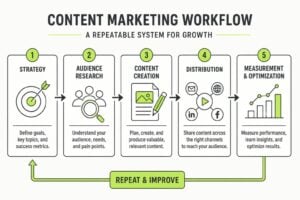
Create once, distribute strategically. Write a detailed blog post on your website. Pull key insights for LinkedIn articles. Extract quotes for social posts. Turn it into an email newsletter segment. Repurpose it as a video script or podcast talking points.
Each platform has different audiences and algorithms. Content marketing and branding work best when you maximize reach without duplicating effort. Your web presence grows through smart repurposing, not endless creation.
Link Building and Citation Networks
Every mention of your business online contributes to web presence strength. Some are more valuable than others.
High-value links and citations:
- Industry directories: Relevant, well-maintained directories that potential clients actually use
- Guest articles: Published content on reputable sites in your niche, with author bio linking back
- Partner mentions: Clients, vendors, collaborators linking to you from their sites
- Media coverage: Press releases, interviews, features in industry publications
- Local citations: Chamber of commerce, local business associations, community sites
Quality beats quantity. One link from a respected industry publication does more for your web presence than 100 directory spam links. Focus on relevance and authority.
Making It All Work Together
A fragmented web presence confuses customers and wastes resources. Integration creates efficiency.
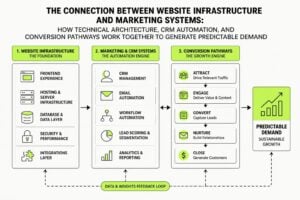
Think about how someone discovers you through organic search, clicks through to your website, downloads a resource, receives automated emails, sees retargeting ads, follows you on LinkedIn, reads case studies, and eventually books a call. That's your web presence working as a system.
Marketing systems connect these touchpoints. CRM tracks the journey. Automation nurtures leads across channels. Analytics shows which parts of your web presence actually drive results. Without this infrastructure, you're guessing.
The goal isn't to be everywhere. It's to be present where it matters and absent where it doesn't. Service businesses don't need TikTok if their buyers are on LinkedIn. They don't need a podcast if blog content converts better. Your web presence should reflect how your customers actually buy, not every possible channel.
Measuring What Matters
Track metrics that connect to revenue:
| Metric | What It Tells You | How to Improve It |
|---|---|---|
| Organic search traffic | Are you visible to people searching? | SEO, content, technical optimization |
| Direct traffic | Are people remembering and returning? | Brand consistency, remarketing |
| Conversion rate | Does your web presence convince? | Clear messaging, trust signals, CTAs |
| Cost per lead | Is paid presence efficient? | Targeting, ad quality, landing pages |
| Customer lifetime value | Do the right people find you? | Positioning, qualification, nurture |
Vanity metrics like social followers or page views don't matter if they don't connect to business outcomes. Your web presence exists to generate and convert demand. Measure accordingly.
Your web presence is the infrastructure that turns attention into opportunity. It's not about being everywhere or looking perfect. It's about showing up consistently where your customers make decisions and giving them enough confidence to choose you. If you're ready to build a web presence that actually drives growth, MDO Digital can help. We design high-trust websites, connect your digital touchpoints through proper systems, and make sure every piece of your presence works toward predictable demand.