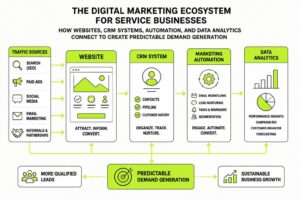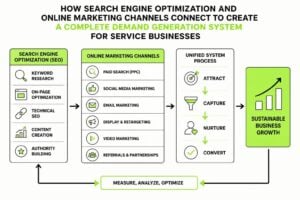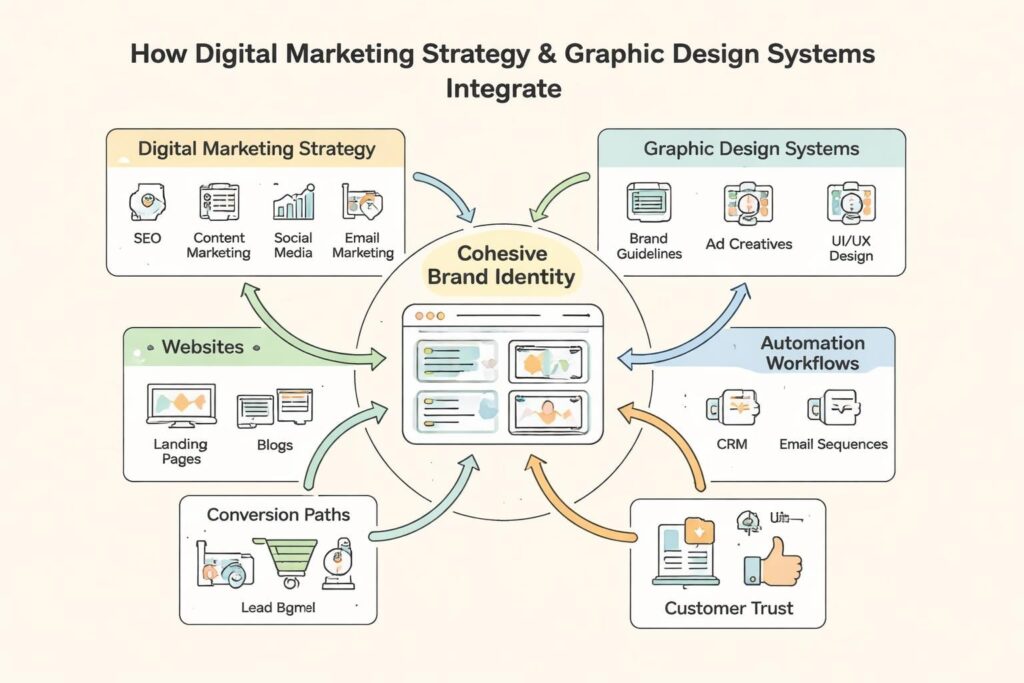
Most service businesses treat digital marketing and graphic design as separate departments. Marketing runs campaigns. Design makes things look good. But this split creates friction, inconsistency, and wasted budget. When digital marketing and graphic design operate as a single system, they compound. Every visual decision supports conversion. Every marketing asset reinforces brand trust. The result is predictable demand instead of chaotic hope.
Why Digital Marketing and Graphic Design Must Work as One System
Marketing without design is noise. Design without marketing is decoration.
Service businesses that scale with clarity understand this. They don't hire a designer to "make the website pretty" after the marketing strategy is set. They build both together from the start.
Here's what happens when you separate them:
- Ad creative doesn't match landing page design, breaking trust immediately
- Email campaigns use different fonts and colors than your website
- Sales collateral looks like it came from three different companies
- Website conversions suffer because no one considered user flow during design
- Marketing data can't inform design decisions because systems don't talk
Digital marketing and graphic design need shared language, shared goals, and shared infrastructure. Understanding graphic design fundamentals helps marketers make better strategic decisions, not just prettier assets.
The Trust Transfer Problem
Every touchpoint in your customer journey either builds trust or bleeds it.
When someone clicks your ad, visits your landing page, downloads your lead magnet, receives your welcome email, and books a call, they're evaluating one thing: does this business have its act together?
Visual inconsistency signals chaos. Different logo treatments. Mismatched color palettes. Fonts that change from platform to platform. These aren't just aesthetic problems. They're conversion killers.
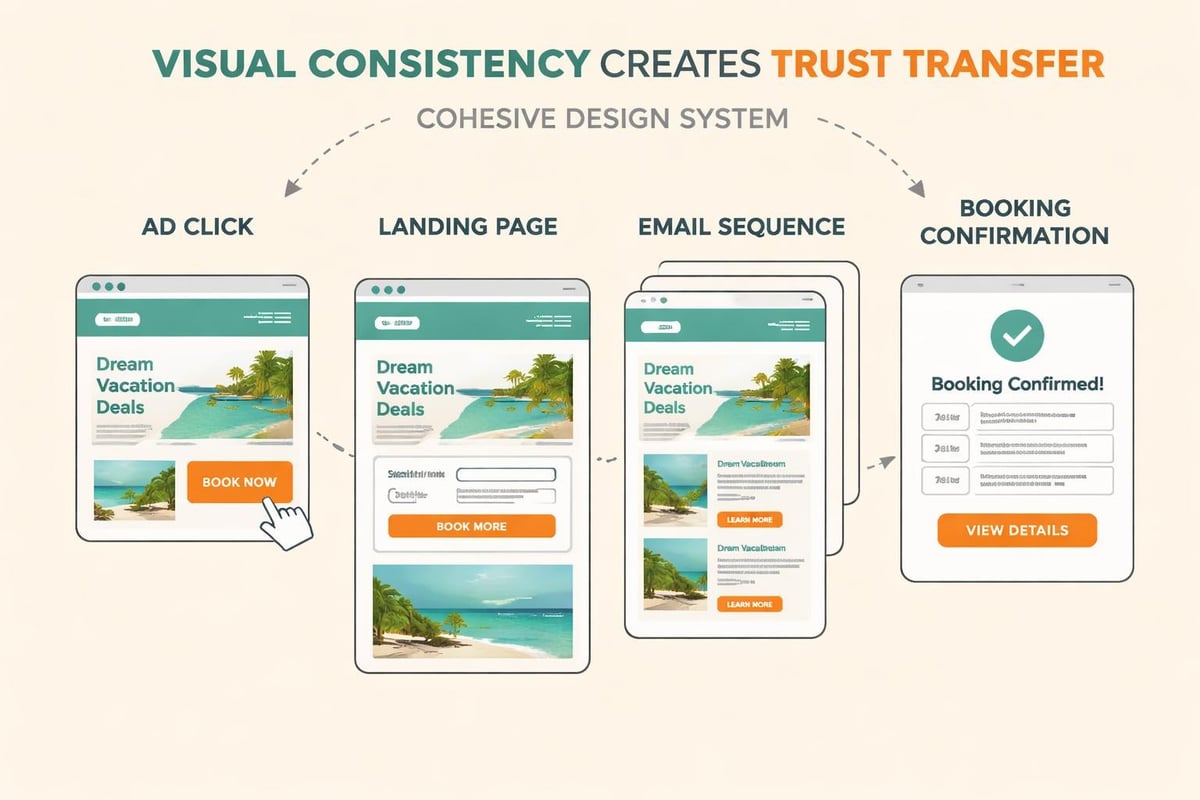
Strong digital branding solutions treat every visual element as part of the marketing system. The same brand rules that govern your website should control your ads, your CRM templates, your proposal documents, and your client portal.
Building Design Systems That Support Marketing Infrastructure
A design system isn't a brand guide PDF that lives in a folder nobody opens. It's living infrastructure that makes execution faster and results more predictable.
Core Components of a Marketing Design System
Your design system should include these elements, structured for actual use:
| Component | Purpose | Where It Lives |
|---|---|---|
| Color palette (primary, secondary, semantic) | Visual consistency across all channels | Design tools, CRM, website CMS |
| Typography scale and hierarchy | Readable, scannable content that guides action | Website, email templates, documents |
| UI component library | Reusable buttons, forms, cards that convert | Website builder, landing page tool |
| Icon and illustration style | Brand personality without slowing production | Asset library, design files |
| Grid and spacing system | Professional layouts that work on all devices | CSS framework, email builder |
| Image treatment and filters | Cohesive visual storytelling | Photo editing presets, brand guidelines |
This infrastructure supports marketing and web development by removing decision fatigue. Your team doesn't debate button colors on every campaign. They execute within established parameters that already convert.
Design Decisions That Impact Marketing Performance
Not all design choices are equal. Some directly affect your bottom line.
Hierarchy and visual flow determine whether prospects understand your offer in three seconds or bounce. F-pattern and Z-pattern layouts aren't just design theory. They're conversion architecture.
White space and density control perceived value. Service businesses often cram too much into headers and hero sections, signaling desperation. Strategic space signals confidence and premium positioning.
Color psychology and contrast drive action. Your CTA button color matters less than contrast ratio and placement within the visual hierarchy. The role of graphic design in digital marketing extends beyond aesthetics into behavioral psychology.
Mobile-first responsive design isn't optional anymore. Over 60% of B2B research now happens on mobile. If your forms, CTAs, and content don't work perfectly on a phone, you're losing qualified leads.
Practical Integration Points Where Design and Marketing Compound
Let's get specific about where digital marketing and graphic design intersect in ways that actually move revenue.
Website Design as Marketing Infrastructure
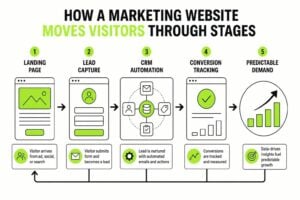
Your website isn't a digital brochure. It's a lead generation and qualification system.
Every page should serve a specific marketing function:
- Homepage: Filter and route traffic to the right next step
- Service pages: Educate, build authority, overcome objections
- Case studies: Provide social proof at the consideration stage
- Resources/blog: Capture early-stage awareness traffic
- Contact/booking: Remove friction from conversion
Design decisions at each stage should reduce cognitive load and guide prospects toward action. This means clear headlines, scannable copy blocks, strategic use of visual breaks, and CTAs that stand out without screaming.
When you're focused on website development and marketing, treat design and conversion optimization as the same discipline. You can't optimize what you can't measure, and you can't measure effectively if design choices aren't intentional.
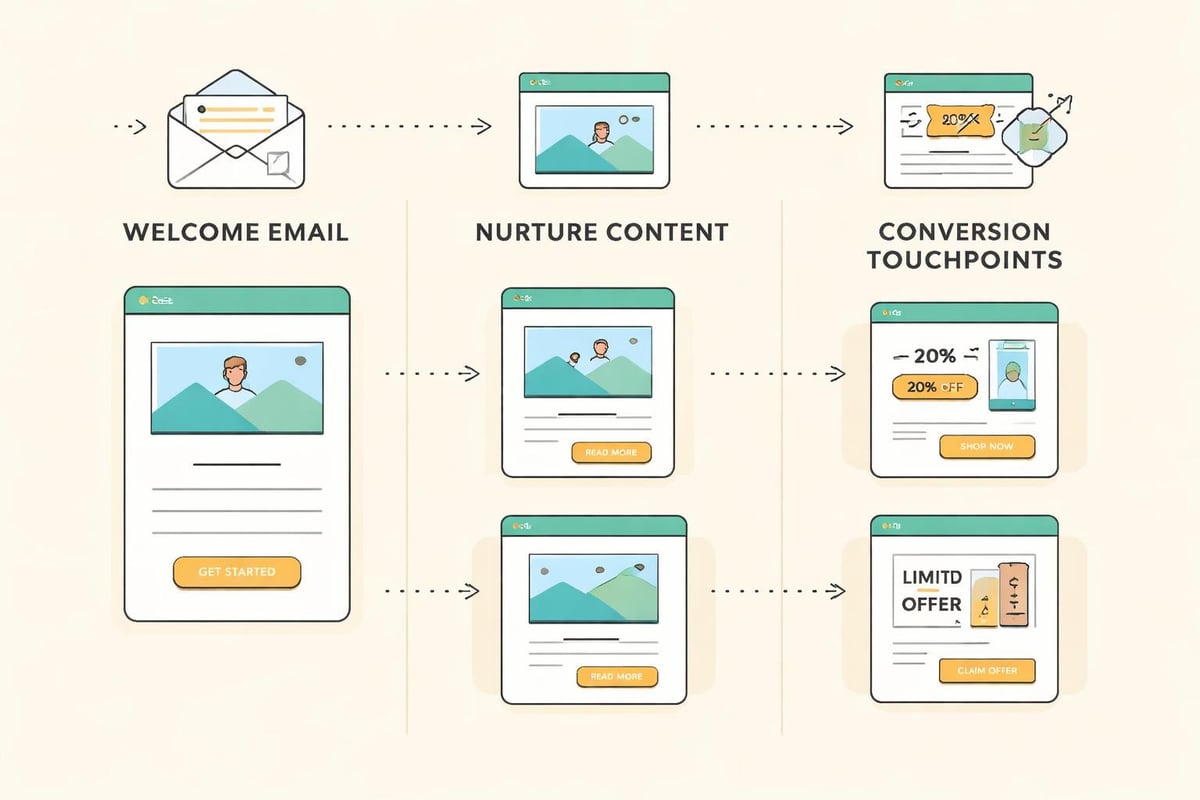
Email Marketing and Visual Consistency
Email is where design consistency often falls apart. Marketing sends one-off campaigns with whatever template looks good that day. Different fonts. Different button styles. Different brand voice.
This trains your list not to trust you.
Your email design system should include:
- Branded header and footer templates
- Consistent typography that matches your website
- Standard button styles and placement
- Image treatment that reinforces brand personality
- Mobile-optimized layouts that don't break
When someone moves from your website to your email sequence to your booking calendar, the experience should feel like a single, coherent system. That's how you maintain trust transfer through the entire journey.
Paid Advertising Creative That Converts
Most ad creative focuses on grabbing attention. That's half the job. The other half is setting accurate expectations for what happens after the click.
Your ad design should visually preview your landing page. Same color palette. Similar layout structure. Matching brand personality. This continuity reduces bounce rate and increases conversion because there's no jarring disconnect.
Elements that matter in ad creative:
- Clear value proposition in the visual, not just the copy
- Brand recognition without requiring people to read fine print
- Scannability because people scroll past ads in under a second
- Mobile optimization because that's where most impressions happen
- Consistent visual language that connects to your website and landing pages
When you run data-driven marketing campaigns, your creative becomes testable infrastructure. You're not just making things look good. You're building a visual system you can iterate and improve based on real performance data.
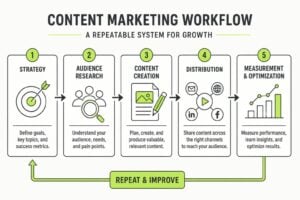
Content Marketing Where Design Carries the Message
Content marketing without strong design is like building a house without walls. The structure might be sound, but nobody wants to live there.
Visual Hierarchy in Long-Form Content
Blog posts, guides, and resources need design systems that make information digestible.
Here's what works:
- Descriptive subheadings that break content into scannable chunks
- Bulleted and numbered lists that organize complex information
- Pull quotes and callouts that emphasize key takeaways
- Strategic use of bold text to guide speed readers
- Data visualization through simple charts and comparison tables
- Consistent formatting that reduces cognitive load
The goal is to make your content work for multiple reading styles. Some people scan. Some people read deeply. Some people bounce between both. Your design system should support all three.
Infographics and Visual Storytelling
When done well, infographics can compress complex service offerings into shareable, understandable visuals. When done poorly, they're clip-art chaos that damages brand credibility.
Good infographic design for service businesses:
- Tells one clear story, not twelve different points
- Uses your brand colors and fonts consistently
- Balances information density with white space
- Includes clear source attribution and your logo
- Works at multiple sizes (social, email, website)
The best infographics support your broader content strategy. They're not standalone pieces. They summarize blog content, support case studies, or visualize your methodology in a way that builds authority.
Measurement and Iteration for Integrated Systems
Digital marketing and graphic design both improve through testing and iteration. But you can't optimize what you don't measure.
Design Metrics That Connect to Marketing Outcomes
Track these instead of vanity metrics:
| Design Element | Marketing Metric | What It Tells You |
|---|---|---|
| Above-fold layout | Bounce rate, time on page | Whether your value prop is clear |
| CTA button design | Click-through rate | If your design guides action effectively |
| Form field design | Form completion rate | Whether you're creating unnecessary friction |
| Page load speed | Conversion rate, SEO ranking | If your design is technically sound |
| Mobile responsiveness | Mobile conversion rate | Whether you're losing mobile traffic |
| Visual hierarchy | Scroll depth, engagement | If people understand your content structure |
These metrics create a feedback loop between design decisions and business outcomes. You're not designing based on taste. You're building a system that improves based on evidence.
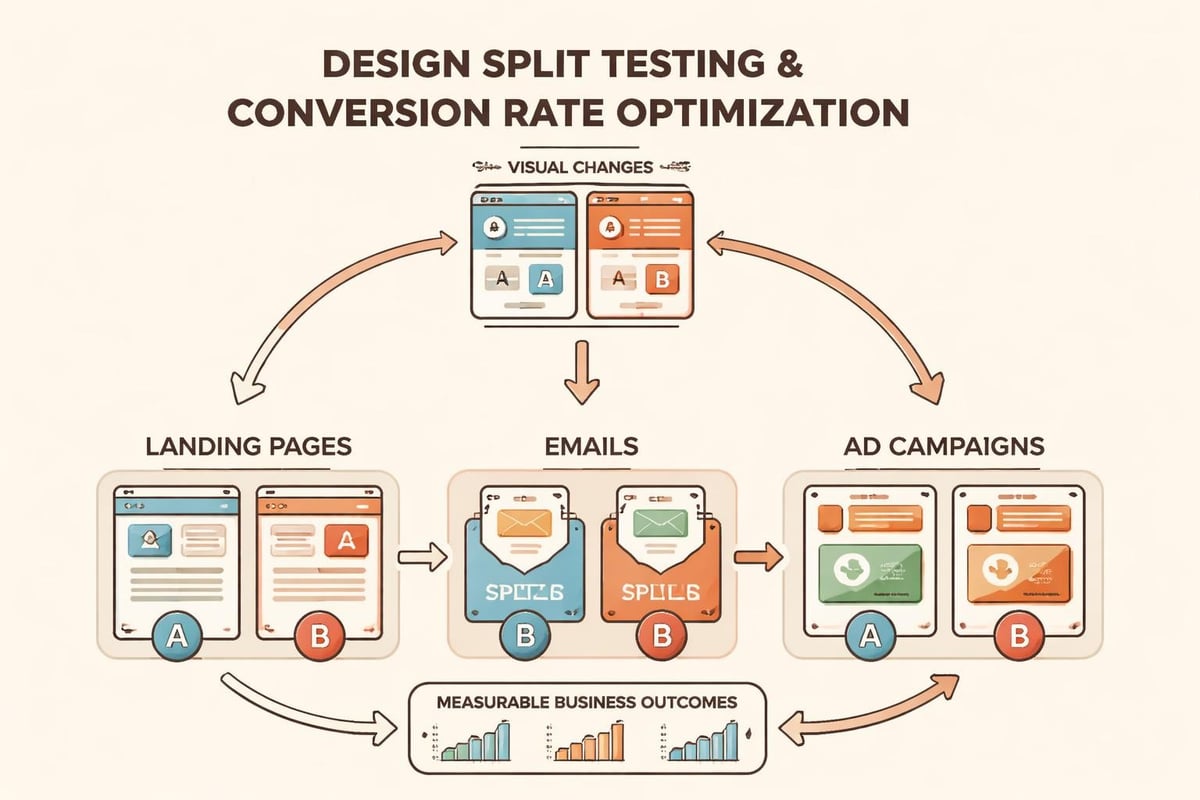
A/B Testing Design Elements
Not every design decision needs testing, but the ones that impact conversion do.
Test these systematically:
- Headline placement and size on landing pages
- CTA button color, size, and copy across key conversion points
- Form length and field labels on lead capture pages
- Image vs. video in hero sections and product explanations
- Layout density to find the sweet spot between information and overwhelm
The key is testing one variable at a time and giving tests enough traffic to reach statistical significance. Design changes based on gut feeling waste budget. Design changes based on data compound over time.
Common Mistakes That Break the Marketing-Design Connection
Even businesses that understand the importance of integrated systems make predictable mistakes.
Treating Design as an Afterthought
The worst approach: finalize your marketing strategy, write all your copy, build your funnel architecture, then hire a designer to "make it look good."
This creates design that decorates rather than drives results. Visual decisions should inform strategy from the beginning. Layout affects messaging. Hierarchy determines what people notice. Design isn't makeup. It's infrastructure.
Using Too Many Visual Styles
Brand consistency doesn't mean boring. It means intentional variation within a coherent system.
Service businesses often break this by:
- Letting different team members create assets without guidelines
- Using whatever stock photos look good that day
- Changing design direction with every campaign
- Following design trends instead of building brand equity
Visual consistency and branding rules create compound recognition over time. People should be able to identify your content before reading your name.
Ignoring Technical Performance
Beautiful design that loads slowly or breaks on mobile kills conversion.
Technical design requirements for marketing performance:
- Image optimization: Compress without visible quality loss
- Responsive breakpoints: Test on actual devices, not just browser resize
- Accessibility standards: Color contrast, alt text, keyboard navigation
- Cross-browser compatibility: Safari renders differently than Chrome
- Email client testing: Outlook handles CSS differently than Gmail
These aren't design details. They're marketing fundamentals that protect your conversion rates and support structured growth.
Building Internal Capacity vs. Working with Specialists
Most service businesses face a choice: build design and marketing capacity in-house or work with specialists who integrate both.
When In-House Makes Sense
If you have:
- Consistent daily design needs across multiple campaigns
- Budget for full-time specialists in both disciplines
- Systems to maintain brand consistency without constant oversight
- Leadership that understands how to manage creative and marketing together
Then building internal capacity can work. But it requires investment in people, tools, and processes that many service businesses underestimate.
When Specialist Partners Create Better Outcomes
Service businesses focused on their core expertise often get better results by partnering with agencies that specialize in integrated marketing systems.
This works when you need:
- Strategic design and marketing that compounds over time
- CRM and automation infrastructure that requires both technical and visual expertise
- Brand clarity that informs all downstream execution
- Systems that work together instead of siloed projects
The right partner doesn't just execute tasks. They build infrastructure that makes your internal team more effective and your marketing more predictable.
What Integrated Digital Marketing and Graphic Design Actually Looks Like
Theory is useful. Examples are better.
A service business scaling with integrated systems might have:
Website: Clean, conversion-focused design built on a component system. Every page serves a specific marketing function. Forms, CTAs, and content hierarchy guide prospects toward action. Mobile experience is optimized for quick decisions. Page speed is under 2 seconds. Analytics track behavior at a granular level.
Email automation: Branded templates that match website design. Consistent typography, spacing, and visual treatment. Personalization that feels natural, not robotic. Clear CTAs that lead to the next logical step. Mobile-optimized layouts that work in every major email client.
Paid campaigns: Ad creative that visually previews landing page experience. Consistent brand presence across platforms. Testing framework that improves creative based on performance data. Retargeting that adapts creative to prospect stage.
Content marketing: Blog posts with strong visual hierarchy and scannable formatting. Graphics and charts that clarify complex concepts. Consistent design language that builds brand recognition. Lead magnets that match website quality and brand standards.
Sales collateral: Proposals, one-pagers, and presentations that look like they came from the same company as your website. Professional, on-brand, conversion-focused. Easy to customize without breaking design integrity.
All of this works together. Someone who clicks an ad, lands on your website, downloads a resource, receives emails, and books a call experiences one coherent brand. That consistency builds trust. Trust drives conversion.
Digital marketing and graphic design aren't separate functions. They're two parts of the same system, one that either works together to build trust and drive results, or works against itself creating friction and wasted opportunity. Service businesses that treat them as integrated infrastructure see predictable growth because every touchpoint reinforces the same message with consistent professionalism. If you're ready to remove the chaos and build marketing systems that actually compound, MDO Digital can help you design the infrastructure, build the automation, and create the brand clarity that turns attention into predictable demand.