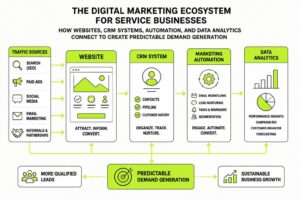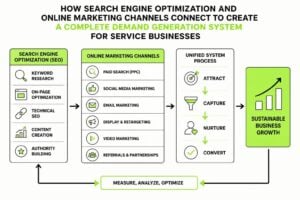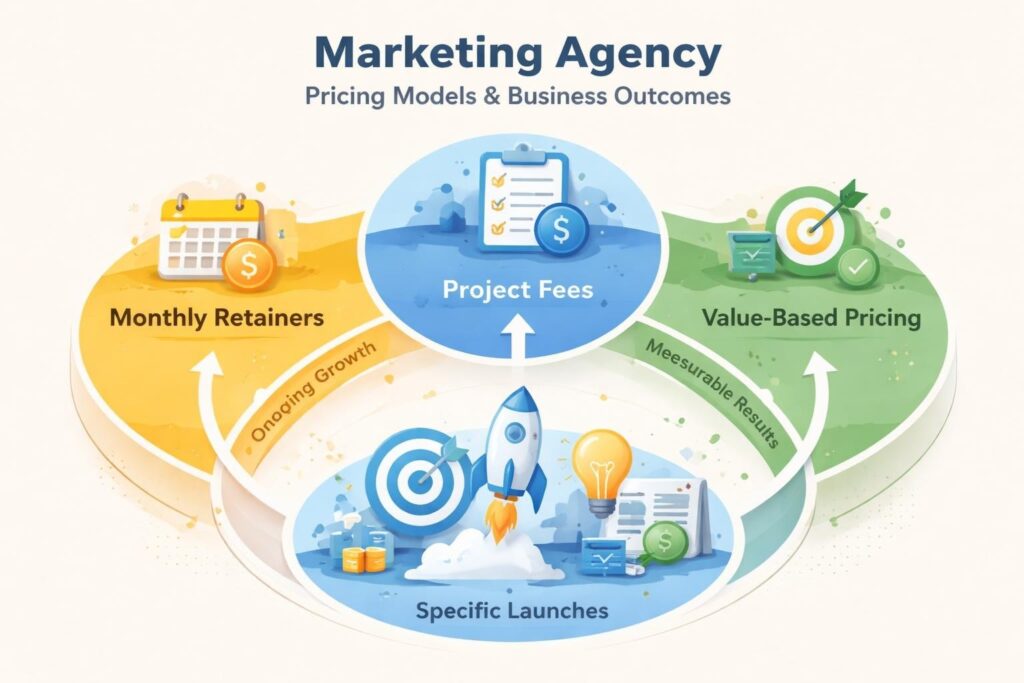
Most service business owners hit the same wall when evaluating marketing partners. They collect a few proposals, see wildly different numbers, and wonder what they’re actually paying for. One agency quotes $2,500 a month. Another wants $15,000. A third proposes equity. The lack of standardisation isn’t a bug in the industry, it’s the reality of buying a service that combines strategy, execution, infrastructure, and ongoing optimisation. Understanding marketing agency pricing isn’t about finding the cheapest option. It’s about knowing what you’re funding and why certain models make more sense for businesses that need structured, predictable growth.
What Actually Drives Marketing Agency Pricing
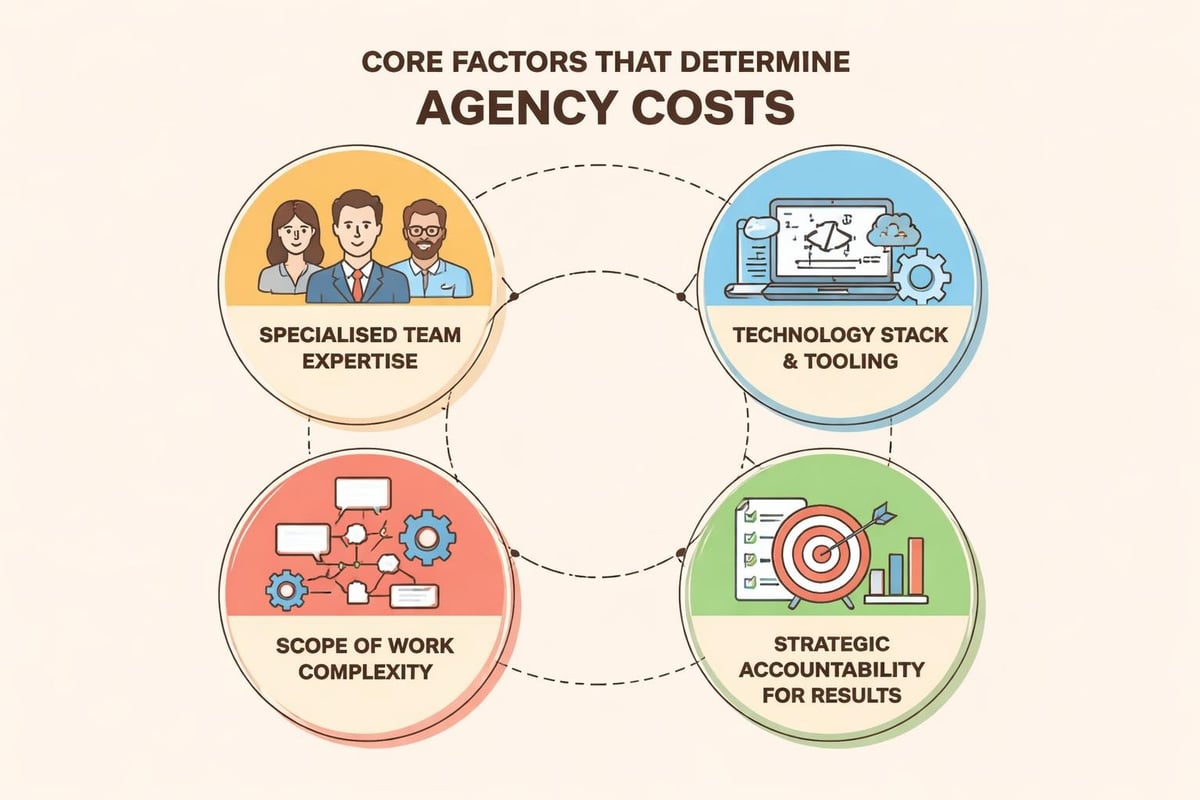
The inputs that determine what an agency charges aren’t arbitrary. They’re tied to expertise, overhead, delivery infrastructure, and the level of strategic accountability they’re willing to own.
Talent costs sit at the foundation. A junior contractor writing blog posts for $50 an hour delivers very different output than a senior strategist who’s built CRM systems for dozens of clients. Agencies with specialised teams (designers, developers, paid media buyers, automation engineers) carry higher payroll costs, which get reflected in retainers.
Tooling and infrastructure add up fast. Marketing automation platforms, analytics suites, design software, project management tools, and reporting dashboards each carry monthly fees. Agencies either absorb these costs or pass them through to clients. When evaluating proposals, ask what tools are included and who owns the accounts.
Scope and complexity matter more than hours logged. Building a five-page website costs less than designing a high-trust lead generation system with CRM integration, automated nurture sequences, and conversion tracking. Marketing agency pricing structures reflect the layers of work required to deliver measurable outcomes, not just deliverables.
The Role of Market Positioning
Agencies price themselves based on the clients they want to attract. Generalist agencies competing on volume tend to offer lower-cost packages with standardised deliverables. Specialist agencies focused on specific industries or outcomes charge premium rates because they bring proven frameworks and reduce risk.
If an agency has case studies demonstrating predictable results in your vertical, you’re paying for reduced trial-and-error. That’s worth more than hiring someone who needs to learn your business model from scratch.
Common Marketing Agency Pricing Models in 2026
The way agencies structure their fees has evolved. Performance-based pricing has become more common as tracking and attribution have improved. Retainers remain the dominant model for ongoing work, but how they’re packaged has changed.
Monthly Retainer Pricing
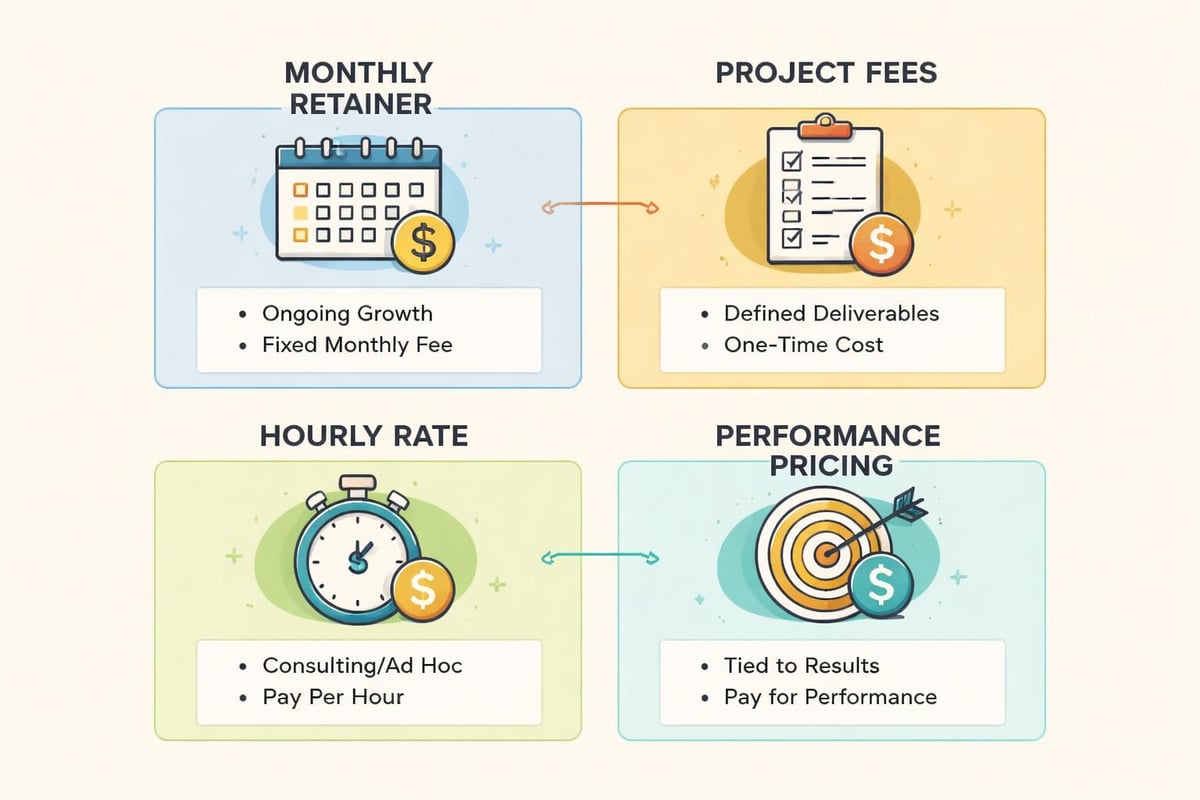
This is the most common model for sustained marketing work. Clients pay a fixed monthly fee for a defined scope of services. Retainers provide budget predictability and allow agencies to plan resources effectively.
| Retainer Tier | Typical Monthly Fee | Common Services Included |
|---|---|---|
| Starter | $2,500 – $5,000 | Content creation, social media management, basic SEO |
| Growth | $5,000 – $12,000 | Paid media management, email automation, conversion optimisation |
| Scale | $12,000 – $30,000+ | Full-stack marketing systems, CRM infrastructure, strategic consulting |
Retainer-based pricing models work best for businesses that need consistent attention across multiple channels. They’re less effective for one-off projects or businesses with highly seasonal demand.
Project-Based Fees
Fixed-price projects make sense for defined deliverables with clear endpoints. Website redesigns, brand identity development, or campaign launches fit this model well.
Project fees typically range from $5,000 for basic execution to $75,000+ for complex systems that require strategy, design, development, and integration work. The challenge with project pricing is scope creep. Without tight definitions, projects expand and margins erode.
Hourly Rates
Some agencies still charge hourly, usually for consulting work or ad-hoc requests. Rates vary based on seniority and specialisation:
- Junior specialists: $100 – $150/hour
- Mid-level strategists: $150 – $250/hour
- Senior consultants: $250 – $500/hour
Hourly billing creates misaligned incentives. Clients want efficiency. Agencies billing by the hour profit from inefficiency. It’s why most sophisticated buyers avoid this model for core marketing work.
Performance and Value-Based Pricing
This model ties fees to measurable outcomes. An agency might charge a base retainer plus a percentage of revenue generated, or structure the entire engagement around hitting specific KPIs.
Performance pricing works when:
- Attribution is clean and agreed upon upfront
- The agency has meaningful control over conversion variables
- Both parties understand the timeline for results
- There’s trust and transparency in data sharing
It fails when attribution is murky, when the sales cycle is long and complex, or when internal factors (product quality, pricing, service delivery) impact conversion more than marketing does.
How Business Size Affects Marketing Agency Pricing
The stage and scale of your business directly impacts what you should expect to invest. Marketing agency pricing varies significantly by business size because the complexity, risk, and resource requirements differ.
Small Businesses and Startups
Companies generating under $1M annually typically work with smaller agencies or freelancers. Budgets range from $1,500 to $7,500 per month. Services focus on foundational work: building a digital presence, establishing basic automation, and testing initial acquisition channels.
At this stage, you’re not buying a full marketing department. You’re funding specific initiatives that prove out a channel or build the infrastructure you’ll scale later.
Mid-Market Companies
Businesses doing $1M to $10M in revenue need more sophisticated systems. They’re past proof-of-concept and focused on scaling what works. Monthly investments typically fall between $7,500 and $25,000.
This tier includes comprehensive marketing services like multi-channel campaign management, CRM implementation, marketing automation, conversion rate optimisation, and strategic consulting. The focus shifts from execution alone to building systems that compound over time.
Enterprise Organizations
Companies above $10M revenue need agencies that can coordinate across departments, integrate with complex tech stacks, and manage significant media budgets. Retainers start at $25,000 monthly and often exceed $100,000 when managing large paid media campaigns or coordinating brand work across multiple markets.
Service-Specific Pricing Benchmarks
Different marketing disciplines carry different cost structures. Understanding typical pricing by service type helps you evaluate whether a proposal is reasonable or inflated.
Paid Media Management
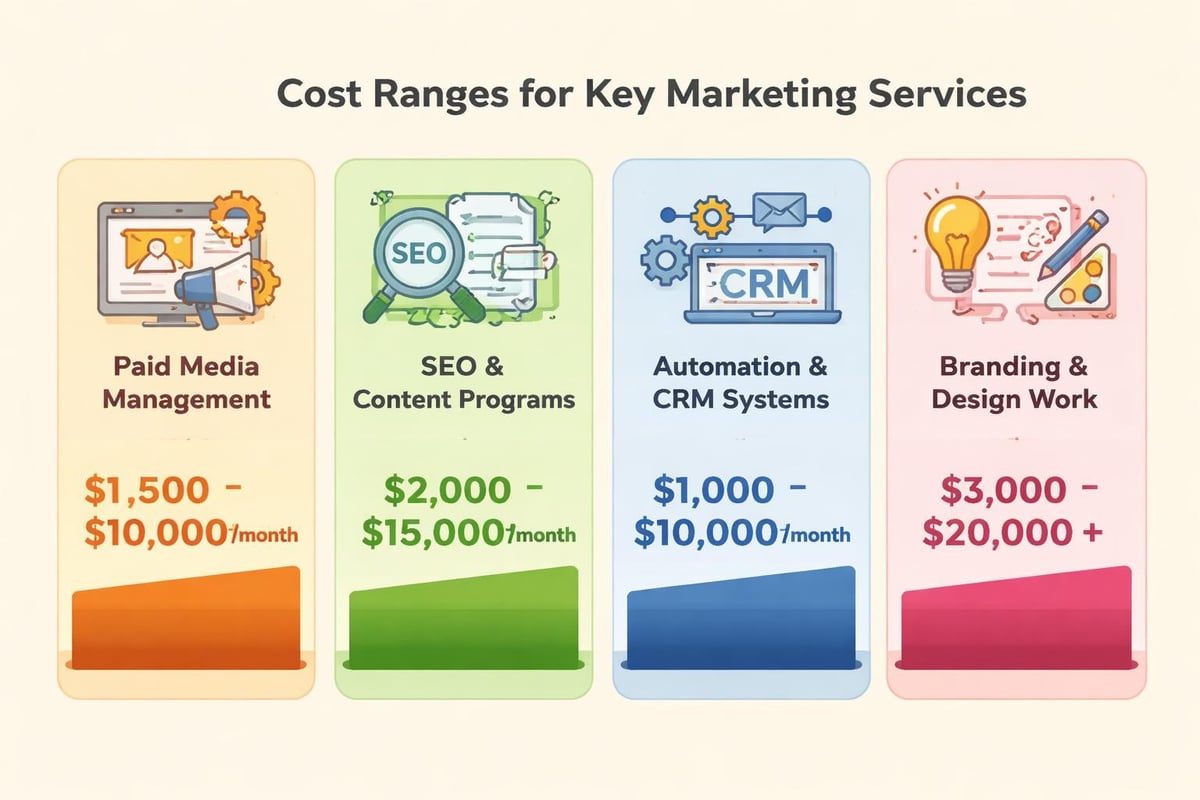
Most agencies charge 10-20% of monthly ad spend for campaign management. If you’re spending $10,000/month on ads, expect $1,000 to $2,000 in management fees. Some agencies use flat monthly fees instead, particularly for smaller accounts where percentage-based pricing doesn’t cover their costs.
SEO and Content Marketing
SEO retainers typically range from $2,500 to $10,000 monthly, depending on competition, site size, and technical complexity. Services usually include keyword research, technical audits, content strategy, link building, and performance reporting.
Content creation varies widely:
- Blog posts: $300 – $1,500 per article
- Long-form guides: $1,500 – $5,000 per piece
- Video production: $2,000 – $15,000 per video
- Ongoing content programs: $3,000 – $12,000 monthly
Marketing Automation and CRM
Building and managing marketing automation infrastructure is specialised work. Initial setup projects range from $5,000 to $50,000 depending on complexity. Ongoing management and optimisation typically runs $2,000 to $8,000 monthly.
This includes email sequence development, lead scoring configuration, integration work, workflow automation, and data hygiene. It’s the infrastructure that turns scattered activity into a predictable system.
Branding and Design
Brand identity projects (strategy, visual identity, messaging framework) typically cost $10,000 to $75,000. Website design and development ranges from $8,000 for basic builds to $100,000+ for custom platforms with complex integrations.
For businesses serious about digital branding solutions, the investment includes research, competitive positioning, visual system development, messaging architecture, and application across touchpoints.
What Cheap Agencies Actually Cost You
Low pricing isn’t always a bargain. It often signals junior talent, high client-to-staff ratios, or cookie-cutter approaches that don’t account for your specific context.
The hidden costs of budget agencies include:
- Wasted ad spend from poorly optimised campaigns
- Lost opportunities when generic content doesn’t convert
- Technical debt from sloppy implementation that needs rebuilding
- Time drain managing inexperienced teams who need constant direction
- Missed growth from strategies that don’t compound
One client came to us after spending 18 months and $45,000 with a cheap agency. They had social posts and blog articles but no system connecting content to leads to sales. They’d funded activity, not outcomes. Starting over cost more than hiring the right partner initially.
How to Evaluate Marketing Agency Pricing Proposals
When comparing proposals, look beyond the total monthly fee. Focus on what you’re actually buying and how it connects to revenue.
Questions to Ask Every Agency
- What specific outcomes can I expect in 90 days? Vague answers about “brand awareness” or “engagement” are red flags.
- Who’s actually doing the work? Know if you’re getting senior strategists or junior contractors.
- What metrics determine success? Agencies should define success in business terms (leads, pipeline, revenue), not vanity metrics.
- What happens if results underperform? Understand how they’ll adjust strategy and whether there’s accountability.
- What do I own at the end? Clarify ownership of content, creative assets, data, and platform accounts.
Red Flags in Pricing Proposals
Watch for proposals that bundle everything into vague line items. Legitimate agencies break down what you’re paying for: strategy hours, execution work, tool costs, media spend, and reporting.
Be cautious of pricing models that lack flexibility. Your needs will evolve. Rigid contracts that prevent scaling up or down create friction when priorities shift.
Avoid agencies that won’t discuss budgets until late in the sales process. Pricing should align with your goals and capacity, not be a surprise revealed after you’re emotionally invested.
The Real Cost of In-House vs Agency
Many businesses compare agency fees to hiring in-house. It’s rarely apples-to-apples.
| Factor | In-House Team | Agency Partner |
|---|---|---|
| Annual Cost | $120K – $300K+ (2-3 people) | $30K – $300K (retainer) |
| Ramp Time | 3-6 months | Immediate |
| Skillset Breadth | Limited to hires | Full team access |
| Overhead | Benefits, tools, training, management | Included in fee |
| Scalability | Slow (hiring takes months) | Fast (adjust scope) |
In-house makes sense when you have consistent, high-volume needs and want deep product knowledge embedded in your team. Agencies make sense when you need diverse expertise, strategic perspective, and the ability to scale quickly without hiring overhead.
For most service businesses between $1M and $10M revenue, a hybrid model works best: a small internal team handling execution with agency support for strategy, specialised skills, and capacity expansion.
What You Should Actually Pay in 2026
There’s no universal “right” price, but there are sensible ranges based on business size and growth goals.
If you’re doing under $1M in revenue: Expect to invest 7-12% of revenue on marketing, with $2,000 to $7,500 monthly going to agency fees. Focus on foundational systems (website, CRM, one proven acquisition channel) rather than spreading budget thin across tactics.
If you’re between $1M and $5M: Plan for 6-10% of revenue on marketing. Agency retainers typically run $7,500 to $18,000 monthly. Invest in integrated systems that connect marketing activity to sales outcomes. This is where marketing systems and branding start compounding.
If you’re above $5M: Marketing budgets often hit 8-12% of revenue, with significant portions going to media spend and agency fees of $15,000 to $50,000+ monthly. Focus shifts to optimisation, attribution modeling, and building infrastructure that supports multiple acquisition channels simultaneously.
These percentages assume you’re growth-focused. Mature businesses maintaining position might spend less. Companies in aggressive expansion phases might invest 15-20% of revenue.
Why Transparency Matters More Than Price
The best agency relationships start with clear conversations about money. Agencies that dodge pricing questions or refuse to explain their fees are hiding something: inflated margins, unclear value, or business models that don’t align with client outcomes.
Look for partners who explain what you’re paying for and tie it to outcomes. Detailed pricing guides and transparent proposals signal agencies confident in their value.
Ask how pricing might change as your business grows. Good agencies have frameworks for scaling with you. They’re not trying to lock you into a specific fee forever. They’re building relationships that evolve as needs change.
The pricing conversation reveals how an agency thinks about partnership. Agencies focused on extracting maximum fees upfront think transactionally. Agencies discussing outcomes, timelines, and scaling think strategically. You want the latter.
Making Your Marketing Investment Actually Work
Price alone doesn’t determine ROI. Execution, strategy quality, and alignment with your business model matter more. A $5,000/month agency delivering qualified leads at profitable CAC beats a $15,000/month agency generating vanity metrics.
Before committing to any marketing agency pricing structure, clarify what success looks like in your business. Define the metrics that actually drive revenue. Make sure the agency understands your sales process, customer lifetime value, and how marketing connects to cash flow.
Then evaluate proposals based on their likelihood of delivering those outcomes, not just their monthly fee. The cheapest option rarely wins. Neither does the most expensive. The right partner understands your business model, brings proven systems, and ties their success to yours.
Marketing agency pricing reflects the systems, expertise, and accountability you’re buying, not just the hours delivered. For service businesses ready to remove chaos and build predictable growth, the right investment creates infrastructure that compounds. MDO Digital helps you build those systems: high-trust websites, CRM automation, and data-driven marketing that protects leads and creates structured demand. Let’s talk about what actually moves your business forward.