In 2026, the world of branding and advertising is shifting faster than a kangaroo on a hot day. Every industry feels the impact, from tech giants to local cafes, as digital channels and consumer habits keep evolving.
Yet, many business leaders find themselves scratching their heads, unsure where branding ends and advertising begins. The lines are blurry, and getting it wrong can cost you growth, trust, and a clear spot in the market.
This article cuts through the confusion. We’ll break down the real differences between branding and advertising in 2026, using fresh data and real examples. You’ll get updated definitions, core objectives, strategies, measurement tips, tech trends, and practical case studies to help you stand out for all the right reasons.
Defining Branding and Advertising in 2026
The meaning of branding and advertising is shifting fast in 2026. As digital channels evolve, so do the rules for building trust and standing out in crowded markets. Understanding what really sets branding and advertising apart is now a must for any business leader aiming for growth.
The Evolving Definition of Branding
Branding is no longer just a logo or a slogan. In 2026, branding and advertising are seen as connected but distinct. Branding is a long-term, holistic process that shapes how people feel about a business. It covers everything from your logo and colors to your tone of voice, values, and the promises you make.
Leading brands like Nike and McDonald’s don’t just sell products. They evoke emotions and create lasting associations, whether it’s inspiration or comfort. Consistency across every touchpoint builds trust and keeps your brand top of mind.
Modern branding is driven by experiences and purpose, not just aesthetics. A 2026 survey found that 78% of consumers prefer brands with clear, consistent values. This shift aligns with top branding trends for 2026, such as purpose-led storytelling and hyper-personalization. Branding is now the bedrock for all other marketing, including advertising.
The Modern Definition of Advertising
Advertising in 2026 is all about tactical, time-bound promotion. It focuses on getting products or services noticed, mainly through paid media like digital ads, TV, print, or even emerging platforms. The goal is clear: drive awareness, spark interest, and encourage immediate action.
Think of the massive campaigns during the Super Bowl 2026, where brands measured their impact in real time. Advertising works hand-in-hand with branding but is unique in its intent and execution.
With digital ad spend projected to hit 650 billion dollars globally this year, advertising is more data-driven and personalized than ever. Instead of casting a wide net, brands use technology to target the right people at the right time, making every dollar work harder.
Key Distinctions Between Branding and Advertising
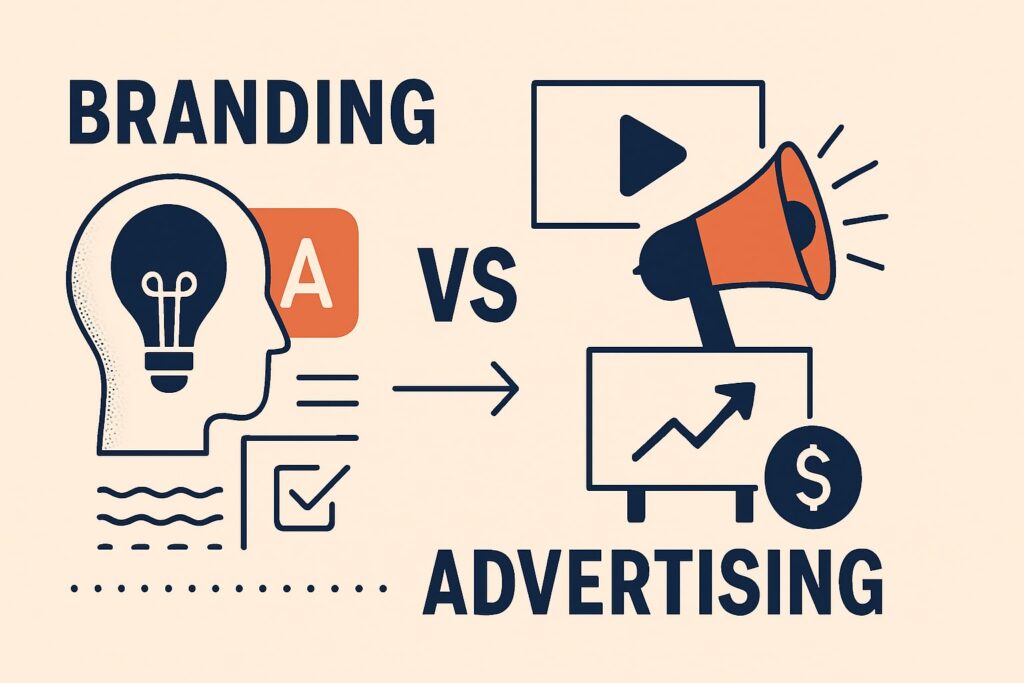
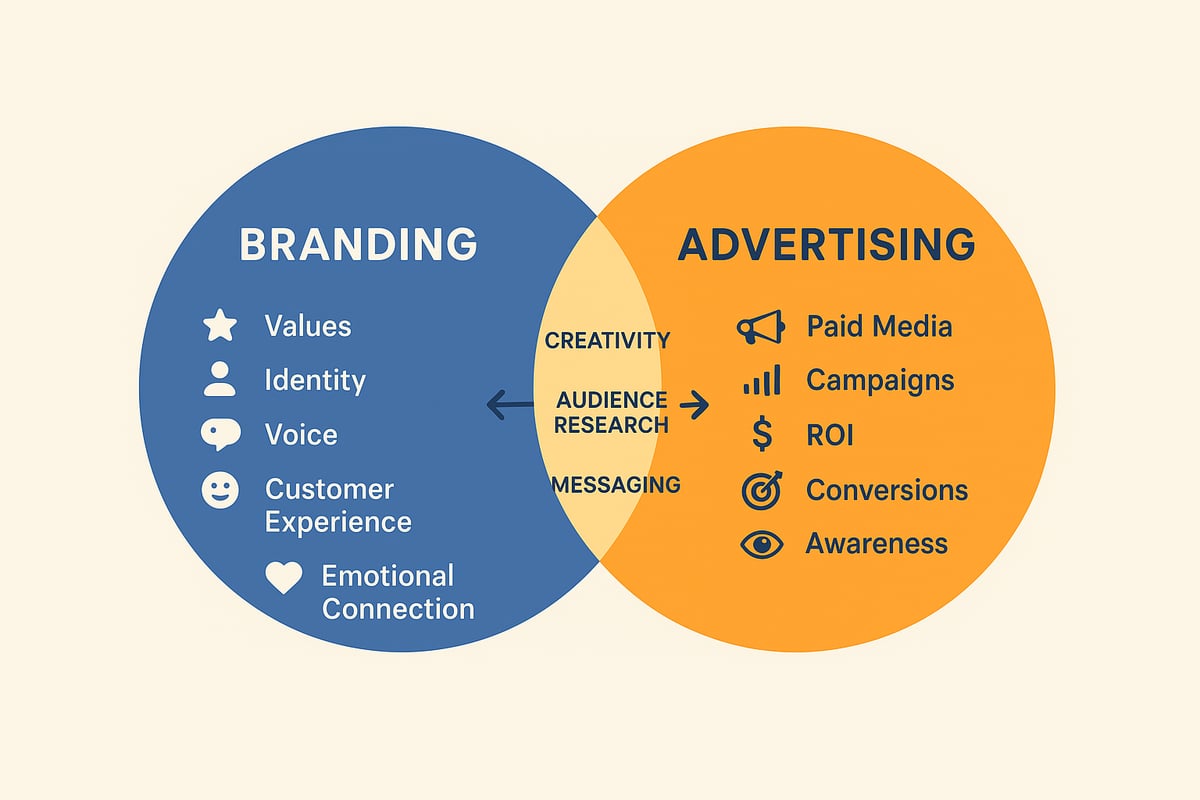
It’s easy to confuse branding and advertising, but there are clear differences. Branding is about who you are, while advertising is how you get noticed. Branding is strategic, ongoing, and focused on loyalty and long-term value. Advertising is tactical, campaign-based, and aims for quick results.
Here’s a quick comparison:
| Branding | Advertising |
|---|---|
| Strategic, ongoing | Tactical, campaign-based |
| Builds loyalty | Drives conversions |
| Shapes perception | Generates awareness |
| Focuses on values | Focuses on offers |
Both rely on creativity and understanding the audience, but their purposes diverge. For example, a startup needs strong branding to define itself and targeted ads to gain traction. In 2025, 62% of marketers admitted they were unclear about the separate roles of branding and advertising, a number that shows just how blurry the line can get.
Why the Confusion Persists
Confusion around branding and advertising lingers for several reasons. Many agencies now offer both services, blending creative design, messaging, and campaign execution. Digital platforms often merge brand storytelling with targeted ads, making it tough to tell where one stops and the other starts.
Small businesses, short on resources, may combine strategies out of necessity. Social media is a prime example, where a single campaign can build brand and drive sales at once. This overlap fuels the need for education about the unique value of each approach.
In 2026, hybrid “brandformance” teams are on the rise. These teams blend branding and advertising skills to deliver both long-term brand equity and immediate business results. Staying clear on these roles helps businesses invest wisely and avoid muddled messaging.
Core Objectives: Branding vs. Advertising
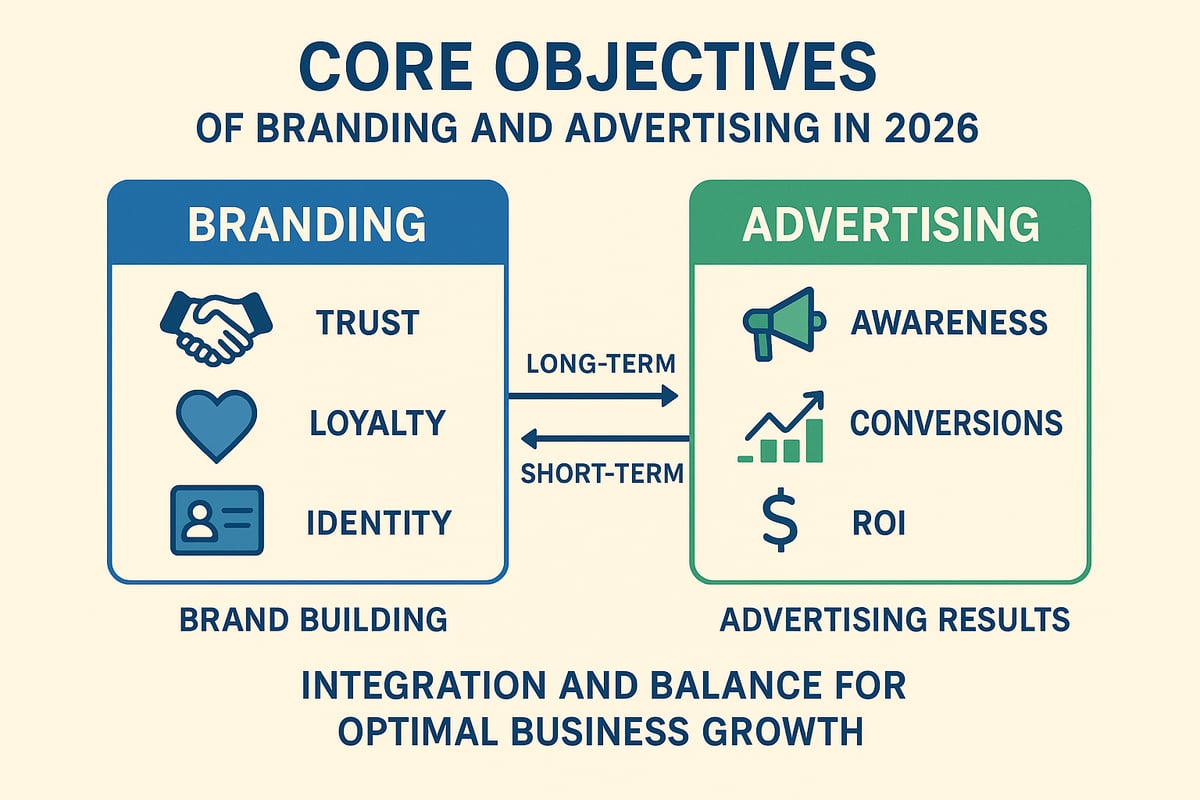
Understanding the core objectives of branding and advertising is like knowing when to plant seeds and when to water them. Each has a distinct role in driving business growth, but they work best when aligned. Let’s break down their goals and how to decide what takes priority in 2026.
Goals of Branding in 2026
Branding in 2026 is all about building long-term emotional connections. It shapes how people feel about your business, not just what they know. The goal is to create a unique identity, earn trust, and foster loyalty that can weather market storms.
A strong brand stands out from the crowd and keeps customers coming back, even when competitors try to lure them away. Take Apple, for example. Its brand equity lets it charge premium prices, and customers stick around because they trust the experience.
Recent studies show that brands with a clear identity see 31% higher customer retention. In short, branding and advertising are both crucial, but branding is your business’s safety net against sudden market shifts.
Goals of Advertising in 2026
Advertising is your tool for generating quick momentum. In 2026, the main objective is to drive awareness and spark immediate action, whether that’s a click, a purchase, or a sign-up. Campaigns are more data-driven than ever, using smart targeting and personalization to reach the right people at the right time.
Think of a streaming ad tailored to your recent searches—personal, relevant, and designed to get you moving. Advertisers today focus heavily on short-term KPIs, with 74% prioritizing conversions and ROI over brand metrics.
While branding and advertising often overlap, advertising acts as the accelerator pedal for your growth, especially when launching new products or re-engaging lost customers.
How Objectives Shape Strategy
The objectives you set will shape every aspect of your strategy. Branding strategies put consistency, storytelling, and customer experience at the forefront. Advertising strategies, on the other hand, focus on reach, frequency, and calls to action.
Let’s compare:
| Branding | Advertising |
|---|---|
| Long-term loyalty | Immediate sales |
| Emotional connection | Measurable ROI |
| Consistent messaging | Campaign-based |
Alignment is vital. If your ads don’t reflect your brand values, you risk confusing customers. Many businesses lean on expert branding and advertising services to ensure their efforts support each other. Companies that balance both see a 23% higher ROI on average.
When to Prioritize Branding or Advertising
Knowing when to lean into branding or advertising is a bit like choosing tools for the job. Early-stage businesses need branding for a strong foundation and advertising for quick traction. Established brands focus on loyalty, while using ads to launch innovations.
During a crisis, branding helps rebuild trust, while advertising can manage reputation. For sustainable growth, experts recommend a 60-40 split in favour of branding. Recent CMO surveys show more brands shifting budgets to long-term brand building, recognising that strong branding and advertising together deliver better results.
A simple framework? Map your business stage and goals, then allocate resources to create the right mix for your market.
Strategies and Tactics: What Sets Them Apart?
In 2026, the gap between branding and advertising strategies is both wider and blurrier than ever. Businesses must understand how each discipline works, not just in theory but in day-to-day execution. Mastering the right mix of approaches can be the difference between standing out and blending in.
Branding Strategies in 2026
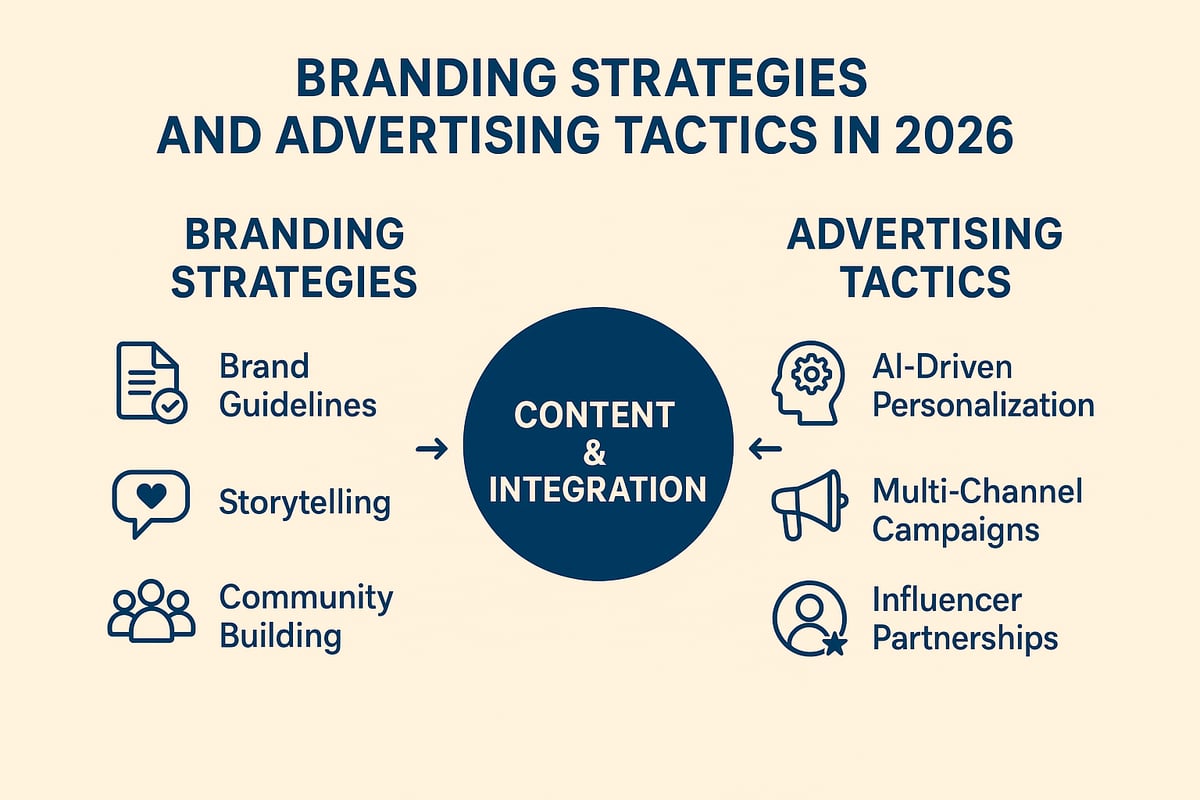
Branding and advertising have evolved, but branding remains the long game. In 2026, successful brands invest in detailed brand guidelines, clear identity systems, and purpose-driven storytelling. Experience design is front and centre, stretching from slick digital UX to memorable in-person touchpoints.
- Develop consistent brand guidelines and visual identity.
- Craft narratives that reflect authentic values and purpose.
- Prioritise customer experience across every channel.
- Encourage employee advocacy and internal alignment.
- Build engaged communities for long-term loyalty.
Community-building and immersive experiences, like branded podcasts or interactive events, are now essential. According to branding trends analysis 2026, 65% of Gen Z trust brands with authentic stories. Branding and advertising both rely on trust, but branding sets the foundation for all future tactics.
Advertising Tactics in 2026
Advertising in 2026 is agile, data-driven, and everywhere your audience might be. Multi-channel campaigns span programmatic display, social, connected TV, and even AR or VR environments. AI and analytics drive hyper-personalisation, making each ad feel tailor-made.
- Run programmatic and real-time bidding across digital platforms.
- Partner with influencers and creators for paid reach.
- Use automation for retargeting and conversion optimisation.
- Leverage AI to adapt creative based on live user sentiment.
- Allocate most budgets to digital-first formats.
Branding and advertising converge in these moments, especially as 80% of ad spend now targets digital-first campaigns. Tactics are responsive, but must still echo the underlying brand voice to avoid feeling generic.
The Role of Content in Both Disciplines
Content is the glue binding branding and advertising. For branding, content educates, inspires, and builds trust. For advertising, it acts as a hook to capture attention and drive action.
| Branding Content | Advertising Content |
|---|---|
| Brand documentaries | Shoppable video ads |
| Thought leadership articles | Sponsored posts |
| Podcasts and webinars | Dynamic banner creatives |
| Community stories | Click-to-buy social ads |
The most effective branding and advertising campaigns align content strategy across both disciplines. In 2026, interactive and immersive content is in demand, but fatigue is real. Creativity and authenticity are the antidote.
Measurement and Success Metrics
Measuring success is where branding and advertising often part ways. Branding relies on KPIs like awareness, sentiment, and Net Promoter Score. Advertising focuses on impressions, CTR, conversions, and return on ad spend.
- Branding KPIs: brand lift, share of voice, loyalty metrics.
- Advertising KPIs: clicks, conversions, CPA, ROAS.
- Unified dashboards blend long-term brand data with short-term ad performance.
- AI is helping bridge the gap, offering smarter attribution insights.
Only 38% of companies in 2025 can accurately measure brand impact. As branding and advertising become more intertwined, investing in unified measurement is critical for ongoing success.
Integration for Maximum Impact
True results come when branding and advertising work hand in hand. Integrated campaigns amplify the brand story and boost ad effectiveness.
- Coordinate quarterly planning between brand and ad teams.
- Use cross-channel messaging to reinforce brand identity.
- Watch for disconnected efforts that waste spend or dilute your message.
- Adopt “brandformance” frameworks for unified planning.
Brands that integrate branding and advertising see up to 35% higher engagement rates. In 2026, success is about synergy, not siloed efforts. The best teams share KPIs, align creative, and keep the customer at the centre.
Technology and Trends Shaping Branding and Advertising
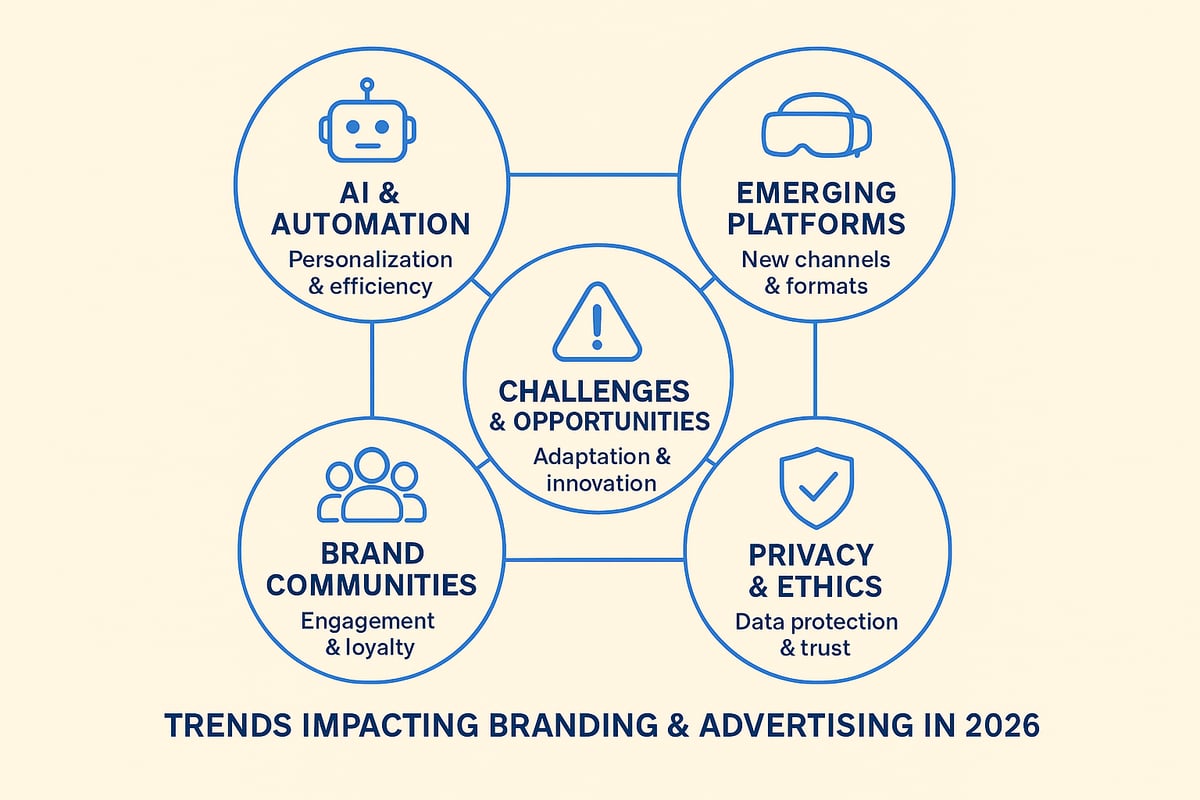
In 2026, technology is rewriting the rules of branding and advertising. From AI-driven personalization to new digital playgrounds, brands face both fresh challenges and golden opportunities. Staying ahead means understanding the tech shifts shaping the way you connect with your market.
AI, Automation, and Personalization
Artificial intelligence is now a pillar of branding and advertising. Brands use AI for smarter audience segmentation, rapid creative testing, and campaign automation. Imagine a chatbot that not only talks like your brand but solves customer problems in real time.
Automation takes the grunt work out of campaign management, letting teams focus on strategy. Personalization is the new norm, with dynamic creative adjusting to each user’s context and preferences. According to industry reports, 70% of brands leverage AI for both branding and advertising in 2026. For a deeper look at how AI is transforming marketing, check out AI’s role in 2026 marketing.
While these advances boost efficiency, there’s a risk of losing the human touch. The best brands balance data-driven tactics with authentic voice.
Emerging Platforms and Media
The digital landscape for branding and advertising is more fragmented than ever. Brands are exploring AR, VR, and even the metaverse to create immersive experiences. These platforms let customers “step into” a brand story, not just watch it.
Shoppable content and live commerce blend branding and advertising, turning inspiration into instant action. Voice search and smart devices are now crucial touchpoints for brand visibility. In 2026, 40% of digital ad spend targets emerging platforms, making adaptation essential.
Brands also experiment with Web3 and NFTs to foster loyalty, though results vary. Staying nimble is vital as consumer habits shift quickly.
Privacy, Ethics, and Consumer Expectations
Privacy is front and centre in branding and advertising discussions. Regulations are tighter, and consumers demand more control over their data. Brands must now build trust with transparency and inclusivity, not just catchy slogans.
Ethical branding matters, with customers rewarding companies that walk the talk. Zero-party data strategies are gaining ground, where users willingly share information in exchange for value. A whopping 82% of consumers prefer brands that respect their privacy.
Advertisers are shifting to contextual targeting and consent-based models. In a privacy-first world, branding becomes a key trust-builder.
The Rise of Brand Communities and Advocacy
Brands are moving from transactions to relationships, using communities as a growth engine. These communities let customers co-create, share feedback, and advocate for the brand.
Loyalty programs now feature exclusive content and offers, blurring the line between branding and advertising. Community-led brands see growth 50% faster than those relying on traditional campaigns.
Advertising plays a supporting role, targeting outreach to nurture these communities. Social platforms are also prioritising features that help brands build and manage their own spaces.
Challenges and Opportunities Ahead
Managing branding and advertising across fragmented channels is no easy feat. Consumers are wary of intrusive ads, and ad fatigue is real. The opportunity lies in using data smartly to create relevant, welcome experiences.
Brands must balance automation with genuine emotional connection. Integration is a top challenge: 55% of marketers struggle to unify branding and advertising efforts.
Success in 2026 means embracing unified, customer-centric strategies. Those who align both disciplines are better placed to weather future disruptions and build lasting equity.
Real-World Examples: Branding and Advertising in Action
Real-world stories bring the theory of branding and advertising to life. Let’s look at how businesses in 2026 are winning (or stumbling) with these strategies, and what you can take away for your own brand.
Branding Case Studies: Successes and Pitfalls
Branding and advertising are intertwined, but branding sets the stage for trust and loyalty. Look at Nike, whose consistent identity keeps fans loyal worldwide. Ontario International Airport’s recent rebrand is another win, with a fresh identity that boosted traveler confidence and led to an 18% revenue lift.
On the flip side, brands with inconsistent messaging often lose ground fast. Market data shows that purpose-led rebrands, when backed by research and team buy-in, outperform superficial changes.
Advertising Case Studies: Winning Campaigns and Lessons Learned
Branding and advertising campaigns can skyrocket results when executed well. Take Corky’s Pest Control, whose PPC push led to a 465% surge in organic clicks. In 2026, Super Bowl ads are still the gold standard for reach, with celebrity-driven spots delivering measurable brand lift.
Yet, even big budgets can fall flat if creative is mismatched or targeting is off. Data shows integrated campaigns increase click-through rates by 54%. Curious about the latest creative trends? Dive into Super Bowl 2026 advertising trends for a snapshot of what’s cutting edge in advertising right now.
How Leading Brands Integrate Both Approaches
Branding and advertising work best when they pull in the same direction. Apple is a textbook case, blending iconic branding with innovative campaigns across TV and TikTok, always keeping their message unified.
Integrated teams regularly align on shared KPIs, and top brands now invest in “brandformance” marketing. When branding and advertising teams work in silos, customers feel the disconnect. Data shows unified campaigns drive 23% higher customer lifetime value, proving that collaboration pays.
Lessons for Service-Based and Digital Businesses
For service businesses, branding and advertising should go hand in hand. Branding builds trust, while targeted ads drive leads. Digital-first brands win by mapping the customer journey and aligning every touchpoint.
Consulting firms, for instance, use branded webinars to establish authority, then follow up with targeted ads for lead gen. Service brands with strong branding see double the referral rates, thanks to CRM and automation tools. Neglecting either discipline limits what your business can achieve with branding and advertising.
Choosing the Right Approach for Your Business in 2026
Selecting the best path for branding and advertising in 2026 is less about following trends and more about aligning choices with your business stage, goals, and resources. Let’s break down how to make these decisions, so your brand stands out and your advertising delivers results.
Assessing Your Business Stage and Goals
Every business faces unique challenges with branding and advertising. Startups often need branding to carve out a distinct identity, while advertising builds initial awareness. Growth-stage businesses should balance both, ensuring brand consistency while scaling reach. Mature companies use branding to deepen loyalty and advertising to launch innovations or enter new markets.
Ask yourself: Is your main challenge building trust, gaining attention, or driving conversions? For example, a SaaS company may rebrand before launching new ad campaigns to maximize impact. In 2026, brands investing in both branding and advertising report a 31% higher market share on average. Align your strategy with your most urgent business goal for the best ROI.
Budgeting and Resource Allocation
Getting the budget right for branding and advertising is crucial. The recommended split for most businesses is 60 percent branding, 40 percent advertising, but this can shift based on industry and competition. Retailers might boost ad spend during peak seasons, while B2B firms invest steadily in brand building.
To help estimate costs, review pricing for branding solutions to see what’s realistic for your size and needs. In 2026, brands are allocating 15 percent more budget to long-term branding efforts. Remember, over-investing in ads without a solid brand foundation can limit growth, just like pouring water into a leaky bucket.
Building Internal Capabilities or Partnering with Agencies
Should you handle branding and advertising in-house or bring in outside help? In-house teams offer control and brand immersion, but agencies provide fresh ideas and specialist skills. Many businesses now choose hybrid “brandformance” agencies that blend both disciplines for seamless integration.
If you’re unsure, consider reaching out to contact branding experts for tailored advice. In 2026, 48 percent of businesses use integrated agencies to bridge the gap between brand and ad execution. Cross-functional teamwork and shared KPIs prevent misalignment and keep your strategy on track.
Future-Proofing Your Brand and Advertising Strategy
The landscape for branding and advertising keeps shifting, so agility is essential. Invest in technology, like AI and analytics, to stay ahead. Build a resilient brand that adapts messaging quickly during global events or market changes.
Brands with adaptive strategies recover 2.5 times faster after a crisis. Keep upskilling your team in both branding and advertising, and remember, unified, customer-centric strategies always win out in the long run. The right mix today will safeguard your growth tomorrow.
So, after unpacking all the ways branding and advertising are evolving in 2026, it’s clear that nailing the balance is no longer just “nice to have”—it’s essential for real, predictable growth. If you’re looking at your own marketing and feeling a bit of that classic chaos, you’re not alone. We’ve helped plenty of service-based businesses cut through the noise and find clarity. If you’re ready to get practical about your brand, your ads, and how they can work together (without the jargon or the waffle), let’s map out a plan that fits you. Book a Strategy Call.