Most service businesses waste money picking sides in the paid vs organic marketing debate when the real answer sits somewhere less tribal. You need both, but for different reasons, at different stages, with different expectations. The businesses that grow predictably understand when to pay for attention and when to earn it. The ones that don't keep burning budget on channels that don't match their stage or expectations.
The Core Difference Between Paid and Organic Marketing
Paid marketing means you're buying visibility. Google Ads, Facebook campaigns, LinkedIn promotions, display networks. You pay per click, per thousand impressions, or per action. The traffic stops when the budget does.
Organic marketing earns visibility through content, SEO, relationships, and systems that compound over time. Blog posts, search rankings, email lists, referral networks. The traffic keeps coming even when you're not actively pushing.
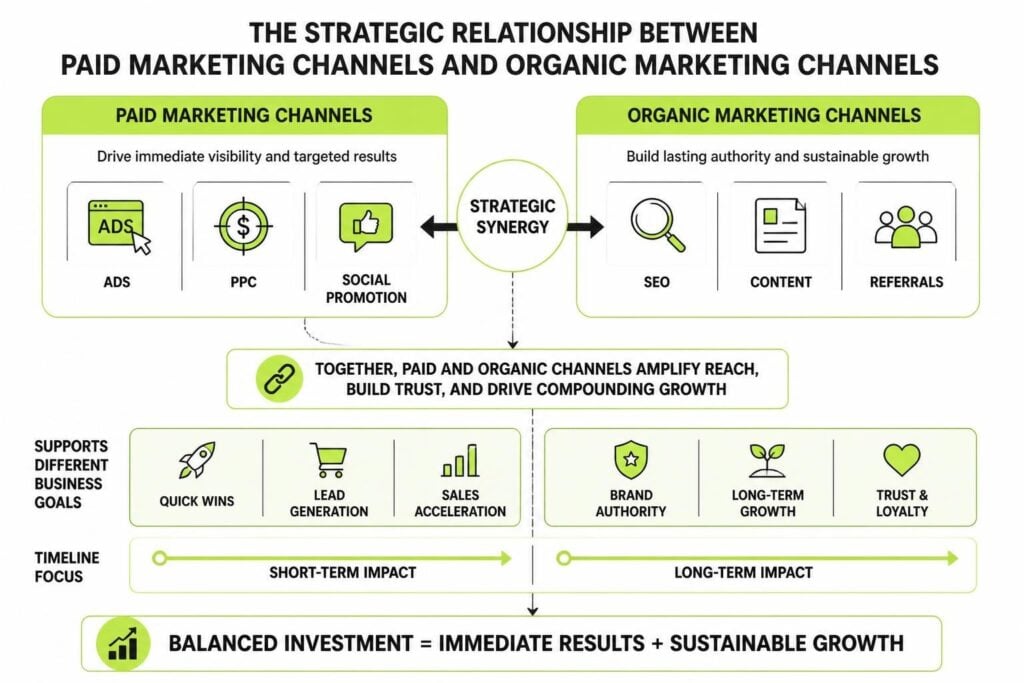
The main distinction isn't just cost. It's control versus sustainability. Paid channels give you immediate control over volume and targeting. Organic marketing builds assets that appreciate and distribute risk across channels you own.
Speed and Predictability
Paid marketing delivers results within days. You can test messaging, validate offers, and generate leads before your website even ranks for a single keyword. The data is clean, the attribution is clear, and you can scale what works.
Organic takes months to gain traction. Your first blog post won't drive leads. Your tenth might. Your fiftieth could become your best sales asset. The difference between paid and organic search comes down to whether you're optimising for this quarter or the next three years.
| Factor | Paid Marketing | Organic Marketing |
|---|---|---|
| Time to results | Days to weeks | Months to years |
| Cost structure | Ongoing per acquisition | High upfront, low maintenance |
| Control | High, immediate | Low, compounding |
| Longevity | Stops when budget stops | Continues indefinitely |
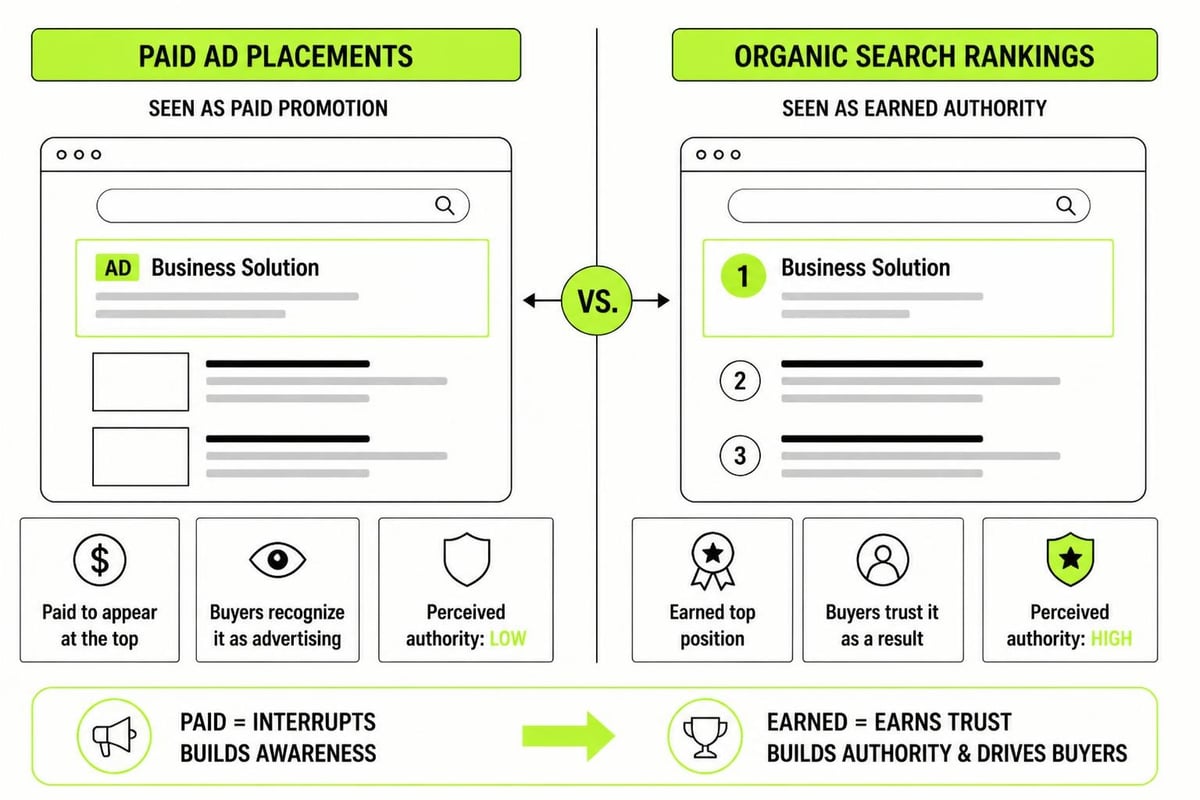
| Trust signal | Lower (recognised as ads) | Higher (earned placement) |
Cost Structure Over Time
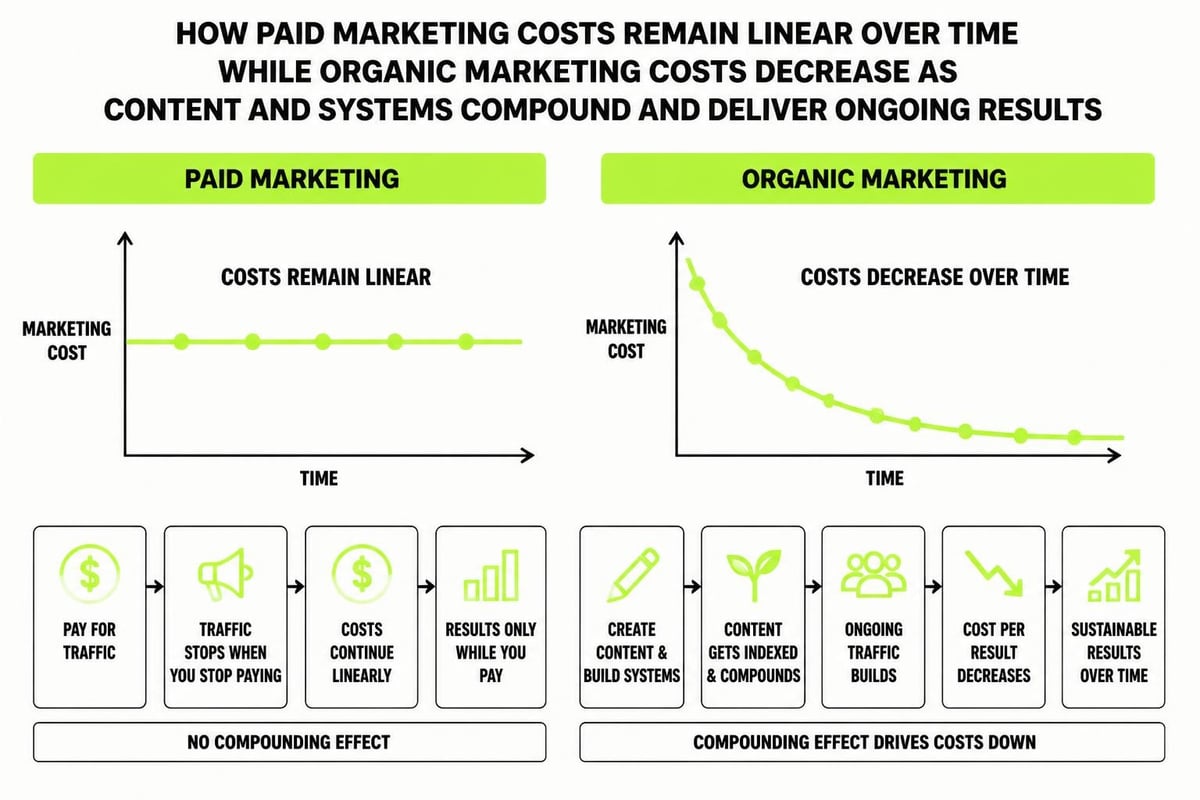
The numbers tell the real story. Paid marketing costs stay linear or increase. Your cost per click on Google Ads doesn't drop just because you've been running campaigns for two years. If anything, competition increases and CPCs rise.
Organic costs decrease over time. A blog post published in 2024 still drives leads in 2026 without additional spend. An email list built through opt-ins keeps delivering value every time you send a campaign. The marginal cost of each new lead drops as your assets mature.
This doesn't make organic "better." It makes it suited for different business scenarios. If you need 20 qualified leads by next month, paid is your only realistic option. If you're building a business that needs to operate efficiently in year three, organic becomes essential infrastructure.
When Paid Marketing Makes Strategic Sense
Paid works brilliantly in specific situations. New offer launches, market validation, seasonal promotions, competitive gaps. Any time you need speed, volume, or targeted reach that you haven't earned yet.
Testing messaging before committing to content. You can run five different headlines through Facebook ads and know which resonates within 48 hours. That insight informs your organic content, your website copy, and your email sequences. Paying for that data is faster than guessing through six months of blog posts.
Market Entry and Speed to Revenue
If you're entering a new market or launching a new service, you don't have domain authority yet. Your website doesn't rank. Your content hasn't been indexed. You need clients now, not in eight months when your SEO strategy matures.
Paid channels let you buy your way into conversations you haven't earned yet. LinkedIn ads can put your message in front of decision makers at target companies. Google Ads can capture people searching for exactly what you offer. The speed justifies the cost when your runway demands revenue.
Campaign-Based Promotions
Limited-time offers, events, webinars, product launches. These need concentrated attention within a specific window. Organic traffic doesn't turn on and off. Paid does. You can scale budget up for two weeks, drive registrations, then scale back down.
- Black Friday sales
- Webinar registrations with fixed dates
- Conference promotions
- Seasonal service offerings
- Limited beta access programs
The challenge isn't running the campaign. It's what happens after. Too many businesses treat paid as a standalone channel instead of the front door to an organic system. The leads you pay for should enter a nurture sequence, receive valuable content, and be tracked through a proper CRM.
Data and Attribution Clarity
Paid platforms give you clean data. Impressions, clicks, conversions, cost per acquisition. You know exactly what you spent and what you got. Organic versus paid marketing differs significantly in measurement complexity.
Organic attribution is messy. Someone reads three blog posts, subscribes to your email list, ignores five emails, then books a call after a referral mentions your name. What gets credit? The data exists but requires systems to track it properly.
Why Organic Marketing Builds Compounding Assets
Organic isn't just "free traffic." It's infrastructure. Every piece of content, every ranking improvement, every email subscriber represents an asset that works for you repeatedly without additional cost.
The math shifts dramatically over time. A service business that publishes two quality blog posts per month has 24 pieces of content after year one. If each post generates an average of three qualified leads per month after it ranks, that's 72 leads monthly from year-old content. Year two adds another 24 posts. Now you're getting 144 leads monthly from content. The volume compounds while the cost doesn't.
Trust and Perceived Authority
People trust earned visibility more than bought visibility. They know ads are ads. When your website ranks organically for "marketing systems for service businesses," the searcher assumes you're legitimate enough to have earned that position. When they see your ad, they know you paid for it.
This matters more in high-consideration purchases. If someone's investing $15,000 in a website and CRM buildout, they're doing research. They're reading multiple articles. They're comparing options. The integration of organic content with strategic authority building creates trust that ads alone can't replicate.
Email Lists and Owned Audiences
The most valuable organic asset is an owned audience. An email list. A referral network. People who've opted in to hear from you. These channels cost nothing to reach after the initial acquisition.
Building a list through organic content and opt-in offers creates a marketing channel you control. Facebook can change their algorithm tomorrow. Google can update their ranking factors. Your email list doesn't disappear because a platform changed their mind.
If you're building marketing infrastructure that lasts, a structured approach helps. The 7-Step Marketing Plan walks through creating opt-in offers, CRM systems, and nurture campaigns that turn organic traffic into qualified pipeline without constant ad spend.
Content That Educates and Converts
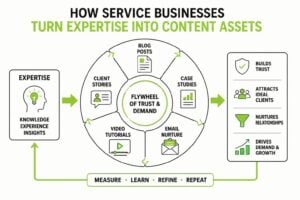
Well-executed organic content does double duty. It ranks and drives traffic. It also educates prospects, answers objections, and positions your expertise. The blog post that ranks for "CRM setup for service businesses" also explains why proper CRM matters, what to look for, and how to evaluate options.
| Content Type | Primary Function | Secondary Value |
|---|---|---|
| How-to guides | Drive organic search traffic | Educate and build authority |
| Case studies | Social proof and conversion | SEO for niche terms |
| Comparison posts | Capture comparison searches | Help prospects self-qualify |
| Industry analysis | Thought leadership | Backlink opportunities |
The content keeps working. A case study published in 2024 still influences decisions in 2026. An in-depth guide still ranks and educates. The work you put in once delivers value repeatedly. That's the compounding effect paid can't match.
How to Balance Paid and Organic Marketing Strategically
The paid vs organic marketing debate dissolves when you map channels to business stage and objectives. Early stage needs different tools than scale stage. Brand awareness needs different channels than demand capture.
Map Channels to Business Goals
Start with what you're trying to achieve. If the goal is validation, paid lets you test faster. If the goal is sustainable growth, organic builds the foundation. If the goal is both, you layer them strategically.
Most service businesses need:
- Immediate lead generation to sustain operations (paid)
- Long-term assets that reduce acquisition cost (organic)
- Systems that convert both into retained clients (CRM and nurture)
Trying to do everything at once spreads budget thin and delivers mediocre results everywhere. Pick one primary channel, execute it properly, then expand.
Use Paid to Fuel Organic Growth
The smartest approach uses paid marketing to accelerate organic outcomes. Run ads to your best organic content to boost engagement signals. Promote gated content to build your email list faster. Use paid to validate topics before investing in comprehensive organic content.
Paid traffic to organic assets creates a feedback loop. The traffic improves rankings. Better rankings reduce your dependence on paid. Lower acquisition costs free up budget to invest in more organic infrastructure. Finding the right balance between channels requires tracking what drives sustainable growth, not just immediate clicks.
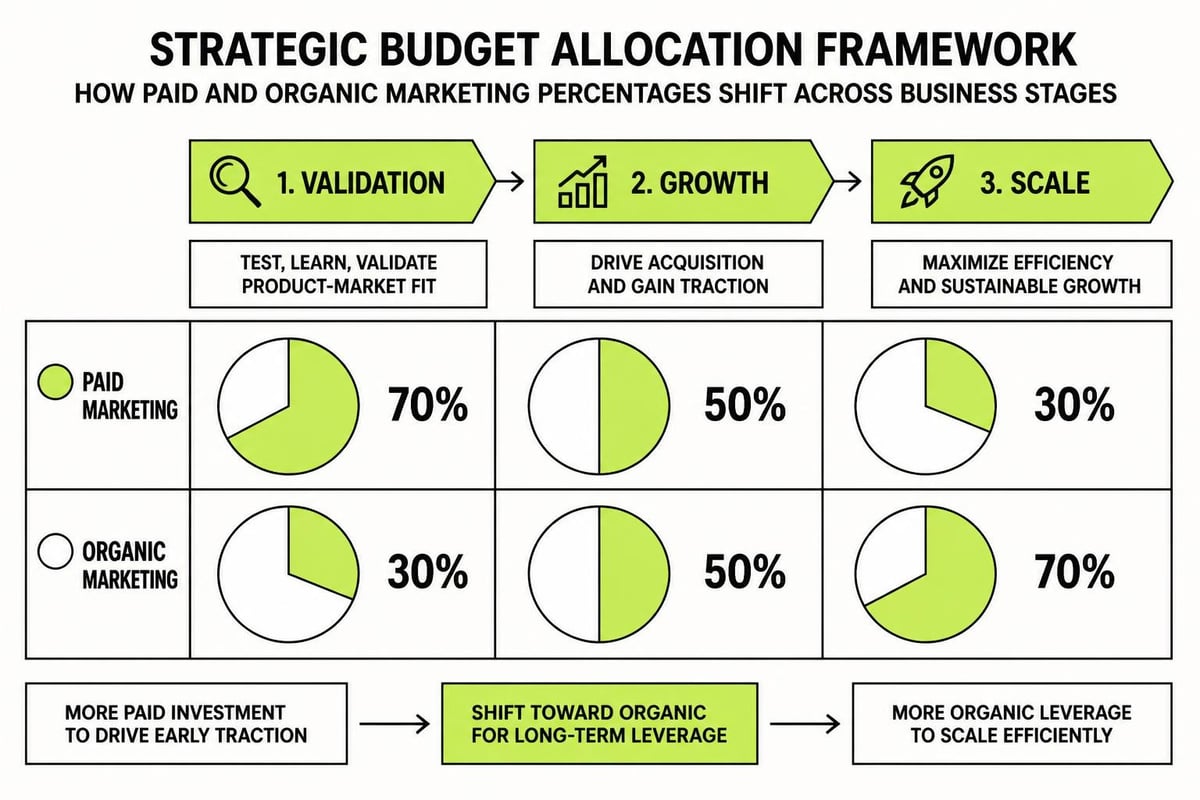
Budget Allocation by Business Stage
| Business Stage | Paid % | Organic % | Primary Focus |
|---|---|---|---|
| Pre-revenue | 70% | 30% | Validate offer, generate first clients |
| Early revenue ($10-50k/mo) | 60% | 40% | Scale what works, build content foundation |
| Growth ($50-200k/mo) | 40% | 60% | Reduce CAC, build compounding assets |
| Scale ($200k+/mo) | 30% | 70% | Optimise efficiency, own your channels |
These aren't rules, they're starting frameworks. A business with strong founder-led content might flip the ratios. A business in a highly competitive paid landscape might invest heavier in organic earlier. The key is intentional allocation based on your specific situation.
Track the Right Metrics for Each Channel
Paid and organic marketing require different measurement approaches. Judging organic content by immediate conversions misses the long-term value. Judging paid campaigns by brand awareness ignores their strength in direct response.
For paid marketing, track:
- Cost per click and cost per acquisition
- Conversion rate by campaign and audience
- Return on ad spend (ROAS)
- Time to conversion from first click
- Customer lifetime value by source
For organic marketing, track:
- Organic traffic growth month over month
- Keyword rankings for target terms
- Email list growth and engagement rates
- Content-assisted conversions (multi-touch attribution)
- Backlinks and domain authority improvements
The metrics tell you if you're using each channel appropriately. If your paid ROAS is below 3:1, you're either targeting wrong or your offer needs work. If your organic traffic hasn't grown in six months, your content isn't resonating or your technical SEO needs attention.
Common Mistakes That Waste Budget on Both Channels
Most businesses don't fail at paid vs organic marketing because they pick the wrong one. They fail because they execute poorly on whichever they choose. The mistakes are predictable and avoidable.
Running Paid Without Conversion Infrastructure
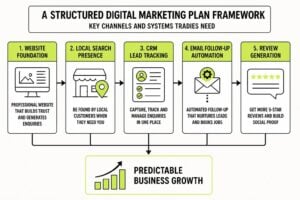
Driving traffic to a website that doesn't convert is expensive education. No clear call to action, no lead capture, no follow-up sequence. You pay for clicks that go nowhere because the infrastructure doesn't exist to convert attention into pipeline.
Before you scale paid spend, build the system that handles the traffic:
- Landing pages with single, clear offers
- CRM to capture and track every lead
- Automated follow-up sequences
- Clear qualification criteria
- Sales process to handle inbound volume
The conversion rate matters more than the traffic volume. A campaign driving 100 visitors at 10% conversion beats one driving 500 visitors at 1% conversion. Fix conversion before you add traffic.
Creating Organic Content Without Search Intent
Publishing content nobody searches for is the organic equivalent of burning money. Blog posts about "why branding matters" might feel valuable, but if nobody's searching for it, it won't rank or drive traffic.
Effective organic content matches search intent. Someone searching "how to choose a CRM" wants a buying guide, not a philosophical essay. Someone searching "CRM implementation checklist" wants a practical resource. Why starting with organic marketing requires understanding what your market actually searches for, not just what you want to say.
Treating Channels as Silos
Paid and organic marketing work better together than apart. The data from paid campaigns informs organic content topics. The authority from organic content improves paid conversion rates. The email list built through organic provides a free channel to promote paid offers.
Integration beats isolation. A prospect sees your ad, clicks through, reads a blog post, subscribes to your list, receives a nurture sequence, then books a call. That journey crosses paid and organic multiple times. Treating them as separate strategies misses how real buyers actually move through your ecosystem.
Ignoring Customer Acquisition Cost Economics
The paid vs organic marketing decision ultimately comes down to unit economics. What does it cost to acquire a client? What's their lifetime value? How long until they're profitable?
If your average client is worth $25,000 and you can acquire them for $2,000 through paid ads, the math works. If organic content can drop that cost to $500 over time, the long-term math works even better. If you're paying $8,000 to acquire a $5,000 client, neither channel saves you.
Track CAC by channel, by campaign, by content piece. Know what works and what doesn't. Double down on efficient channels and fix or abandon expensive ones. The clarity around unit economics determines whether you're building a business or just staying busy.
Building a Marketing System That Uses Both
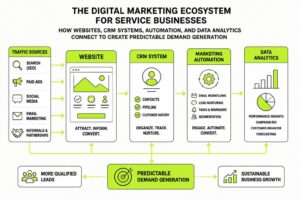
The businesses growing predictably in 2026 aren't picking paid or organic. They're building systems where both channels feed a central infrastructure designed to convert, nurture, and retain.
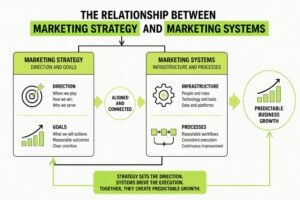
Start With Strategy, Not Tactics
Most businesses jump straight to "should we run Facebook ads or publish blog posts?" Wrong question. The right question is "what does our business need right now and what channels best deliver that?"
Map out your buyer journey first. How do people discover you? What convinces them to engage? What moves them from interested to committed? Once you understand the journey, you can assign paid and organic to the stages where each works best.
Paid might drive awareness and initial contact. Organic content might educate and build trust. Email nurture might maintain engagement. The system connects the pieces instead of treating each as standalone.
Build Assets That Appreciate
Every dollar you spend on marketing should either generate immediate return or build an asset that appreciates. Paid delivers immediate return. Organic builds appreciating assets. Both belong in a complete system.
Appreciating assets include:
- Published content that ranks and drives compounding traffic
- Email lists that grow and engage over time
- CRM data that improves targeting and personalisation
- Referral networks that send qualified leads
- Brand authority that reduces sales cycle length
The more assets you build, the less you depend on paid traffic to hit revenue targets. Your cost to acquire drops. Your margins improve. Your business becomes more valuable because it's not dependent on you personally funding ads every month. The insights shared across our marketing resources demonstrate how systems thinking beats channel obsession.
Create Feedback Loops Between Channels
The best marketing systems use each channel to make the others more effective. Paid campaigns identify which messages resonate. That data shapes organic content topics. Organic content builds authority that improves paid conversion rates. The loop continues.
Practical feedback loops:
- Run paid campaigns to test headlines and offers
- Use winning messaging in organic content and SEO
- Promote high-performing organic content with paid boost
- Track which organic posts assist paid conversions
- Create more content around topics that drive both paid and organic results
This approach requires integrated tracking. You need to see the full customer journey, not just last-click attribution. When someone clicks a paid ad, reads three blog posts, subscribes to your email list, then books a call after a nurture sequence, what drove the conversion? All of it. The system is the strategy.
The paid vs organic marketing question misses the point entirely. You need both, used strategically, at different stages, for different outcomes. Paid gives you speed and control. Organic builds assets that compound. Together, they create a marketing system that drives growth without burning through budget or hoping algorithms stay friendly. If you're ready to build marketing infrastructure that actually scales your service business, MDO Digital helps you design the systems, build the automation, and create the clarity that turns marketing from chaos into predictable demand.