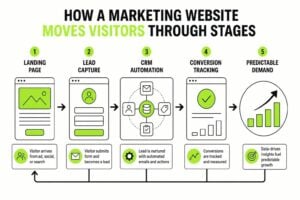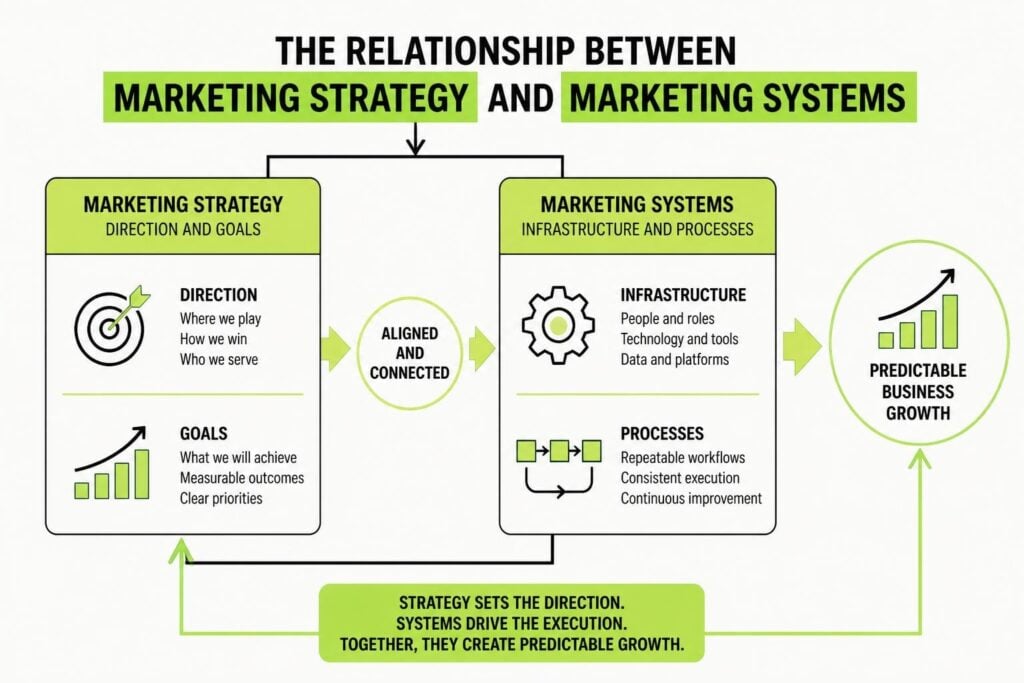
Most service businesses treat marketing systems vs marketing strategy as the same thing. They're not. Strategy tells you where to go. Systems get you there reliably. You need both, but they serve completely different functions. A brilliant strategy without systems collapses under pressure. Systems without strategy burn resources in the wrong direction. Understanding the difference isn't academic. It's the gap between chaotic growth and compounding momentum.
What Marketing Strategy Actually Means
Marketing strategy is about choices. It defines who you serve, what problems you solve, and how you position yourself against alternatives. It answers the big questions. Which market segment gets your attention? What message cuts through? Where do you play to win?
Strategy Sets the Direction
Think of strategy as your map. It shows the destination and the route. Without it, you're guessing. With it, every decision has a reference point.
A solid marketing strategy includes:
- Target audience definition: specific buyer personas with real pain points
- Value proposition: why someone chooses you over doing nothing or picking a competitor
- Positioning: the mental category you own in your market
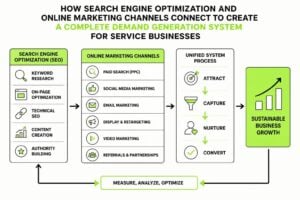
- Channel selection: where your ideal clients actually spend attention
- Message framework: the core narrative that builds trust and creates demand
Strategy doesn't care about execution details. It cares about clarity. When you know who you're talking to and what you're saying, the tactical work becomes simpler.
Harvard Business Review notes that putting marketing at the core of your growth strategy requires strategic priorities before operational systems. You can't optimise what you haven't defined.
What Marketing Systems Actually Do
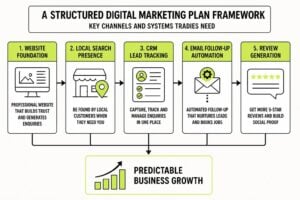
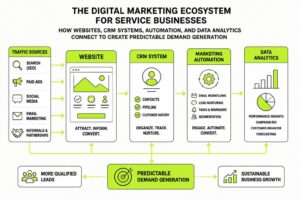
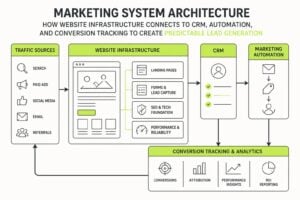
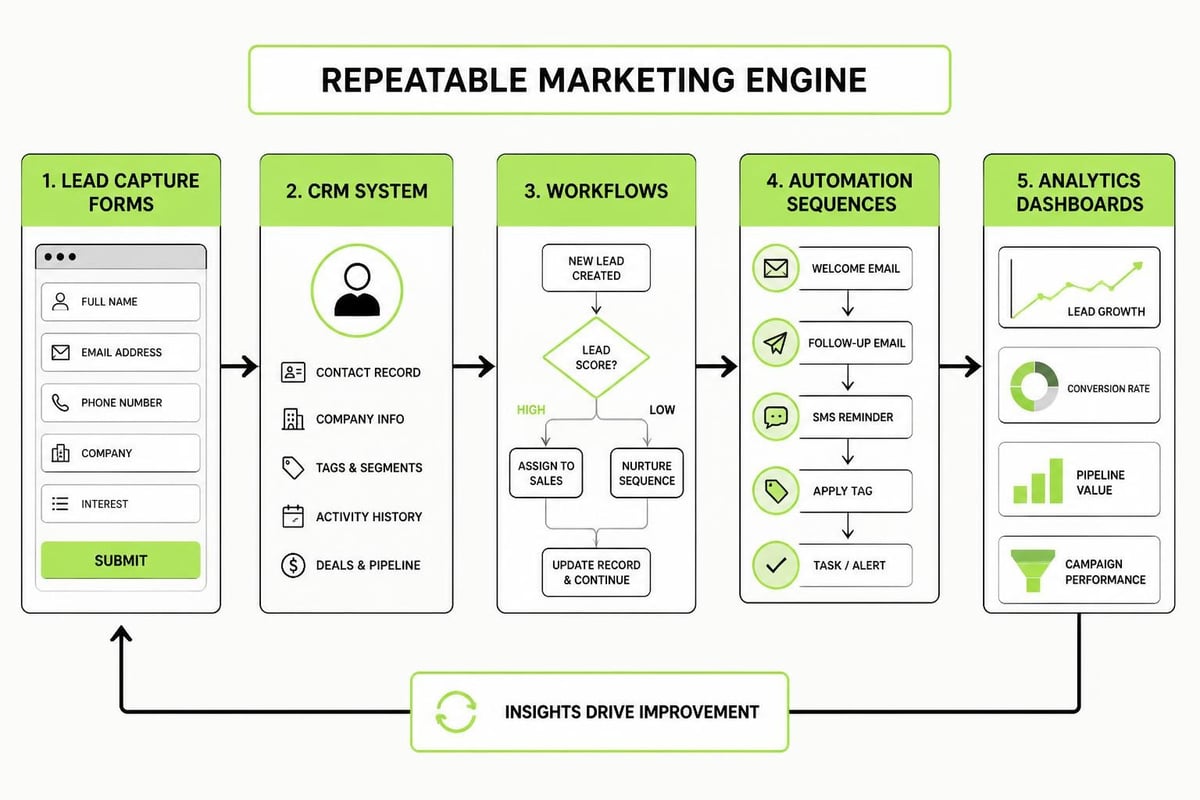
Marketing systems are infrastructure. They're the repeatable processes, tools, and workflows that turn strategy into predictable results. Systems capture leads, nurture relationships, move prospects through decision stages, and measure what's working.
Systems Handle the Repetition
Where strategy is decided once (and refined over time), systems run daily. They're the machinery.
A marketing system typically includes:
- Lead capture mechanisms: forms, landing pages, opt-in offers
- CRM infrastructure: centralised database where every lead lives
- Automation sequences: email nurture, follow-up workflows, segmentation logic
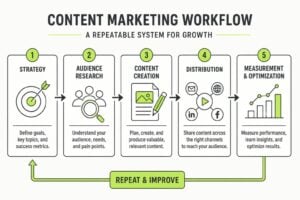
- Content production: processes for creating blogs, social posts, videos consistently
- Analytics and reporting: dashboards that show what's converting and what's not
If you've ever lost a lead because someone forgot to follow up, that's a systems problem. If your team doesn't know which campaign generated a client, that's a systems problem. Strategy can't fix these gaps.
| Strategy Component | System Component |
|---|---|
| Define target audience | Build CRM segments and tags |
| Choose social platforms | Schedule content production workflow |
| Craft value proposition | Create landing pages and opt-in forms |
| Set revenue goals | Implement attribution and pipeline tracking |
| Position against competitors | Develop brand guidelines and messaging templates |
The relationship is simple. Strategy decides. Systems deliver. One doesn't replace the other.
Why Marketing Systems vs Marketing Strategy Is a False Choice
The debate isn't about picking one. It's about understanding that marketing systems vs marketing strategy represent two halves of the same machine. Strategy without systems stays theoretical. Systems without strategy become busy work.
Strategy Guides, Systems Execute
You can't automate your way out of a positioning problem. You also can't manually scale a process that should be systematised. Both limitations show up in service businesses trying to grow.
Here's what happens when they're misaligned:
- Great strategy, no systems: You know exactly who to target and what to say, but leads fall through the cracks because nothing's automated. Growth happens in bursts, then stalls when you're too busy to follow up.
- Great systems, no strategy: Your CRM is pristine, your automations fire perfectly, but you're targeting the wrong people with the wrong message. Efficiency at doing the wrong thing.
- Neither: Chaos. Reactive marketing. Hoping referrals keep coming. No compounding momentum.
When both align, you get a repeatable growth system that generates consistent demand. Your strategy tells you which leads matter. Your systems make sure those leads are captured, nurtured, and converted without manual heroics.
How to Build Both Together
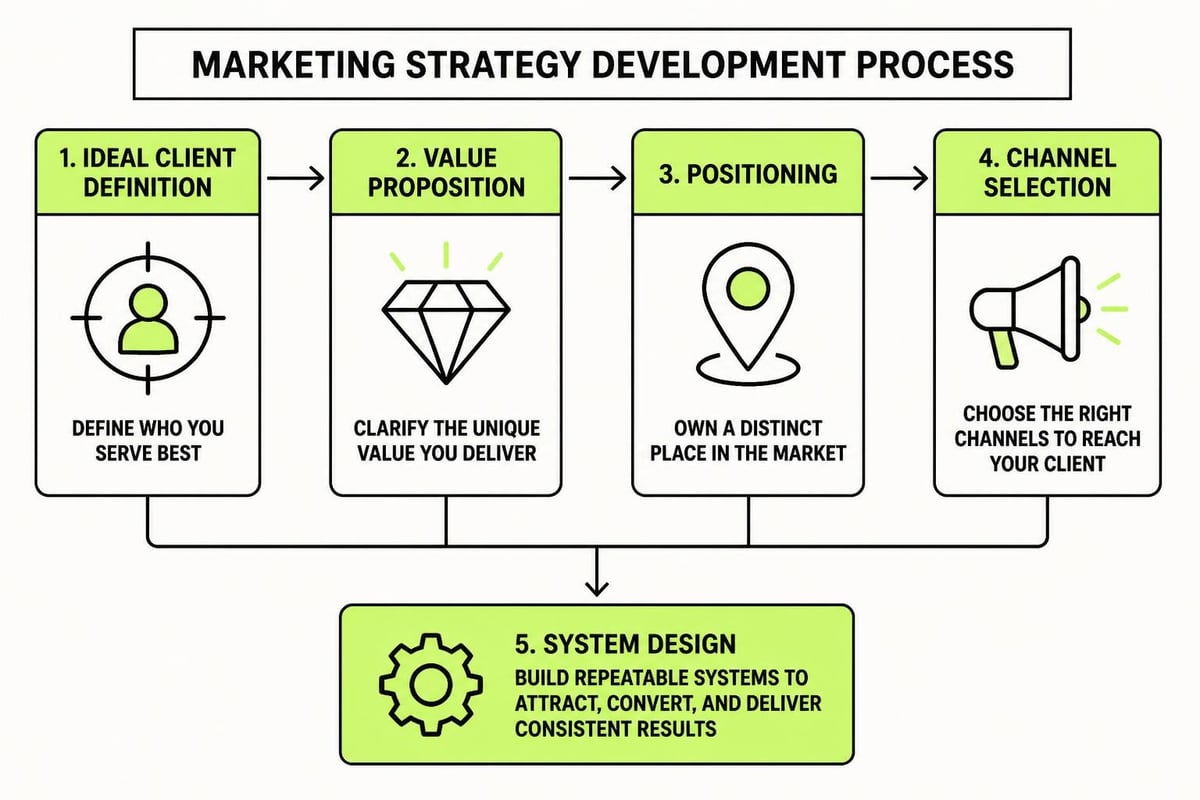
Start with strategy. Get clear on who you serve, what you sell, and how you're different. Then build systems to execute that strategy at scale. The sequence matters.
Step One: Define Strategic Foundations
Before you touch a CRM or write an automation, answer these:
- Who is your ideal client? Not just demographics. Psychographics, buying triggers, objections, existing behaviour.
- What outcome do they want? The result they'll pay for, not the service you deliver.
- Why you, not someone else? Your positioning in one sentence.
- Where do they look for solutions? The platforms and channels where attention already exists.
This is strategy work. It's thinking, not doing. Most businesses skip it because it feels slow. But building a marketing system without this foundation is like constructing a house without blueprints.
Step Two: Map the Client Journey
Once strategy is clear, map how someone moves from stranger to client. This is where systems thinking starts.
A typical service business journey includes:
- Awareness: They discover you exist (content, ads, referrals)
- Interest: They want to know more (lead magnet, email list)
- Consideration: They're evaluating options (nurture sequence, case studies)
- Decision: They're ready to buy (sales call, proposal)
- Experience: They become a client (onboarding, delivery)
- Advocacy: They refer others (review requests, referral systems)
Each stage needs a system. Your strategy tells you what message fits each stage. Your systems deliver that message reliably.
Step Three: Build the Infrastructure
Now you implement. CRM, automation, analytics, content workflows. The tools don't matter as much as the structure.
Core system components:
| System Layer | Purpose | Example Tools |
|---|---|---|
| Lead Capture | Collect contact details | Landing pages, forms, opt-ins |
| CRM Database | Centralise all contacts | HubSpot, ActiveCampaign, Pipedrive |
| Email Automation | Nurture and follow up | Sequences, broadcasts, segments |
| Content Engine | Publish consistently | Editorial calendar, SOPs |
| Analytics Stack | Measure and optimise | Google Analytics, CRM reports |
According to MarketingOps.com research, marketing operations professionals spend most of their time on system reliability and integration. That's because systems break when they're not maintained or when strategy shifts and systems don't adapt.
If you're looking for a practical framework that bridges marketing systems vs marketing strategy, the 7-Step Marketing Plan walks through how to set goals, define your buyer, choose platforms, create opt-in offers, build CRM infrastructure, deliver great client experiences, and generate referrals. Each step builds on the last, creating a complete system anchored in strategic clarity.

Step Four: Test, Measure, Refine
Both strategy and systems need iteration. Your initial positioning might miss the mark. Your automation sequences might have drop-off points. The difference is how you spot problems.
- Strategy problems: Low conversion rates across all channels, high unsubscribe rates, clients who don't fit your ideal profile.
- System problems: Leads not getting followed up, data gaps in your CRM, broken automations, manual work that should be automated.
Forrester recommends creating a formal marketing operations charter to define roles, governance, and technology. This ensures systems stay aligned with strategy as both evolve.
Common Mistakes in Balancing Both
Service businesses make predictable errors when dealing with marketing systems vs marketing strategy. Knowing them helps you avoid the traps.
Mistake One: Jumping to Tactics
You see a competitor running Facebook ads and think that's the answer. But tactics without strategy just burn budget. Ads are a system component. They need strategic clarity first. Who are you targeting? What's the offer? Where do leads go after they click?
Mistake Two: Over-Complicating Systems
More tools don't mean better systems. A simple CRM with clean data beats a complex stack that nobody uses. Start with the minimum infrastructure needed to execute your strategy, then add complexity only when you hit real constraints.
Mistake Three: Treating Strategy as Static
Markets shift. Competitors move. Client needs evolve. Your strategy should be reviewed quarterly, not set once and forgotten. When strategy changes, systems must adapt. If you pivot your positioning but keep the old automation sequences, you're sending the wrong message to the right people.
Mistake Four: Ignoring the Feedback Loop
Systems generate data. That data should inform strategy. If your nurture sequence shows people dropping off at email three, maybe your positioning isn't resonating. If certain lead sources convert at 10x others, maybe your channel strategy needs adjustment. The insights flow both ways.
What This Looks Like in Practice
A service-based business that gets marketing systems vs marketing strategy right operates differently. Here's what changes.
Before alignment:
- Leads come in sporadically from random sources
- Follow-up depends on someone remembering
- No clear picture of what's working
- Revenue feels unpredictable
- Marketing is a cost centre, not a growth engine
After alignment:
- Leads flow consistently from defined channels
- Every lead enters a system that nurtures automatically
- Clear attribution from first touch to closed client
- Revenue becomes forecastable
- Marketing compounds over time instead of resetting each month
This isn't theory. It's what happens when you combine marketing and business development into a single integrated system guided by clear strategy.
The Infrastructure vs Intent Question
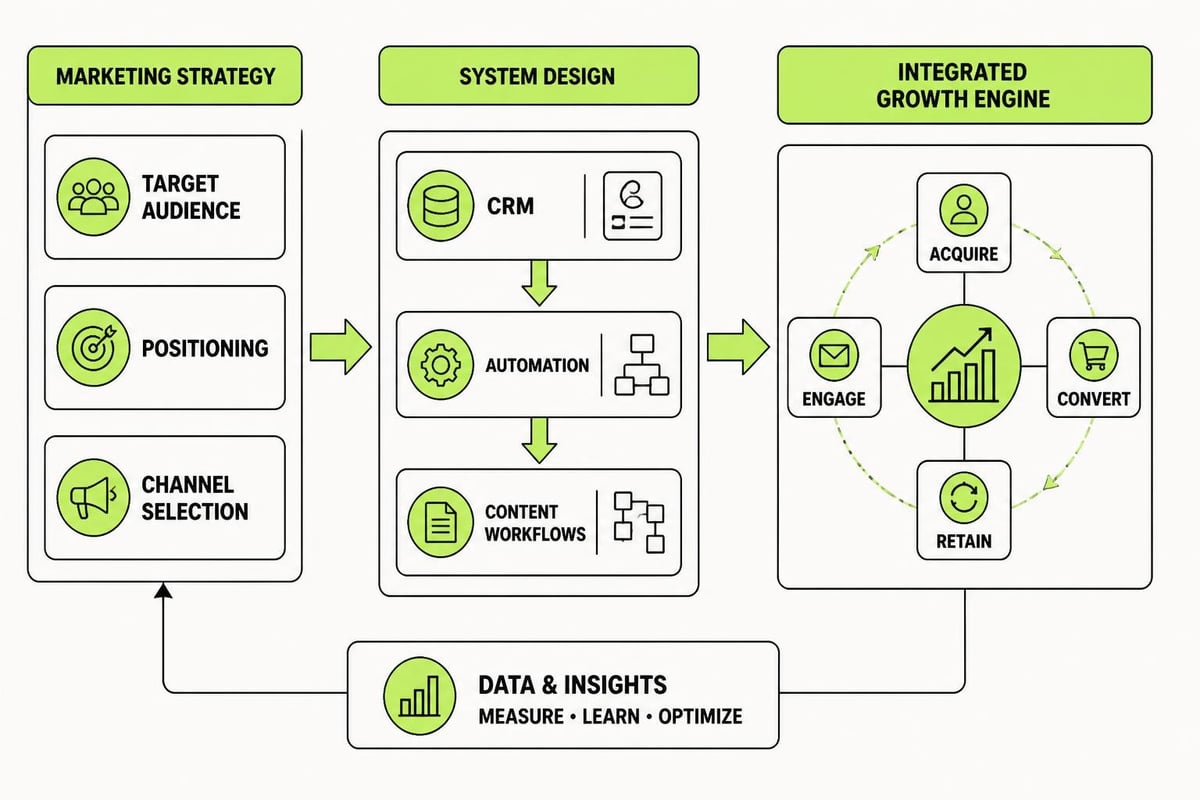
One way to understand marketing systems vs marketing strategy is to think about infrastructure vs intent. Strategy is your intent. What you're trying to achieve and why. Systems are infrastructure. The roads, pipelines, and machinery that make intent real.
You wouldn't build a factory without knowing what product you're making. You also wouldn't design a product without considering how to manufacture it at scale. Same logic applies here.
Strategic intent examples:
- We help professional services firms build predictable pipeline
- We position ourselves as the premium option for clients who value long-term relationships
- We focus on organic channels because our buyers research heavily before making contact
System infrastructure examples:
- A 12-email nurture sequence that educates on our methodology
- A CRM that segments leads by service interest and engagement level
- A content calendar that publishes two deep-dive articles per week on topics our buyers search for
Intent shapes infrastructure. Infrastructure enables intent. When you treat them as separate concerns, both suffer.
Building for Compound Growth
The real power of understanding marketing systems vs marketing strategy shows up in compounding. Strategy that doesn't compound is just project work. Systems that don't compound are just maintenance.
How Strategy Compounds
Good positioning gets stronger as more people recognise it. A clear value proposition becomes easier to communicate as case studies accumulate. Channel selection improves as you learn which platforms generate the best-fit clients. Strategy compounds through learning and market presence.
How Systems Compound
Every lead that enters your CRM adds to your database. Every automation you build saves time on the next campaign. Every piece of content you create becomes an asset that works for years. Systems compound through accumulation and efficiency.
When both compound together, growth accelerates. Your strategy becomes sharper because your systems generate data. Your systems become more effective because your strategy gets clearer.
The Role of Expertise
Most service businesses don't have dedicated marketing operations expertise. They're trying to build strategy and systems while delivering client work. That's the constraint. You can learn enough to be dangerous, but digital marketing experts spend full-time staying current on what actually works.
The knowledge gap isn't about tactics. It's about knowing which systems support which strategies, how to integrate tools without creating data chaos, and how to measure what matters instead of vanity metrics.
This is where specialisation helps. You focus on your core service. Someone else focuses on building the marketing infrastructure that feeds your pipeline. Division of labour based on expertise, not just task delegation.
When to Prioritise One Over the Other
There are moments when marketing systems vs marketing strategy isn't balanced. Sometimes you need to invest heavily in one before the other catches up.
Prioritise strategy when:
- You're entering a new market or launching a new service
- Your current positioning isn't resonating
- You're not clear who your ideal client is
- Marketing feels scattershot and reactive
Prioritise systems when:
- Strategy is clear but execution is chaotic
- Leads are being lost due to manual processes
- You can't measure what's working
- You're hitting growth constraints because you can't scale delivery of your strategy
Both need attention eventually. But the sequence matters based on where your biggest constraint lives right now.
The Integration Point
At some point, marketing systems vs marketing strategy stops being a useful distinction. They merge into a single operating model. Your strategy informs every system decision. Your systems validate or challenge strategic assumptions.
That integration is the goal. Not just having both, but making them indivisible. When a new lead enters your CRM, the automation they receive reflects your positioning. When you review analytics, the metrics you track align with strategic goals. When you create content, the topics and distribution follow both strategic priorities and systematic processes.
This is what online business and marketing looks like when it's actually working. Not guesswork. Not grinding. Just clear intent executed through reliable infrastructure.
Marketing systems vs marketing strategy aren't competing priorities. They're two parts of how predictable growth actually happens. Strategy gives you direction. Systems give you delivery. Both need to work together, and both need ongoing attention as your business scales. If you're ready to build marketing infrastructure that turns attention into demand without the chaos, MDO Digital specialises in exactly that. We remove the guesswork, protect your leads, and create growth systems that compound over time.