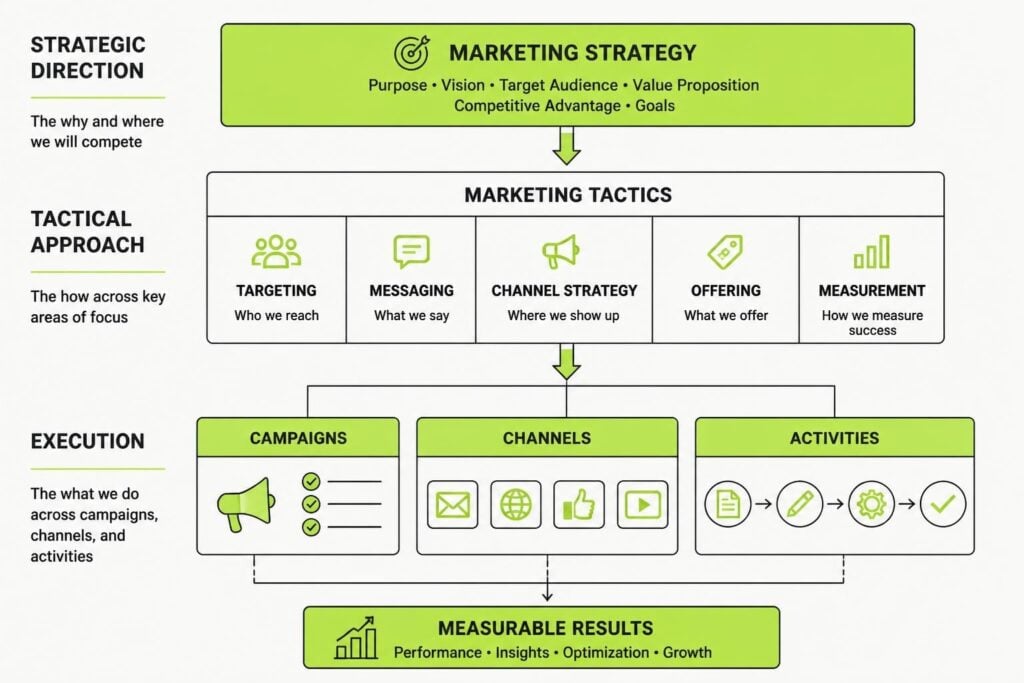
Most business owners confuse activity with progress. They post on social media, send emails, run ads, and wonder why the numbers don't move. The problem isn't effort. It's the absence of a proper framework to connect what you're doing to why you're doing it. Understanding marketing strategy vs tactics isn't just useful, it's essential for building a marketing system that compounds over time instead of burning cash and goodwill. Strategy sets the direction. Tactics get you there. Mixing them up is like setting sail without checking the map.
Why Marketing Strategy vs Tactics Matters More Than You Think
The distinction between marketing strategy vs tactics might seem academic, but it determines whether your business grows predictably or lurches from one shiny object to the next.
Strategy is your high-level plan. It defines who you serve, what problem you solve, how you position yourself, and where you'll compete. It's the answer to "why are we doing this?" and "who are we doing it for?"
Tactics are the specific actions you take to execute that strategy. Email campaigns. Social posts. Ad copy. Landing pages. These are the tools, not the blueprint.
When you treat tactics as strategy, you end up chasing trends without context. You run Facebook ads because everyone else is, not because they fit your customer journey. You post daily on LinkedIn because a guru said so, not because your audience is there.
Harvard Business Review notes that many organisations mistake operational plans for actual strategy, leading to disconnected execution and wasted resources. The same applies in marketing. A content calendar isn't a strategy. It's a tactic that supports one.
What Strategy Actually Looks Like
Strategy starts with clarity about three things:
- Your ideal customer: Not "everyone who might buy." The specific persona who gets the most value and is easiest to serve.
- Your market position: What makes you different, credible, and worth choosing over alternatives.
- Your growth levers: The few channels and offers that reliably move prospects from stranger to customer.
Once these are defined, strategy becomes your filter. Every tactic gets evaluated against whether it reinforces your position, reaches your audience, or activates a proven lever. If it doesn't, you don't do it, no matter how clever it sounds.
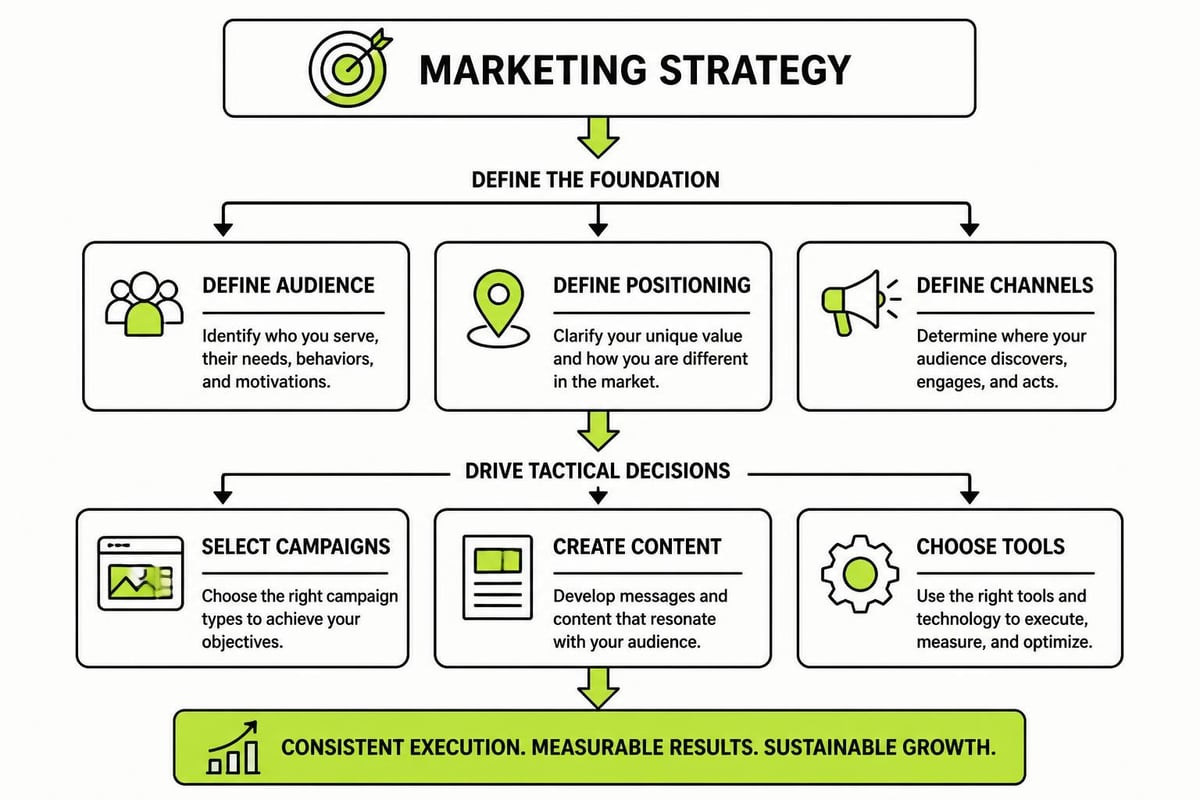
The Real Difference Between Marketing Strategy vs Tactics
Let's make this concrete with a comparison table, because vague definitions don't help anyone.
| Aspect | Strategy | Tactics |
|---|---|---|
| Focus | Long-term direction and positioning | Short-term execution and actions |
| Question answered | Why and who? | What and how? |
| Timeframe | 12–36 months | Days to weeks |
| Examples | Target market selection, brand positioning | Email sequences, ad campaigns, blog posts |
| Measured by | Market share, revenue growth, brand strength | Click rates, conversions, engagement |
| Changes | Rarely, only with major market shifts | Frequently, based on performance data |
Strategy is slow and deliberate. Tactics are fast and flexible. The American Marketing Association clarifies this relationship well, explaining that tactics without strategy lead to random acts of marketing, while strategy without tactics is just a theory that never touches reality.
Strategy Informs Tactics, Not the Other Way Around
Here's where most service businesses get stuck. They choose tactics first, then try to reverse-engineer a strategy to justify them. That's backwards.
If your strategy is to position as the premium choice for property managers who value systems over speed, your tactics follow that logic:
- You write content that demonstrates depth, not hacks.
- You invest in case studies and testimonials that show long-term results.
- You advertise in places where decision-makers research, not where bargain hunters scroll.
- You build a CRM that nurtures over months, not days.
Every tactic supports the strategic position. Nothing exists in isolation. This is how marketing solutions for service businesses actually scale without chaos.
Common Mistakes When Mixing Up Marketing Strategy vs Tactics
Most businesses don't fail because they pick bad tactics. They fail because they pick tactics that contradict each other or don't support a coherent strategy.
Mistake One: Tactic Hopping Without Strategic Consistency
You launch a referral program, then pivot to cold outreach, then try influencer partnerships, then bet on SEO. Each one could work, but none get enough time or integration to prove themselves. You're changing tactics faster than you can measure them.
The problem isn't the tactics. It's the absence of a strategic framework to decide which ones matter and how long to commit.
Mistake Two: Treating Tactics as Plug-and-Play
A tactic that works brilliantly for a B2C e-commerce brand might flop for a B2B consulting firm. Context matters. Audience matters. Your strategic position matters.
Running TikTok ads isn't inherently good or bad. It's good if your audience is there and your offer suits the platform. It's a waste if you're targeting CFOs in their 50s who don't scroll short-form video.
Mistake Three: No Feedback Loop Between Strategy and Tactics
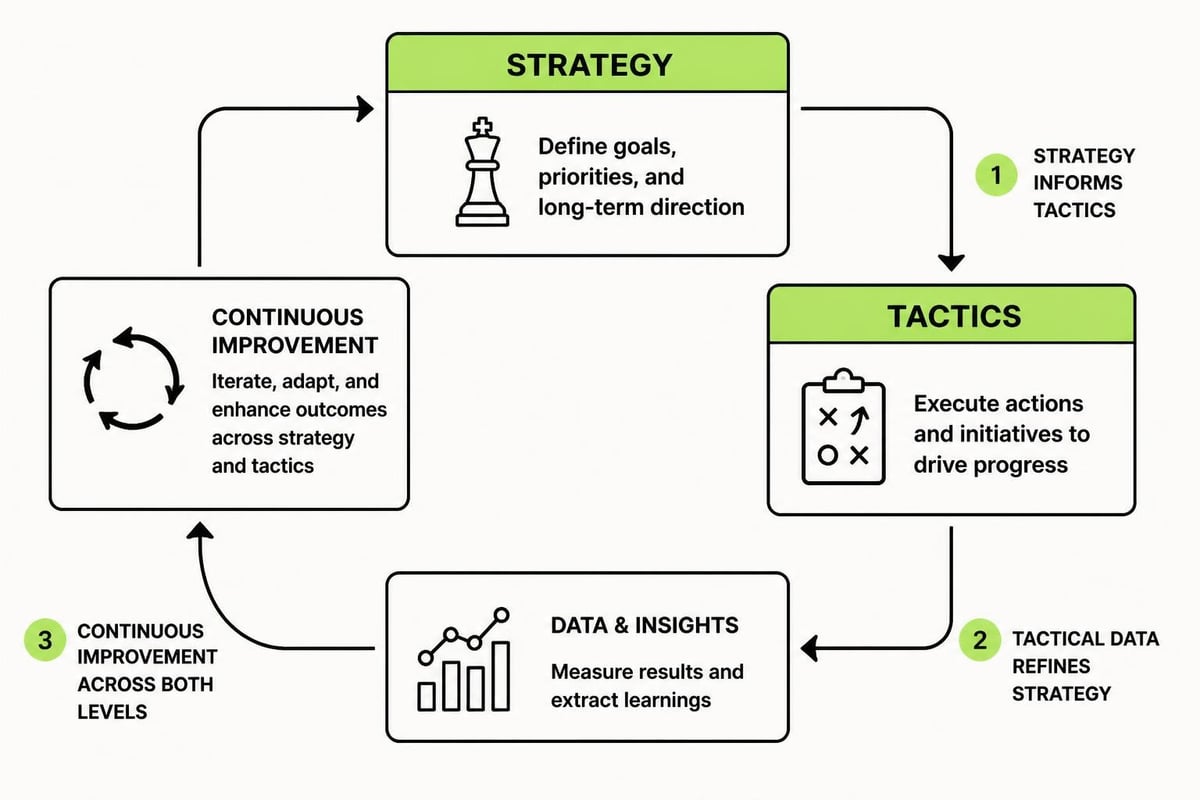
Strategy should inform tactics, but tactics should also refine strategy. If every tactic aimed at a certain segment underperforms, maybe your strategy misjudged the audience. If one channel crushes it, maybe your positioning resonates there better than expected.
The feedback loop matters. Nielsen’s annual marketing report highlights how companies that link strategy, measurement, and execution see significantly better ROI than those that treat them as separate workstreams.
Building a Marketing System That Connects Strategy and Tactics
Understanding marketing strategy vs tactics is only useful if you can build a system that connects them. Theory doesn't move revenue. Execution does.
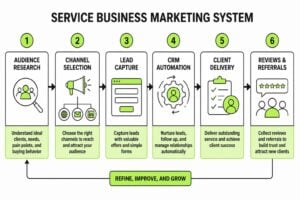
A structured system starts with a repeatable framework. You need clear steps from awareness to conversion, and tactics assigned to each step based on strategic priorities.
Here's a practical approach:
Step One: Define Your Strategic Pillars
Write down your core strategic decisions:
- Target market: Specific industry, company size, role, pain point.
- Value proposition: The unique outcome you deliver and why it matters.
- Positioning: How you want to be perceived relative to alternatives.
These don't change week to week. They're your foundation.
Step Two: Map the Customer Journey
Identify the stages your prospects move through:
- Awareness (they realise they have a problem)
- Consideration (they evaluate solutions)
- Decision (they choose a provider)
- Retention (they stay and refer)
Each stage needs different tactics, but the strategy determines what those tactics emphasise.
Step Three: Assign Tactics to Each Stage
Now you get tactical. For each journey stage, pick 2–3 activities that align with your strategy.
Awareness tactics might include:
- SEO-optimised content targeting high-intent keywords
- Paid ads on platforms where your audience researches
- Partnerships or guest content in trusted industry spaces
Consideration tactics might include:
- Case studies and testimonials
- Educational email sequences
- Product demos or audits
Decision tactics might include:
- Clear pricing and process transparency
- Consultative sales calls
- Proposal templates that reinforce positioning
Retention tactics might include:
- Onboarding sequences
- Regular check-ins and optimisation
- Referral incentives
A well-structured system like the 7-Step Marketing Plan gives you a repeatable framework to connect strategic goals with tactical execution, ensuring every action feeds the next.
Step Four: Measure What Matters at Each Level
Strategic metrics track long-term health. Tactical metrics track short-term performance.
| Strategic Metrics | Tactical Metrics |
|---|---|
| Revenue growth | Click-through rate |
| Customer lifetime value | Email open rate |
| Market share | Ad conversion rate |
| Brand awareness | Landing page conversion |
| Customer acquisition cost | Cost per lead |
Tactics inform strategy when you see patterns. If tactical metrics are strong but strategic metrics stall, your tactics might not align with the strategy. If both are weak, the strategy itself may need revisiting.
Using return on marketing investment effectively requires connecting these layers, not treating them as separate dashboards.
How to Audit Your Current Approach to Marketing Strategy vs Tactics
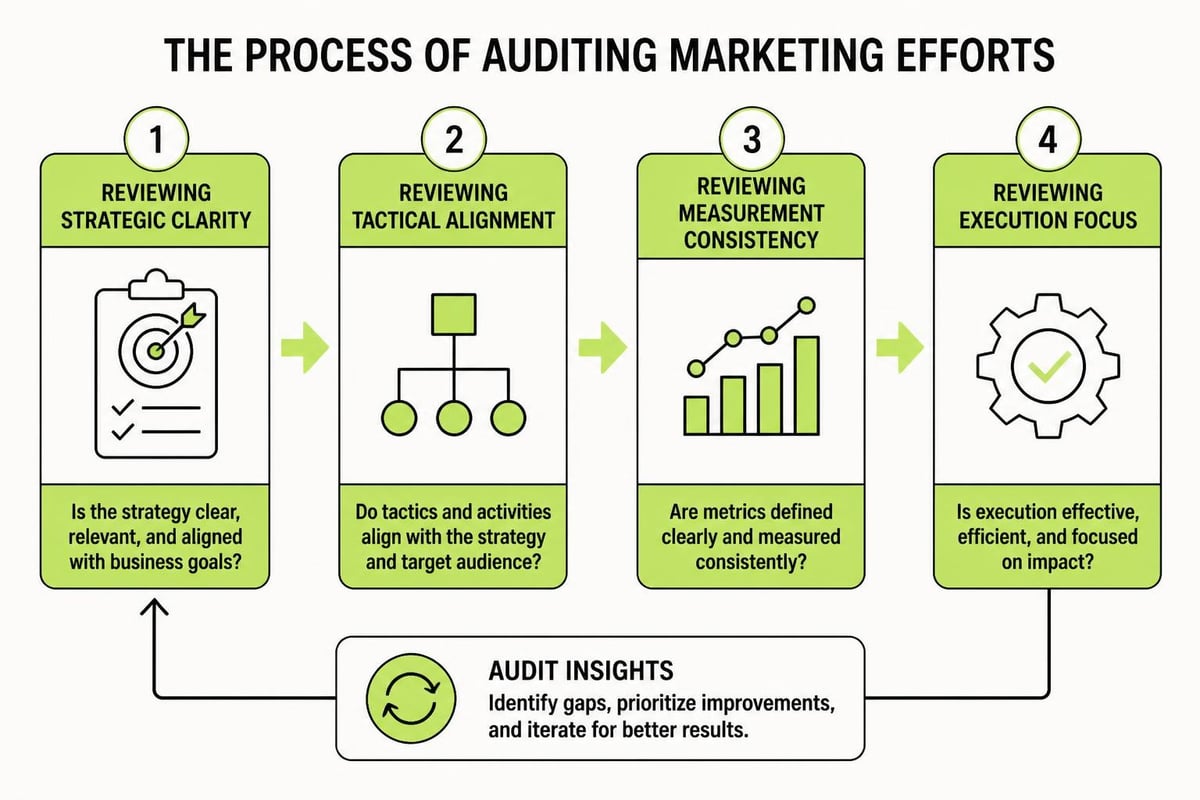
If you're unsure whether you're confusing strategy and tactics, run this quick audit.
Question One: Can You Explain Your Strategy in Three Sentences?
If you can't articulate who you serve, what makes you different, and where you focus, you probably don't have a strategy. You have a collection of tactics.
Question Two: Do Your Tactics Contradict Each Other?
Look at your messaging across channels. Does your LinkedIn position you as premium while your Facebook ads compete on price? Do your emails talk about speed while your website emphasises thoroughness? Contradictory tactics reveal strategic confusion.
Question Three: Are You Measuring Tactics Without Strategic Context?
High email open rates mean nothing if those emails don't move people toward a strategic goal. Good engagement on social posts is irrelevant if the audience isn't your target market.
Every tactical metric should connect to a strategic outcome. If it doesn't, stop tracking it or stop doing the tactic.
Question Four: How Often Do You Change Direction?
If you shift focus every quarter, you're tactic-hopping. Strategy requires commitment over multiple cycles. Tactics can and should evolve, but the underlying strategy should stay consistent long enough to prove or disprove itself.
Think with Google’s 2024 planning insights recommend scenario-based planning that keeps strategy stable while allowing tactical flexibility in response to market shifts.
Practical Examples of Marketing Strategy vs Tactics in Action
Let's ground this in real scenarios that service-based businesses face.
Example One: Expanding Into a New Service Area
Strategy: Position as the go-to provider for small accounting firms transitioning to cloud infrastructure.
Tactics:
- Write a lead magnet on "5 Mistakes Accountants Make When Moving to the Cloud"
- Run LinkedIn ads targeting firm owners in your region
- Build an automated email sequence that educates over 4 weeks
- Create case studies from early adopters
- Speak at local accounting industry events
The strategy defines the niche and positioning. The tactics execute it across channels and formats.
Example Two: Competing Against Larger Agencies
Strategy: Win by being more responsive, transparent, and systems-focused than bigger competitors.
Tactics:
- Publish detailed pricing and process guides on your website
- Offer free audits with actionable insights, not just sales pitches
- Use CRM automation to respond within minutes, not hours
- Share behind-the-scenes content that shows how you work
- Build client dashboards that provide real-time performance visibility
Each tactic reinforces the strategic position of "we're the ones who actually care and move fast."
If you're building this kind of system, focusing on branding and digital marketing ensures your positioning isn't just words on a page, it's embedded in every customer interaction.
Why Service Businesses Struggle With Marketing Strategy vs Tactics
Service businesses face unique challenges when separating strategy from tactics. Unlike product companies, your "product" is expertise, process, and relationships. That's harder to package and position.
You're also often time-poor. It's easier to react tactically than to step back and think strategically. A new platform launches, a competitor runs a clever campaign, a lead asks for something you don't normally offer. You adapt on the fly.
But reactive marketing doesn't compound. It exhausts.
The businesses that scale sustainably are the ones that commit to strategic clarity, even when it feels slower upfront. They define their lane, build systems around it, and let tactics evolve within that structure.
Forrester’s campaign taxonomy research shows that companies with clear taxonomies and consistent vocabularies execute faster and measure better, because everyone knows how tactics connect to strategy.
Integrating Strategy and Tactics Into Daily Operations
Knowing the difference between marketing strategy vs tactics doesn't help unless you embed it into how your team works.
Create a Strategy Document Everyone Can Reference
Write a one-page strategy doc that includes:
- Target audience definition
- Positioning statement
- Strategic priorities for the year
- Channels and offers you'll focus on
- What you won't do (just as important)
Share it with everyone who touches marketing. Use it to evaluate new ideas.
Review Tactics Against Strategy Weekly
In your marketing meetings, don't just review performance. Ask:
- Does this tactic still support our strategy?
- Are we seeing data that suggests the strategy needs adjusting?
- Are we spreading too thin or doubling down effectively?
Build Systems, Not Just Campaigns
One-off campaigns are tactical. Systems are strategic. A content calendar that publishes randomly is tactical. A content engine that answers customer questions at each funnel stage is strategic.
The same applies to CRM, automation, lead nurturing, and sales follow-up. Build infrastructure that executes strategy repeatedly, not just once. This is where marketing and business development merge into a growth engine.
When to Revisit Your Marketing Strategy vs Tactics Balance
Your strategy shouldn't change every month, but it's not set in stone forever either. Certain signals indicate it's time to reassess.
Signal One: Tactical Performance Plateaus Across the Board
If every tactic underperforms despite optimisation, the strategy might be targeting the wrong audience or positioning you poorly.
Signal Two: Market Conditions Shift Significantly
New competitors, regulatory changes, technology disruptions, or customer behaviour shifts can make a previously sound strategy obsolete.
Signal Three: You've Achieved Your Strategic Goals
If your strategy was to dominate a local niche and you've done that, it's time for a new strategic phase. Expansion, diversification, or premium repositioning might follow.
Signal Four: Internal Capabilities Change
If you acquire new skills, tools, or team members, your strategic options expand. A business that couldn't execute complex automation a year ago might now have that capability.
Revisiting strategy is strategic. Changing it reactively is just tactical chaos wearing a strategy label.
Understanding marketing strategy vs tactics transforms how you build, measure, and scale your marketing. Strategy is the direction. Tactics are the steps. Both matter, but strategy comes first. If you're ready to build a marketing system that removes chaos, protects leads, and creates structured growth, MDO Digital can help. We specialise in turning scattered activity into repeatable infrastructure that compounds over time.