Most service businesses throw marketing offers into the market like spaghetti at a wall, hoping something sticks. They run promotions that don't convert, create packages nobody wants, and wonder why their sales pipeline feels like a leaky bucket. The problem isn't the market. It's that most offers are built without structure, clarity, or connection to what buyers actually need. A well-designed marketing offer does more than attract attention. It filters the right leads, communicates value instantly, and makes the next step obvious. This matters because your offer is the bridge between awareness and action, and if that bridge is shaky, you lose trust before you ever start a conversation.
Why Most Marketing Offers Fail Before They Launch
The typical marketing offer fails because it's built from the inside out. Business owners start with what they want to sell rather than what their audience needs to buy. They bundle services randomly, add discounts without strategy, and wrap it all in vague language that sounds impressive but means nothing.
Here's what actually happens when an offer misses the mark:
- Wrong audience targeting leads to high traffic but zero conversions
- Unclear value propositions make prospects hesitate and compare endlessly
- No qualifying mechanism means you attract price shoppers, not buyers
- Weak calls to action leave interested people with nowhere to go
- Missing urgency or scarcity removes any reason to act now instead of later
The gap between a mediocre offer and one that drives predictable demand isn't creativity. It's structure. When you build marketing systems around clear offers, you create a repeatable path from attention to revenue.
The Anatomy of Effective Marketing Offers
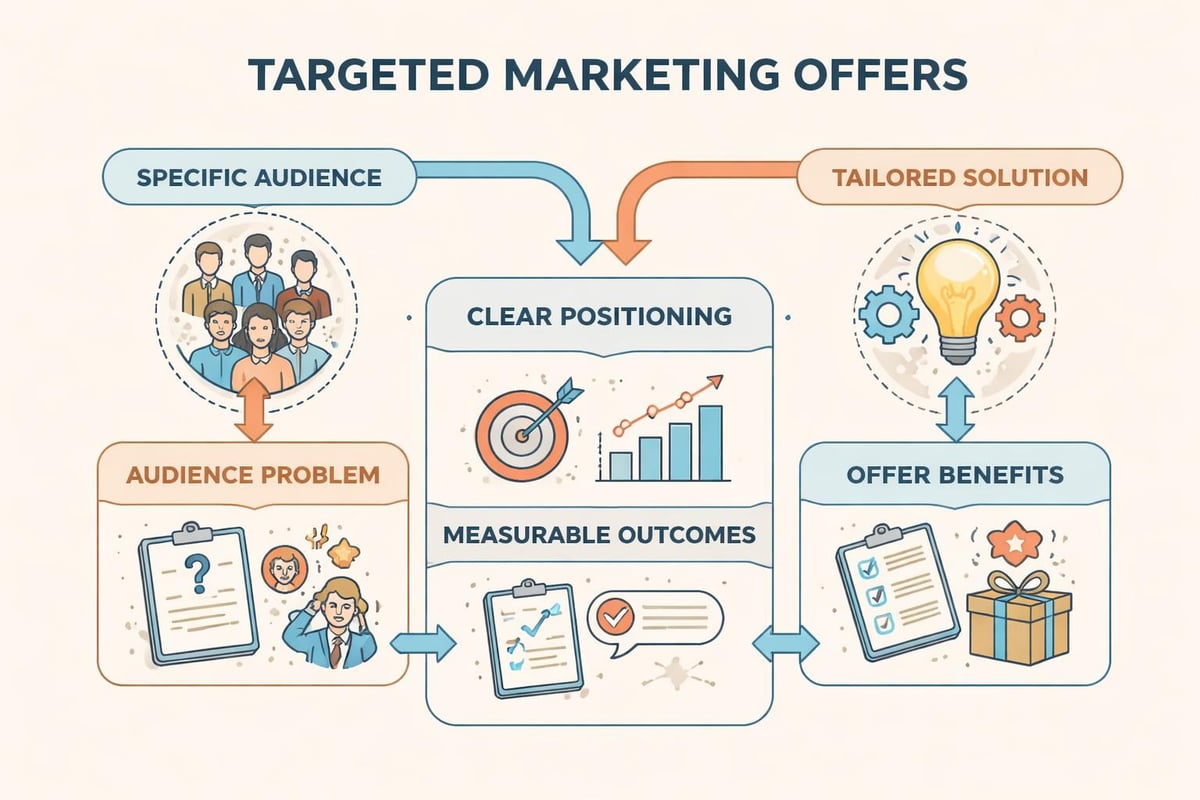
Strong marketing offers share common DNA. They solve a specific problem for a specific person at a specific time. Everything else is decoration.
| Element | Weak Version | Strong Version |
|---|---|---|
| Target | "Small businesses" | "Service businesses doing $500K-$2M with broken CRM" |
| Problem | "Need more customers" | "Leads fall through gaps, repeat work costs time, growth feels chaotic" |
| Solution | "Marketing services" | "90-day CRM buildout with automation, lead tracking, and handoff protocols" |
| Outcome | "Better results" | "Zero lost leads, 40% faster client onboarding, clear revenue forecasting" |
| Proof | "We're experienced" | "Case study: 6 clients reduced admin time by 15 hours/week in 60 days" |
Notice the difference isn't length. It's specificity. Generic marketing offers compete on price because they haven't earned the right to compete on value. When you name the exact situation your buyer faces, you stop being one of many options and become the obvious choice.
Building Marketing Offers Around Real Buyer Intent
Understanding what someone wants to buy is different from understanding what they need. Your job isn't to educate them into wanting something different. It's to meet them where they are and guide them forward.
Buyer intent falls into stages, and your marketing offers should map to each one:
- Awareness stage – They know they have a problem but don't know the solution
- Consideration stage – They're comparing approaches and vendors
- Decision stage – They're ready to buy and evaluating specific offers
- Expansion stage – They're existing clients ready for more depth
Most businesses create one offer and wonder why it doesn't work across all stages. That's like using a hammer for every job. Different moments need different marketing offers.
Structuring Offers by Intent Level
At the awareness stage, your offer should be low-friction and educational. Think diagnostic calls, frameworks, or assessments. These aren't revenue generators. They're qualification tools that build trust and surface real need.
For consideration, create comparison-focused offers. Audits work well here, as do strategic roadmaps. You're showing your thinking and methodology without giving away the execution. This is where you separate browsers from buyers.
Decision-stage marketing offers need clear scope, transparent pricing, and speed to value. Package specific outcomes with defined timelines. Make the buy decision simple by removing ambiguity.
According to research on marketing effectiveness, the most successful campaigns align messaging to customer readiness. Your offers should do the same.
Pricing Strategy Within Your Marketing Offers
Price isn't just a number. It's a signal about positioning, quality, and who you serve. How you structure pricing within your marketing offers directly impacts both conversion rates and client quality.
Common pricing models for service offers:
- Fixed project pricing – Clear scope, clear price, defined timeline
- Retainer arrangements – Ongoing access, predictable monthly cost
- Value-based pricing – Tied to outcomes or percentage of results
- Tiered packages – Good, better, best options at different price points
- Performance pricing – Base fee plus results-based bonuses
The wrong model attracts the wrong clients. If you're positioning as premium but pricing like a commodity, you'll get tire-kickers. If you're priced high but can't articulate specific outcomes, you'll get objections.
When designing your pricing strategy, consider what behavior you want to encourage. Monthly retainers create stability but can breed complacency. Project pricing drives urgency but can feel transactional. Hybrid models often work best, especially for service businesses scaling systems.
Making Price a Filter, Not a Barrier
Your marketing offers should use price to qualify, not to maximize volume. If you want to work with serious buyers who value expertise, price accordingly. Too low and you attract people who don't respect your time. Too high without proof and you price yourself out before the conversation starts.
The sweet spot is pricing that makes the right people pause and think, not pricing that makes everyone walk away. Include transparency around what's included, what's not, and what results they can expect. Hidden costs kill trust faster than high prices.
Crafting the Value Proposition That Sells
The value proposition inside your marketing offers answers one question: why should I choose you over doing nothing, doing it myself, or choosing someone else? If you can't answer that in one clear sentence, your offer isn't ready.
Most value propositions fail because they focus on features instead of transformation. "We build websites" is a feature. "We turn your website into a lead-generating machine that feeds your sales pipeline while you sleep" is transformation. One describes what you do. The other describes what changes for them.
| Weak Value Props | Strong Value Props |
|---|---|
| "Full-service marketing" | "End-to-end systems that turn chaos into predictable growth" |
| "Custom CRM setup" | "Zero lost leads through automated handoffs and follow-up sequences" |
| "Brand strategy" | "Position that cuts through noise and makes you the obvious choice" |
| "Content creation" | "Thought leadership that builds authority and drives inbound demand" |
Your value proposition should stack three layers: the functional benefit (what it does), the emotional benefit (how it feels), and the strategic benefit (where it leads). The best marketing techniques combine all three into messaging that resonates at multiple levels.
Messaging and Positioning Your Marketing Offers
Words matter more than most business owners think. The difference between "we help businesses grow" and "we remove the chaos that stops service businesses from scaling past $1M" is the difference between ignored and booked out.
Your messaging should answer these questions instantly:
- Who is this for? (Be specific, not inclusive)
- What problem does this solve? (Name the pain clearly)
- Why now? (Create urgency without manufactured scarcity)
- What's different here? (Your unique mechanism or approach)
- What happens next? (Clear, single call to action)
Generic language kills conversion because it fails to create recognition. When someone reads your offer and thinks "that's exactly my situation," you've won half the battle. When they read it and think "sounds nice but could be anyone," you've lost before you started.
Common Messaging Mistakes
Avoid industry jargon unless your audience lives in it. Don't hide behind buzzwords like "synergy," "innovative solutions," or "best-in-class." These mean nothing and signal that you don't actually know what you do.
Also avoid the rookie mistake of trying to be everything to everyone. Common email marketing mistakes include sending to broad, unqualified lists. The same applies to offer messaging. Narrow beats wide every time.
When you're developing your brand positioning, remember that clarity creates confidence. Confused prospects don't buy. They delay, compare, and usually choose the option that felt easiest to understand.
Delivery Mechanisms and Fulfillment Structure
How you deliver on your marketing offers impacts both client satisfaction and your ability to scale. The best offer in the world becomes a nightmare if fulfillment is chaotic, inconsistent, or requires you to reinvent the wheel every time.
Delivery models to consider:
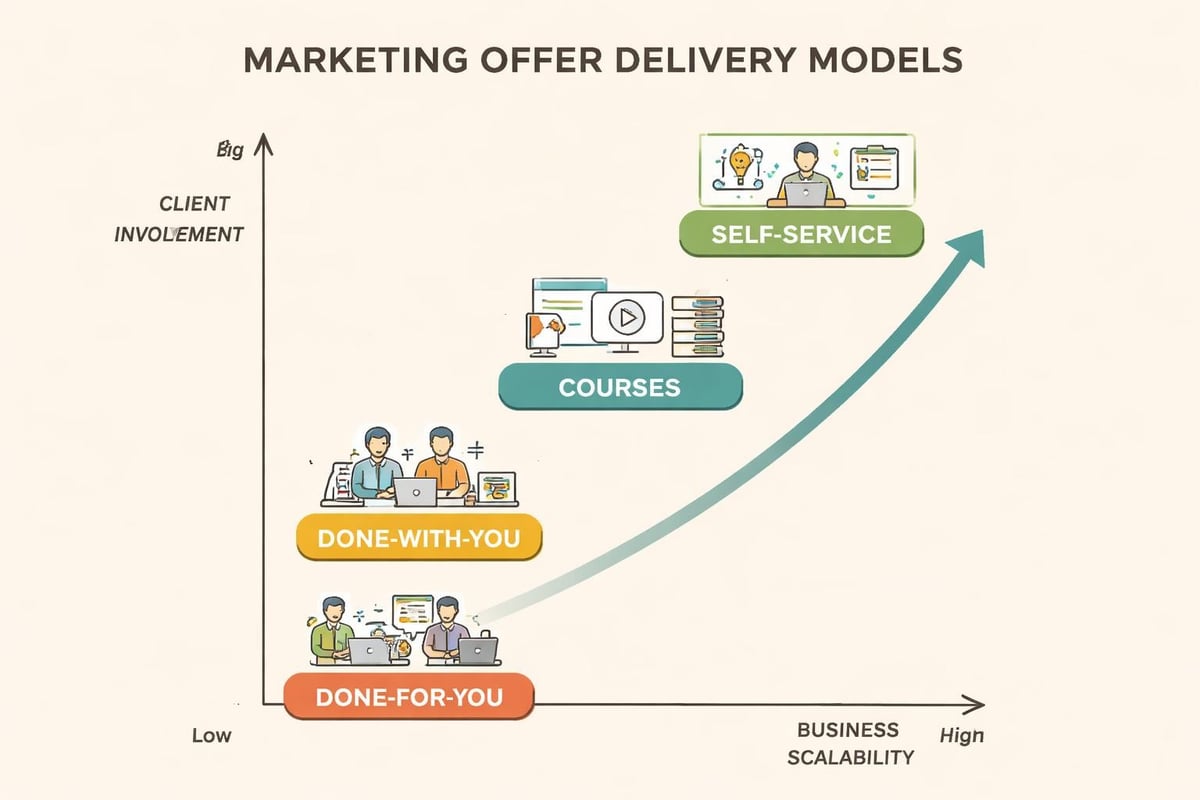
- Done-for-you – You handle everything, they receive finished deliverables
- Done-with-you – Collaborative work with defined roles and touchpoints
- Self-service with support – They implement, you guide and troubleshoot
- Hybrid models – Mix of done-for-you foundations with done-with-you optimization
Each model requires different systems, different team structure, and different client communication. Done-for-you scales through process and team. Done-with-you scales through frameworks and leverage. Self-service scales through content and automation.
The key is matching delivery to your market's sophistication and your business's capacity. If you promise white-glove service but deliver generic templates, you'll burn trust. If you offer DIY solutions to buyers who want it handled, you'll lose deals.
Testing and Optimizing Your Marketing Offers
No offer lands perfectly on the first try. The best ones evolve through testing, feedback, and iteration. What worked in 2024 might be stale in 2026. Markets shift, competition adapts, and buyer expectations change.
Metrics That Matter for Offer Performance
Track these to know if your marketing offers actually work:
| Metric | What It Tells You | Target Benchmark |
|---|---|---|
| Conversion rate | Percentage who take action | 2-5% for cold, 10-25% for warm |
| Average deal size | Revenue per closed offer | Should increase over time |
| Sales cycle length | Days from first touch to close | Shorter is usually better |
| Client acquisition cost | Total marketing spend ÷ new clients | Should be 1/3 or less of LTV |
| Offer acceptance rate | Proposals sent vs proposals signed | 30-50% is healthy |
Low conversion but high traffic means messaging mismatch. High conversion but low traffic means distribution problem. High traffic and conversion but low deal size means positioning issue.
Review these monthly and adjust. Maybe your guarantee isn't strong enough. Maybe your entry offer is priced wrong. Maybe you're attracting the right people but losing them at the proposal stage. Data shows you where the leaks are.
Learning From What Doesn't Work
Failed marketing offers teach more than successful ones if you're paying attention. When something flops, dig into why. Talk to people who didn't buy. Ask what stopped them. Most will tell you if you ask directly.
Looking at successful marketing case studies helps, but understanding your own failures matters more. Someone else's winning strategy might bomb in your market. Your unique context, audience, and positioning create different variables.
Packaging Multiple Offers Without Confusion
Most growing businesses eventually need multiple marketing offers. One for entry-level buyers, one for premium clients, maybe one for specific verticals or use cases. The challenge is presenting options without creating decision paralysis.
The solution is clear hierarchy and logical progression. Your offers should create a natural path from low commitment to high investment. Someone who buys your audit should naturally flow into implementation. Someone who takes the strategy session should see the done-for-you package as the obvious next step.
Framework for multi-offer structure:
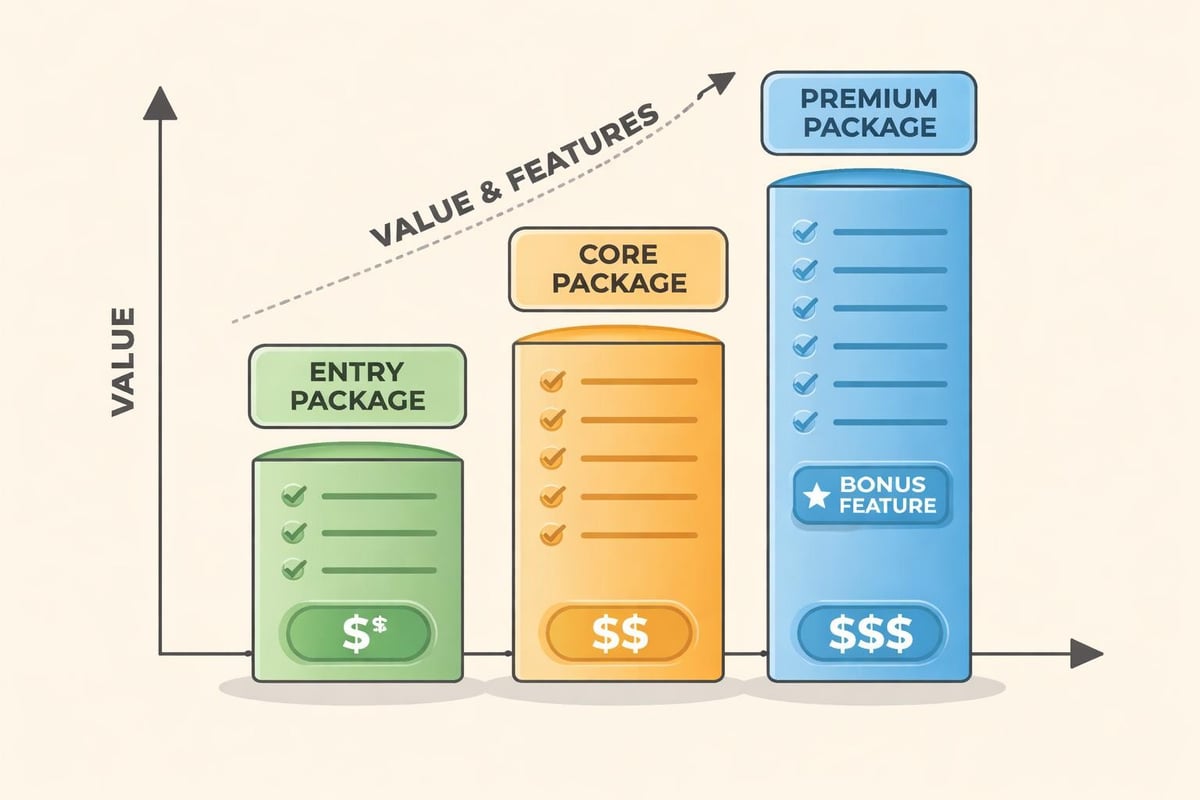
- Entry offer – Low price, high value, specific outcome, fast delivery (5-10 days)
- Core offer – Main revenue driver, solves complete problem, 30-90 day engagement
- Premium offer – Comprehensive solution, ongoing support, VIP access, 6-12 months
- Ascension offer – For existing clients, deeper expertise, specialized focus
Each tier should have clear boundaries. Don't let your entry offer bleed into your core offer's territory. Don't make your premium offer feel like "core plus some extras." Each should stand alone as a complete solution while naturally pointing to what comes next.
You can explore how different businesses structure their marketing offers to find patterns that fit your model. The key is consistency in how you package, price, and position across your portfolio.
Distribution Channels for Your Marketing Offers
Even perfect marketing offers fail if nobody sees them. Distribution matters as much as design. Where you place your offers, how you introduce them, and who delivers the message all impact performance.
High-performing distribution channels:
- Email sequences to qualified leads who've shown interest
- Website landing pages optimized for single offers with clear CTAs
- Sales conversations where offers solve problems identified in discovery
- Content marketing that educates then presents offers as natural solutions
- Paid advertising targeting specific buyer intent keywords or demographics
- Partner referrals from complementary businesses serving the same audience
Different channels work for different offers. Your premium package probably won't convert from cold Facebook ads. Your entry-level diagnostic might crush it. Your core offer might perform best when presented in a sales call after you've built rapport.
Test channel fit methodically. According to Microsoft’s go-to-market best practices, successful offers match distribution strategy to customer acquisition patterns. Don't assume. Measure and adjust.
When you're building integrated marketing systems, your offers should flow naturally through each channel. Email nurtures to landing pages. Landing pages to sales calls. Sales calls to proposal delivery. Each touchpoint should reinforce the offer's value and move toward decision.
The Role of Proof and Social Evidence
Nobody wants to be first. Even if your offer is perfect, buyers need proof that others have succeeded with it. This is where case studies, testimonials, and social proof become critical components of your marketing offers.
Specific beats vague every time. "Clients love us" means nothing. "We helped James reduce lead follow-up time from 3 days to 4 hours, recovering $40K in previously lost opportunities" creates belief. The more specific your proof, the more transferable it feels.
Include proof elements throughout your offer presentation:
- Before/after metrics showing measurable change
- Client testimonials addressing specific objections or concerns
- Case studies walking through problem, solution, and results
- Industry recognition or credentials that build authority
- Process transparency showing how you deliver outcomes
Learning how to effectively use case studies in marketing helps you position proof that converts. Don't just list wins. Tell stories that mirror your prospect's current situation and show them what's possible.
Also consider reviewing inspiring case study examples to understand how top performers structure their proof. The pattern is always the same: specific problem, clear intervention, measurable outcome, attributable to your work.
Guarantees and Risk Reversal
Strong marketing offers often include guarantees that shift risk from buyer to seller. This isn't about doing refunds. It's about showing confidence in your ability to deliver results.
Types of guarantees that work:
- Outcome guarantees – "If we don't achieve X result, we'll work until we do"
- Satisfaction guarantees – "If you're not happy after 30 days, we'll refund your investment"
- Performance guarantees – "We'll hit these milestones or extend the engagement at no cost"
- Process guarantees – "You'll receive weekly updates and have 24-hour response times"
The right guarantee depends on what your market fears most. If they're worried about wasting money, offer refunds. If they're worried about wasting time, guarantee speed. If they're worried about results, tie your fee to outcomes.
Just don't offer guarantees you can't honor. Nothing destroys credibility faster than backing down from a promise when tested. Make sure your operations can actually deliver what your marketing offers promise.
Seasonal and Timely Marketing Offers
Some marketing offers work year-round. Others gain power from timing. Q4 budget spending, new year planning, tax season, industry events-all create windows where specific offers resonate more.
Build a calendar of offer opportunities based on your audience's buying cycles. Service businesses often see increased interest in January (new budgets) and September (post-summer planning). Professional services might tie offers to regulatory changes or compliance deadlines.
Limited-time offers work when the urgency is real. "This week only" feels manufactured. "Before the Q2 planning cycle starts" feels strategic. "Ahead of the platform migration deadline" creates genuine pressure.
According to data-driven marketing tips from experts, timing accounts for up to 30% of campaign performance. The same offer presented at the right moment converts twice as well as at the wrong one.
Automation and Systems Behind Successful Offers
Manual offer management doesn't scale. As volume increases, you need systems that handle delivery, communication, and fulfillment without requiring your constant attention. This is where marketing automation and CRM infrastructure become essential.
Core systems to support your marketing offers:
- CRM tracking to manage leads from first touch through closed deal
- Email automation delivering nurture sequences based on offer interest
- Proposal software generating consistent, professional offer documents
- Project management tools ensuring delivery stays on track
- Payment processing making it easy for buyers to say yes
- Reporting dashboards showing offer performance in real-time
These aren't luxuries. They're requirements if you want predictable growth. Every manual step in your offer process is a point of failure and a limit on scale. Automate everything that doesn't require human judgment or relationship building.
When you structure content and branding systems properly, your offers become repeatable, refinable, and ultimately more profitable. Initial setup takes effort, but the compound returns make it worthwhile.
Strong marketing offers aren't about clever tactics or persuasion tricks. They're about clarity, structure, and meeting buyers where they are with solutions they actually need. When you build offers around real problems, communicate value clearly, and back everything with proof and systems, conversion stops feeling like luck and starts feeling like process. If you're ready to replace chaotic marketing with structured growth that compounds over time, MDO Digital helps service businesses design high-trust systems that turn attention into predictable demand. We remove the chaos, protect your leads, and build infrastructure that scales.