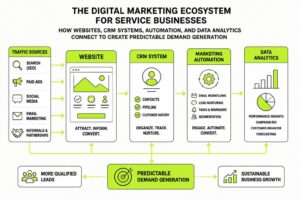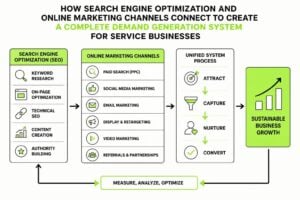
Most service businesses don't have a lead problem. They have a system problem. Enquiries come in from three different places, half disappear into email inboxes, and nobody knows which marketing channel actually works. A proper marketing funnel for service based business fixes this. It's not about complexity or spending more. It's about creating a clear path from first contact to paying client, then protecting every lead along the way. When you map the journey, automate the follow-up, and measure what matters, you stop guessing and start growing.
What makes service funnels different from product funnels
Service businesses face a unique challenge that ecommerce stores don't. You can't add trust to a cart. Someone buying your consulting, your trades work, or your professional services needs to believe you'll deliver before they commit. That means your marketing funnel for service based business needs more touchpoints, stronger proof, and clearer communication at every stage.
Product funnels optimize for speed. Get the visitor to checkout fast, minimize friction, reduce steps. Service funnels optimize for confidence. Your prospects need time to evaluate, compare, and convince themselves (or their team) that you're the right choice.
The core stages that actually matter
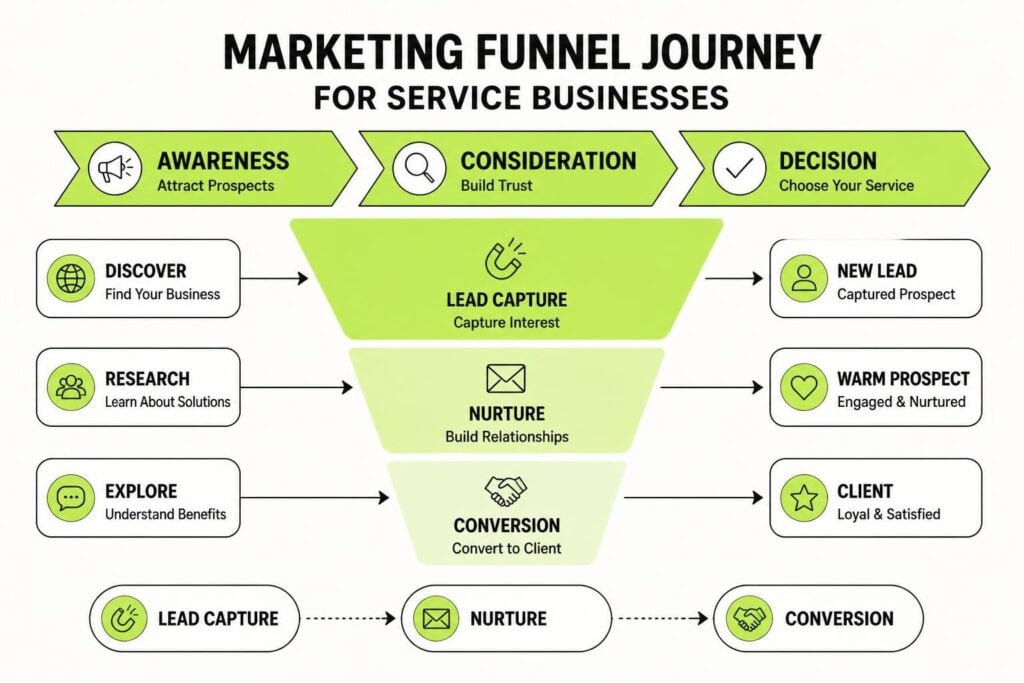
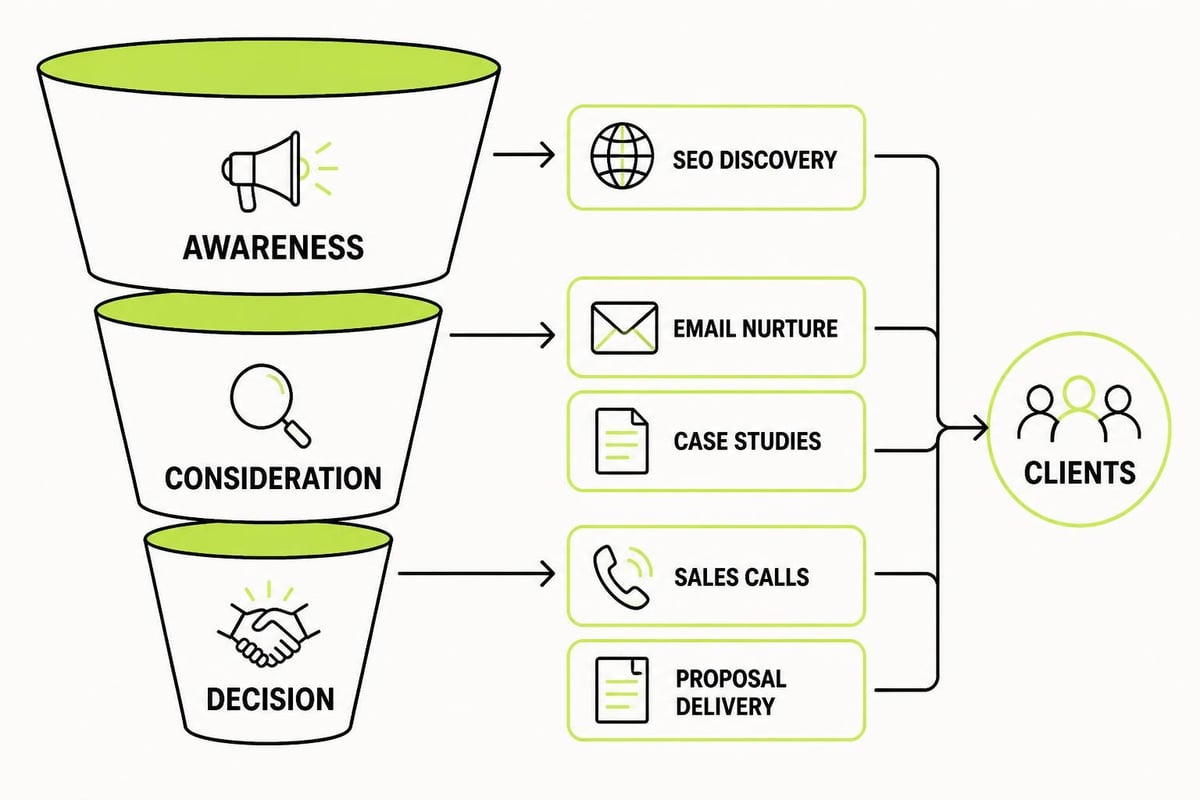
Every funnel breaks down into three stages, regardless of what you call them:
- Awareness: Someone discovers you exist and that you solve a problem they have
- Consideration: They evaluate whether you're credible, relevant, and worth engaging
- Decision: They choose you (or they don't) and become a client
Inside those stages, you need specific assets and actions. Top of funnel might be local SEO, content, or paid ads. Middle of funnel is email nurture, case studies, and discovery calls. Bottom of funnel is proposals, demos, and closing conversations.
The mistake most service businesses make is building only the top or the bottom. They run ads but have no follow-up sequence. Or they're brilliant on sales calls but nobody knows they exist. A complete marketing funnel for service based business connects all three stages with systems that move people forward.
Building the top of your funnel (awareness)
If nobody knows you exist, the rest doesn't matter. Top of funnel is about being visible where your buyers are already looking. For most service businesses, that means organic search, referrals, and occasionally paid channels.
Search intent is everything. When someone types "commercial plumber Melbourne" or "brand strategy for SaaS," they're not browsing. They have a problem right now. Ranking for those terms puts you in front of buyers at the exact moment they're ready to engage.
Local service businesses benefit massively from Google Business Profile optimization, local citations, and location-specific content. If you're a tradie, consultant, or agency serving a geographic area, showing up in local pack results is non-negotiable.
Content that pulls people in
Paid ads work, but they're expensive and they stop the moment you stop paying. Organic content compounds. A well-written guide, a video walkthrough, or a case study published in 2024 can still generate leads in 2026.
The best top-of-funnel content answers the questions your buyers ask before they're ready to buy:
- "How much does [service] cost in [city]?"
- "What should I look for when hiring a [service provider]?"
- "How long does [process] take?"
- "What's the difference between [option A] and [option B]?"
You don't need to publish daily. You need to publish strategically. One great piece that ranks and converts is worth more than ten mediocre posts that nobody reads. If you're mapping out content, Qualtrics’ guide on creating a customer journey map offers a useful framework for aligning content to each stage.
The middle (where most leads die)
Someone downloads your checklist. They fill in a contact form. They watch your webinar. Then… nothing. This is where 70% of service businesses lose the game. You captured attention, but you didn't build a system to turn that attention into a conversation.
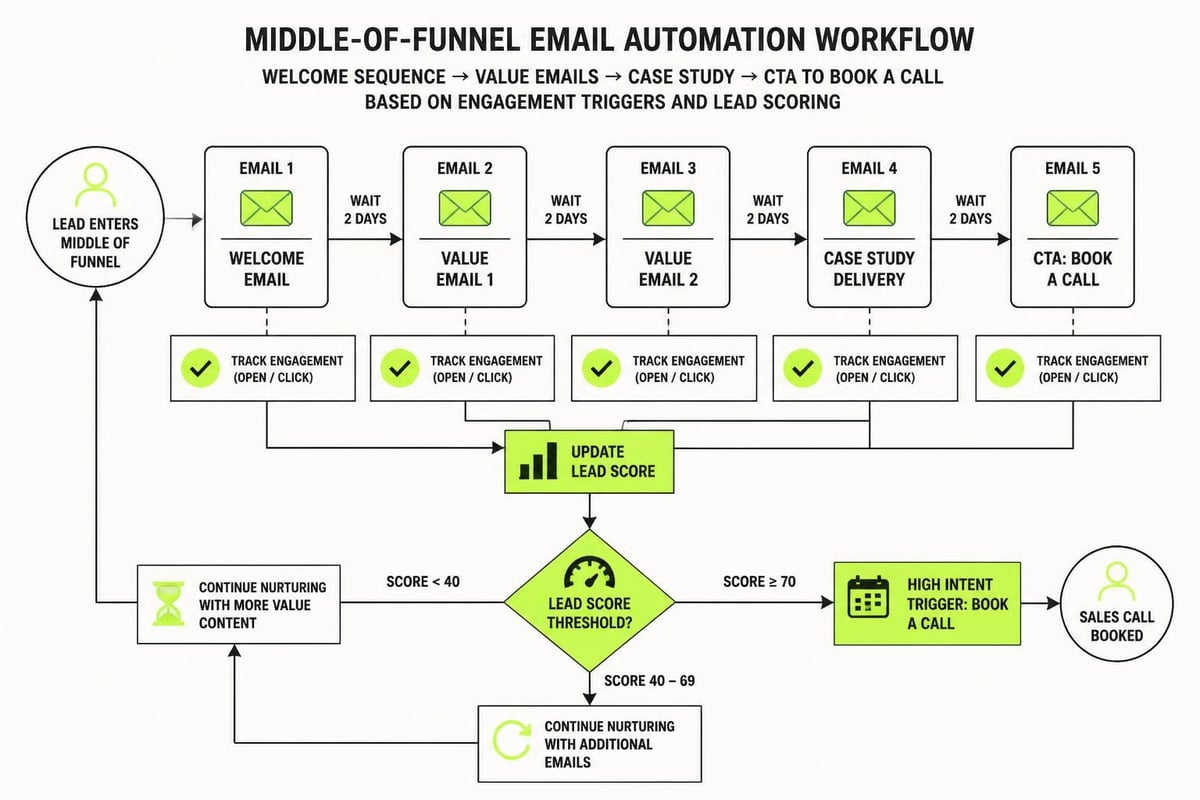
Middle of funnel is nurture. It's email sequences, retargeting, case studies, and proof that you can actually do what you say. For high-ticket services, this stage might last weeks or months. For urgent needs (emergency plumber, legal advice), it might be hours.
| Funnel Stage | Typical Timeframe | Key Actions |
|---|---|---|
| Awareness | First 24 hours | SEO discovery, ad click, referral |
| Consideration | 3-30 days | Email sequence, case studies, FAQ |
| Decision | 1-7 days | Proposal, call, contract |
The longer the consideration phase, the more structure you need. A marketing funnel for service based business in consulting or professional services requires multiple touchpoints before someone books a call. That means your CRM needs to track engagement, your email system needs to deliver value (not just pitches), and your follow-up needs to be automated but personal.
Email sequences that actually work
Here's what a basic nurture sequence looks like for a service business:
- Email 1 (immediate): Deliver what they opted in for. Set expectations.
- Email 2 (day 2): Share a quick win or insight related to their problem.
- Email 3 (day 5): Case study or client story showing results.
- Email 4 (day 8): Address the most common objection or concern.
- Email 5 (day 12): Clear call to action (book a call, request a quote, start a project).
Not everyone will convert on your timeline. Some people need six months. That's why your CRM should segment leads by engagement and intent, not just by when they signed up. Campaign Monitor’s deliverability guide covers practical tactics for keeping your emails out of spam and maintaining engagement over time, which directly impacts whether your funnel actually works.
Bottom of funnel (converting interest into revenue)
By the time someone reaches the bottom of your funnel, they're qualified and interested. They know who you are. They've consumed your content. Now they need a reason to choose you over the competitor they're also talking to.
This is where trust wins. Testimonials, case studies, guarantees, and proof matter more than features. A detailed proposal with clear deliverables, timelines, and pricing removes uncertainty. A messy PDF with typos does the opposite.
What to include in your proposal or sales process
Your closing process should answer every question a buyer might have before they ask it:
- What exactly will you deliver?
- When will it be done?
- What does it cost, and what's included?
- What happens if something goes wrong?
- Why should they trust you?
Framing matters. Instead of listing tasks, show outcomes. Instead of "We'll set up your CRM," say "You'll have a system that captures every lead and follows up automatically so nothing falls through the cracks."
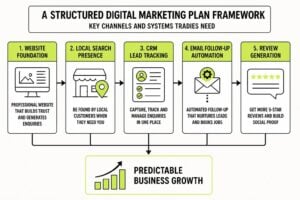
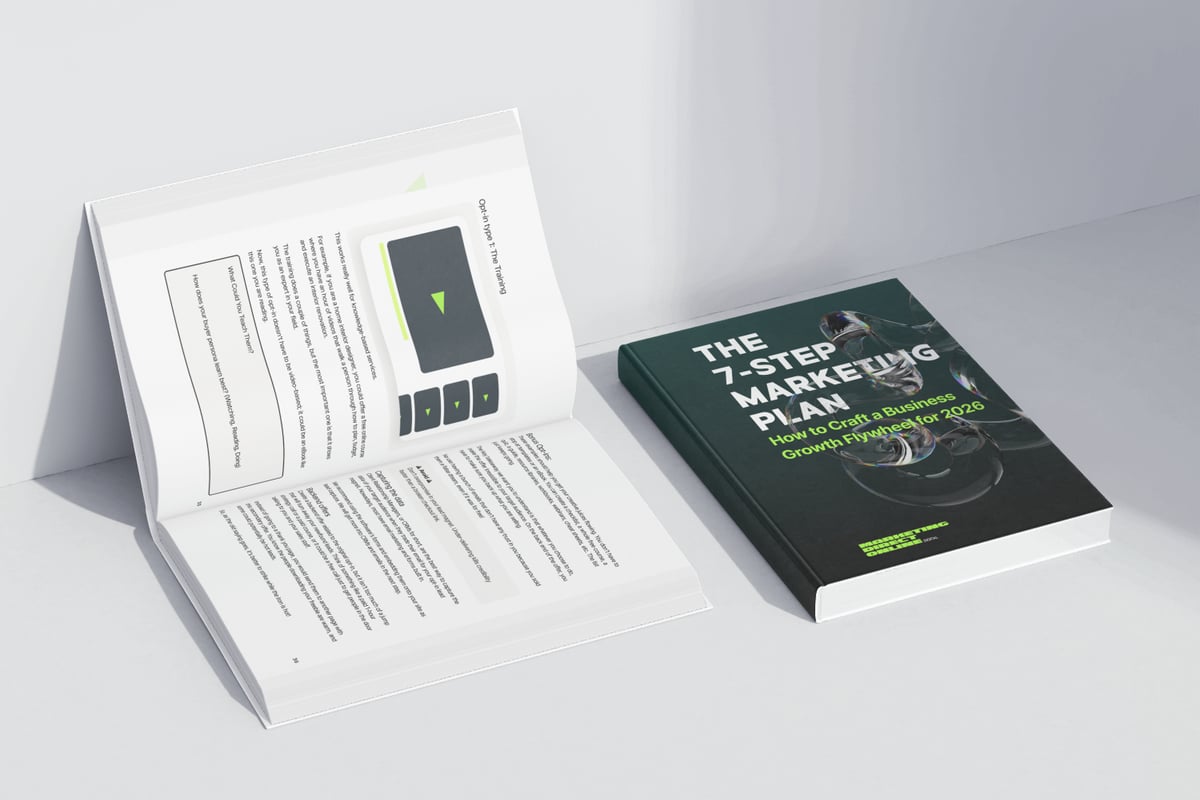
A practical framework like the 7-Step Marketing Plan helps businesses structure their marketing funnel for service based business from goal-setting through to referral generation. Each step builds on the last, creating a repeatable system that compounds over time rather than requiring constant manual effort.
Many service businesses also benefit from a discovery call or audit before they propose. It positions you as a consultant, not a vendor. It gives you information to customize your offer. And it increases close rates because you're solving a specific problem, not pitching a generic package.
Measuring what matters (not what's easy)
Vanity metrics feel good but don't pay the bills. Website visits, social followers, and email open rates are interesting. Revenue per lead, cost per acquisition, and conversion rate by channel actually tell you whether your marketing funnel for service based business works.
Track these instead:
- Leads generated by source (organic, paid, referral)
- Lead-to-opportunity conversion rate
- Opportunity-to-client conversion rate
- Average deal size
- Customer acquisition cost (CAC)
- Lifetime value (LTV)
If you know that organic search generates 40 leads a month, 10 become opportunities, and 3 close at an average of $8,000, you can calculate exactly what your SEO is worth. If paid ads cost $3,000 a month and generate two clients worth $6,000 total, you know that channel is underwater.
Building feedback loops into your funnel
The best funnels improve over time because you're testing and iterating. A/B test your landing page headlines. Try different email subject lines. Adjust your discovery call script based on which objections come up most often.
Forrester’s research on mapping the customer journey shows that businesses using structured journey maps make better decisions about where to invest and what to fix. You don't need enterprise software to do this. A spreadsheet tracking leads by source, stage, and outcome is enough to spot patterns and prioritize improvements.
| Channel | Leads/Month | Opps | Clients | CAC | LTV | ROI |
|---|---|---|---|---|---|---|
| Organic SEO | 40 | 10 | 3 | $200 | $8,000 | 40x |
| Paid Ads | 25 | 8 | 2 | $1,500 | $6,000 | 4x |
| Referrals | 10 | 7 | 5 | $50 | $12,000 | 240x |
When you measure properly, you stop wasting budget on channels that don't convert and double down on the ones that do. Most service businesses discover that referrals and organic search drive the highest ROI, but they've been pouring money into paid ads because that's what everyone else does.
Common mistakes that break service funnels
Even well-intentioned businesses sabotage their own funnels. Here are the usual culprits:
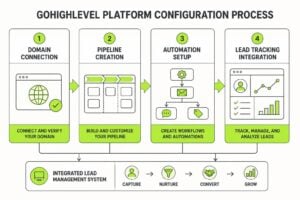
No CRM or terrible CRM hygiene. If leads live in your inbox, a spreadsheet, and someone's memory, you don't have a funnel. You have chaos. A proper CRM tracks every interaction, automates follow-up, and surfaces opportunities before they go cold.
Generic messaging at every stage. Someone who just discovered you needs different content than someone who's read five blog posts and watched a webinar. Segment your audience and tailor your message to where they are in the journey.
Asking for too much, too soon. Nobody's filling out a 12-field form to download a checklist. Keep top-of-funnel offers low-friction. Name and email. That's it. You can qualify them later.
Ignoring speed to lead. The faster you respond to a new enquiry, the higher your close rate. If someone fills in a contact form and doesn't hear from you for three days, they've already moved on. Automate the first touchpoint (confirmation email, booking link, SMS) so they know you're paying attention.
No nurture for "not yet" leads. Most people aren't ready to buy today. That doesn't mean they'll never buy. A 12-month email nurture sequence keeps you top of mind so when they are ready, you're the obvious choice. For practical guidance on lifecycle emails and automation, Litmus’ playbook on email marketing for agencies is a solid resource.
How systems remove the guesswork
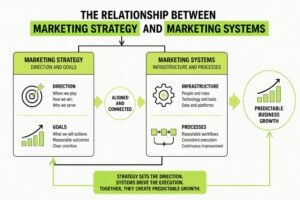
A marketing funnel for service based business only works when it's built on systems, not effort. You can hustle your way to a few clients. You can't hustle your way to predictable growth.
Systems mean:
- Leads are captured automatically and added to your CRM
- Follow-up emails are sent on schedule without you remembering
- Opportunities are scored and prioritized so you focus on the best fits
- Reporting happens weekly so you know what's working
When business and marketing align around repeatable processes, growth becomes predictable. You stop wondering where next month's revenue is coming from because you can see it in your pipeline.
This is especially true for businesses juggling multiple services or locations. A tradie running three crews needs a system that books jobs, sends reminders, and requests reviews without manual input. A consultancy with five service lines needs segmentation and messaging that speaks to each buyer persona.
Building trust at scale
Trust is the bottleneck in every service funnel. You can drive traffic and capture leads all day, but if people don't believe you'll deliver, they won't convert.
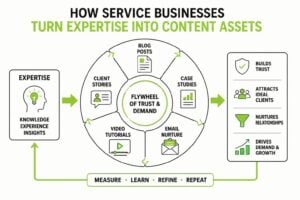
Proof scales trust. Case studies, testimonials, video reviews, and before-and-after examples show that you've done this before and done it well. Don't bury them on a testimonials page nobody visits. Weave them into your email sequences, your sales conversations, and your proposal process.
Transparency also builds trust. Clear pricing (even if it's a range), honest timelines, and upfront communication about what's included and what's not removes the anxiety buyers feel when they're comparing options.
Some businesses worry that showing pricing will scare people off. Usually, the opposite is true. Clarity attracts the right buyers and repels the wrong ones. That's a feature, not a bug. The Hanover Research whitepaper on customer journey mapping includes data showing that reducing friction and uncertainty at key touchpoints improves conversion rates across the funnel.
Aligning your funnel with how people actually buy
Nobody wakes up and thinks, "I'll go through a marketing funnel today." They have a problem. They search for solutions. They evaluate options. They make a decision.
Your job is to meet them where they are, answer the questions they're asking, and make it easy to take the next step. That might mean a blog post that ranks for their search query. An email that addresses their biggest concern. A proposal that makes the decision obvious.
A marketing funnel for service based business is just a map of that journey. The better you understand how your buyers move from problem to purchase, the better you can design touchpoints that guide them forward.
Building a funnel that works isn't about adding more tactics. It's about creating a system that captures attention, nurtures interest, and converts leads without relying on hustle or hope. At MDO Digital, we help service businesses design high-trust websites, build CRM infrastructure, and run data-driven marketing that turns attention into predictable demand. If you're ready to remove the chaos and build structured growth that compounds, let's talk.