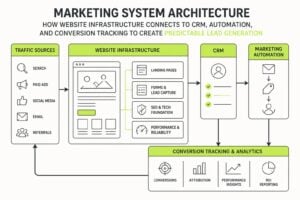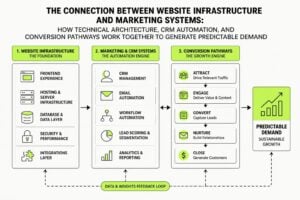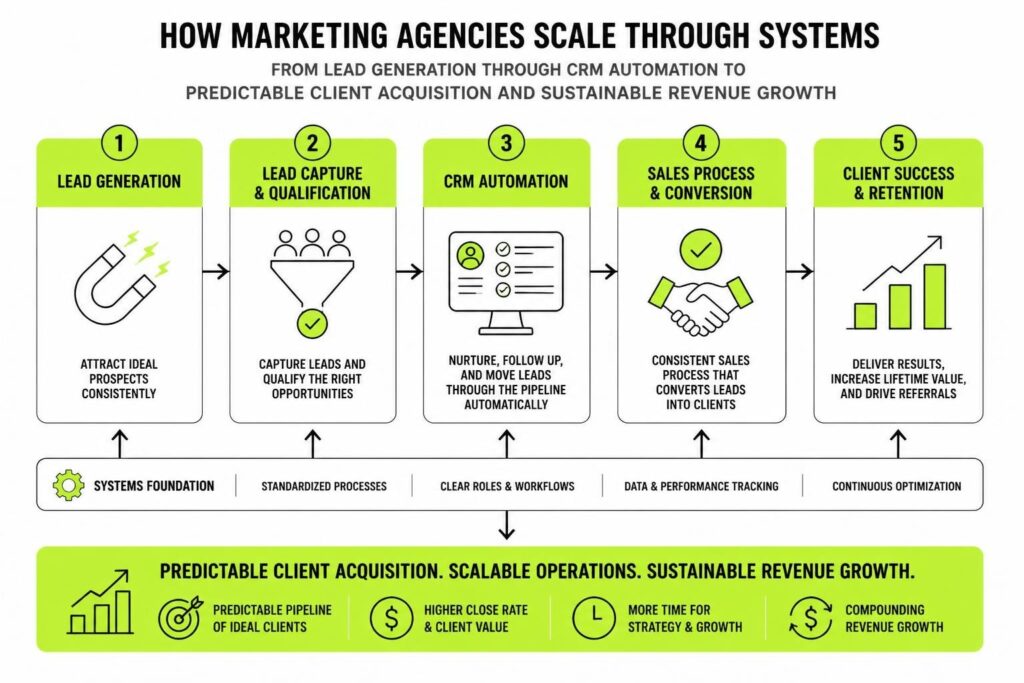
Most marketing agencies hit a ceiling around the same revenue point. Not because they lack talent or client demand, but because they're trading time for money without the infrastructure to scale. Marketing agency growth isn't about working longer hours or hiring faster. It's about building systems that protect leads, automate delivery, and create predictable outcomes. The agencies that grow sustainably in 2026 are the ones that treat their own operations like they'd treat a client's business: with data, structure, and ruthless clarity.
The Foundation: Systems Over Hustle
Growth built on chaos doesn't compound. It collapses.
The difference between a $500K agency and a $2M agency isn't usually the quality of work. It's the infrastructure underneath. When every client requires custom workflows, bespoke reporting, and manual follow-up, you're building a house of cards. One key person leaves, and revenue drops. One busy month, and leads fall through cracks.
Structured marketing agency growth requires:
- Standardised service delivery that doesn't sacrifice quality for efficiency
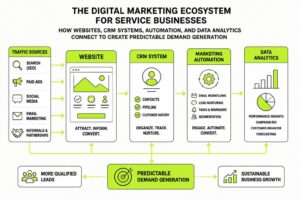
- CRM systems that track every lead from first touch to closed deal
- Automation workflows that nurture prospects without human intervention
- Data dashboards that show what's working in real time
- Documented processes that any team member can follow
These aren't nice-to-haves. They're the difference between trading hours for dollars and building an asset that grows while you sleep.
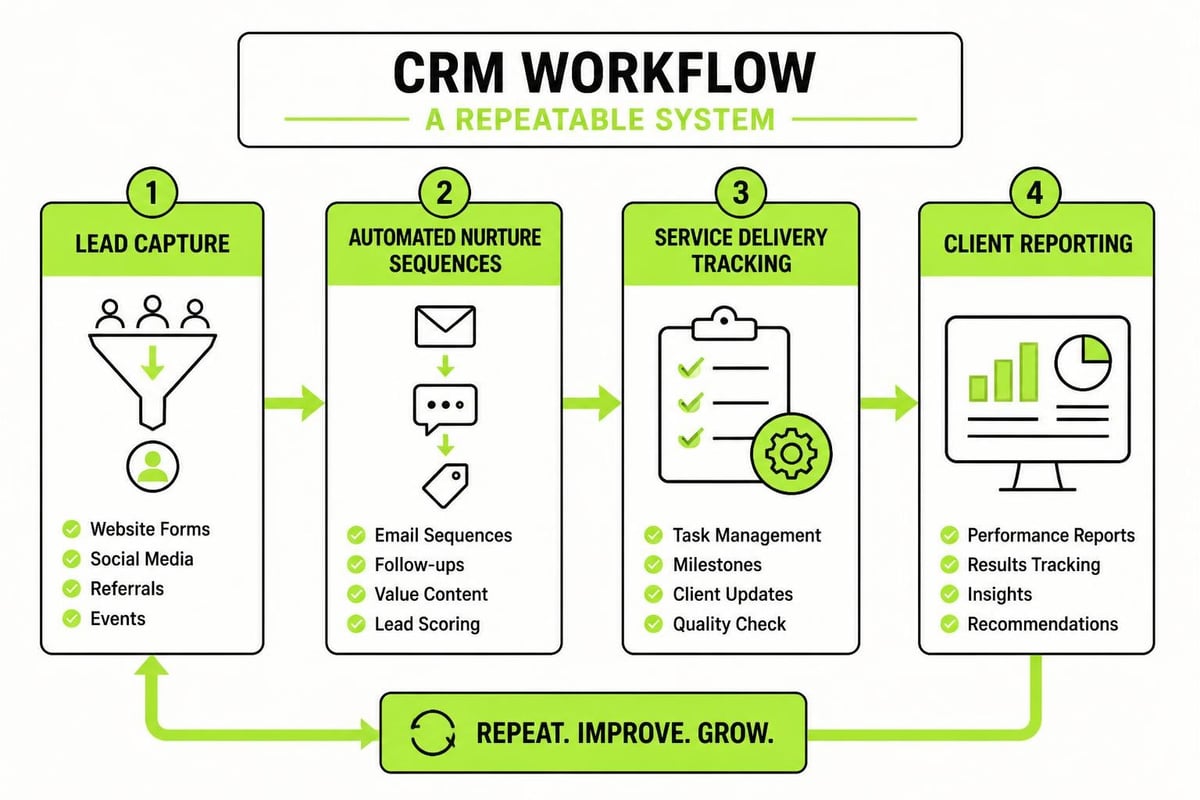
Building Your Client Acquisition Engine
Most agencies treat client acquisition like a side project. They post on LinkedIn when they remember. They rely on referrals and hope. Then wonder why revenue fluctuates month to month.
Effective positioning and differentiation starts with knowing exactly who you serve and what outcome you deliver. Not "we do digital marketing for small businesses." That's noise. "We build lead generation systems for commercial plumbers that generate 15+ qualified leads per month" is a position. It's specific. It's measurable. It's defensible.
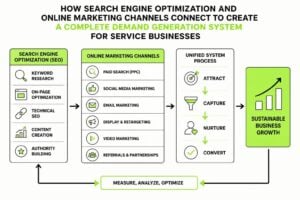
A proper acquisition engine includes:
- Clear positioning that makes you the only choice for a specific market
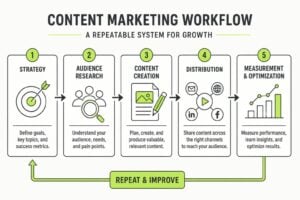
- Content that demonstrates expertise before the sales call happens
- Opt-in offers that qualify leads while providing immediate value
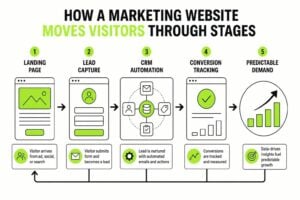
- Automated nurture sequences that build trust over weeks, not days
- Sales process that converts at predictable rates
When you know your conversion rates at every stage, you can reverse-engineer revenue. Need ten new clients this quarter? Work backwards from your close rate, proposal rate, and lead volume. Then build the machine to deliver those numbers.
Service Design That Scales
You can't scale custom work. Full stop.
The agencies growing fastest in 2026 aren't offering bespoke everything. They're productising their services into repeatable frameworks that deliver consistent results. This doesn't mean cookie-cutter work. It means identifying the 80% that stays the same across clients and systematising it ruthlessly.
| Service Type | Custom Approach | Productised Approach |
|---|---|---|
| Website Design | Start from scratch each time | Template system with proven conversion frameworks |
| SEO | Different strategy per client | Standardised audit, keyword research, content calendar process |
| Ad Management | Ad hoc platform choices | Platform selection based on client profile, structured testing protocol |
| Reporting | Manual deck creation | Automated dashboards with standard KPIs |
The productised approach protects your margins. It reduces delivery time. It makes training new team members faster. And it actually delivers better results because you're refining a proven system rather than reinventing the wheel.
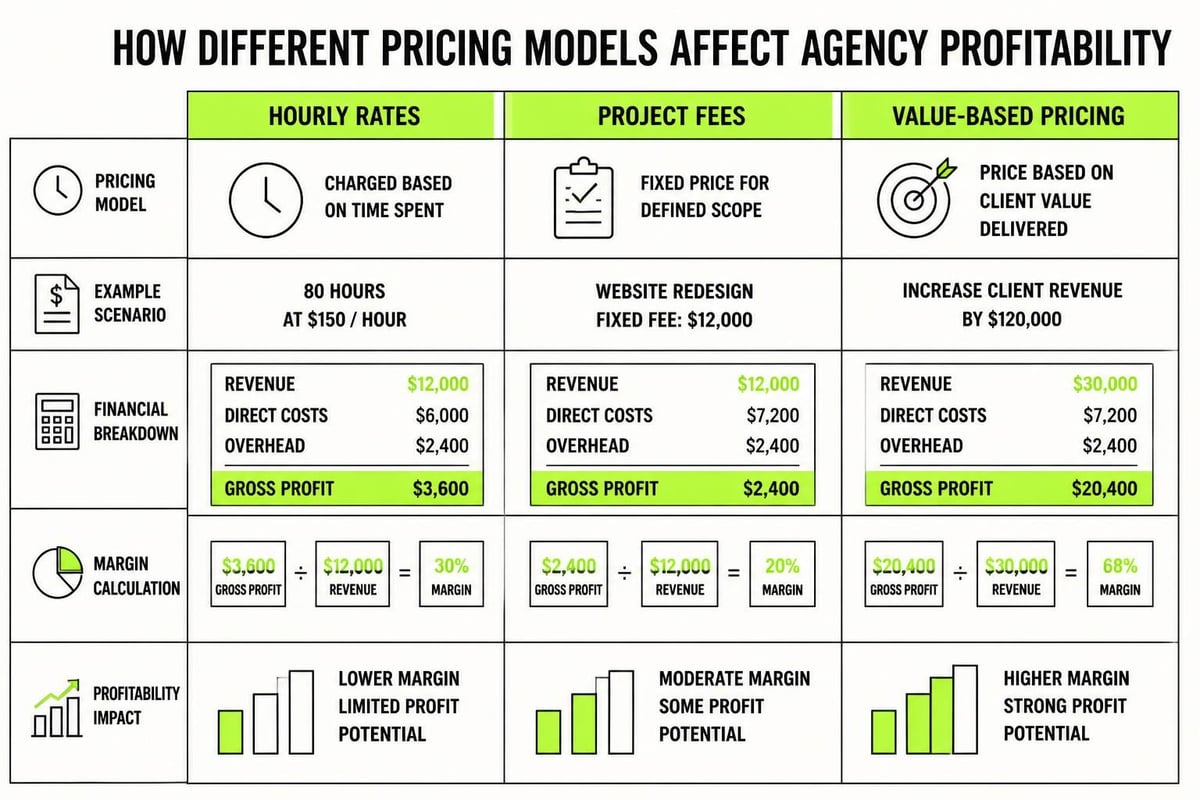
Pricing for Profit, Not Just Revenue
Marketing agency growth stalls when you're chasing top-line revenue without watching margins. A $2M agency at 15% margin is worse than a $1M agency at 40% margin. You're working harder, managing more, and taking home less.
Smart pricing strategy starts with understanding your actual costs. Not just direct costs like ad spend or tools. Your time. Your team's time. The opportunity cost of taking on work that doesn't compound.
Value-based pricing works when you:
- Deliver measurable outcomes, not just deliverables
- Position against results, not hours
- Qualify clients who understand ROI
- Walk away from projects that don't fit your system
The goal isn't to be the cheapest option. It's to be the obvious choice for clients who value outcomes over activity.
Operations and Team Structure
Hiring your way to growth without systems is expensive. You'll bring on people, realise they don't fit, cycle through contractors, and wonder why nothing sticks.
Successful marketing agency growth treats hiring as a strategic function, not a reactive one. You hire when systems are in place to support new capacity. Not before.
Start with roles that:
- Remove bottlenecks in your current delivery
- Free up leadership for strategy and growth
- Generate revenue directly through sales or delivery
- Build infrastructure that supports future scaling
Fractional specialists beat full-time generalists in the early stages. You don't need a full-time copywriter if you're only producing content twice a week. Fractional talent layers let you access expertise without the overhead, keeping margins healthy while you scale.
Documentation and Process
If it's only in your head, it doesn't exist as a business asset.
Every workflow, every client onboarding sequence, every reporting template should live in documentation that anyone on your team can access. This isn't busywork. It's the foundation that lets you step away from delivery and focus on growth.
- Client onboarding: From contract to kickoff, every step documented
- Service delivery: What gets done, when, by whom, using which tools
- Communication protocols: How often you report, what metrics you share, what format
- Quality control: What gets checked before it goes to the client
- Offboarding: How you transition clients out smoothly
When processes live in systems, not in people, you can scale without everything breaking.
Data, Tracking, and Optimisation
You can't improve what you don't measure. And most agencies are flying blind.
Marketing agency growth accelerates when you treat your agency like a data-driven operation. Track everything that matters. Ignore vanity metrics. Optimise for outcomes.
Metrics That Matter
| Metric Category | What to Track | Why It Matters |
|---|---|---|
| Acquisition | Lead volume, source, cost per lead | Know where growth comes from |
| Conversion | Proposal-to-close rate, average deal size | Improve sales efficiency |
| Delivery | Project margin, completion time vs estimate | Protect profitability |
| Retention | Client lifetime value, churn rate, NPS | Sustainable revenue > new logos |
The agencies that achieve measurable growth aren't guessing. They're testing, measuring, and iterating based on what the data shows. Not what they feel or hope.
A simple framework we've seen work repeatedly involves building a structured marketing plan that covers every stage of the client journey. The 7-Step Marketing Plan helps businesses create a repeatable system that generates leads consistently. It's the same thinking that applies to agency growth: define your buyer, choose your platform, create your opt-in offer, nurture through CRM, deliver experience, and build referral loops. When you systemise these steps, growth becomes predictable.

Positioning and Niche Strategy
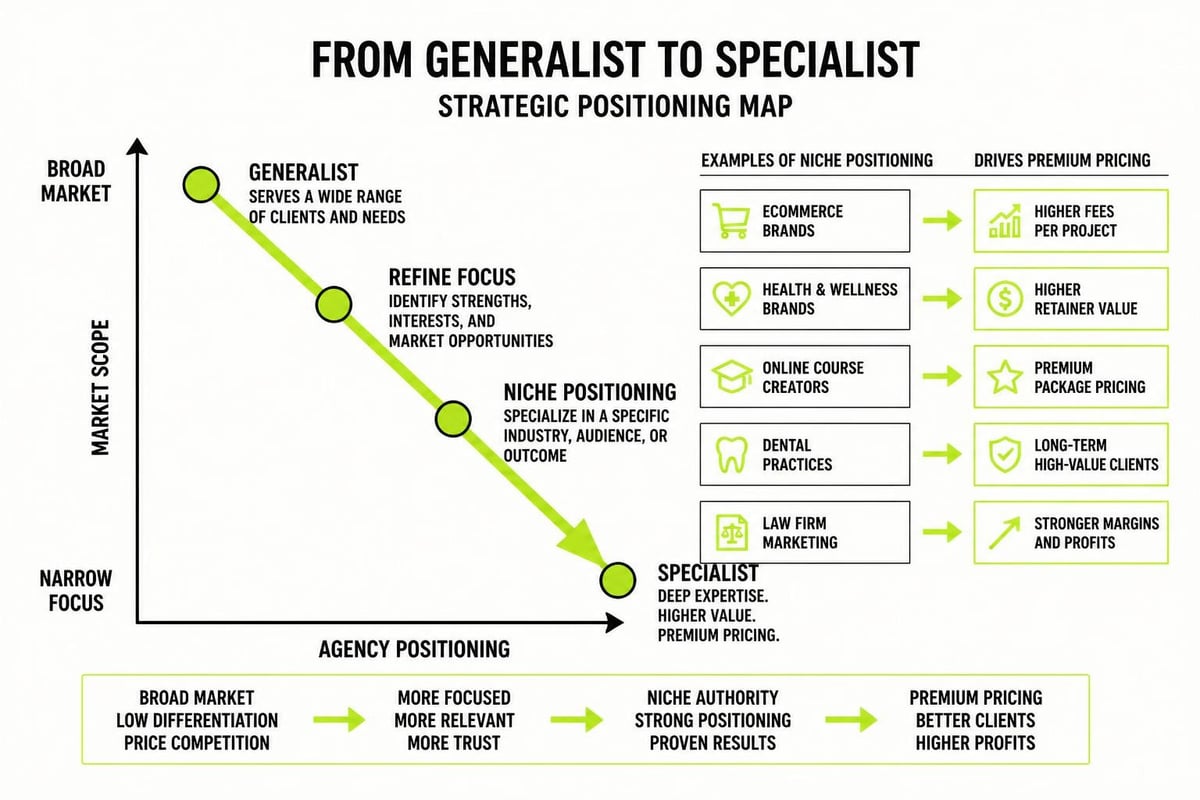
The riches are in the niches. You've heard it. Most agencies ignore it anyway.
Generic positioning ("we help businesses grow") makes you invisible. Specific positioning ("we build automated lead systems for B2B SaaS companies selling to enterprise") makes you the only call for that market.
Strong positioning lets you:
- Charge premium rates because you're the expert
- Close faster because prospects already trust your specialisation
- Deliver better results because you're refining the same playbook
- Build case studies that actually convert similar prospects
Choosing a niche doesn't limit your market. It focuses your message so the right clients find you.
Building Authority in Your Niche
Once you pick your lane, own it. Authority drives inbound leads, which cost less and close faster than outbound.
Authority-building tactics:
- Publish case studies with real numbers, not fluff
- Create frameworks and name them (it makes you quotable)
- Speak at industry events where your buyers gather
- Build tools or resources that solve specific problems
- Get featured in publications your niche actually reads
This compounds. Each piece of content, each case study, each speaking gig builds on the last. Within 12-18 months, you're the name people mention when someone asks for a recommendation.
Technology and Automation
Marketing agency growth in 2026 separates into two camps: agencies using AI and automation strategically, and agencies still doing everything manually.
The gap widens every quarter.
Automation isn't about replacing people. It's about removing repetitive tasks so your team focuses on strategy and relationships. AI integration done right handles research, first drafts, data analysis, and reporting. Humans handle refinement, strategy, and client communication.
High-impact automation areas:
- Lead nurturing: Email sequences triggered by behaviour, not calendar dates
- Reporting: Dashboards that update in real time, not monthly deck creation
- Content creation: AI handles research and first drafts, humans add insight and voice
- Client onboarding: Automated task sequences ensure nothing falls through cracks
- Proposal generation: Templates with dynamic pricing based on scope inputs
The goal isn't to automate for automation's sake. It's to protect your time and your team's attention for work that requires judgment, creativity, and strategic thinking.
Building Referral Systems
Most agencies hope for referrals. The best ones engineer them.
A happy client doesn't automatically become a referring client. You need structure. Ask at the right time (after a win, not during delivery stress). Make it easy (specific introductions, not vague "know anyone who needs help?"). Follow up when referrals convert.
Systematic referral generation:
- Schedule quarterly check-ins to ask for introductions
- Create referral incentives that feel generous, not transactional
- Build partnerships with complementary service providers
- Showcase client wins publicly so referrals see proof
- Follow up every referral, even if it doesn't close
When 30-40% of new business comes from referrals, your acquisition costs drop and close rates climb. These leads already trust you before the first call.
Managing Cash Flow During Growth
Growth eats cash. Fast growth eats it faster.
You're hiring before revenue lands. Paying for tools and infrastructure. Covering overhead while waiting for clients to pay invoices. If you're not watching cash flow, growth can kill a profitable agency.
| Growth Phase | Cash Flow Challenge | Solution |
|---|---|---|
| Early (sub-$500K) | Irregular revenue, high delivery costs | Retainer model, deposits, tight expense control |
| Middle ($500K-$2M) | Hiring ahead of revenue | Fractional roles, performance milestones, line of credit |
| Scale ($2M+) | Larger team, infrastructure investment | Payment terms discipline, CFO oversight, runway planning |
Run monthly cash flow projections. Know your runway. Negotiate payment terms that favour your cash position. Get comfortable with financial management or hire someone who is. Business fundamentals matter more as you scale, not less.
Client Retention and Expansion
New client acquisition gets attention. Retention drives profit.
It costs five times more to win a new client than keep an existing one. And existing clients who see results will expand scope, refer others, and stick around for years. Marketing agency growth built purely on new logos is exhausting and inefficient.
Retention strategies:
- Deliver measurable results, tracked in dashboards they can see anytime
- Communicate proactively, especially when things go sideways
- Build annual strategy reviews that identify new opportunities
- Create tiered service models that encourage upgrades
- Celebrate wins publicly and give them credit
When annual retention hits 85%+, you're building on a solid foundation. Each new client adds to a growing base, not just replacing churn.
Marketing agency growth comes down to systems, positioning, and disciplined execution. You need infrastructure that supports scale, a clear market position that drives premium pricing, and processes that protect margins while delivering results. Most agencies plateau because they treat growth as something that happens to them, not something they engineer deliberately. If you're ready to build marketing systems that create structured, predictable growth, MDO Digital helps service-based businesses scale with clarity through high-trust websites, CRM infrastructure, and data-driven marketing that converts.