Most business owners face this question when growth starts to demand more marketing horsepower. You've bootstrapped the basics, but now you need real capability. The hiring agency vs in-house marketer debate isn't new, but it's more nuanced in 2026 than ever before. Technology has changed what one person can do. Remote work has changed who you can hire. And the expectation for integrated marketing systems means both options look different than they did five years ago.
This isn't about which choice is universally better. It's about understanding what each model actually delivers, what it costs in real terms, and which gaps each one leaves behind.
What You Actually Get With Each Option
When you're weighing hiring agency vs in-house marketer decisions, start with what lands on your desk.
The In-House Reality
An in-house marketer becomes part of your team. They learn your business deeply, sit in your meetings, and own the day-to-day execution. For many service businesses, this feels like the natural path to control and continuity.
What an in-house hire typically brings:
- Deep product and customer knowledge over time
- Direct availability during business hours
- Cultural alignment with your team
- Focused attention on your business alone
- Faster internal communication loops
What they usually don't bring:
- Broad cross-industry pattern recognition
- Full-stack capability across all channels
- Built-in redundancy when they're sick or leave
- Established vendor relationships and tools
- Peer review or strategic sparring partners
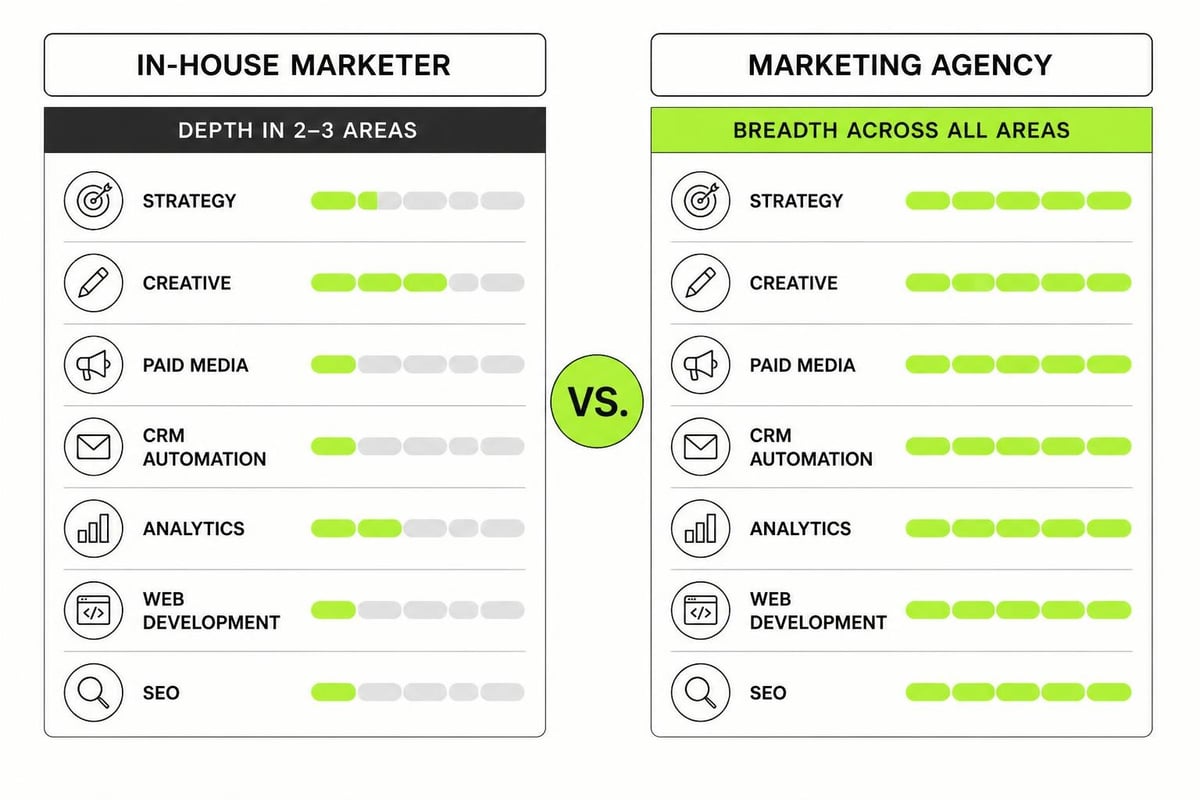
The single biggest limitation isn't skill. It's bandwidth and breadth. One person can be excellent at content and decent at ads, or strong in automation and okay at design. But they can't be world-class across CRM architecture, paid media, SEO, email sequences, web development, and brand strategy simultaneously.
Research from Forrester shows that 68% of marketers report skills gaps as their top hiring challenge. You're not just competing for talent. You're trying to find a unicorn who fits your budget.
The Agency Reality
An agency partnership means you're buying access to a system, not a person. The question when evaluating hiring agency vs in-house marketer tradeoffs is whether that system creates more value than a dedicated individual.
What a good agency brings:
- Multi-disciplinary teams (strategy, creative, tech, media)
- Established processes and frameworks
- Tools and software already in place
- Cross-client insights and fresh perspectives
- Scalable capacity when you need to move fast
What agencies struggle with:
- Deep day-to-day immersion in your business
- Instant availability for small tasks
- Long-term culture fit and loyalty
- Transparent cost structure (you pay for their margin)
- Consistency if account teams turn over
The core value isn't just skill. It's structure. A solid agency has already solved the workflow problems, hired the specialists, and built the infrastructure. You plug into something that works, rather than building it from scratch.
According to the In-House Agency Forum’s research, even large companies with in-house teams still partner with agencies for specialist capability and surge capacity. It's rarely an either/or in practice.
The Real Cost Comparison
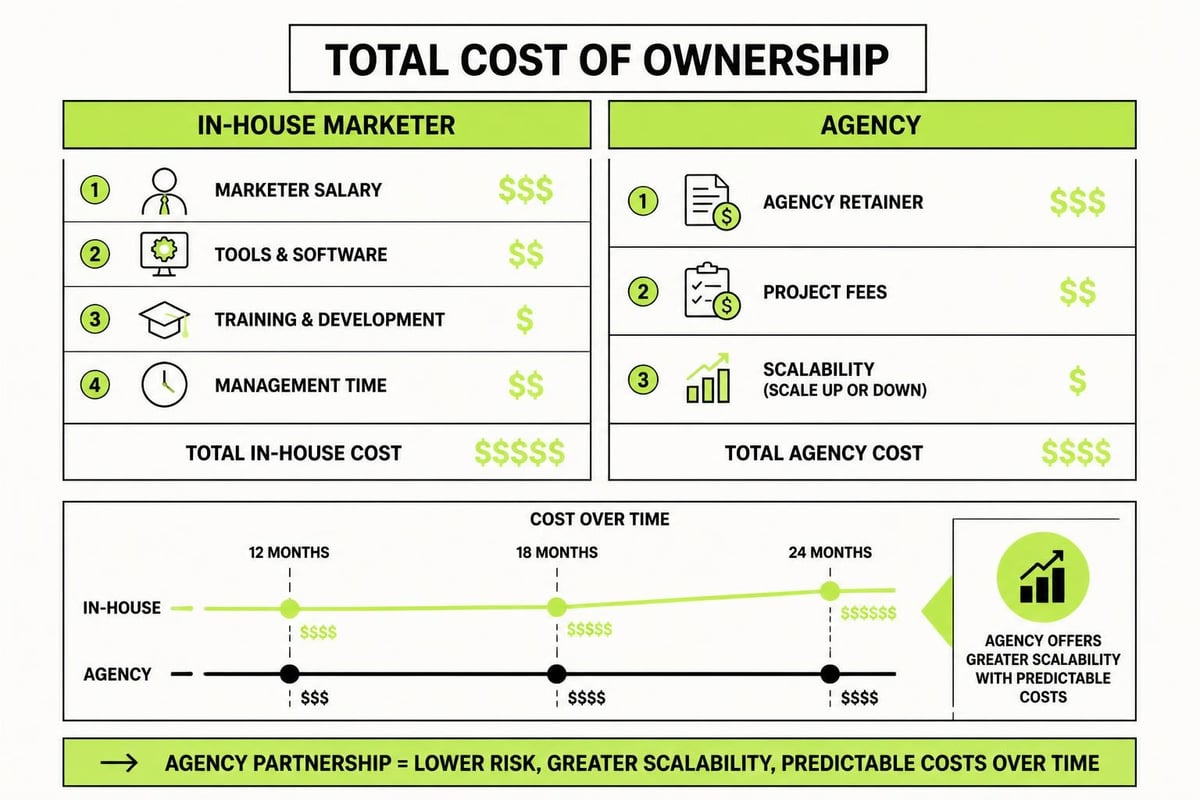
Most business owners underestimate the full cost of hiring in-house and overestimate what they'll pay an agency. Let's fix that.
In-House: More Than Salary
If you're hiring a mid-level marketer in Australia in 2026, expect to pay between $75,000 and $95,000 base salary. But that's just the start.
| Cost Category | Annual Amount (AUD) | Notes |
|---|---|---|
| Base Salary | $75,000 – $95,000 | Mid-level generalist |
| Superannuation | $8,250 – $10,450 | 11% in 2026 |
| Payroll Tax | $3,000 – $4,500 | Varies by state/threshold |
| Recruitment | $5,000 – $15,000 | Agency fees or time cost |
| Tools & Software | $3,000 – $8,000 | CRM, analytics, design, ads |
| Training & Development | $2,000 – $5,000 | Courses, conferences, upskilling |
| Management Overhead | $5,000 – $10,000 | Your time directing and reviewing |
| Total First Year | $101,250 – $147,950 | Before productivity ramp-up |
That's the floor. If they leave after 18 months (common in marketing roles), add replacement costs and knowledge loss. If they need a designer or developer to execute campaigns, add contractors.
Agency: Retainer Plus Projects
Agency pricing varies wildly, but for a service business needing strategic support and execution, expect a retainer between $3,000 and $8,000 per month for foundational work. Larger projects (website builds, campaign launches, automation builds) sit on top. For more context on how agencies structure fees, our piece on marketing agency pricing breaks down common models.
| Service Level | Monthly Retainer | What's Included |
|---|---|---|
| Foundation | $3,000 – $4,500 | Strategy, content, basic ads, reporting |
| Growth | $5,000 – $8,000 | Multi-channel, automation, CRM, optimisation |
| Scale | $8,000 – $15,000+ | Full-stack, creative, media, tech builds |
Annual spend: $36,000 to $96,000 for retainer work, plus project fees. If you add a $25,000 website build and a $15,000 CRM buildout in year one, you're at $76,000 to $136,000 total.
On paper, agencies and in-house hires cost roughly the same at mid-tier. The difference is what you get for that spend and how fast you can scale up or down.
Speed, Flexibility, and Control
The hiring agency vs in-house marketer question often hinges on how quickly you need results and how much you value control.
Speed to Value
In-house: Expect 3-6 months to recruit, onboard, and get productive output. Longer if you need a senior hire or niche skill set. Then add ramp-up time as they learn your customers, products, and market. You're looking at 6-9 months before they're firing on all cylinders.
Agency: If they're good, you get strategic input and execution in the first 30 days. They've done this before. They know what works. The Harvard Business Review notes that speed to market is a top priority for growth-focused companies, and agencies offer a shortcut to capability.
If you're in a window where timing matters (launching a new service, entering a new market, capitalising on a PR moment), agencies win.
Flexibility and Scale
In-house: Fixed cost, fixed capacity. If your marketer is maxed out, you hire another one or nothing gets done. Scaling down is painful. Letting someone go takes time, money, and emotional energy.
Agency: Variable cost, variable capacity. Need to double your ad spend and content output for a quarter? Agencies can spin up resources. Need to pull back when cash is tight? Retainers can usually flex or pause with notice.
The World Federation of Advertisers found that 62% of brands use hybrid models precisely because flexibility matters. Few businesses have perfectly linear growth. You need marketing capacity that can adapt.
Control and Ownership
In-house: You control priorities, timelines, and pivots. Your marketer is in Slack, in meetings, responding in real time. If strategy needs to shift mid-campaign, it happens fast.
Agency: You're one client among several. Priorities compete. Communication has more friction. Urgent requests aren't always urgent to them. If you need someone to drop everything and rewrite a proposal deck at 4pm, in-house wins every time.
Control feels good. But control over one person with limited capability is less useful than guided access to a team with broad capability. It depends what you're controlling.
Capability Gaps and Hybrid Models
Here's where the hiring agency vs in-house marketer debate gets interesting. Most businesses don't choose one forever.
What In-House Marketers Need Support With
Even excellent in-house marketers hit walls. Common gaps:
- Technical builds: CRM setup, marketing automation, integrations, tracking infrastructure
- Creative production: Video, design, copywriting at volume
- Specialist channels: Paid search, programmatic, SEO technical audits
- Strategic facilitation: Outside perspective when internal assumptions calcify
If you hire in-house, budget for contractor or agency support in at least two of those areas. Otherwise your marketer spends half their time learning skills adjacent to their core strength, and you get mediocre results in multiple channels instead of excellence in one.
What Agencies Need Support With
Agencies bring capability, but they don't live in your business. Common gaps:
- Internal alignment: Keeping sales, product, and leadership on the same page
- Rapid tactical execution: Small, urgent tasks that don't fit a project scope
- Deep customer insight: Nuanced understanding of buyer objections and language
- Continuous optimisation: Daily tweaks and tests that require context
If you hire an agency, plan to have someone internal (even part-time) who owns the relationship, translates business needs, and fills tactical gaps. Agencies don't self-manage without a capable client-side partner.
The Hybrid Approach
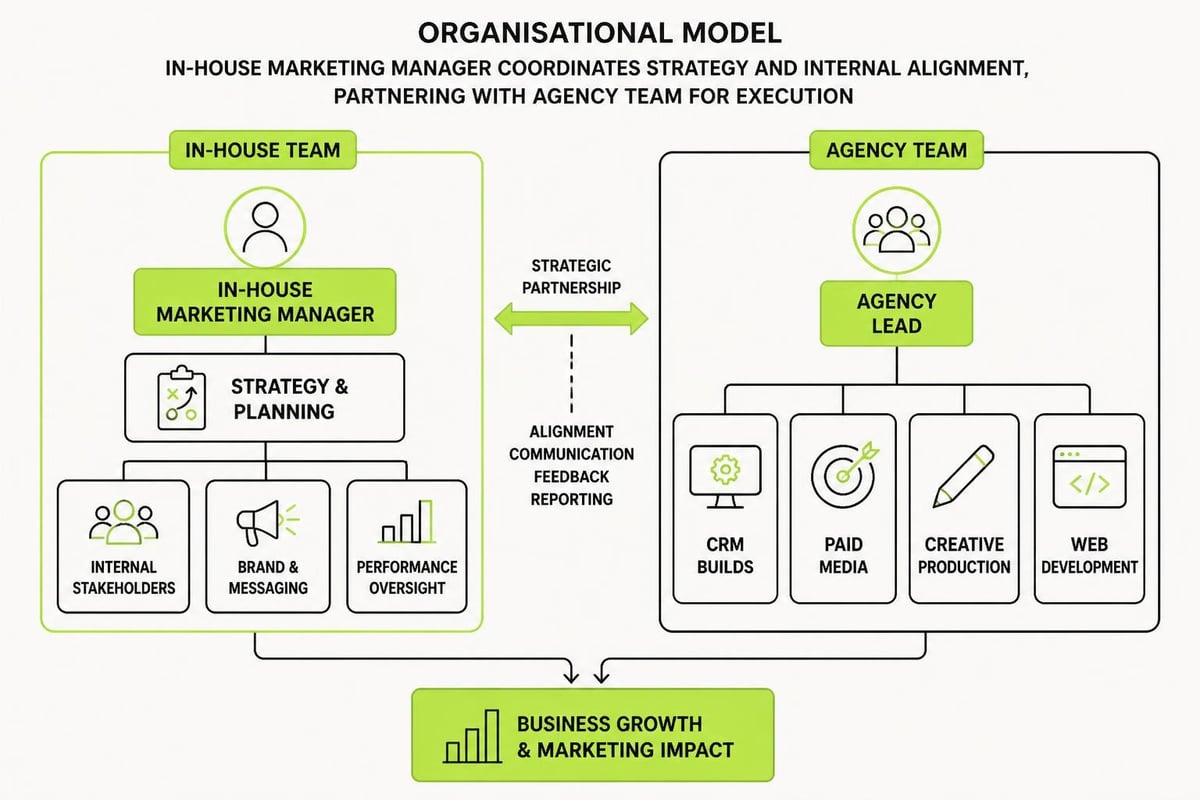
This is where most service businesses end up. Hire an in-house marketer to own strategy, customer insight, and day-to-day execution in one or two core channels. Partner with an agency (or specialist contractors) for technical builds, creative production, and channels outside the in-house marketer's strength.
Typical hybrid split:
- In-house: Strategy, content, email, social, campaign coordination, reporting
- Agency/Contractors: Website and CRM builds, paid media, design, video, SEO
Deloitte’s research on digital operating models confirms this trend. Businesses that grow sustainably use a "core plus flex" model. Build in-house for what's strategic and repeatable. Buy external capability for what's specialised or seasonal.
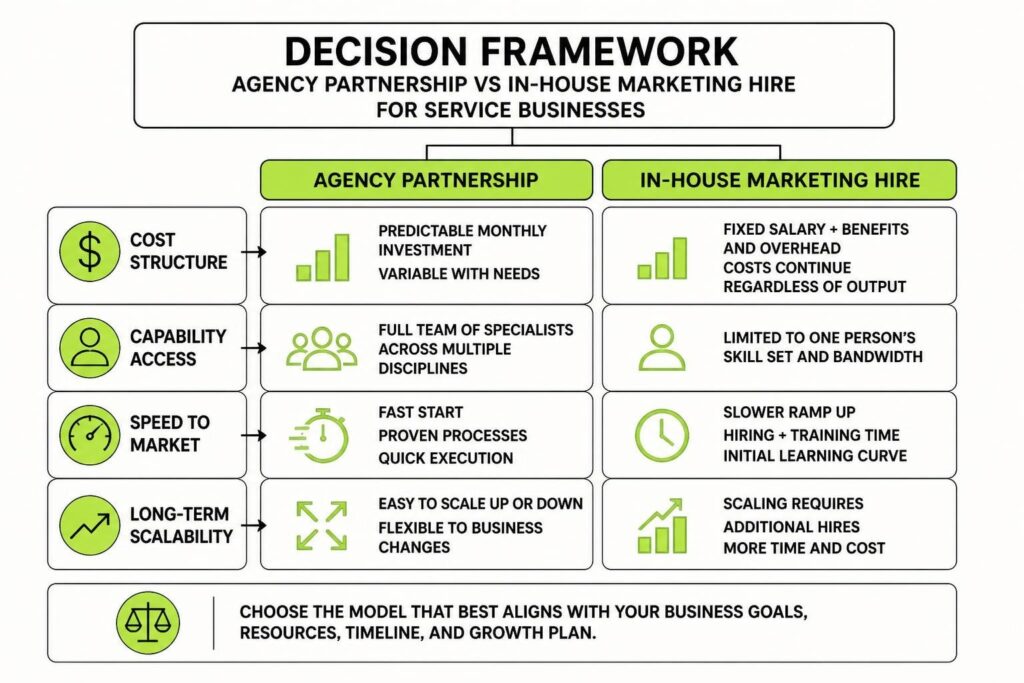
Decision Framework: Which Model Fits Your Business
Stop asking which is better. Start asking which fits your situation right now.
You Probably Need In-House If:
- Your marketing is deeply integrated with sales and product (long cycles, complex buying)
- You need someone in internal meetings to represent marketing's voice
- Your market or product changes fast and requires constant pivots
- You value control and immediate availability over breadth of capability
- You have predictable, steady marketing needs without big spikes
- You're building a marketing function for the first time and need to learn what works
You Probably Need an Agency If:
- You need results fast and don't have 6 months to recruit and onboard
- Your marketing requires multi-channel capability (web, CRM, ads, content, creative)
- You're launching something new and need experienced perspective
- Your internal team is small and you can't afford specialist hires
- You want access to tools, processes, and tech without building them yourself
- You need scalable capacity that can ramp up or down with demand
You Probably Need Both If:
- You're growing past $2M revenue and marketing is a primary growth lever
- You have enough volume to justify one in-house hire but not a full team
- You need strategic continuity (in-house) and specialist execution (agency)
- You're in a phase where investment will spike for 6-12 months, then stabilise
The cleanest version of hiring agency vs in-house marketer is often a marketing coordinator or manager in-house, plus a strategic agency partner who handles builds, creative, and paid media. You get continuity and control without sacrificing capability.
For businesses trying to build a marketing system that actually compounds over time, having a clear framework helps. Our 7-Step Marketing Plan walks through the structure that drives repeatable growth, whether you're running it in-house, through an agency, or both.
Common Mistakes to Avoid
Most businesses get the hiring agency vs in-house marketer decision wrong not because they choose poorly, but because they execute poorly.
Hiring In-House, Then Under-Resourcing Them
You hire a good marketer, pay them fairly, then don't give them a budget, tools, or support. They spend six months trying to do everything with free trials and Canva templates. Results are weak. You blame the hire.
Fix: If you hire in-house, commit to a minimum $2,000/month operating budget for tools, ads, and contractors. A marketer without resources is just expensive overhead.
Hiring an Agency, Then Micromanaging Them
You pay for strategic expertise, then override every recommendation because it doesn't match your gut. The agency becomes an order-taker. You get execution without insight.
Fix: If you hire an agency, trust their process for at least 90 days. If you can't, you hired the wrong agency or you're not ready for external help.
Expecting One In-House Hire to Replace an Agency
You hire a mid-level generalist and expect them to deliver what a five-person agency team delivers. They burn out or leave.
Fix: Be honest about scope. One person can own 2-3 channels well. Everything else needs support.
Judging Success Too Early
Marketing systems take time to build. Whether in-house or agency, expect 3-6 months before you see meaningful results. Most businesses bail at month two because leads haven't doubled.
Fix: Set realistic milestones. Month one is setup. Month two is testing. Month three is optimisation. Growth compounds after the foundation is built. If you want to understand how that foundation works, read our guide on how to build a marketing funnel.
Choosing Based on Cost Alone
The cheapest option is rarely the best. A bad in-house hire costs you six months and $50,000. A cheap agency wastes your retainer and delivers nothing. Both are expensive.
Fix: Optimise for capability and fit, not price. The right marketing partner (in-house or agency) pays for itself in 6-12 months.
What Actually Matters Long-Term
The hiring agency vs in-house marketer debate misses a bigger point. What matters isn't who executes your marketing. It's whether your marketing system works.
You need:
- Clear strategy tied to revenue goals
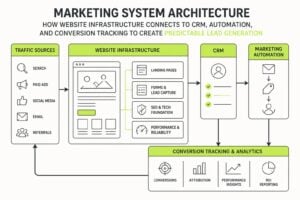
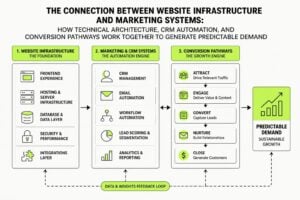
- Infrastructure that captures and nurtures leads (CRM, automation, tracking)
- Repeatable processes that don't depend on one person's heroics
- Data and feedback loops that tell you what's working
- Enough capability to execute across the channels your customers actually use
Whether that comes from an in-house hire, an agency, or a hybrid model is secondary. The structure matters more than the label.
Most service businesses under $5M revenue don't need a full in-house marketing team. They need one strategic internal person who understands the business, plus external specialists who deliver capability the internal person can't. That model is leaner, faster, and more resilient than either option alone.
As your business scales, the model evolves. You might bring more capability in-house. You might deepen the agency partnership. You might build a small internal team and keep agencies for specialist work. The best answer changes as your business changes.
The mistake is thinking you choose once and you're done. Marketing infrastructure is a living system. It needs to adapt, just like everything else in your business. If you want to explore what a structured approach to business and marketing looks like in practice, our broader writing on integration and systems might help.
Choosing between hiring agency vs in-house marketer isn't about finding the universally right answer. It's about matching capability to your current stage, budget, and growth goals. Most service businesses thrive with a hybrid approach: internal coordination and external specialisation working together. If you're ready to build marketing systems that remove chaos and create predictable demand, MDO Digital helps service-based businesses do exactly that. We design the infrastructure, run the campaigns, and build the processes that compound growth over time.