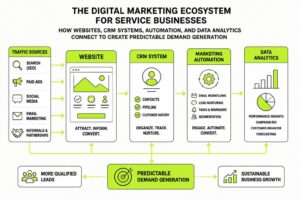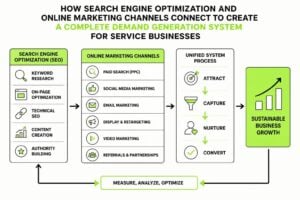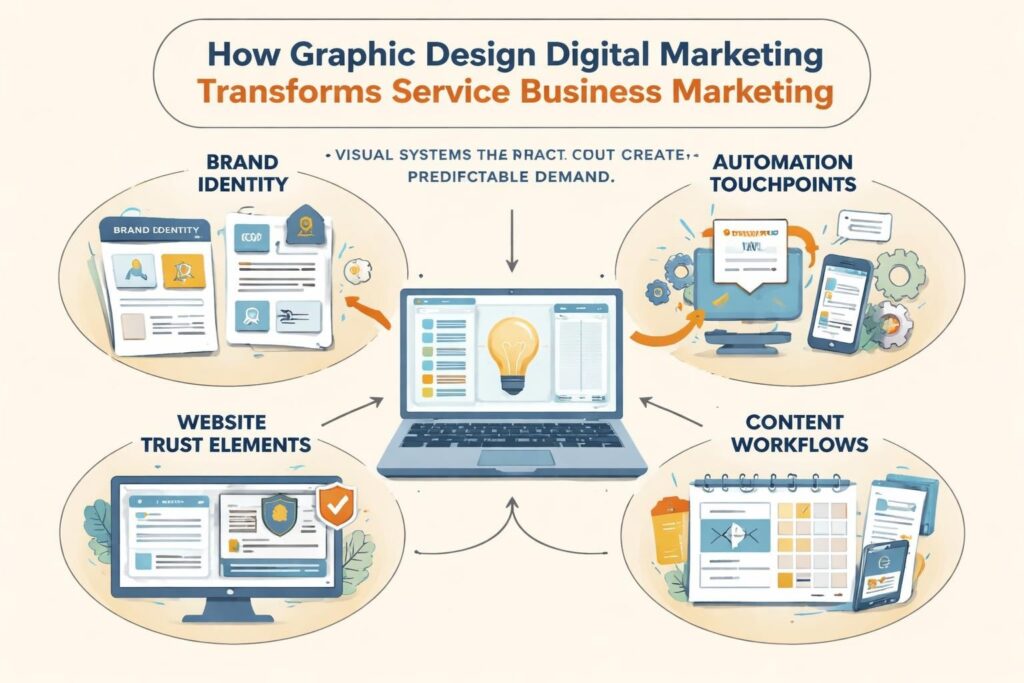
Most service businesses treat graphic design digital marketing as two separate functions. Design sits in one corner creating pretty things. Marketing sits in another corner chasing leads. The gap between them costs you money every day. When visual systems and marketing infrastructure work together, you stop bleeding opportunities through inconsistent touchpoints. You build trust at scale. Your brand shows up with the same clarity whether someone opens an email, lands on your website, or sees your ad. This isn't about making things beautiful. It's about making things work.
The Real Role of Visual Systems in Marketing Infrastructure
Graphic design digital marketing isn't decoration. It's the structural language your business uses to communicate value, build recognition, and guide decisions. Every visual element either reinforces your positioning or creates friction.
Think about your own behavior. You make snap judgments about businesses based on visual coherence. A website with amateur graphics signals amateur operations. Inconsistent branding across channels signals chaos behind the scenes. Your prospects do the same math.
Understanding the foundational principles of graphic design helps you see why this matters. Design creates hierarchy, establishes trust, and reduces cognitive load. In marketing systems, these functions compound over time.
How Visual Coherence Affects Lead Quality
When your brand identity translates consistently across every touchpoint, you filter for better prospects. People who resonate with your visual language tend to align with your values and pricing. This isn't accidental.
Strong graphic design digital marketing creates three tangible business outcomes:
- Reduced sales cycle length because trust builds faster through visual consistency
- Higher qualified lead ratios as weak fits self-select out based on brand positioning
- Improved customer lifetime value from stronger initial brand connection
The businesses we work with at MDO Digital often discover their design chaos was masking other systemic problems. Fix the visual layer, and suddenly you can see where your CRM breaks down or your messaging falls apart.
Building Marketing Systems That Scale With Design
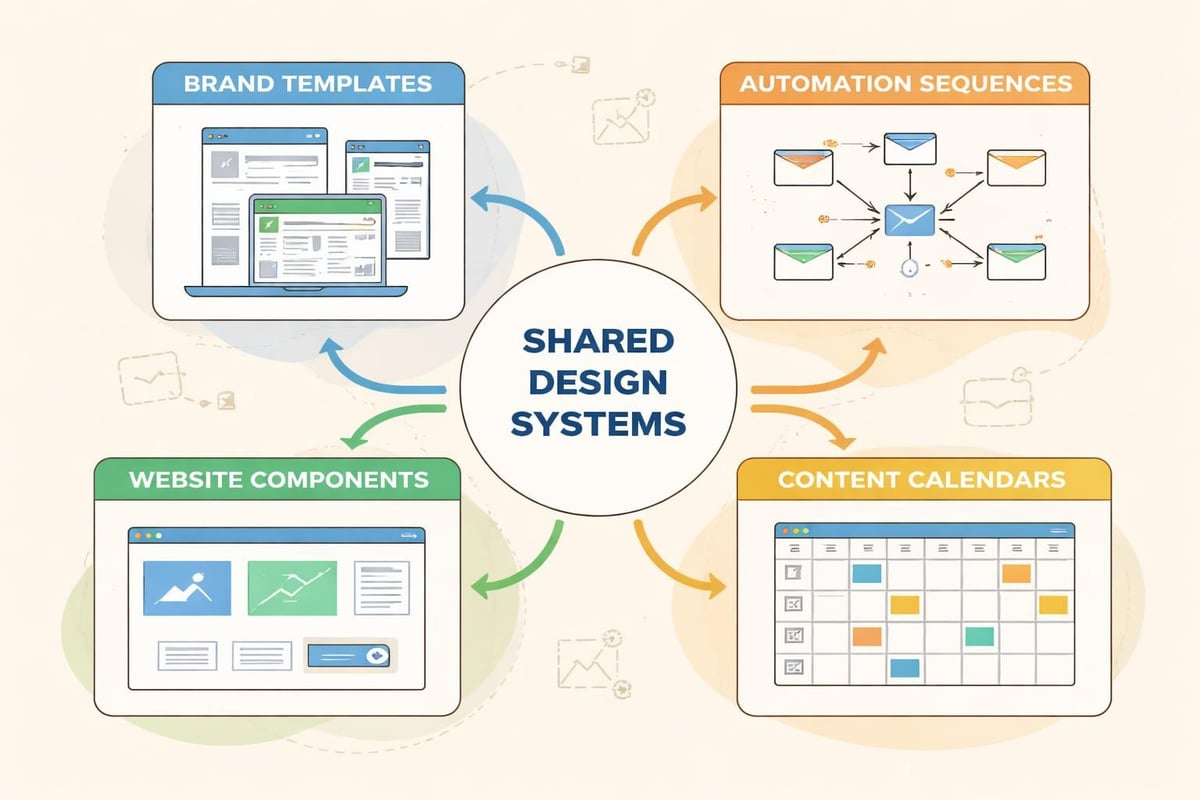
Service businesses scale when systems remove decision fatigue. Graphic design digital marketing becomes infrastructure when you template the repeatable parts and protect the variable parts.
Template Libraries That Maintain Brand Integrity
Your team shouldn't reinvent layouts every time they create an asset. Build a core library:
- Proposal and document templates that reflect your brand hierarchy
- Email sequences with consistent visual structure across nurture stages
- Social media asset frameworks that allow content variation within design constraints
- Landing page modules that combine quickly without designer involvement
- Presentation decks that maintain visual authority in sales conversations
Each template should carry your brand's visual DNA while allowing enough flexibility for context. Lock down the elements that create recognition. Open up the elements that need customization.
This approach doesn't limit creativity. It protects consistency while your team focuses energy on strategy instead of font choices. Professional graphic design impacts digital marketing success by making execution faster and more reliable.
Integration Points Where Design Meets Automation
Your CRM and automation tools don't run on spreadsheets alone. Every email, notification, and touchpoint needs visual structure that reinforces your brand promise.
| Touchpoint Type | Design Function | Business Impact |
|---|---|---|
| Welcome sequences | Establish brand expectations | Sets relationship tone, reduces early churn |
| Proposal delivery | Project visual authority | Increases close rates, justifies pricing |
| Onboarding flows | Reduce confusion through clarity | Decreases support burden, improves activation |
| Re-engagement campaigns | Rebuild connection through familiarity | Recovers revenue from dormant leads |
| Customer education | Make complex information digestible | Increases product adoption, reduces churn |
The service businesses that grow predictably treat these touchpoints as system components, not one-off design projects. You build them once with intention, then optimize based on data.
Website Design as Your Always-On Marketing Asset
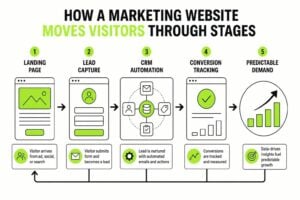
Your website is either a conversion engine or a compliance checkbox. The difference comes down to how graphic design digital marketing principles get applied to structure, hierarchy, and trust signals.
Most service business websites fail because they organize around internal departments instead of buyer journeys. Your prospects don't care about your org chart. They care about whether you understand their problem and can solve it competently.
Trust Architecture Through Visual Hierarchy
High-trust website design guides attention deliberately. Every page should answer three questions immediately:
- Where am I? (Clear positioning and context)
- Is this for me? (Relevant messaging and social proof)
- What happens next? (Obvious path forward)
Graphic design digital marketing solves these questions through visual weight, white space, and deliberate contrast. Your most important elements should dominate visually. Your calls to action should create obvious next steps without shouting.
When we audit service business websites, the conversion problems usually trace back to visual confusion. Too many competing elements. No clear hierarchy. Design working against the message instead of amplifying it.
Content Presentation That Converts Attention to Demand
Your content marketing either builds authority or wastes effort. Design determines which outcome you get. Learning core design principles helps marketers present ideas with maximum impact.
Structure your content with these visual systems:
Typography hierarchy that makes scanning effortless and draws readers deeper. Color psychology that reinforces brand personality and guides emotional response. Image selection that supports claims instead of filling space. Layout rhythm that varies visual weight to maintain engagement.
Each piece of content should feel like it comes from the same brand universe. Not identical, but recognizably yours. This recognition builds over time, creating brand equity that competitors can't copy quickly.
Brand Identity Systems That Create Market Position
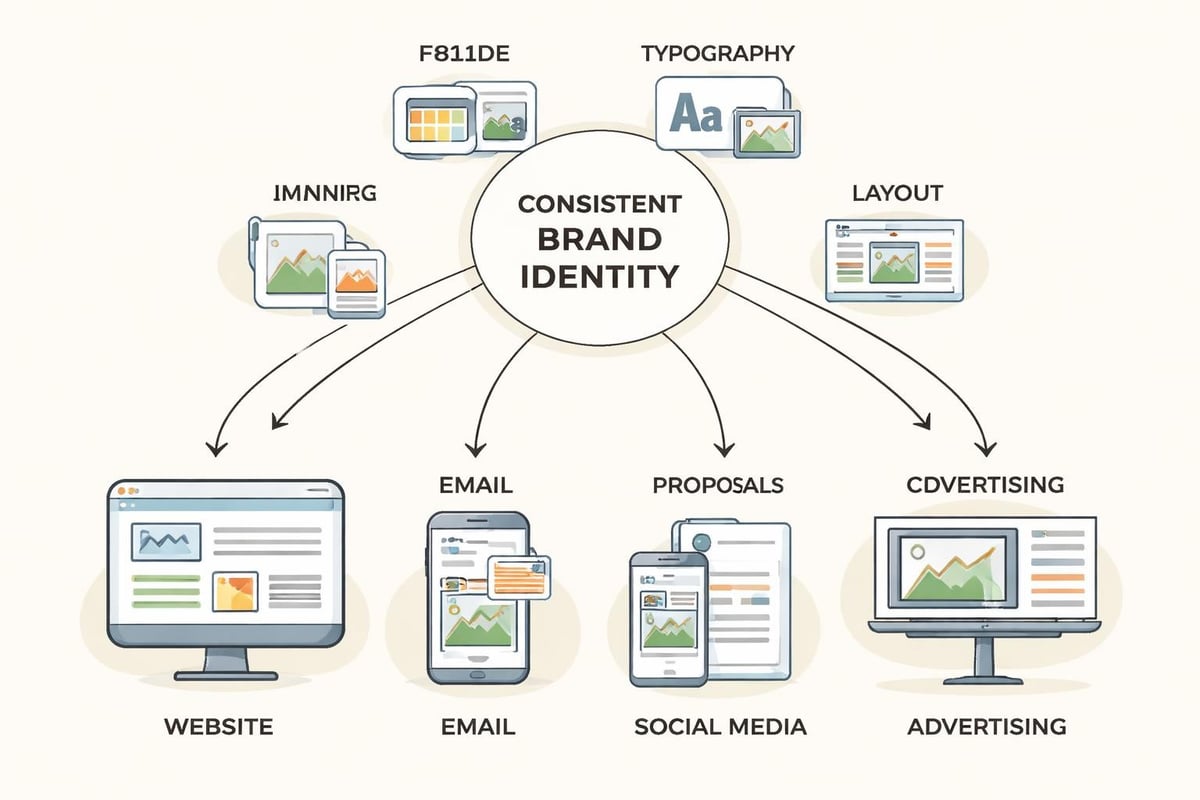
Graphic design digital marketing fails when brand identity stays locked in a PDF guideline document. Your brand needs to live in every customer interaction, adapted for context but coherent in execution.
Service businesses often underinvest in brand systems because the ROI feels abstract. But weak branding has concrete costs. You compete on price because prospects can't differentiate you visually. Your team wastes time debating design decisions. Marketing assets look disconnected across channels.
Core Elements That Define Visual Recognition
Your brand system should document the non-negotiables:
- Primary and secondary color palettes with specific use cases
- Typography choices for headlines, body copy, and interface elements
- Logo variations and clear usage rules for different contexts
- Photography and illustration styles that align with positioning
- Iconography and graphic elements that create visual shortcuts
These aren't constraints. They're decision frameworks that speed up execution and protect consistency. When your team knows the rules, they can move faster without checking in constantly. Our work in branding focuses on systems that remove chaos while allowing creative expression.
Applying Brand Systems Across Marketing Channels
Consistency doesn't mean repetition. Your brand should flex appropriately for each channel while maintaining core recognition. An Instagram post shouldn't look identical to a LinkedIn article, but both should feel unmistakably yours.
| Channel | Design Adaptation | Consistency Anchors |
|---|---|---|
| Website | Full brand expression, detailed layouts | Complete color palette, all typography |
| Simplified for inbox rendering | Brand colors, logo, key typography | |
| Social media | Platform-optimized formats | Color palette, visual style, tone |
| Advertising | Attention-grabbing variations | Logo placement, brand colors, messaging consistency |
| Documents | Professional, readable formats | Typography hierarchy, color accents |
Digital marketing performs better when design stays coherent across these applications. Your audience processes your brand cumulatively. Each touchpoint either reinforces or dilutes the previous impression.
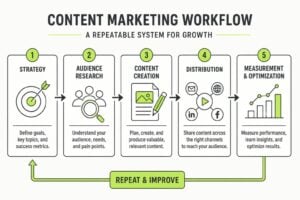
Content Creation Workflow With Design Integration
Graphic design digital marketing breaks down when content and design operate as separate workflows. Writers finish copy, throw it over the wall, and designers make it "look pretty." This handoff model wastes time and weakens outcomes.
Service businesses that scale build integrated content workflows where design thinking informs creation from the start. You're not designing around finished copy. You're creating designed experiences that achieve specific business goals.
Planning Content With Visual Structure
Before writing a single word, map the visual story:
- Define the one action this content should drive
- Identify the emotional journey from arrival to conversion
- Sketch visual hierarchy showing what dominates each section
- Plan supporting graphics that prove claims or simplify complexity
- Design the conversion path with deliberate visual emphasis
This planning process changes what you write and how you write it. You're not filling predetermined layouts. You're architecting persuasive experiences where text and visuals work together.
The importance of graphic design in digital marketing becomes obvious when you see content performance improve through better integration. Your conversion rates climb because design and copy optimize for the same outcome.
Production Systems That Maintain Quality at Scale
You can't manually design every piece of content as your business grows. Build production systems with these layers:
Strategic content that gets full custom design treatment (major launches, core site pages, key campaigns). Templated content that uses proven frameworks with variable elements (blog posts, case studies, email sequences). Automated content that generates from system rules (social shares, notifications, data reports).
Each layer requires different levels of design involvement, but all three should maintain brand coherence. Your templates should be good enough that 80% of content never needs a designer's review.
Advertising Design That Converts Cold Audiences
Service businesses waste advertising budget on generic creative. Pretty images with bland copy that could represent any competitor. Graphic design digital marketing in advertising means building assets that stop scrolls, communicate value quickly, and drive qualified clicks.
Your ad creative competes against everything else in the feed. Subtle doesn't work. But neither does garish. The winning approach balances visual disruption with brand coherence.
Creating Pattern Interruption Without Brand Dilution
Effective ad design breaks the scroll pattern while staying true to your brand:
- High contrast elements that create visual stops without looking desperate
- Unusual compositions that feel fresh but professional
- Benefit-focused imagery that shows outcomes instead of generic concepts
- Clear value propositions emphasized through typography and layout
- Strong calls to action that create obvious next steps
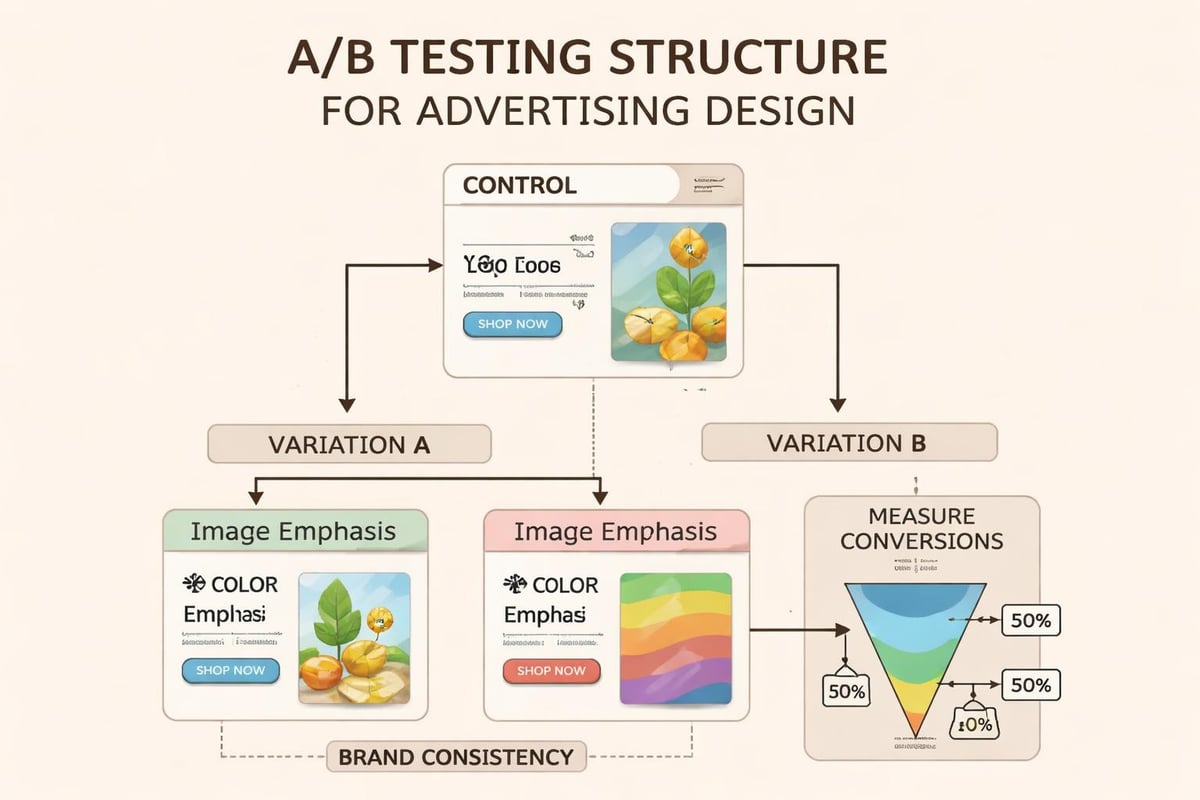
Test multiple visual approaches, but keep brand DNA consistent. Your color palette, typography, and overall style should remain recognizable even as you vary compositions and messaging.
Retargeting Creative That Rebuilds Connection
People who clicked once but didn't convert need different creative than cold audiences. Your retargeting design should acknowledge the existing relationship and move the conversation forward.
Build retargeting sequences that visually reference previous touchpoints. Use consistent imagery across the journey so prospects subconsciously recognize you. Adjust messaging based on their behavior, but keep visual language familiar. This approach uses graphic design to build brand authority through repeated, coherent exposure.
Measuring Design Impact on Marketing Performance
Graphic design digital marketing only matters if it moves business metrics. Visual appeal is nice. Revenue is better. Structure your measurement around outcomes, not aesthetics.
Track how design changes affect these conversion points:
Website conversion rate across different traffic sources and landing pages. Email engagement metrics including open rates, click-through rates, and conversion. Sales cycle length from first touch to closed deal. Average deal size as brand perception improves. Customer acquisition cost as conversion rates improve across channels.
When you improve graphic design digital marketing systematically, these metrics should trend positively. Not overnight, but consistently over quarters. The businesses that see strongest results treat design as system optimization, not project decoration.
Attribution Models for Visual Changes
Isolating design impact requires thoughtful attribution. Run controlled tests where possible:
- A/B test landing page designs with identical traffic sources
- Compare email performance across old and new templates
- Track proposal close rates before and after design updates
- Monitor brand search volume as visual consistency improves
- Survey customers about what influenced their buying decision
Not everything is measurable, but more is trackable than most businesses attempt. Build baseline metrics before making major design changes. Track consistently afterward. The patterns become clear over time.
Design Skills Your Marketing Team Actually Needs
You don't need every marketer to become a professional designer. But basic visual literacy improves every marketing outcome. When your team understands design principles, they make better decisions about content, campaigns, and brand applications.
Focus skill development on these practical areas:
Fundamental Design Principles That Improve Marketing
Hierarchy – Understanding how visual weight guides attention and action. Contrast – Using differences in size, color, and spacing to create emphasis. Alignment – Creating professional polish through deliberate positioning. Proximity – Grouping related elements to improve comprehension. White space – Using emptiness strategically to improve clarity and reduce overwhelm.
These principles improve marketing performance even without advanced design software skills. Your team starts seeing how layouts help or hurt conversion. They request better creative because they understand what "better" means.
Resources like those compiled by academic institutions focused on graphic design provide foundational knowledge that translates directly to marketing applications.
Tool Literacy vs Design Expertise
Your marketing team should be comfortable with:
| Tool Type | Required Proficiency | Business Impact |
|---|---|---|
| Template editors (Canva, Figma templates) | High – daily use | Maintains brand consistency, speeds production |
| Email builders | High – weekly use | Improves deliverability and conversion |
| Presentation software | Medium – as needed | Professional client interactions |
| Photo editing | Low – basic crops/resizing | Adequate content preparation |
| Advanced design software | Not required – work with specialists | Focus budget on strategic projects |
This distribution lets your team move quickly on routine tasks while bringing in expertise for strategic work. You're not trying to replace designers. You're reducing bottlenecks and improving communication between marketing and design functions. Understanding how design integrates with marketing agencies helps structure roles appropriately.
Visual Strategy for Service Business Positioning
Graphic design digital marketing for service businesses differs from product marketing. You're not showing a physical item. You're creating visual metaphors for expertise, process, and outcomes. This requires more strategic thinking about how design communicates intangible value.
Your visual strategy should solve these positioning challenges:
Making expertise tangible through case studies, process visualization, and authority signals. Differentiating from competitors who offer similar services at similar prices. Justifying premium pricing through brand perception and professional polish. Simplifying complex services so prospects understand value quickly.
Each challenge has visual solutions. The businesses that win their markets use graphic design digital marketing as strategic positioning, not tactical decoration.
Process Visualization That Builds Confidence
Service buyers fear the unknown. Your process might be excellent, but if prospects can't visualize it, they stay nervous. Design makes your methodology tangible.
Create visual frameworks that show:
- How you diagnose problems and develop solutions
- What phases a project moves through from start to completion
- Where client input happens and what you handle independently
- How you measure success and report results
- What clients receive at each stage of engagement
These process visualizations become sales assets, website content, and proposal components. They don't just explain your work. They build confidence that you've done this before and know what you're doing. This confidence directly impacts close rates and deal size.
Strong graphic design digital marketing creates predictable growth by removing visual chaos and building trust at every touchpoint. When your brand shows up consistently across websites, automation, content, and advertising, prospects move through your funnel faster and convert at higher rates. If your current marketing feels scattered or your visual presence doesn't match your expertise, MDO Digital helps service businesses build the design systems and marketing infrastructure that turn attention into predictable demand. We remove the chaos so you can focus on the work that compounds.