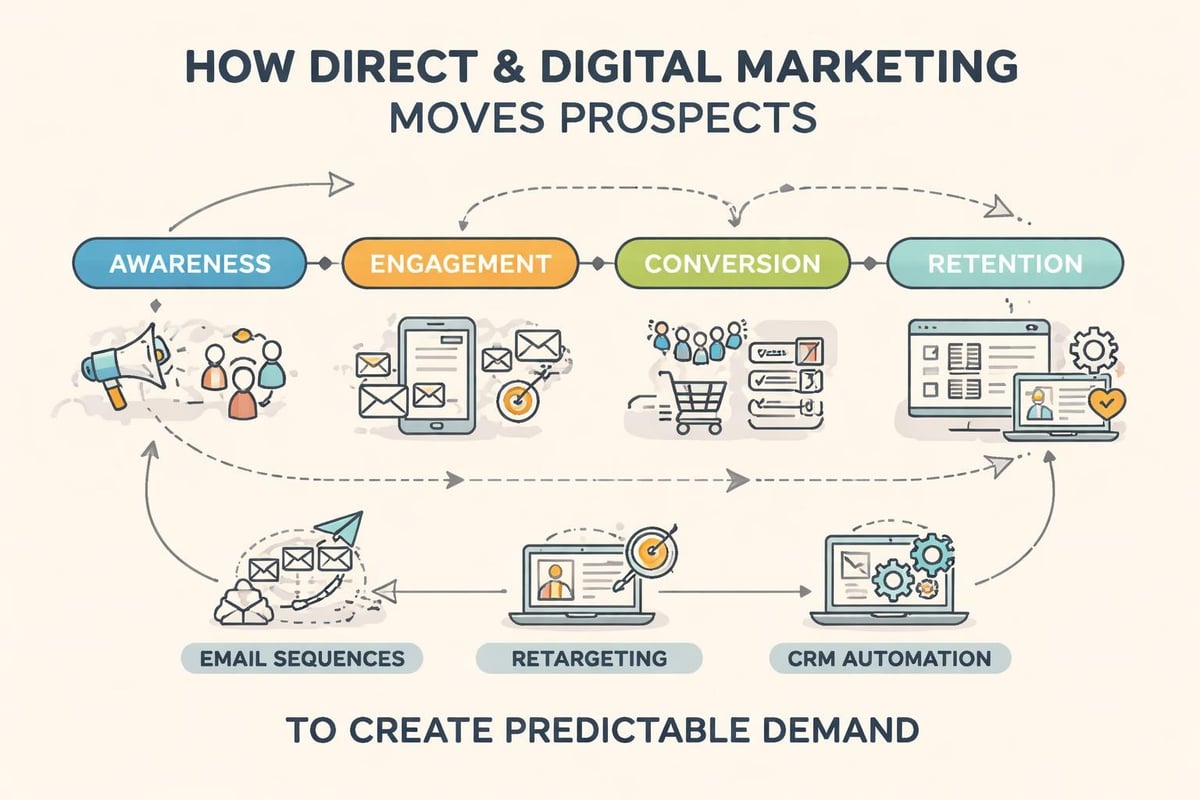
Most service businesses treat marketing like a megaphone. They shout into the void and hope someone hears them. Direct and digital marketing flips that model. Instead of broadcasting to everyone, you speak to the right people with the right message at exactly the right time. This isn't about volume. It's about precision, measurement, and structure. When you combine the accountability of direct response with the reach of digital channels, you create a system that turns attention into predictable demand. No guessing. No wasted spend. Just structured growth that compounds over time.
What Direct and Digital Marketing Actually Means
Direct marketing has always been about response. You send a message, someone acts, and you measure what happened. Mail, phone, fax (remember those?), it all worked the same way. You targeted specific people, made an offer, and tracked who converted.
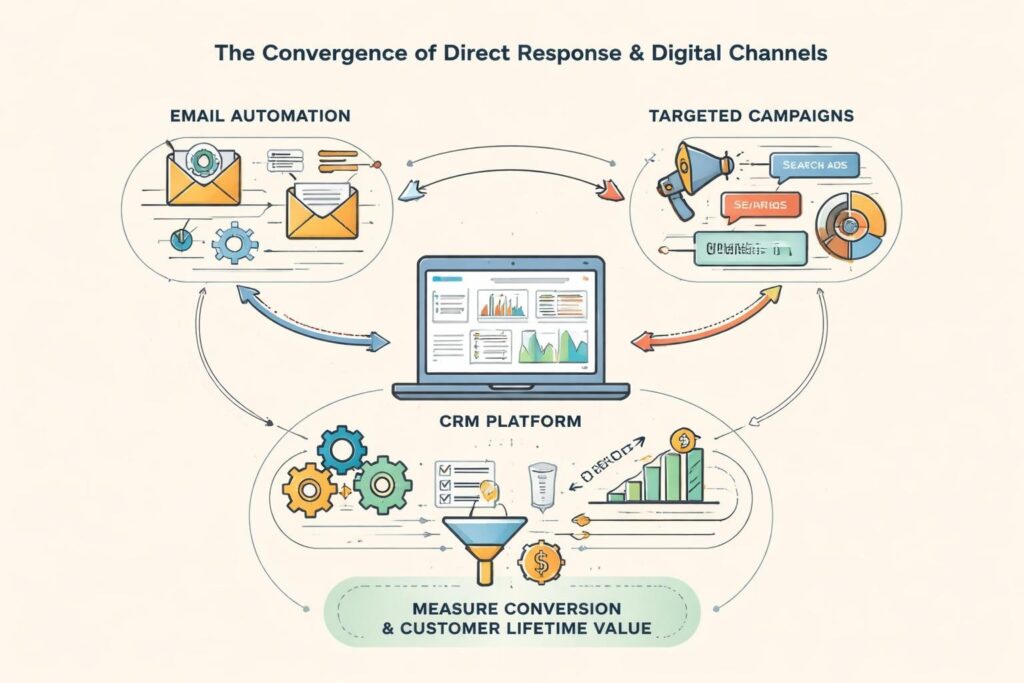
Digital added scale and speed. Now you can reach thousands instantly, test variations in real time, and automate follow-up based on behavior. Direct digital marketing merges these two worlds into one framework.
The core principles stay consistent:
- Targeted messaging delivered to specific segments
- Measurable outcomes tied to revenue and conversion
- Direct response that triggers immediate action
- Relationship building through ongoing communication
- Data collection that improves targeting over time
Why Service Businesses Need Both
Service businesses live or die by trust. You're not selling widgets. You're selling expertise, time, and outcomes. That requires a longer conversation. Direct and digital marketing creates the infrastructure for those conversations at scale.
Traditional advertising builds awareness. That's fine if you're Coca-Cola. But if you're a consulting firm, agency, or professional service, awareness doesn't pay the bills. You need leads. Qualified ones. And you need them moving through a predictable process that doesn't rely on you chasing people down.
Building Your Direct and Digital Marketing Infrastructure
You can't run effective campaigns without proper infrastructure. This is where most businesses fall apart. They launch ads, send emails, and wonder why nothing sticks. The problem isn't the message. It's the system underneath.
| System Component | Purpose | Impact on Results |
|---|---|---|
| CRM Platform | Centralizes lead data and tracks behavior | Prevents lead loss, enables segmentation |
| Email Automation | Nurtures prospects based on actions | Maintains engagement without manual work |
| Landing Pages | Captures leads with specific offers | Increases conversion through message match |
| Analytics Setup | Measures campaign performance | Shows what's working, what's not |
| Lead Scoring | Prioritizes high-intent prospects | Focuses sales effort where it matters |
Your marketing infrastructure needs to handle three jobs: capture, nurture, convert. Miss any one and you're burning money.
Capture: Getting Contact Information
Most websites leak leads like a sieve. Someone visits, looks around, leaves. You never hear from them again. Direct and digital marketing fixes this by creating specific capture points tied to value.
High-converting capture mechanisms:
- Lead magnets (guides, templates, assessments) that solve immediate problems
- Webinar registrations that demonstrate expertise
- Free consultations with clear next steps
- Tool access (calculators, planners) that require email
- Content upgrades attached to blog posts
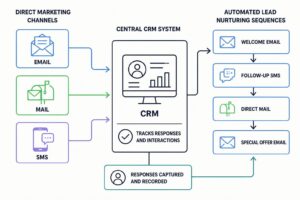
Each capture point feeds your CRM. From there, automation takes over. This is where digital channels shine. You can segment based on what someone downloaded, which pages they visited, or which emails they opened.
Nurture: Building Trust Over Time
Service buyers don't convert in one visit. They need time to trust you. Direct and digital marketing creates that trust through consistent, relevant communication.
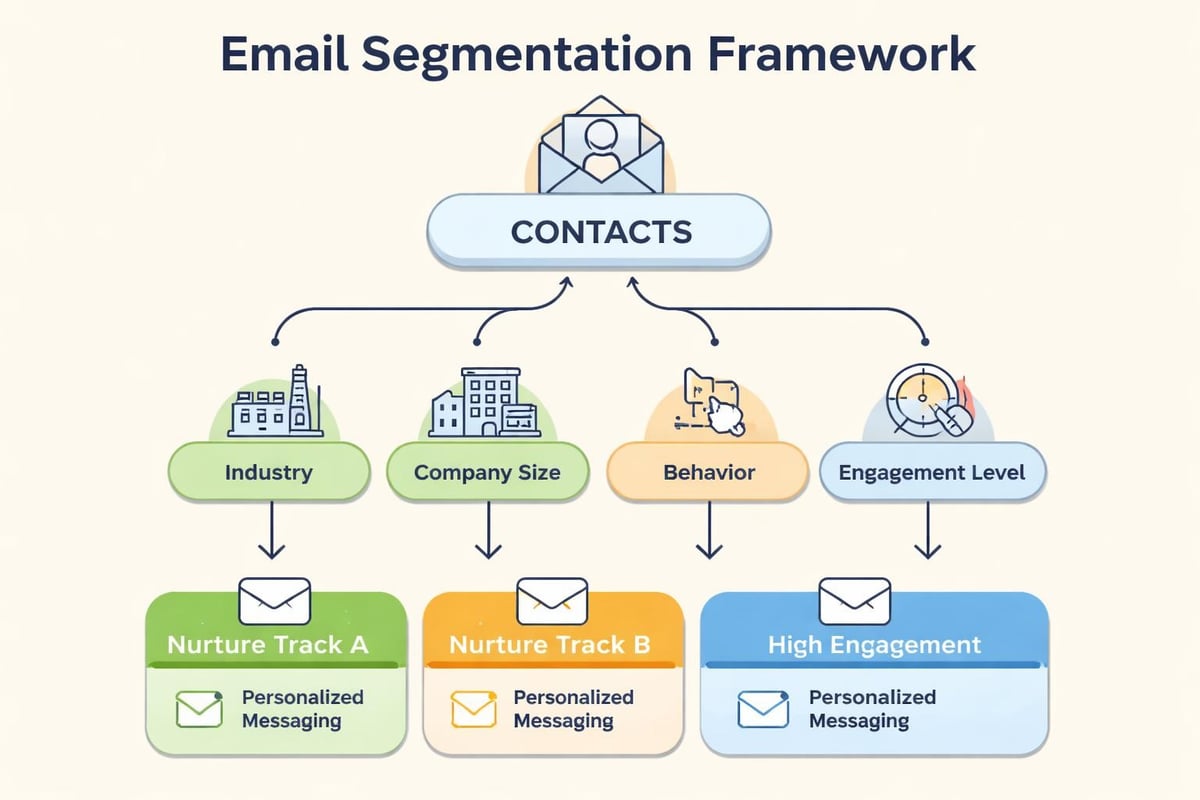
Email remains the workhorse here. Not broadcast emails. Sequences triggered by behavior. Someone downloads your positioning guide? They get a five-email sequence about brand clarity. They visit your pricing page? Different sequence focused on ROI and process.
The Data & Marketing Association has tracked email performance for decades. The data is clear: personalized, behavior-triggered emails outperform generic broadcasts by massive margins.
Your nurture tracks should vary based on:
- Lead source (where they came from)
- Content consumed (what problems they're researching)
- Engagement level (how often they open and click)
- Stage in journey (awareness vs. decision)
This isn't set-it-and-forget-it. You test subject lines, adjust timing, and refine messaging based on what converts.
Digital Channels That Drive Direct Response
Channel selection matters less than most people think. What matters is message-market match and proper tracking. That said, some channels work better for service businesses than others.
Email: The Revenue Engine
Email converts better than any other channel for high-ticket services. Why? Control and context. You own the list. You control the message. And when someone's reading their inbox, they're in decision mode.
Effective email types for direct response:
- Welcome series that sets expectations and delivers quick value
- Educational sequences that solve problems and demonstrate expertise
- Case study campaigns that show proof and outcomes
- Event invitations that create conversation opportunities
- Re-engagement campaigns for dormant contacts
The key is segmentation. One message to your whole list is lazy. Break it down. New leads get different content than long-term subscribers. Decision-makers get different angles than implementers.
Paid Search: Capturing Active Intent
Someone searching "marketing systems for service businesses" isn't browsing. They're looking for solutions. Paid search captures that intent and directs it to specific landing pages.
The direct marketing principle applies here: tight message match. Your ad promise should match your landing page headline, which should match your offer. Any disconnect and conversion drops.
| Search Strategy | Best For | Conversion Focus |
|---|---|---|
| Branded terms | Protecting your name | High intent, defend market share |
| Solution terms | Problem-aware prospects | Mid-funnel, education-first |
| Competitor terms | Stealing market share | Comparison, differentiation |
| Question terms | Early research | Trust-building, list growth |
Track every click to revenue. Not just cost per lead. Cost per customer. If a keyword costs $50 per lead but converts at 30%, it's cheaper than a $20 lead that converts at 5%.
Retargeting: Closing the Loop
Most people need 7-12 touchpoints before they buy. Retargeting keeps you visible without being pushy. Someone visits your site, doesn't convert, then sees your ads as they browse other sites. Not creepy if done right. Just persistent.
Retargeting audiences worth building:
- Page-specific visitors (pricing, case studies, services)
- Video viewers (engaged but not yet converted)
- Email openers who didn't click
- Cart abandoners (if you have digital products)
- Past customers (upsell and referral campaigns)
Run different creative to different segments. Someone who visited your branding services page doesn't need generic brand ads. Show them case studies. Testimonials. Specific outcomes.
Testing and Optimization: The Direct Marketing Discipline
Here's where most digital marketers fail. They launch campaigns, check vanity metrics, and call it done. Direct and digital marketing requires constant testing and refinement.
Direct marketing built its reputation on measurement. Every piece had a tracking code. Every offer had a response rate. Digital gives you even more data, but only if you structure your tests properly.
What to Test First
Start with the variables that move the needle. Subject lines are easy to test but rarely create 10x improvements. Offer positioning? That changes everything.
High-impact test variables:
- Offer type (guide vs. consultation vs. assessment)
- Headline positioning (pain vs. aspiration vs. proof)
- Price anchoring (value prop vs. guarantees vs. payment terms)
- CTA clarity (what happens next, why now)
- Landing page length (short form vs. long copy)
Run one test at a time. Changing five variables at once tells you nothing. Test for statistical significance, not gut feel. And document everything. What worked in Q1 might not work in Q3.
Analytics That Actually Matter
Traffic is a vanity metric. So is open rate. Focus on metrics that connect to revenue.
| Metric | What It Tells You | Why It Matters |
|---|---|---|
| Cost per qualified lead | Efficiency of acquisition | Controls budget and scale |
| Lead-to-customer rate | Quality of targeting | Validates offer-market fit |
| Customer lifetime value | Long-term profitability | Justifies acquisition cost |
| Time to conversion | Sales cycle length | Predicts cash flow |
| Channel attribution | Which sources convert | Allocates budget effectively |
Your marketing systems should surface this data automatically. If you're pulling reports manually, you're wasting time that should go to optimization.
Automation: Scaling Without Breaking
Service businesses hit a ceiling when marketing requires constant manual effort. You can't personally email every lead. You can't remember who downloaded what six weeks ago. Automation removes those limits.
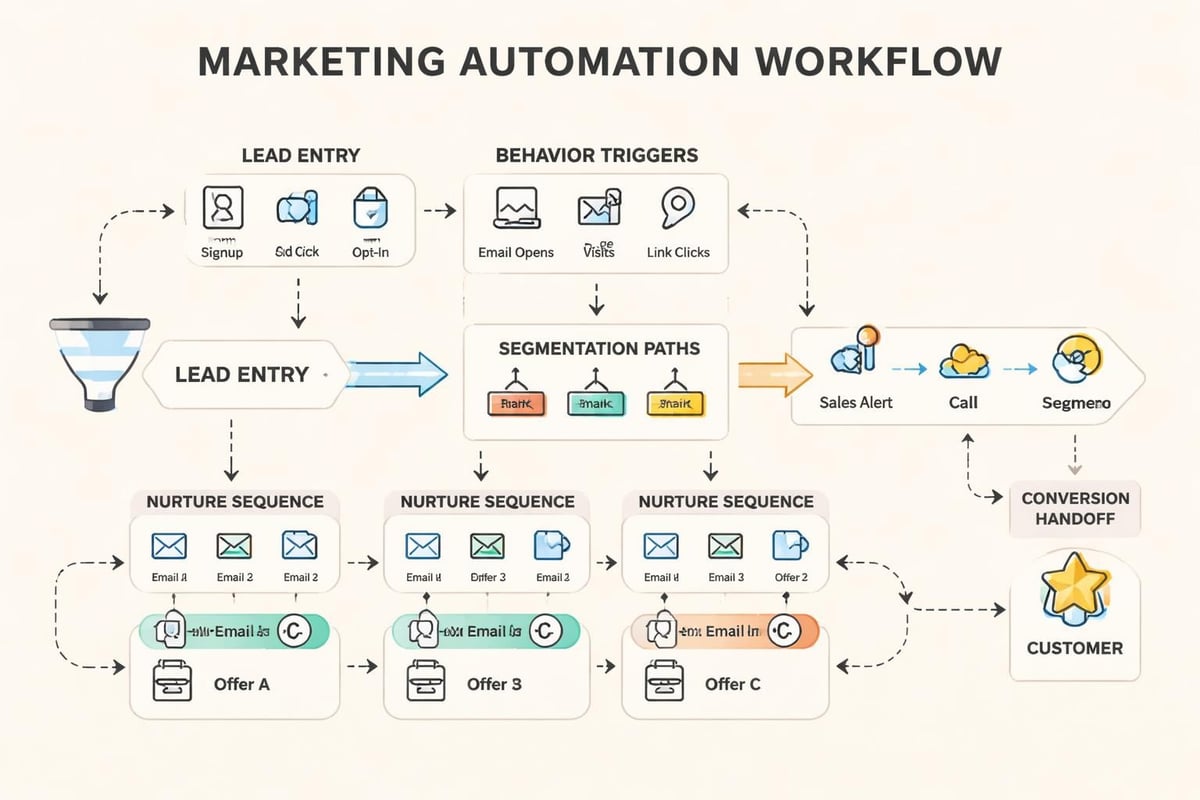
But automation without strategy is just faster chaos. You need structured workflows based on customer behavior and business logic.
Essential Automated Workflows
These workflows run in the background, nurturing leads and moving them toward conversion without your daily involvement:
Lead qualification automation:
- New lead enters system
- Lead scoring assigns points based on fit and behavior
- High-score leads notify sales immediately
- Low-score leads enter nurture sequence
- Engagement triggers re-scoring
Nurture sequence automation:
- Lead downloads specific resource
- Enters topic-specific email sequence
- Behavioral triggers (opens, clicks) adjust message path
- Low engagement triggers different content angle
- High engagement triggers sales notification
Customer onboarding automation:
- Sale closes in CRM
- Welcome email with next steps sends immediately
- Onboarding tasks trigger based on service type
- Check-in emails at key milestones
- Review request after project completion
The goal isn't to remove human touch. It's to ensure nothing falls through the cracks and your team focuses on high-value conversations.
Privacy, Compliance, and Trust
Direct and digital marketing relies on data. That means you're responsible for handling it properly. This isn't just legal compliance (though that matters). It's trust.
Service businesses operate on reputation. Spam someone's inbox or misuse their data and you're done. Not just with that prospect. With everyone they tell.
Non-negotiable compliance requirements:
- CAN-SPAM compliance for all email marketing
- GDPR adherence if you serve EU clients
- Clear opt-in processes with explicit consent
- Easy unsubscribe on every email
- Data security protecting customer information
Beyond legal requirements, practice ethical marketing. Don't trick people into signing up. Don't hide your identity. Don't sell email lists. This should be obvious, but you'd be surprised how many agencies cut corners.
When you respect people's data and attention, they notice. That builds trust faster than any clever headline.
Integration: Making Everything Work Together
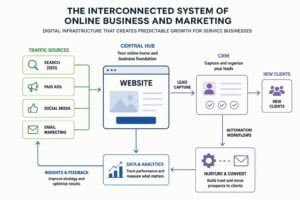
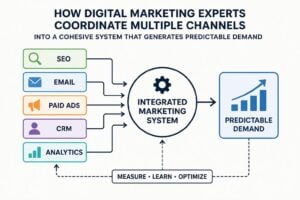
The power of direct and digital marketing comes from integration. Your email platform talks to your CRM. Your CRM talks to your analytics. Your analytics inform your ad targeting. Everything feeds everything else.
Most businesses run disconnected tools that don't share data. Email in one system. CRM in another. Analytics in a third. You end up with gaps, duplicates, and blind spots.
Critical integration points:
- Website to CRM (lead capture flows directly)
- CRM to email platform (segments sync automatically)
- Ad platforms to CRM (track source to revenue)
- Analytics to all systems (unified reporting)
- Payment systems to CRM (customer lifecycle tracking)
When integration works, you get a complete picture. You know which channels drive revenue. Which messages convert. Which segments are worth investing in. You can make decisions based on data, not hunches.
Our work at MDO Digital focuses heavily on this infrastructure layer. You can't run effective campaigns on broken systems.
Content as Direct Response Fuel
Content marketing and direct marketing aren't opposites. Done right, every piece of content serves a direct response goal. It either captures a lead, nurtures a relationship, or moves someone toward a buying decision.
Generic blog posts that end with "hope you enjoyed this" waste everyone's time. Every article should have a clear next step. Download this. Book that. Join this.
Content types that drive response:
- Problem-solution guides with tool or template offers
- Case studies with consultation CTAs
- How-to tutorials with course or service upsells
- Industry research requiring email to access
- Comparison articles guiding toward your solution
The content itself demonstrates expertise. The CTA creates the business outcome. Miss either piece and you're leaving money on the table.
This approach to content marketing and branding turns your blog from a cost center into a lead generation engine.
Measurement and Attribution
You can't improve what you don't measure. Direct and digital marketing demands clear attribution from first touch to closed deal.
Most businesses use last-click attribution. Whatever someone clicked right before converting gets all the credit. That's lazy and wrong. Someone might see your ad, read three articles, download a guide, attend a webinar, then book a call. Every touchpoint mattered.
Attribution models worth considering:
- First-touch (what started the relationship)
- Last-touch (what closed the deal)
- Linear (equal credit to all touchpoints)
- Time-decay (more credit to recent interactions)
- Position-based (extra credit to first and last)
No model is perfect. The point is acknowledging that conversion happens across multiple channels over time. Your digital marketing strategy should reflect that reality.
Track the full customer journey. From anonymous visitor to paying customer to referral source. That's how you understand what actually drives growth.
Direct and digital marketing isn't complicated, but it does require discipline. You need clear offers, proper infrastructure, consistent testing, and obsessive measurement. When you combine direct response principles with digital channel reach, you create a system that generates predictable demand instead of hoping for random inquiries. That's the difference between a business that reacts to the market and one that controls its own growth. If you're ready to build marketing systems that actually drive revenue, MDO Digital can help you design the infrastructure, implement the automation, and run campaigns that convert attention into customers. Let's remove the chaos and build something that scales.