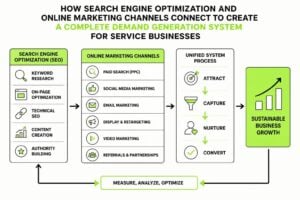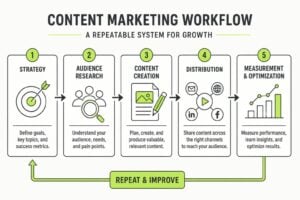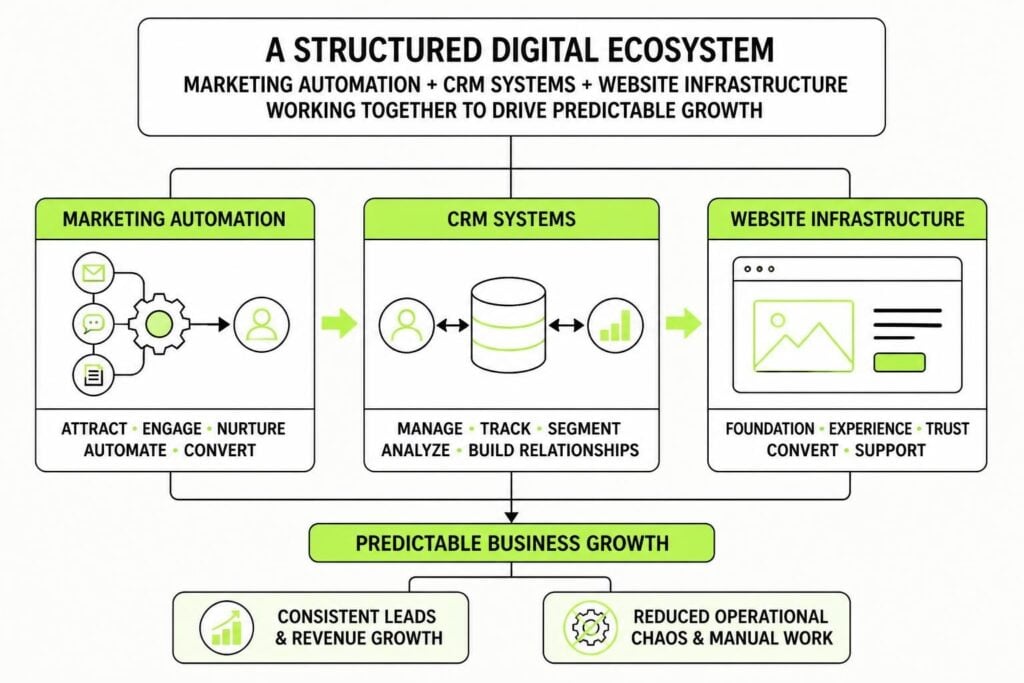
Most service businesses hit a point where their digital presence becomes the bottleneck. You're getting leads, but they're falling through cracks. Your website looks fine, but it doesn't convert. Your CRM is either non-existent or a mess of scattered contacts. The problem isn't effort, it's structure. To develop digital infrastructure that actually scales, you need systems that work together, not a collection of disconnected tools hoping for the best.
What It Means to Develop Digital Infrastructure
When we talk about developing digital systems, we're not discussing flashy redesigns or the latest marketing trend. We're talking about building the backbone that turns attention into revenue predictably.
Digital infrastructure includes:
- Your website and how it captures and qualifies leads
- CRM systems that track every interaction and opportunity
- Automation that nurtures prospects without manual work
- Data flows that show you what's working and what's wasting money
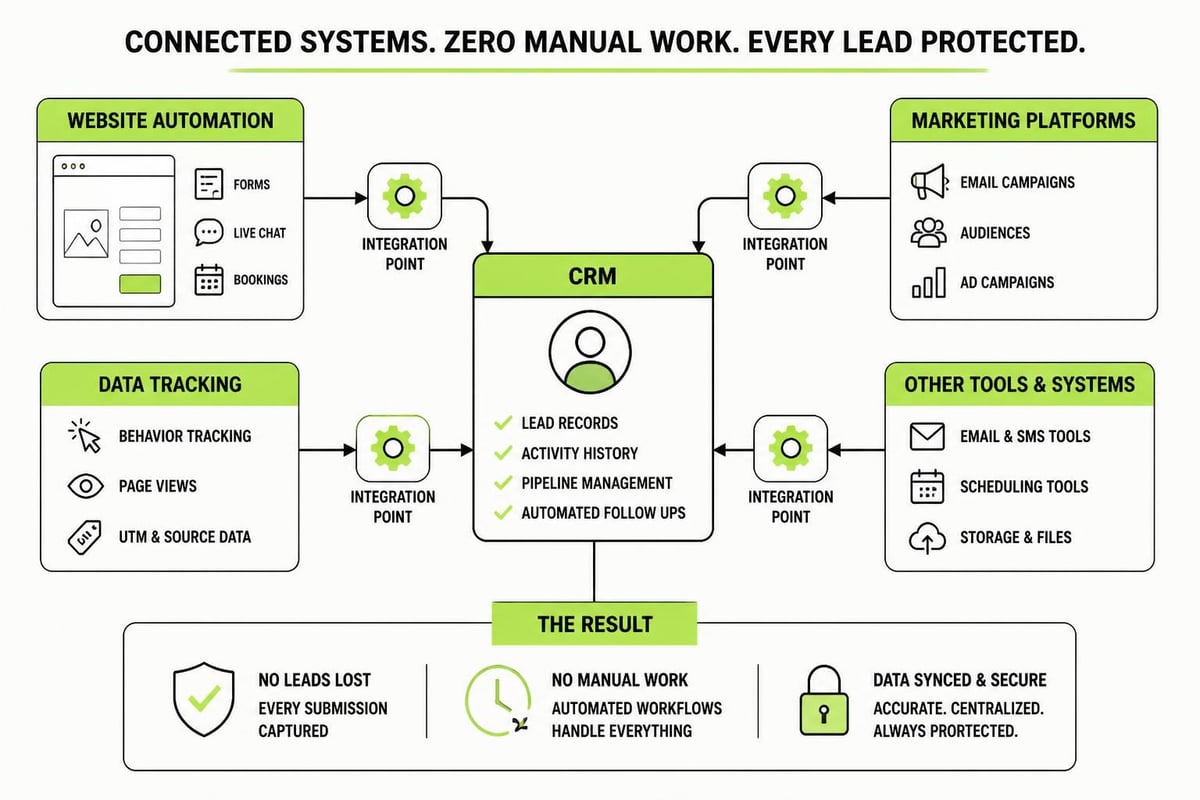
- Integration points where tools talk to each other properly
Think of it like plumbing. No one notices when it works perfectly. Everyone notices when it doesn't. The OECD’s Going Digital framework outlines how digital infrastructure supports economic growth, and the same principles apply at the business level. Your digital systems either create compounding advantages or compounding problems.
The Foundation: High-Trust Websites
Your website isn't a brochure. It's a filtering and conversion mechanism that should work 24/7. To develop digital assets that convert, your website needs clear messaging, obvious next steps, and zero friction between interest and action.
Most service business websites fail because they try to please everyone. They're vague about who they help, unclear about what they offer, and buried in features instead of outcomes. A high-trust website does the opposite.
| Element | What It Does | Why It Matters |
|---|---|---|
| Clear value proposition | States exactly who you help and how | Qualifies visitors immediately |
| Strategic calls to action | Guides visitors to one next step | Removes decision paralysis |
| Social proof | Shows evidence of past results | Builds credibility without selling |
| Speed and accessibility | Loads fast, works on all devices | Keeps attention, meets standards |
The difference between a site that converts at 1% and one that converts at 4% isn't design skill. It's strategic clarity. When you develop digital touchpoints with clear intent, conversion becomes predictable.
Building CRM and Automation Infrastructure
This is where most businesses either create leverage or create chaos. A CRM isn't just a database of contacts. It's the central nervous system of your growth operation.
To develop digital systems that protect leads, your CRM must:
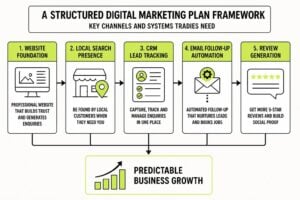
- Capture every lead automatically from forms, calls, emails, and third-party platforms
- Tag and segment based on behavior so you know exactly where someone is in the buying journey
- Trigger appropriate follow-up without manual input or memory
- Track every touchpoint so nothing falls through cracks
- Report on pipeline health with actual data, not guesses
You'd be surprised how many businesses run on spreadsheets and memory. That works until it doesn't. Usually around the point where you're trying to scale beyond yourself.
Automation That Actually Works
Automation gets a bad rap because most businesses implement it badly. They automate too early, automate the wrong things, or automate without strategy. The result is robotic emails that feel disconnected and campaigns that annoy instead of nurture.
Good automation is invisible. It feels human because it's based on real buyer behavior and actual needs. When someone downloads a guide, visits your pricing page three times, or opens every email, your system should respond intelligently.
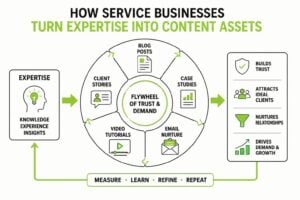
Here's what effective automation looks like in practice. Someone visits your site, downloads a resource, and enters your ecosystem. Over the next two weeks, they receive a sequence that educates, builds trust, and demonstrates expertise. If they engage, the system alerts your team for direct outreach. If they don't, they move to a long-term nurture campaign.
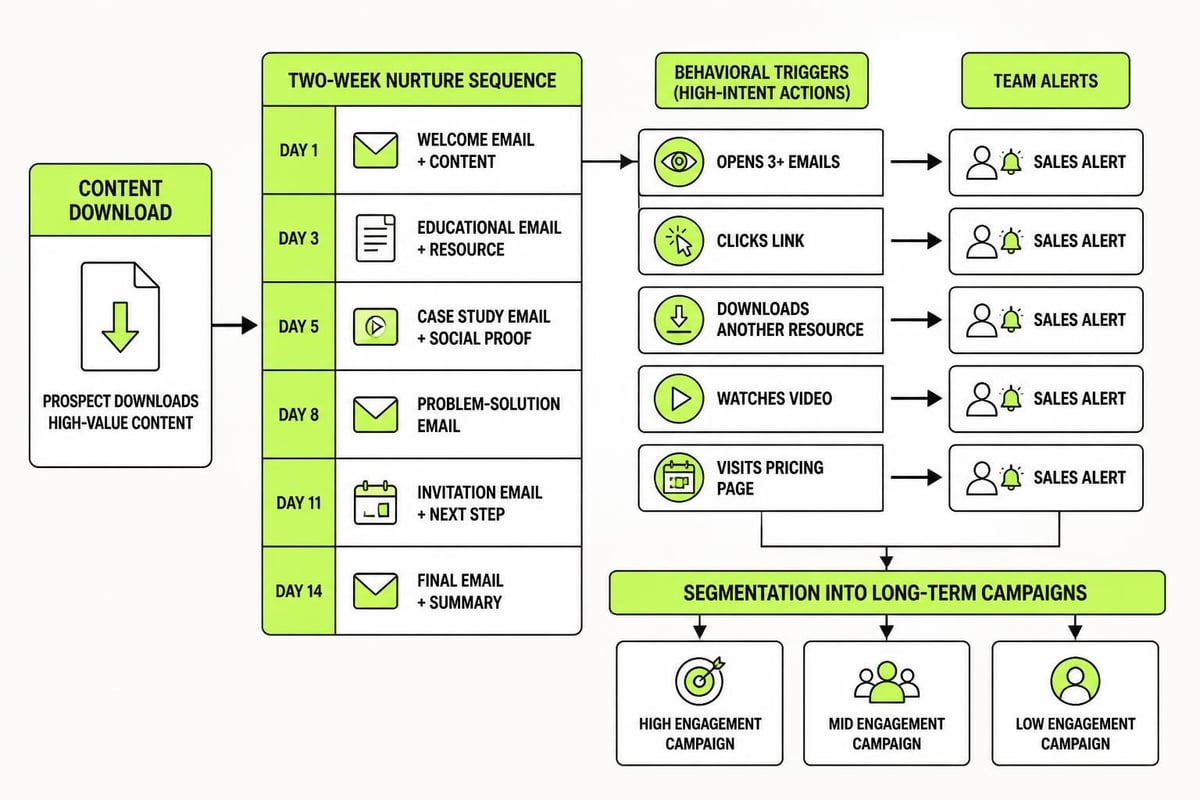
No manual checking. No forgotten follow-ups. No wondering if someone's ready to talk. The 7-Step Marketing Plan framework shows how these pieces connect, from initial attraction through to client delivery and referrals. When you develop digital workflows that handle the repetitive work, you free up capacity for the high-value conversations that actually close business.

Data-Driven Marketing That Converts Attention
You can't improve what you don't measure. Yet most service businesses make marketing decisions based on feelings, not data. They run ads because someone said they should. They post on social media because everyone else does. They redesign their website because they're bored of looking at it.
None of that is strategy. Strategy requires knowing what works, why it works, and how to do more of it. To develop digital marketing systems that compound over time, you need visibility into the entire funnel.
What to Track and Why
Not all metrics matter equally. Vanity metrics like social media followers or website visitors feel good but don't pay bills. Focus on the numbers that connect to revenue.
Essential metrics for service businesses:
- Lead volume by source so you know where to invest
- Conversion rate at each stage so you spot bottlenecks
- Cost per lead and cost per client so you understand profitability
- Time to close so you can forecast accurately
- Lifetime value by segment so you optimize for the right clients
When you track this properly, marketing stops being a cost center and becomes a predictable growth engine. You know that spending $X on this channel generates Y leads at Z conversion rate, resulting in predictable revenue. That's when scaling gets easier.
Integration: Making Systems Talk to Each Other
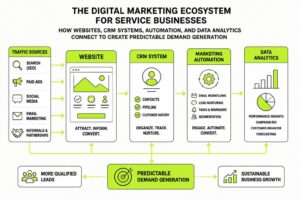
The real leverage in digital infrastructure comes from integration. When your website, CRM, email platform, scheduling tool, and analytics all share data automatically, you eliminate double entry, reduce errors, and get complete visibility.
Most businesses run on disconnected islands. The website captures leads into one system. Someone manually exports them to the CRM. Email campaigns run from a different platform. Appointments get booked through a separate calendar. No one has a complete picture.
Here's the cost: lost leads, duplicated effort, missed opportunities, and zero ability to optimize because you can't see the full journey. To develop digital ecosystems that actually work, integration is non-negotiable.
| Integration Type | What It Connects | Business Impact |
|---|---|---|
| Form to CRM | Website inquiries auto-create contacts | Zero manual data entry, instant follow-up |
| CRM to email | Segments trigger targeted campaigns | Relevant messaging based on behavior |
| Calendar to CRM | Bookings update contact records | Complete interaction history |
| Analytics to CRM | Campaign source tracked to revenue | Know what marketing actually works |
| Payment to CRM | Transactions update lifecycle stage | Accurate pipeline and forecasting |
The DORA research on software delivery shows that high-performing teams prioritize automation and integration. The same applies to marketing systems. When systems talk to each other, manual work drops dramatically and accuracy goes up.
Security and Compliance in Digital Development
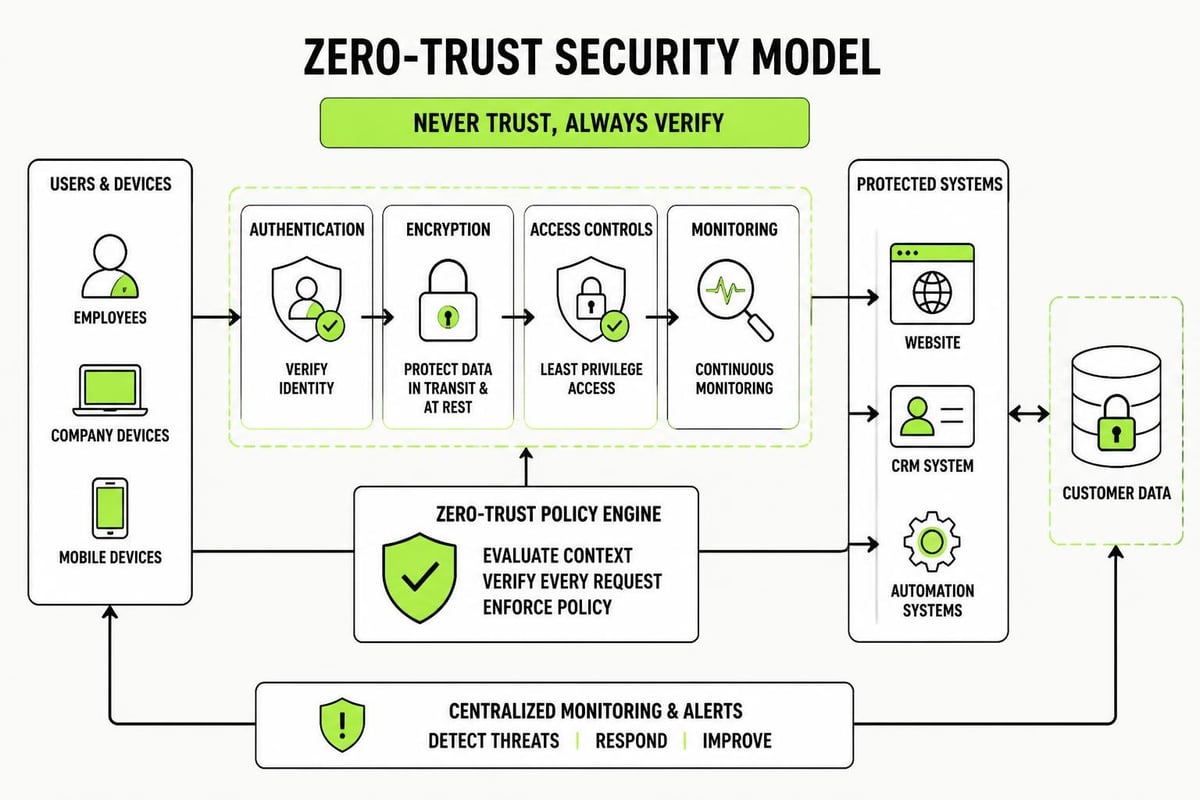
Building digital infrastructure isn't just about features and flows. It's about protecting client data, maintaining trust, and meeting regulatory requirements. In 2026, businesses can't afford to treat security as an afterthought.
Core security practices when you develop digital systems:
- Use secure hosting with regular backups and monitoring
- Implement proper access controls and authentication
- Encrypt data in transit and at rest
- Maintain compliance with privacy regulations (GDPR, Australian Privacy Principles)
- Have clear data handling and retention policies
The NIST Zero Trust Architecture provides a framework for securing modern systems. While it's designed for enterprise IT, the principles apply to any digital infrastructure. Never assume trust, always verify, and minimize access to what's necessary.
Moving from Chaos to Structure
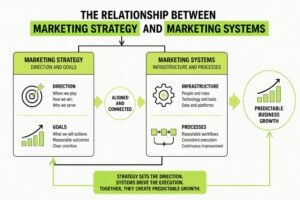
The difference between businesses that scale smoothly and those that hit walls often comes down to systems. You can have the best service delivery in your industry, but if your digital infrastructure is held together with hope and duct tape, growth creates problems instead of profit.
To develop digital infrastructure that compounds:
- Start with the customer journey and map every touchpoint from awareness to advocacy
- Identify friction points where leads get lost or efforts get duplicated
- Choose tools based on integration capability, not feature lists
- Implement in phases so you can test, learn, and optimize before moving to the next piece
- Document processes so systems don't live only in someone's head
The Harvard Business Review’s work on digital transformation shows that successful initiatives focus on business outcomes, not technology for its own sake. The question isn't "What's the best CRM?" It's "What outcomes do we need, and what systems will deliver them?"
Common Pitfalls to Avoid
Even with the right intent, businesses make predictable mistakes when developing digital systems. The good news is they're avoidable if you know what to watch for.
Don't automate broken processes. If your manual process doesn't work, automating it just creates faster failure. Fix the process first, then automate it.
Don't buy tools before defining workflows. Features look impressive in demos. Most go unused because they don't match how you actually work. Define your ideal workflow, then find tools that support it.
Don't implement everything at once. The temptation is to rebuild everything simultaneously. That's how projects stall. Phase your rollout, get wins, build momentum.
Don't neglect training and adoption. The best system in the world is useless if your team doesn't use it. Plan for training, create documentation, and build habits.
Platform Strategy and Vendor Selection
Choosing the right platforms is less about features and more about fit. The platform that works for a tech startup might be overkill for a consultancy. The one that's perfect for e-commerce might lack what service businesses need.
When evaluating platforms to develop digital infrastructure:
- Integration capability matters more than feature count
- Ease of use affects whether your team will actually use it
- Scalability means it should grow with you, not become a constraint
- Support quality determines how quickly problems get solved
- Total cost includes implementation, training, and ongoing management, not just subscription fees
The Microsoft Cloud Adoption Framework provides guidance on selecting and implementing cloud platforms strategically. While it's focused on Azure, the decision framework applies to any platform choice.
Many businesses change platforms every few years because they chose based on a demo instead of their actual requirements. That's expensive, disruptive, and avoidable. Take time to understand what you need, how you work, and where you're heading. Then choose platforms that support that journey.
Measuring What Matters
You've built the systems. You've integrated the platforms. You've automated the workflows. Now what?
Now you measure, optimize, and compound. Digital infrastructure isn't set-and-forget. It's a living system that should improve continuously based on real data.
Set up dashboards that show:
- Lead generation by channel and trend over time
- Conversion rates at each funnel stage
- Campaign performance and ROI
- Pipeline health and forecast accuracy
- Customer acquisition cost vs lifetime value
Review these weekly at first, then monthly once systems are stable. Look for patterns, spot opportunities, and eliminate what's not working. The World Bank’s work on digital development emphasizes the importance of data in driving better decisions. The same applies to your business infrastructure.
Continuous Improvement
The businesses that win with digital systems aren't those with perfect implementations. They're the ones that iterate consistently. They test messaging, measure results, and adjust based on evidence.
Every month, pick one element to improve. Maybe it's your homepage conversion rate. Maybe it's email open rates. Maybe it's the time between inquiry and first response. Focus on one thing, improve it meaningfully, then move to the next.
This approach, borrowed from agile development and research on high-performing teams, creates compounding improvements that add up significantly over time. A 5% improvement each month doesn't sound dramatic, but compound that over a year and you're in different territory entirely.
The User Experience Foundation
None of this matters if the user experience is poor. You can have the most sophisticated automation and integration in the world, but if your website is confusing, your forms are broken, or your emails look like spam, people won't engage.
User experience, as defined by Nielsen Norman Group, encompasses every aspect of how someone interacts with your business digitally. It's not just design. It's functionality, clarity, speed, and how everything feels when someone's trying to work with you.
Core UX principles when you develop digital touchpoints:
- Make the next step obvious at every stage
- Reduce friction between interest and action
- Provide clear feedback when someone takes action
- Optimize for mobile because that's where most people are
- Test with real users, not just internal teams
Poor user experience costs you leads, damages trust, and makes everything else you've built less effective. Good user experience is invisible, it just works.
To develop digital infrastructure that scales, you need to think in systems, not tactics. You need platforms that integrate, automation that feels human, and data that shows you what's working. Most importantly, you need to build with intention, not just add tools because they exist. If you're ready to move from chaos to structured growth, MDO Digital helps service businesses build the marketing systems and infrastructure that turn attention into predictable demand. Let's build something that compounds.