Most service businesses treat branding development like a one-off logo project. They hire a designer, get some files, slap them on a website, and wonder why nothing changes. The truth is simpler and harder: branding development is the systematic process of translating what you do, who you serve, and why it matters into a consistent experience that builds trust at every touchpoint. It's not decoration. It's infrastructure. When done properly, it removes friction, creates recognition, and turns scattered marketing efforts into a compounding system that attracts the right clients and repels the wrong ones.
Why Branding Development Matters for Service Businesses
Service businesses live or die on trust. Unlike product companies, you can't hand someone a sample or let them try before they buy. They're buying your expertise, your process, and your promise. Branding development creates the visual and verbal shorthand that communicates all of that before you get on a call.
Without structured branding development, your business looks different everywhere. Your website says one thing, your proposals say another, and your LinkedIn presence might as well belong to someone else. Prospects feel that inconsistency, even if they can't name it. It reads as unprofessional, uncertain, or amateur.
The Components of Strategic Branding Development
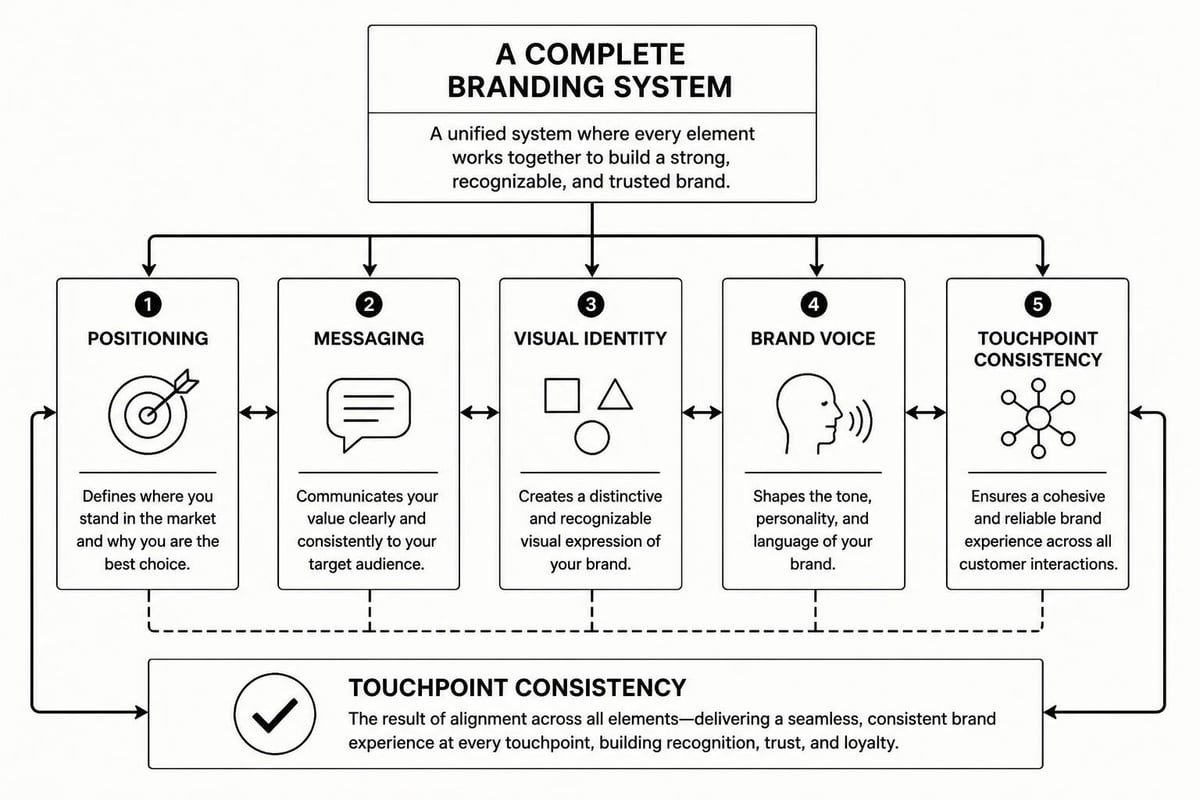
Effective branding development involves more than visual assets. It's a layered system:
- Positioning: Who you serve, what problem you solve, and why you're different
- Messaging framework: The specific language you use to describe your work
- Visual identity: Logos, colours, typography, and how they're applied
- Brand voice: Tone, vocabulary, and communication style
- Touchpoint consistency: How everything from emails to contracts reflects the brand
- Internal alignment: Making sure your team can articulate what you stand for
Each layer supports the others. Your positioning informs your messaging. Your messaging shapes your visual identity. Your visual identity reinforces your voice. When one piece is missing or misaligned, the whole system weakens.
The Business Case for Investing in Branding Development
Branding development isn't a creative indulgence. It's a business decision with measurable returns. Here's what changes when you do it properly.
Higher conversion rates. A clear, consistent brand reduces cognitive load. Prospects don't have to work to understand what you do or whether you're credible. They feel it immediately. That speeds up decision-making and shortens sales cycles.
Better client quality. Strong branding development attracts people who value what you do and repels those who don't. You stop competing on price because your brand communicates expertise, not commodity service. The clients who hire you already trust you before the first conversation.
Easier content creation. When your brand voice and messaging framework are defined, writing website copy, email campaigns, and social posts becomes faster. You're not starting from scratch every time. You're applying a system.
| Business Outcome | Before Branding Development | After Branding Development |
|---|---|---|
| Sales conversations | Explaining what you do from scratch | Prospects arrive pre-qualified and informed |
| Pricing objections | Frequent, focused on cost | Rare, focused on fit |
| Team alignment | Everyone describes the business differently | Consistent story across all team members |
| Marketing efficiency | Scattered efforts, unclear messaging | Cohesive campaigns with clear voice |
| Referral quality | Mixed bag of leads | Referrals that match ideal client profile |
Research from Kellogg School of Management shows that brands built with strategic intent outperform those developed reactively, particularly in service industries where trust and expertise are the primary products.
The Cost of Skipping Branding Development
Businesses that skip branding development don't save money. They just spend it differently, inefficiently, over time. Every new hire has to figure out the brand for themselves. Every marketing campaign starts with debate about tone and messaging. Every prospect conversation includes unnecessary friction because your positioning isn't clear.
You also leave money on the table. Without strong branding, you're forced to compete on price, or you lose deals to competitors who simply look more established. The MDO Digital branding resources cover this dynamic in detail, showing how clarity creates pricing power.
How to Approach Branding Development Systematically
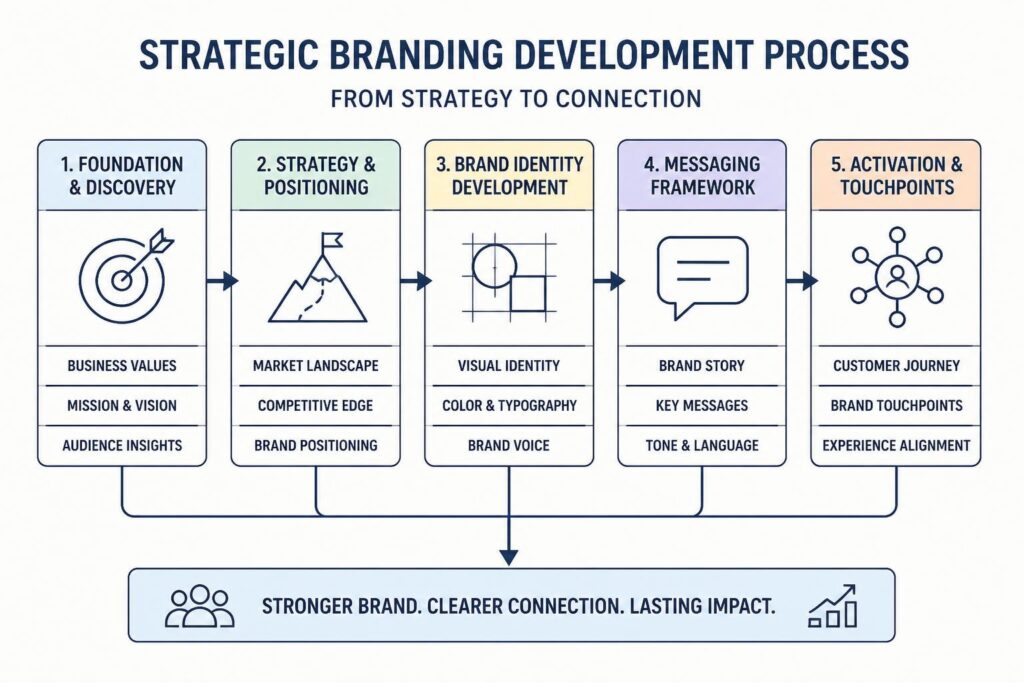
Branding development isn't a lightning bolt of inspiration. It's methodical work that starts with strategy and ends with execution.
Step 1: Define Your Positioning
Start with the hard questions. Who do you serve? What problem do you solve better than anyone else? Why does that matter to them? Your positioning statement should be specific enough to exclude people. If everyone is your customer, no one is.
Write a positioning statement that includes:
- Target audience (specific role, industry, or stage)
- Core problem you solve
- How you solve it differently
- The outcome clients achieve
This becomes the foundation everything else is built on. If your positioning is vague, every downstream decision will be harder.
Step 2: Build Your Messaging Framework
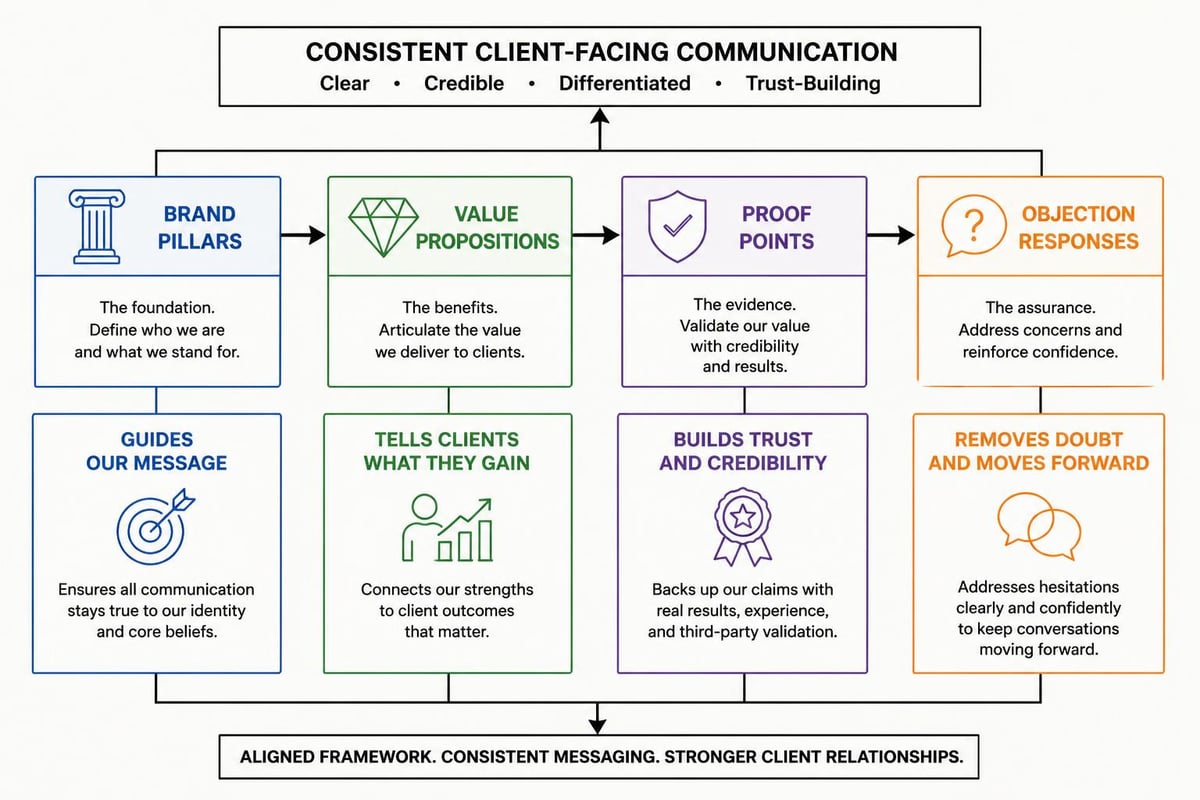
Once positioning is clear, translate it into language your audience uses. This is where you develop:
- Value propositions for each service or offering
- Proof points that back up your claims
- Objection responses that address common hesitations
- Brand pillars (3-4 core themes that show up everywhere)
Your messaging framework should live in a document your whole team can access. It's not creative writing. It's a reference tool that keeps everyone on the same page.
Step 3: Develop Visual Identity with Purpose
Only after positioning and messaging are locked should you touch design. Your visual identity should reflect your positioning, not contradict it. If you serve enterprise clients, your brand shouldn't look like a freelancer's passion project. If you're disrupting an industry, your visuals should communicate that.
Work with a designer who asks strategic questions, not just aesthetic ones. The output should include:
- Primary and secondary logo variations
- Colour palette with usage guidelines
- Typography system (headings, body, accents)
- Image style and photography direction
- Application examples (website, presentations, proposals)
Step 4: Apply Consistently Across Touchpoints
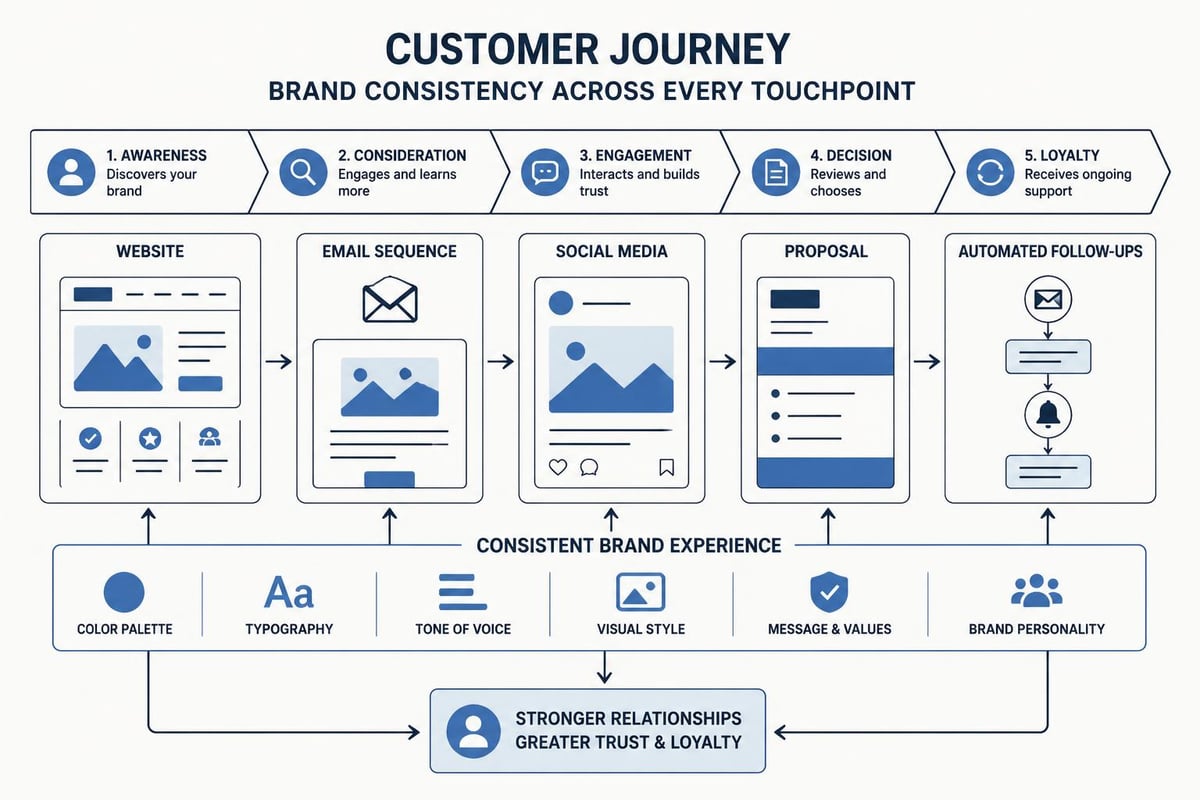
Branding development only works if it's applied everywhere. That means auditing every place a prospect or client encounters your business:
- Website and landing pages
- Email signatures and templates
- Proposals and contracts
- Social media profiles
- Presentations and pitch decks
- Office signage (if applicable)
- Packaging or deliverables
Consistency builds trust. Inconsistency erodes it. Even small mismatches (different logos, off-brand colours, inconsistent tone) create doubt.
Many service businesses find that building a structured approach to client acquisition and nurture helps reinforce their brand at every stage. The 7-Step Marketing Plan offers a framework that aligns branding with repeatable marketing systems, ensuring your brand voice shows up consistently from first contact through to referral generation.

Step 5: Create Brand Guidelines
Brand guidelines aren't just for big companies. They're the instruction manual that keeps your branding development work from decaying over time. Your guidelines should cover:
- When and how to use logo variations
- Colour codes (hex, RGB, CMYK)
- Typography rules and font files
- Tone of voice examples
- Photography and imagery style
- What NOT to do (common mistakes)
Store this in a shared location and refer to it every time you create something new. It's the difference between a brand and a collection of random assets.
Common Branding Development Mistakes
Even businesses that invest in branding development can get it wrong. Here are the patterns that undermine the process.
Copying competitors. If your brand looks and sounds like everyone else in your space, you've wasted the opportunity to differentiate. Branding development should make you recognizable, not camouflaged.
Designing by committee. When everyone on the team gets equal input on creative decisions, you end up with bland compromise. Set clear decision-making authority and trust the process.
Forgetting the audience. Your brand isn't for you. It's for the people you're trying to reach. What feels safe or familiar to you might be exactly what your market needs, or it might bore them. Use research and feedback, not gut feel.
Skipping internal rollout. If your team doesn't understand or believe in the brand, it won't work. Invest time in internal education. Make sure everyone can explain the positioning and apply the visual identity correctly.
According to research on branding fundamentals, the gap between what businesses intend with their branding and what audiences perceive often comes down to inconsistent execution and poor internal adoption.
Branding Development in a Digital-First World
The fundamentals of branding development haven't changed, but the channels where your brand lives have multiplied. In 2026, your brand needs to work across websites, social platforms, email, video, podcasts, and emerging channels you haven't considered yet.
Designing for Digital Touchpoints
Digital branding development requires flexibility within consistency. Your logo needs to work at 16×16 pixels (favicon) and 2000×2000 pixels (social share image). Your colour palette needs to be accessible (WCAG compliant). Your typography needs to load fast and render well on every device.
This doesn't mean dumbing down your brand. It means stress-testing it across contexts. Website design work often reveals gaps in branding systems that look fine in print but fall apart online.
Brand Voice in Automated Systems
More of your brand communication now happens through automated systems: CRM emails, chatbots, onboarding sequences, and nurture campaigns. If your brand voice isn't clearly defined, these touchpoints will feel robotic and off-brand.
Document how your brand sounds in different scenarios:
| Scenario | Brand Voice Example |
|---|---|
| Welcome email | Warm, direct, focused on next steps |
| Nurture sequence | Educational, helpful, not pushy |
| Proposal follow-up | Confident, consultative, outcome-focused |
| Testimonial request | Grateful, specific, easy to act on |
| Re-engagement | Honest, low-pressure, value-first |
The more you automate, the more intentional your branding development needs to be.
Evolving Your Brand Without Losing Equity
Branding development isn't a one-time project. Markets shift, businesses grow, and what worked three years ago might not work today. The goal is to evolve without confusing people.
When to refresh, not rebrand. If your positioning is still accurate but your visuals feel dated, a refresh might be all you need. Update colours, modernize typography, refine the logo. Keep the core recognizable.
When to rebrand completely. If your business has fundamentally changed (new services, new market, new positioning), a full rebrand makes sense. Just communicate the change clearly to existing clients and audiences.
Test before you launch. Don't surprise your market with a brand overhaul. Show new concepts to trusted clients, partners, or a focus group. Get feedback before you commit.
Brands that maintain long-term value balance consistency with gradual evolution. Research into brand development theory shows that the most durable brands update their expression while preserving their core identity.
Measuring Branding Development Success
You can't improve what you don't measure. Branding development has both qualitative and quantitative indicators of success.
Quantitative metrics:
- Website conversion rate (visitors to leads)
- Sales cycle length (first contact to close)
- Average deal size (are you attracting better clients?)
- Customer acquisition cost (does strong branding reduce it?)
- Referral rate (do clients understand and remember you?)
Qualitative indicators:
- Client feedback (do they mention trust or professionalism?)
- Sales conversations (are prospects pre-sold or skeptical?)
- Team confidence (can everyone articulate the brand clearly?)
- Market perception (what do people say when they mention you?)
Track these over time. Effective branding development shows up as incremental improvements across multiple metrics, not a single dramatic spike.
Making Branding Development Practical
Service businesses don't need enterprise-level budgets to do branding development well. They need clarity, discipline, and a willingness to make decisions.
Start with positioning and messaging. You can do that work internally with the right framework. Once those are locked, invest in professional design. Don't cheap out on visual identity, but don't overspend on assets you won't use.
Apply the brand consistently from day one. It's better to have a simple, consistent brand than a sophisticated one that's applied inconsistently. Over time, you can refine and expand. The foundation is what matters.
If you're looking for practical systems that connect branding to actual business growth, explore resources on marketing systems and strategy that show how brand clarity feeds into lead generation, nurture, and conversion.
Branding development is one of the few business investments that compounds. Every time someone encounters your brand and has a consistent, trust-building experience, your market position strengthens. Every time they encounter inconsistency, you lose ground. The businesses that treat branding as infrastructure, not decoration, are the ones that scale without chaos.
Branding development is the system that turns abstract expertise into tangible trust. When you define your positioning, build consistent messaging, and apply it everywhere your business shows up, you stop competing on price and start attracting clients who value what you do. MDO Digital helps service businesses build brand systems that work alongside CRM, automation, and data-driven marketing to create predictable, scalable growth. If your brand feels scattered or your marketing lacks clarity, let's fix that.