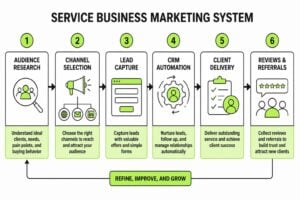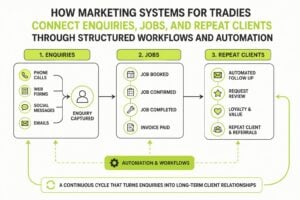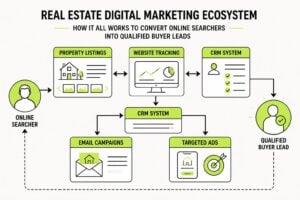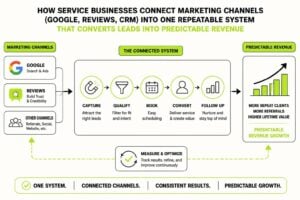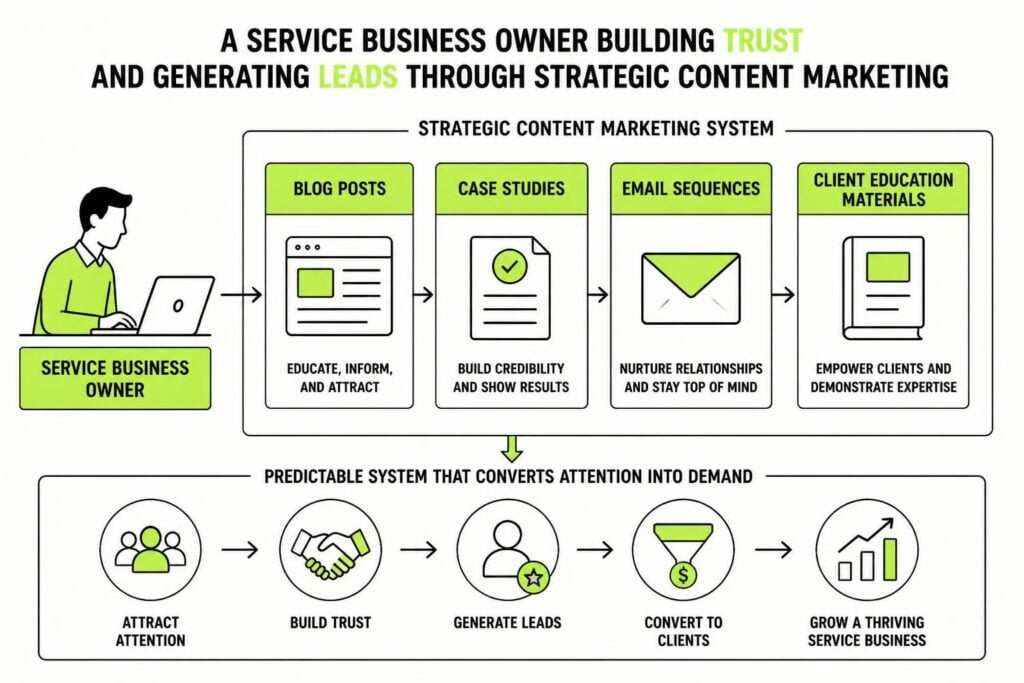
Most service businesses know they should be creating content. What they don't know is which content actually moves the needle. The gap between publishing regularly and generating real client demand is where most marketing efforts stall. Content marketing for service business isn't about posting for the sake of activity. It's about building trust systematically, demonstrating expertise where your buyers already look, and creating a repeatable system that turns attention into booked calls and signed contracts.
Why Content Marketing Works Differently for Service Businesses
Product businesses can show before and after photos. Service businesses need to prove competence before anyone hands over their problem.
The trust barrier is higher. When someone buys accounting services, legal advice, or marketing systems, they're not evaluating features on a spec sheet. They're asking whether you understand their situation and can actually solve it. Content is how you answer that question at scale.
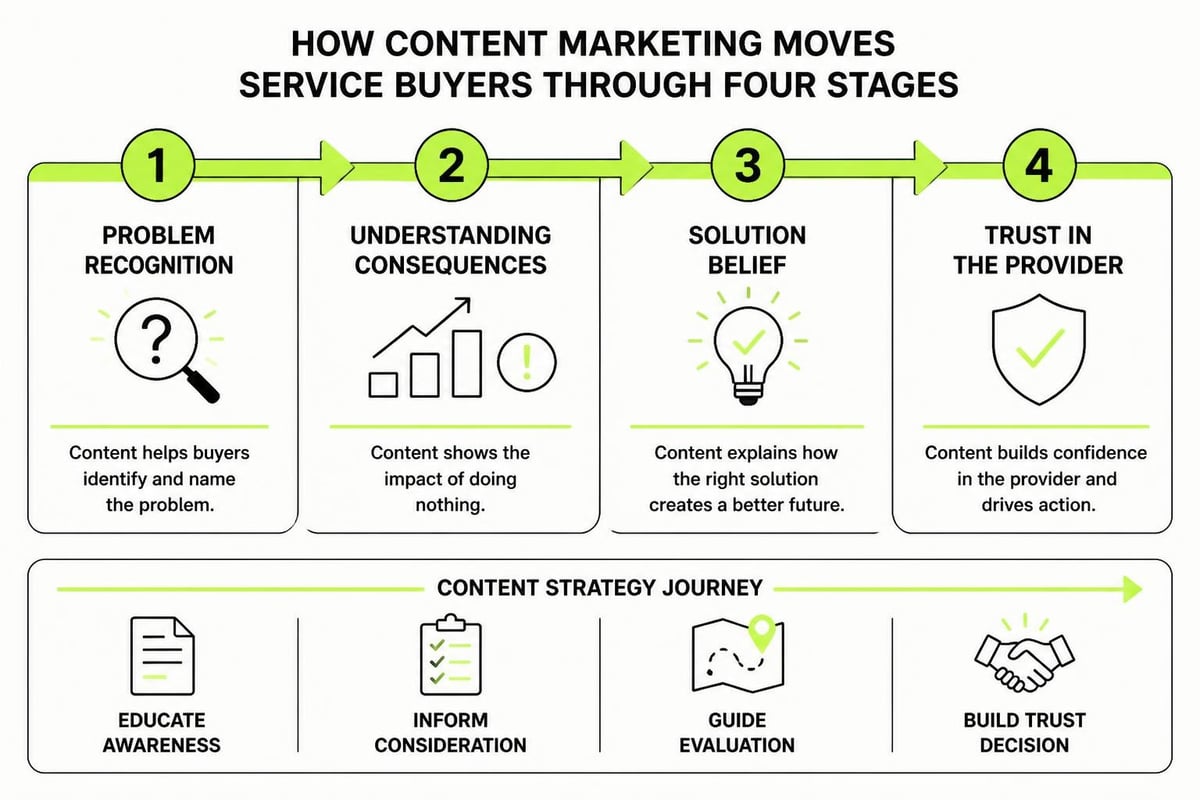
Unlike product marketing, where the goal is often immediate conversion, content marketing for service business operates on a longer cycle. Your buyers need to:
- Recognise they have a problem worth solving
- Understand the implications of not fixing it
- Believe a solution exists
- Trust that you're qualified to deliver it
Each piece of content should move someone through one of these stages. A blog post might create problem awareness. A case study builds belief in the solution. A detailed guide demonstrates your process and competence.
Building Your Content Foundation
Before you create anything, you need structure. Random posts don't compound. A system does.
Map Your Buyer's Journey
Start with the questions your best clients asked before they hired you. Those questions are your content roadmap.
Early stage questions (awareness):
- What's causing this problem?
- Is this normal for businesses like mine?
- How do other companies handle this?
Middle stage questions (consideration):
- What are my options?
- What does good look like?
- How long does this typically take?
Late stage questions (decision):
- How do you approach this specifically?
- What does the process look like?
- What results have you delivered for similar clients?
Each question becomes a content brief. Answer it thoroughly, honestly, and in plain language. This approach aligns with how professional services firms use content to build credibility, focusing on education rather than promotion.
Choose Formats That Match Your Capacity
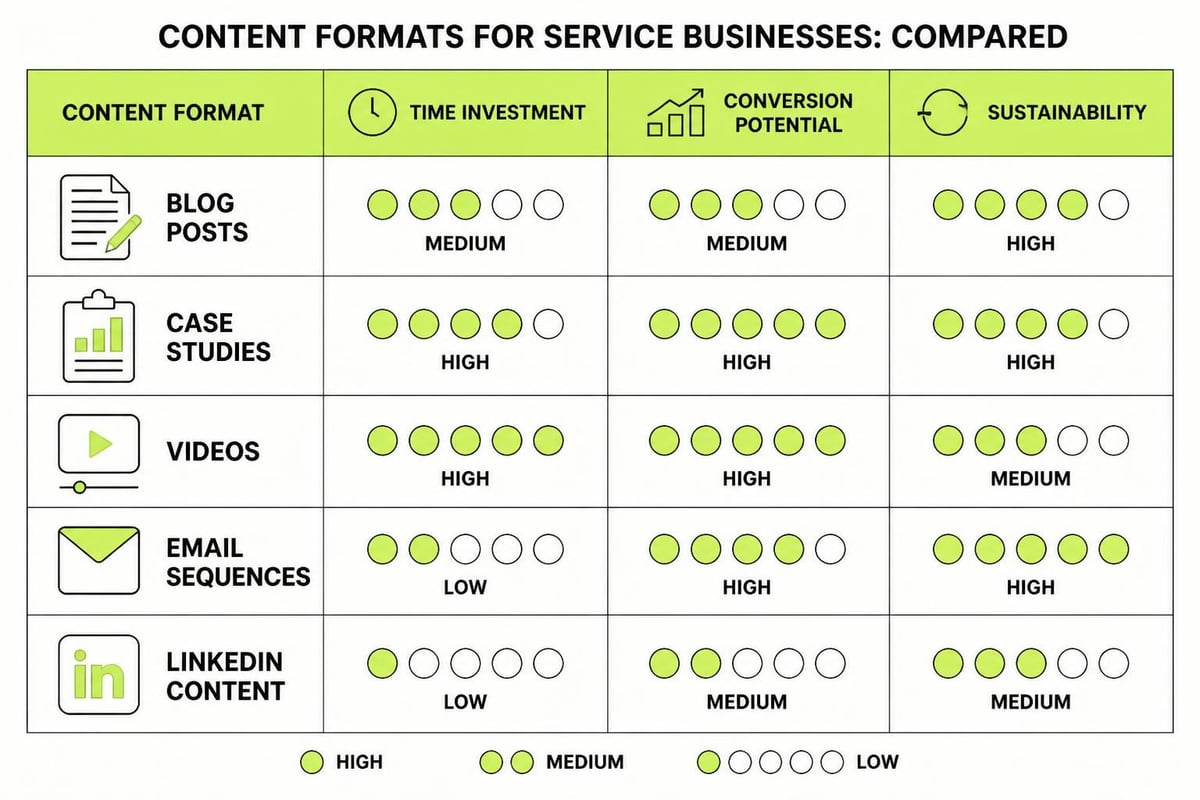
Content marketing for service business fails when you pick formats you can't sustain. If you're a solo operator, a daily blog and weekly video show isn't realistic. Pick one or two formats and do them well.
| Format | Time Investment | Best For | Longevity |
|---|---|---|---|
| Blog posts | Medium | SEO, detailed answers | High (evergreen) |
| Case studies | Medium | Proof, late-stage trust | High (reusable) |
| Email sequences | High (setup) | Nurture, education | High (automated) |
| LinkedIn posts | Low | Visibility, thought leadership | Low (feed-based) |
| Videos | High | Personality, complex topics | Medium (searchable) |
| Podcasts | High | Deep dives, relationship building | Medium (niche) |
We've found blog posts and email sequences create the most predictable results for service businesses. Blogs build search visibility over time. Email converts attention into calls. Both can run while you're doing client work.
Creating Content That Actually Converts
Good content educates. Converting content educates and positions your service as the logical next step.
Write for Search Intent, Not Just Keywords
Someone searching "how to fix cash flow problems" is researching. Someone searching "fractional CFO Melbourne" is buying. Both searches matter, but they need different content.
Informational content builds your audience and authority. These are how-to guides, explainers, and frameworks. They rank well, get shared, and bring new people into your world. But they rarely convert immediately.
Commercial content captures demand that already exists. Service pages, comparison guides, and location-specific content target people ready to hire. These convert faster but have lower search volume.
A balanced content marketing strategy for service business includes both. Use informational content to build your list and authority. Use commercial content to convert people actively looking for your service.
For local service businesses, aligning content with local search intent is critical. The Local SEO checklist for 2024 provides practical steps for structuring service pages, location content, and schema markup to capture commercial intent.
Demonstrate Your Process Without Giving Away the Work
The most common objection to content marketing for service business: "If I tell them how to do it, why would they hire me?"
Because knowing what to do and actually doing it are different things. Most buyers lack time, skill, or confidence to execute, even with perfect instructions. What they want is proof you know what you're doing.
Share frameworks, not deliverables. Explain your diagnostic process. Walk through your methodology. Show the questions you ask and why they matter. This builds trust without eliminating the need for your service.
For example, if you're a brand strategist, you might publish:
- The five questions you ask every client in discovery
- How you identify brand positioning gaps
- A framework for evaluating brand consistency across channels
You're not handing over a completed brand strategy. You're showing how you think and work. That's what creates confidence.
Use Real Examples and Data
Generic advice is forgettable. Specific examples stick.
When we talk about marketing systems for service businesses, we don't just say "automation saves time." We show how a nurture sequence converts 23% of leads over 90 days, or how a properly structured CRM prevents $50K in lost opportunities annually.
Numbers, names (where allowed), and specific outcomes make content credible. They also make it useful. Your reader should finish an article with something they can apply today.
Distributing and Amplifying Your Content
Publishing isn't distribution. Most service businesses create solid content, hit publish, and wonder why nothing happens.
Build an Email List From Day One
Your website traffic is rented attention. Your email list is owned. Every piece of content should include a clear path to subscribe.
Effective opt-in offers for service businesses:
- Checklists and templates
- Framework PDFs
- Video training series
- Assessment tools
- Resource libraries
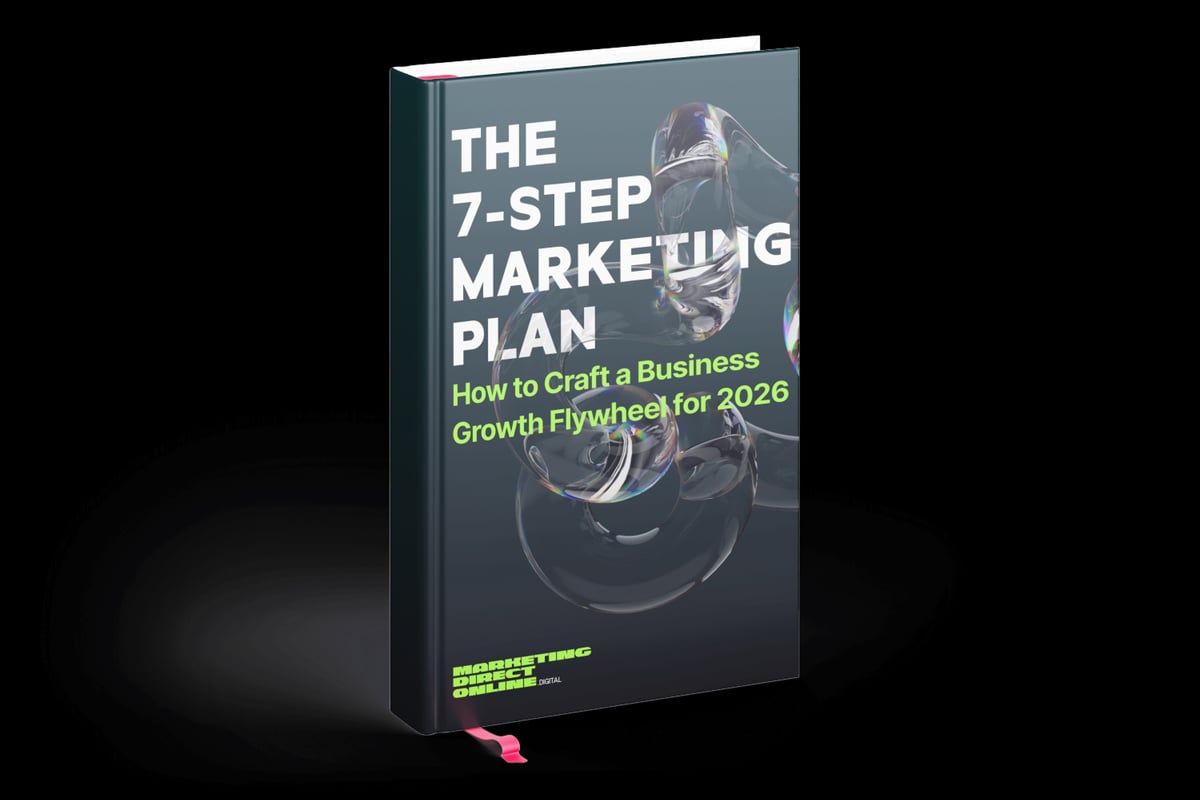
The 7-Step Marketing Plan is a practical example. It gives service businesses a complete framework for building repeatable marketing systems, from buyer personas through to referral generation. It's specific, immediately useful, and demonstrates the kind of structured thinking that makes someone want to work with you.
Once someone opts in, your email sequence does the heavy lifting. A good nurture campaign educates, builds trust, and creates multiple opportunities for someone to raise their hand and start a conversation.
Repurpose Strategically
One piece of core content can become six assets:
- Long-form blog post (pillar content)
- Email series (breaking the post into daily insights)
- LinkedIn carousel (key points as visuals)
- Video walkthrough (you explaining the concepts)
- Podcast episode (discussing the topic in depth)
- Client handout (PDF version for proposals)
You're not creating six different things. You're extracting maximum value from one research and writing effort. According to the Content Marketing Institute’s B2B research, successful content marketers repurpose 90% of their content across multiple channels, significantly increasing reach without proportional increases in production time.
Use Paid Distribution to Accelerate Results
Organic reach is slow. Sometimes you need results this quarter, not next year.
Paid promotion of content works when:
- You're targeting a specific industry or job title
- The content solves a known, urgent problem
- You have a clear conversion path (opt-in, call booking, assessment)
We've seen strong results promoting guides and frameworks on LinkedIn, targeting specific service industries like accounting, legal, or construction. Cost per lead sits between $15-40 for well-targeted campaigns with valuable content.
Don't boost posts randomly. Promote content that's already proven to convert organically. Use paid to scale what works.
Measuring What Matters
Most service businesses measure vanity metrics. Page views feel good but don't pay invoices.
Track Business Outcomes, Not Just Engagement
Metrics that matter for content marketing for service business:
- Leads generated (email opt-ins, contact form fills, call bookings)
- Lead source (which content pieces drive action)
- Conversion rate (percentage of leads that become clients)
- Time to conversion (how long from first content touch to signed contract)
- Client acquisition cost (total content investment divided by new clients)
Track these in your CRM, not just Google Analytics. You need to see the full path from content consumption to signed proposal.
If you're using a system like GoHighLevel, you can track exactly which blog posts, emails, or guides someone consumed before they booked a call. That data tells you what's actually working.
Content Audit and Refresh Cycles
Content compounds when you maintain it. Old posts with outdated information hurt more than they help.
Quarterly audit process:
- Identify top 20 posts by traffic and conversions
- Update statistics, examples, and links
- Improve formatting and readability
- Add or improve calls to action
- Re-promote updated content
A single refresh of a high-performing post can increase traffic by 30-50% and restore its search rankings. It's often more valuable than creating something new.
The enterprise content marketing research from CMI shows that top-performing organizations have formal content governance and refresh processes, treating content as a long-term asset rather than a one-time publication.
Using AI and Automation Without Losing Your Voice
AI is changing content production. Use it as a tool, not a replacement.
Where AI Actually Helps
Research and ideation: AI can pull together data, suggest angles, and identify gaps in your existing content. It's solid for initial research and brainstorming.
First drafts and outlines: Generate a structure or rough draft, then rewrite it in your voice with real examples and specific insights. The Deloitte Digital report on AI in marketing content production found that AI works best when used for drafting and ideation, with human expertise applied to refinement, accuracy, and strategic decisions.
Repurposing: Turning a blog post into social snippets or email subject lines is perfect for AI. It's reformatting, not creating.
Where AI Falls Short
Nuanced expertise: AI can't replace the specific insights you've gained from doing the work. Your experience with real clients, the edge cases, the common mistakes, the industry context. That's what makes content valuable.
Trust building: People buy services from people. Your personality, your perspective, and your specific way of thinking about problems is what differentiates you. AI-generated content sounds like everyone else.
Use AI to speed up production, but apply your expertise and voice to every piece before it goes live. If you can't tell the difference between your content and your competitor's, rewrite it.
Common Mistakes That Kill Results
Content marketing for service business fails predictably. Here's what to avoid.
Mistake 1: Publishing Without a System
Random posts when you feel inspired creates zero momentum. You need:
- Publishing calendar (what, when, who)
- Content workflow (research, draft, review, publish, promote)
- Promotion checklist (email, social, paid)
- Performance review (monthly metrics check)
Without these, content becomes a side project that gets dropped when you're busy. Marketing systems work when they're structured and repeatable.
Mistake 2: Writing for Everyone
Broad content gets ignored. Specific content gets shared and converts.
Don't write "5 Marketing Tips for Small Businesses." Write "5 Marketing Fixes for Plumbing Businesses Losing Calls to Competitors." The second version speaks directly to a defined reader with a known problem. If you're in that situation, you read it. If you're not, you move on. That's exactly what you want.
We've covered this in detail in our piece on marketing for plumbers, where specificity drives both engagement and conversion.
Mistake 3: No Clear Next Step
Every piece of content should lead somewhere. What should someone do after reading?
- Download a framework
- Book a call
- Subscribe to your email
- Read a related case study
- Contact you with questions
Make it obvious. One clear call to action per piece. No decision paralysis.
Mistake 4: Ignoring Distribution
If you spend 8 hours writing and 10 minutes promoting, you've wasted 8 hours. Reverse that ratio. Spend more time getting your content in front of the right people than creating it.
Minimum promotion checklist:
- Email to your list
- Post on LinkedIn with context
- Share in relevant groups or communities
- Send to past clients who might find it useful
- Consider paid promotion if it's a key piece
Content only works if people see it. Distribution isn't optional.
Building Long-Term Content Assets
The best content marketing for service business creates assets that generate leads for years. Here's how to build them.
Create Pillar Content
Pillar content is comprehensive, authoritative, and search-optimized. It covers a topic completely and becomes a reference point.
Examples for service businesses:
- "Complete Guide to [Your Service] for [Your Industry]"
- "How to Choose a [Your Service Type]: What to Look For"
- "[Industry] Best Practices: A Practical Framework"
These take time. Budget 15-20 hours for research, writing, and optimization. But they rank for years and generate consistent leads without ongoing effort.
Build Topic Clusters
Google rewards depth and relevance. Instead of isolated posts, create clusters:
- 1 pillar post (comprehensive guide on a broad topic)
- 8-12 supporting posts (specific subtopics that link back to the pillar)
For example, a branding agency might create:
Pillar: Complete Guide to Brand Development for Service Businesses
Cluster posts:
- How to Define Your Brand Positioning
- Creating a Brand Messaging Framework
- Visual Identity: Logo, Color, Typography Decisions
- Brand Guidelines: What to Include and Why
- Implementing Brand Across Digital Channels
- Measuring Brand Consistency
Each cluster post links to the pillar. The pillar links to each cluster post. This structure signals authority to search engines and helps readers navigate related topics.
Develop Lead Magnets That Qualify
Not all email subscribers are equal. A lead magnet that attracts your ideal client is worth 10x more than one that attracts tire-kickers.
High-value lead magnets:
- ROI calculators or assessment tools
- Implementation checklists
- Decision frameworks
- Process templates
- Case study collections
These require someone to be genuinely interested in solving the problem your service addresses. They filter out casual browsers and attract serious buyers.
Content as a Competitive Moat
The real power of content marketing for service business isn't immediate leads. It's the compounding advantage over time.
Build a Knowledge Library
Your published content becomes a qualification tool. When a prospect finds five or six articles that directly address their situation, they arrive at the sales conversation already convinced you understand their world.
This shortens sales cycles and increases close rates. You're not starting from scratch. You're building on the trust and credibility your content already established.
According to research on content marketing for professional services, firms that consistently publish expertise-driven content see 30-40% shorter sales cycles and higher conversion rates, as content pre-qualifies and educates prospects before the first conversation.
Differentiate Through Depth
Most competitors won't do this work. They'll post sporadically, share generic tips, and wonder why content doesn't work for them. You can differentiate simply by being consistent and useful.
Publishing one valuable post weekly for a year gives you 52 pieces of searchable, shareable content. That's 52 more reasons for someone to find you, trust you, and hire you than your competitors have.
Content marketing isn't fast. But it's the most reliable way for a service business to generate predictable demand without depending on referrals, paid ads, or outbound sales.
Content marketing for service business works when it's treated as a system, not a series of random posts. Consistency, relevance, and a clear path from content to conversation create the foundation for predictable growth. If you're ready to build a structured marketing system that turns your expertise into consistent client demand, MDO Digital helps service businesses scale with clarity through high-trust websites, CRM infrastructure, and data-driven marketing that actually converts.