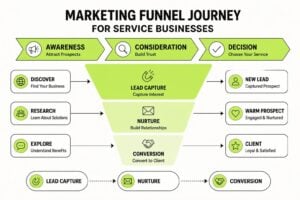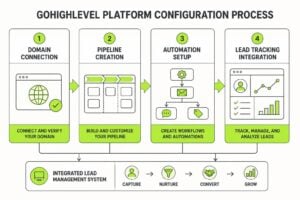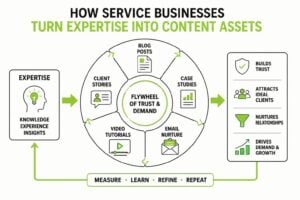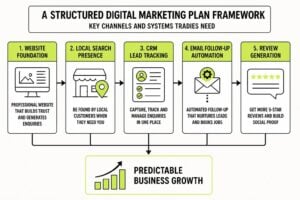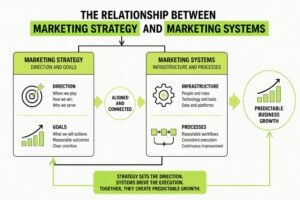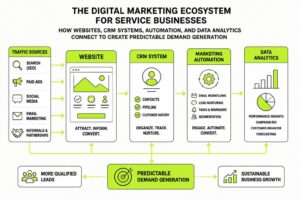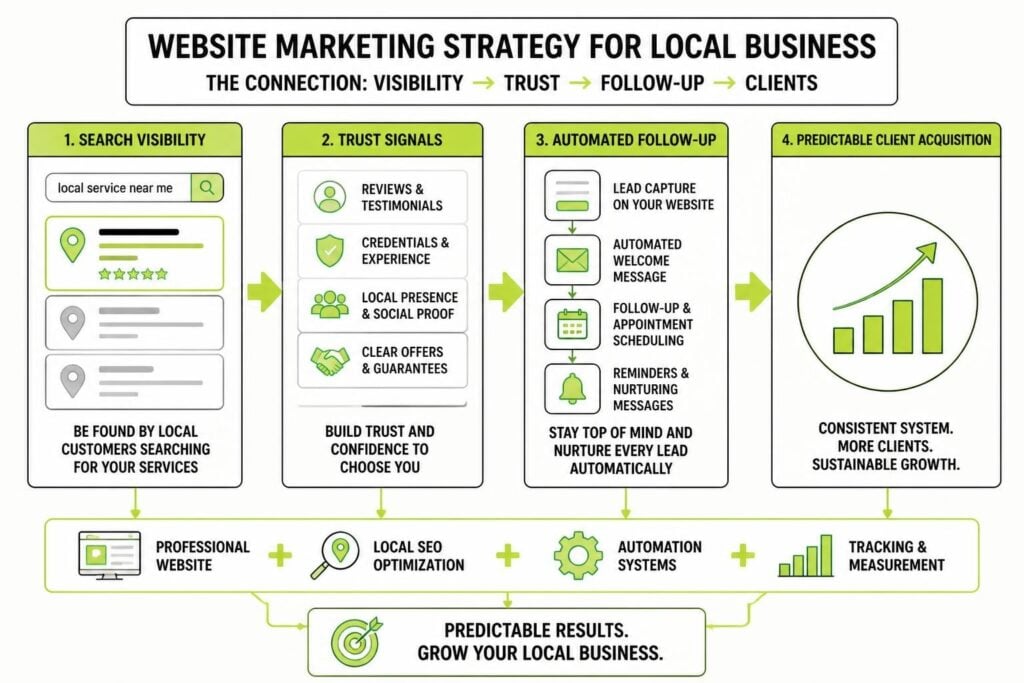
Your website isn't just a digital brochure anymore. For local businesses in 2026, it's the centre of your marketing system. It's where search traffic lands, where trust gets built, and where leads either convert or vanish. The challenge is that most local businesses treat their website as a set-and-forget asset. They launch it, maybe update a phone number, and wonder why it doesn't generate consistent enquiries. Real website marketing for local business means treating your site as infrastructure. It needs to attract the right people, communicate value clearly, capture leads reliably, and feed those leads into a system that nurtures them until they're ready to buy.
This isn't about perfection. It's about building a website that works as hard as you do, without requiring constant manual effort.
The Foundation: What Makes a Local Business Website Actually Work
Most local business websites fail because they optimise for the wrong things. They focus on looking impressive instead of converting visitors. They bury contact details, overwhelm with generic stock photos, and offer no clear next step.
A working website does three things well:
- Communicates what you do and who it's for in the first five seconds
- Builds trust through proof, clarity, and transparency
- Captures leads with low-friction offers and visible calls to action
Everything else is secondary. Your homepage doesn't need parallax scrolling or animated headers. It needs a headline that speaks directly to a problem your customer has, proof that you can solve it, and a clear path to get started.
Trust Signals That Convert
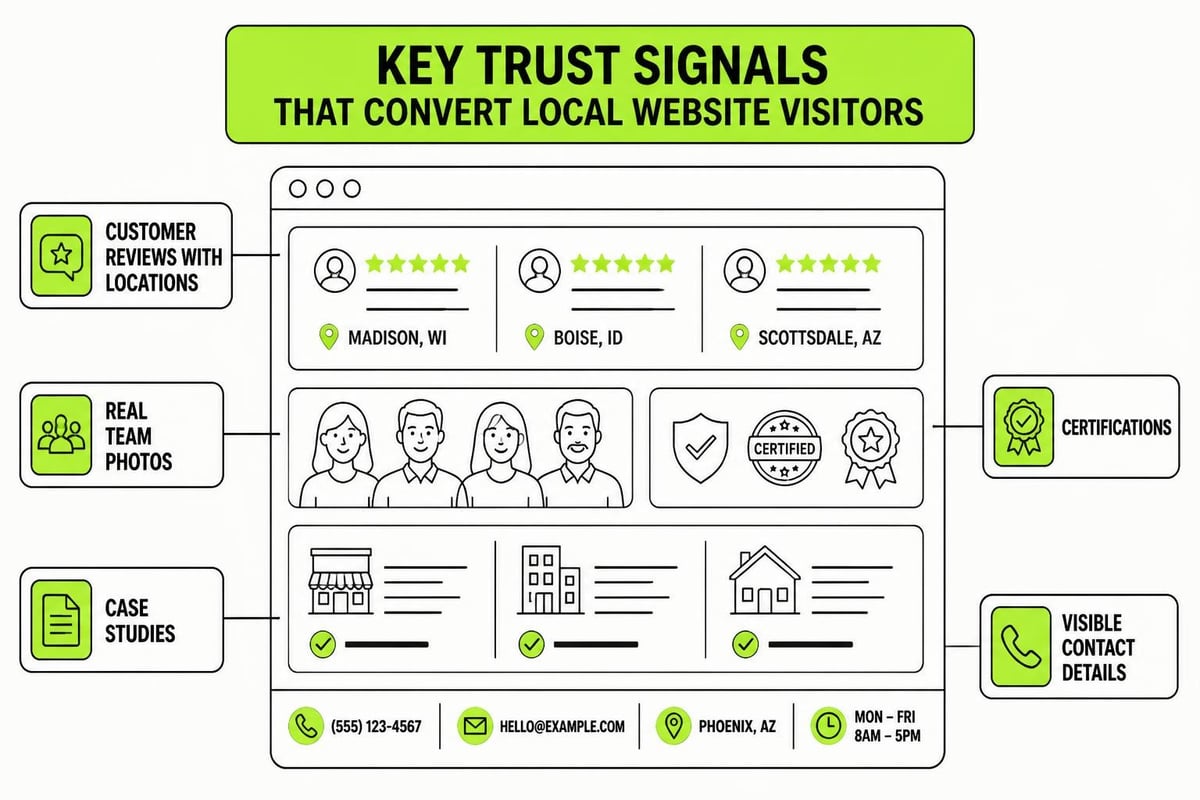
Local customers are risk-averse. They want to know you're real, reliable, and nearby. Your website needs to prove all three before they'll pick up the phone.
Essential trust elements:
- Real photos of your team, workspace, or completed work (not stock images)
- Customer reviews and testimonials with names and locations
- Clear contact details and a physical address
- Credentials, certifications, and years in business
- Case studies or project galleries that show your work
According to BrightLocal’s 2025 research, 98% of consumers read online reviews for local businesses, and 76% trust them as much as personal recommendations. That means your reviews need to be visible, recent, and specific.
SEO for Local Visibility: Getting Found When It Matters
Website marketing for local business starts with being discoverable. If your site doesn't rank for the searches your customers are making, the rest doesn't matter.
Local SEO isn't the same as general SEO. You're not competing nationally. You're competing within a geographic radius, often against businesses that have been around longer or have bigger budgets. But local search has advantages. Intent is high, competition is manageable, and the rules are clear.
On-Page Local SEO Essentials
Your website needs to tell Google exactly where you operate and what you offer. That means structured content, location-specific pages, and proper schema markup.
| Element | Why It Matters | How to Implement |
|---|---|---|
| Title Tags | First thing Google reads | Include city/suburb and service |
| Meta Descriptions | Influences click-through rate | Write for humans, include location |
| H1 Headings | Signals page topic | One per page, include target keyword |
| NAP Consistency | Builds trust with search engines | Same name, address, phone everywhere |
| LocalBusiness Schema | Helps Google understand your site | Use structured data markup |
Schema markup is often overlooked, but it's one of the easiest wins. By adding LocalBusiness structured data to your homepage and location pages, you help Google display your business details directly in search results. This includes your hours, contact info, and even customer ratings.
Location Pages That Rank and Convert
If you serve multiple areas, each one needs its own dedicated page. Not a generic page with a list of suburbs. A proper landing page with unique content, local references, and targeted CTAs.
Each location page should include:
- A headline with the service and location
- Specific details about serving that area (how long, notable projects, local knowledge)
- Customer testimonials from that area
- A map and clear directions
- A lead capture form or booking button
Google rewards specificity. A page that says "We've been servicing Parramatta's plumbing needs since 2015, with over 300 local projects completed" will outrank a page that says "We service Sydney."
Content That Attracts and Qualifies Leads
Website marketing for local business isn't just about ranking. It's about attracting the right people and filtering out the wrong ones. Content does both.
Most local businesses think content marketing means writing blog posts no one reads. That's partly true. Blogging for the sake of blogging is a waste of time. But publishing content that answers the specific questions your customers ask before they hire someone? That's lead generation.
The Questions Your Customers Are Asking
Before someone books a service or walks into your business, they're searching for answers. They want to know:
- How much does this cost?
- How long does it take?
- What should I look for when hiring?
- What are the risks of doing this wrong?
- Can I trust this business?
If your website answers these questions clearly, you position yourself as the expert. You also pre-qualify leads. Someone who reads your pricing guide and still contacts you is a better prospect than someone guessing.
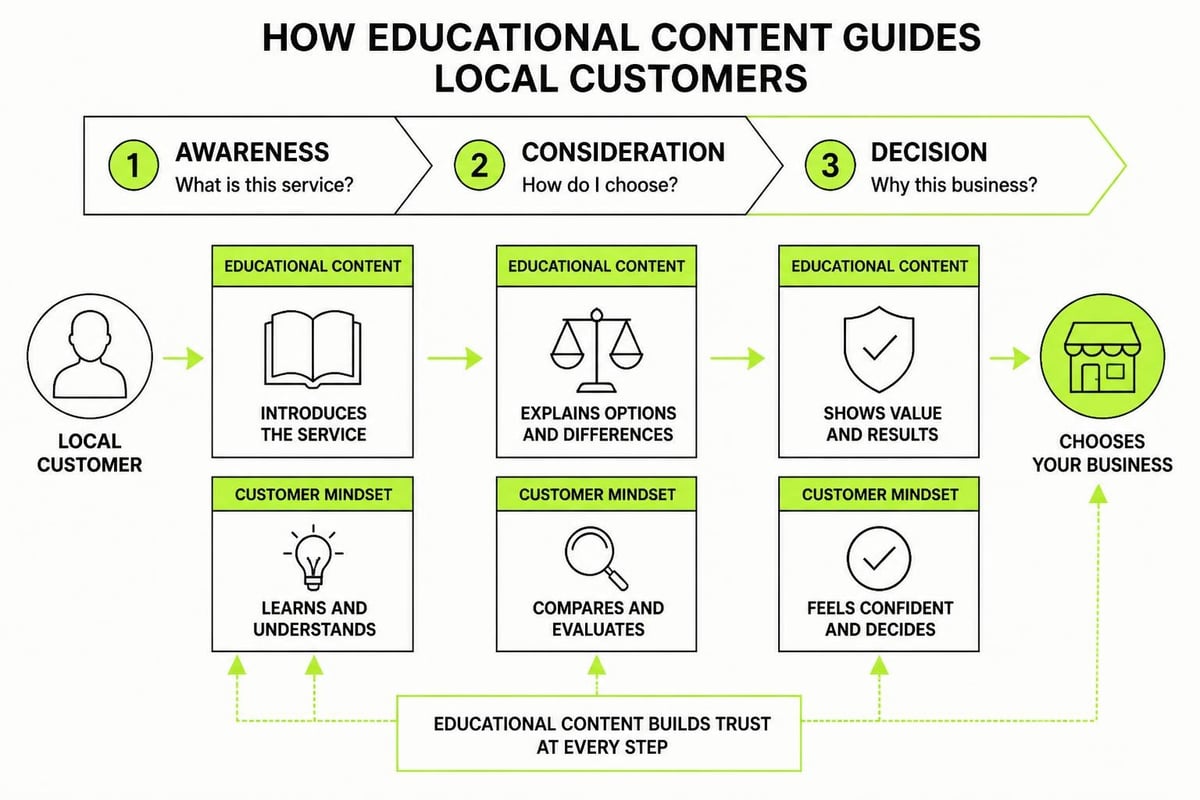
High-value content formats for local businesses:
- Service explainer pages (what's included, what's not, pricing ranges)
- Buyer's guides (how to choose, red flags to avoid)
- Local area guides (if relevant to your service)
- FAQ pages (real questions from real customers)
- Case studies or project breakdowns
This ties directly into how content and digital marketing work together to build a system that runs consistently.
Lead Capture and Conversion Infrastructure
Getting traffic is one thing. Turning that traffic into leads you can follow up with is another. Most local business websites leak potential customers because they don't have proper capture mechanisms.
Forms, Calls to Action, and Offers
Every page should have a clear next step. Not five options. One obvious action that makes sense for where the visitor is in their journey.
On service pages: Book a quote, get an estimate, request a call back
On blog posts: Download a guide, join your email list, book a consultation
On your homepage: Your primary CTA (usually a booking or contact form)
But here's where most local businesses fail. They ask for too much too soon. A six-field contact form with mandatory fields for company size, budget, and project scope will kill conversion. Start with name, email, and a brief message. You can qualify later.
Building a CRM and Nurture System
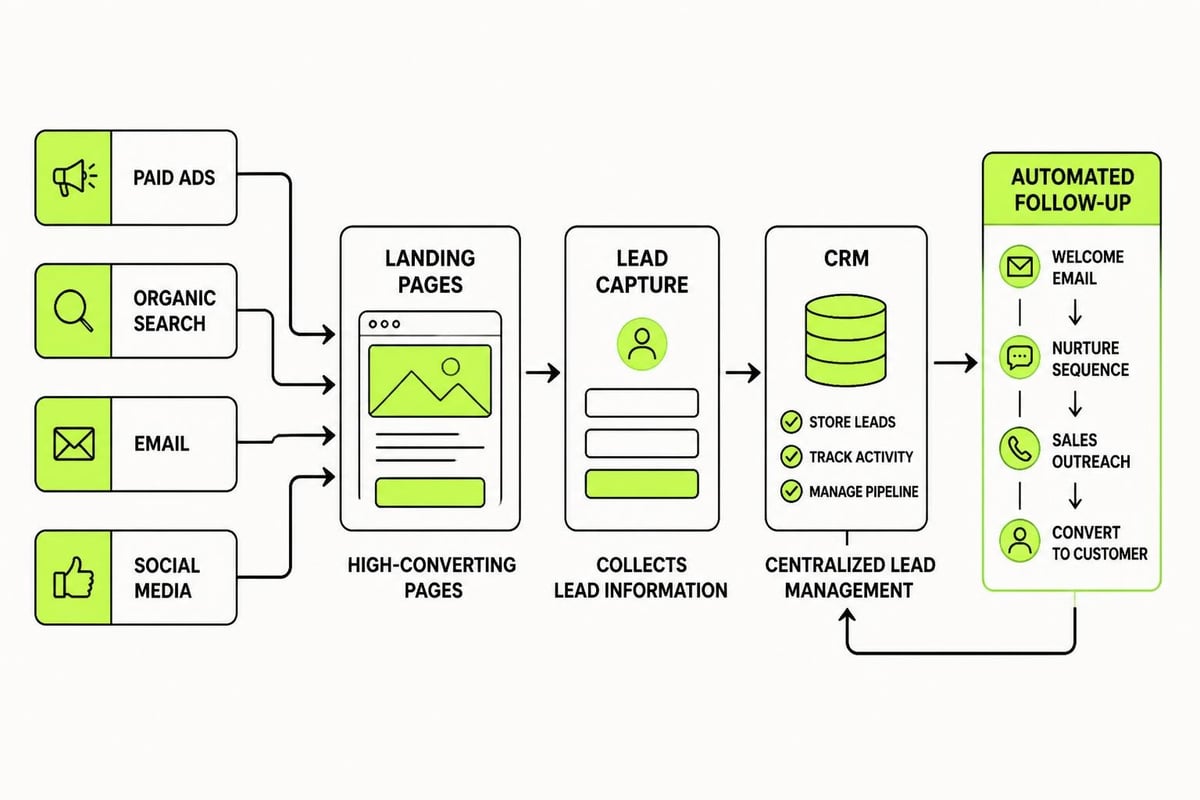
This is where website marketing for local business becomes a system instead of a gamble. When someone fills out a form, where does that lead go? If the answer is "into my email inbox," you're losing money.
Leads need structure. They need to be captured, tagged, followed up with automatically, and tracked through to conversion. A data-driven marketing plan includes CRM integration from day one, so no lead falls through the cracks.
A practical approach to building this system is using a framework that connects every step, from traffic to conversion to referral. The 7-Step Marketing Plan walks through how to set up this infrastructure so your website feeds a repeatable growth engine.
Automated Follow-Up That Feels Human
Speed matters. Research shows that responding to a lead within five minutes increases conversion by 400% compared to waiting an hour. But most local business owners can't drop everything to reply to every form fill.
That's where automation earns its keep. A simple email sequence that:
- Confirms receipt and sets expectations
- Shares relevant content or social proof
- Offers a low-friction next step (book a time, call this number)
This keeps you top of mind without requiring manual effort. You're not spamming. You're staying present while they make a decision.
Performance, Accessibility, and User Experience
A beautiful website that loads slowly or breaks on mobile is a failed website. In 2026, performance isn't optional. It directly impacts SEO, conversion, and trust.
Core Web Vitals and Page Speed
Google's Core Web Vitals measure how fast and stable your site feels to real users. Pages that load slowly, shift content while loading, or take too long to respond hurt your rankings and frustrate visitors.
The three key metrics:
- Largest Contentful Paint (LCP): How quickly the main content loads (aim for under 2.5 seconds)
- Cumulative Layout Shift (CLS): How much the page jumps around while loading (lower is better)
- Interaction to Next Paint (INP): How quickly the page responds to user input (under 200ms is good)
You can audit and improve these using Google’s Core Web Vitals guidance, which includes practical fixes for common issues like image optimization, lazy loading, and script management.
| Issue | Impact | Fix |
|---|---|---|
| Unoptimized images | Slow LCP, high bandwidth | Compress and serve in modern formats (WebP, AVIF) |
| Render-blocking scripts | Slow LCP | Defer non-critical JavaScript |
| No caching | Repeat visitors load slowly | Enable browser and server caching |
| Heavy fonts | Slow load, layout shifts | Use system fonts or subset custom fonts |
Mobile-First Design and Accessibility
More than 60% of local searches happen on mobile. If your website isn't built mobile-first, you're excluding the majority of your potential customers.
Mobile-first doesn't mean shrinking your desktop site. It means designing for small screens, touch targets, and limited attention spans. Navigation should be simple. CTAs should be thumb-friendly. Forms should autofill.
Accessibility is both a legal and a practical concern. Following the W3C’s accessibility guidelines ensures your site works for everyone, including people using screen readers, keyboard navigation, or high-contrast modes. It also improves usability for everyone else.
Quick accessibility wins:
- Use proper heading hierarchy (H1, H2, H3)
- Add alt text to all images
- Ensure sufficient color contrast (4.5:1 for body text)
- Make forms keyboard-navigable
- Label all form fields clearly
Turning Your Website Into a Long-Term Asset
Website marketing for local business isn't a launch-and-leave project. It's an asset that compounds over time when you treat it like infrastructure.
The businesses that win are the ones that publish consistently, optimize iteratively, and connect their website to the rest of their marketing system. They track what's working, double down on it, and cut what isn't.
What to Measure and Why
Vanity metrics like total traffic or page views don't matter. What matters is how your website contributes to growth.
Key metrics for local business websites:
- Organic search traffic from local keywords (are you ranking for what matters?)
- Conversion rate on key pages (service pages, contact forms, booking flows)
- Lead source attribution (which pages or channels drive the best leads?)
- Time to first response (how fast are you following up?)
- Lead-to-customer conversion rate (are your website leads turning into revenue?)
If you're not tracking these, you're guessing. And guessing doesn't scale.
Building Links and Local Citations
Off-page SEO still matters. The more high-quality, local websites link to you, the more authority Google assigns to your site. But chasing spammy directories or buying links will hurt more than help.
Local link-building focuses on earning mentions from local news sites, industry blogs, local chambers of commerce, and partnerships with complementary businesses.
Practical link-building tactics:
- Sponsor local events or sports teams (they'll link to you)
- Get listed in local business directories (Google Business Profile, Yelp, True Local)
- Partner with suppliers or complementary services for co-marketing
- Publish case studies or local data that journalists can reference
- Join local business associations and get listed on their member pages
Citations (mentions of your business name, address, and phone number) also matter. Consistency across platforms signals legitimacy to Google. Keep your NAP details identical everywhere.
Integrating Website Marketing with Broader Strategy
Your website doesn't exist in isolation. It's the hub, but the spokes matter just as much. Paid ads, email, social media, and offline marketing all drive traffic to your site. If those channels aren't aligned, you're wasting budget.
A cohesive strategy means:
- Ad campaigns send traffic to dedicated landing pages, not your homepage
- Email campaigns link to relevant content or offers, not generic pages
- Social posts drive to lead magnets or booking pages
- Offline materials (flyers, business cards) include trackable URLs
This is where marketing systems thinking separates businesses that grow predictably from those that plateau. Every channel feeds the website. The website captures and nurtures leads. The CRM tracks and converts them.
When these pieces connect, marketing stops feeling like a gamble and starts feeling like infrastructure.
Website marketing for local business in 2026 is about building a system that works while you sleep. It's not a one-time project or a set-and-forget asset. It's infrastructure that captures demand, builds trust, and turns attention into revenue. MDO Digital helps service-based businesses design high-trust websites, build CRM and automation systems, and run marketing that converts. If you're ready to remove chaos and create structured growth, we're here to help.