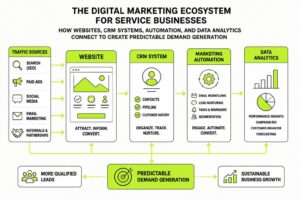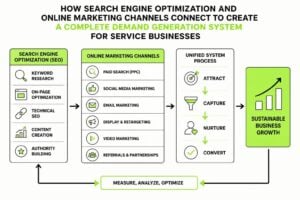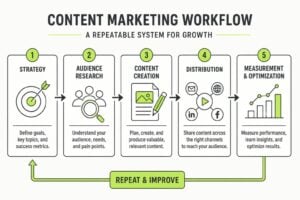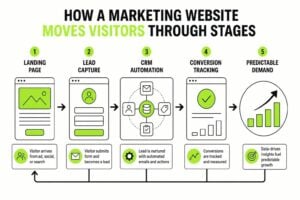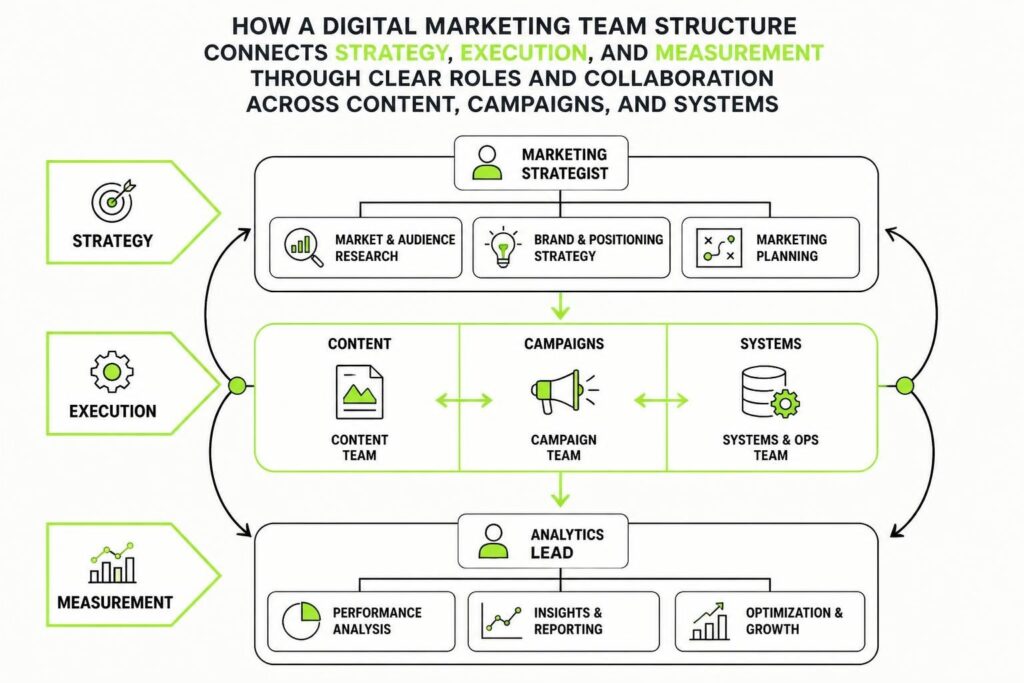
Building a digital marketing team isn't about collecting job titles. It's about creating a structure where strategy, execution, and measurement actually talk to each other. For service based businesses especially, a well built team removes bottlenecks, protects leads from falling through cracks, and turns marketing from a random expense into a predictable system. The challenge isn't just hiring people. It's knowing what roles you actually need, how they should work together, and what level of investment makes sense for your stage of growth.
What a Digital Marketing Team Actually Does
A digital marketing team handles the full cycle of attracting, converting, and retaining customers through digital channels. That includes strategy, content creation, paid advertising, automation, analytics, and optimization.
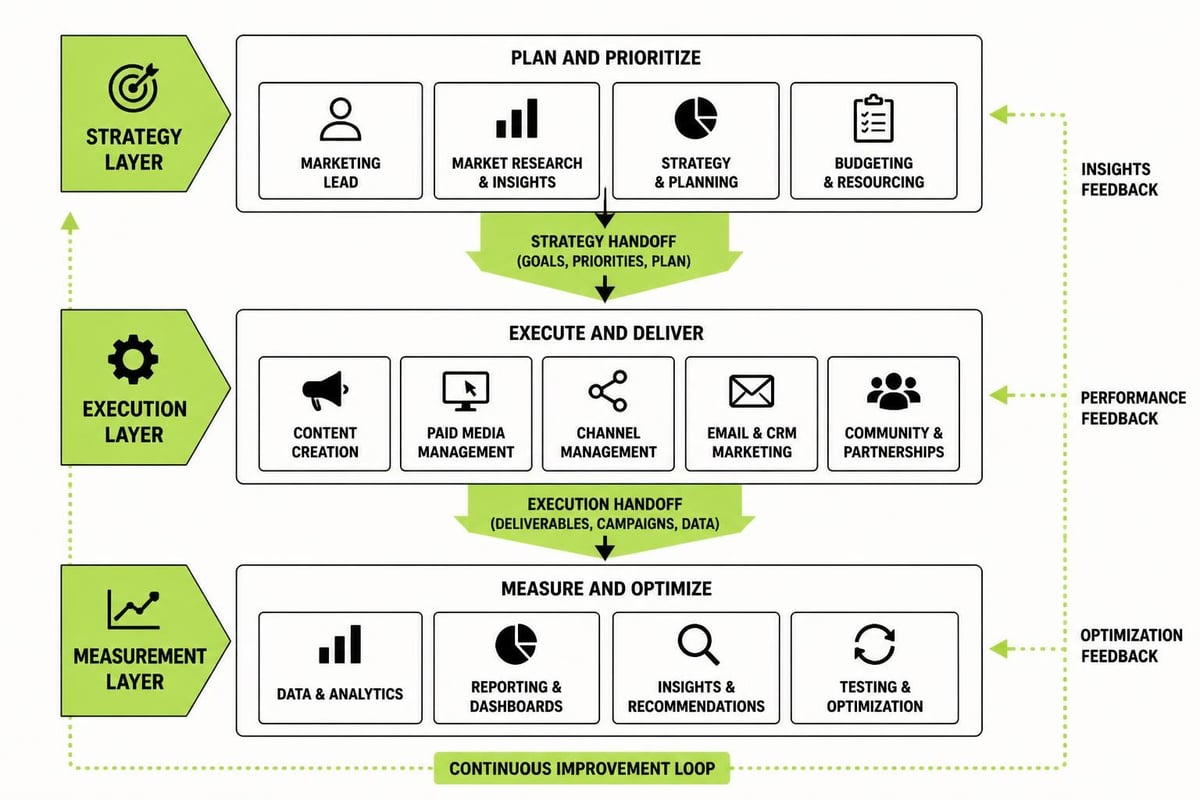
The core functions break down into three layers:
- Strategy and planning: Setting goals, understanding audiences, choosing channels, mapping customer journeys
- Execution: Creating content, running campaigns, building systems, managing platforms
- Measurement and optimization: Tracking performance, testing variations, refining what works, reporting results
Each layer needs specific skills. Strategy requires market understanding and business thinking. Execution needs creative and technical capability. Measurement demands analytical rigor and the ability to translate data into decisions. When these three layers work together properly, you get a marketing function that compounds over time instead of starting from scratch every quarter.
The mistake most businesses make is hiring tactically without a clear view of how the pieces fit. You end up with a social media person who can't access campaign data, a content writer who doesn't know the sales process, and a paid ads specialist working in isolation. The work gets done, but it doesn't build on itself.
Core Roles in a Functional Team
Not every business needs every role from day one. But understanding the full picture helps you decide what to prioritize and where to fill gaps with freelancers, agencies, or part time support.
Marketing Manager or Director
This role owns the overall strategy and coordinates across functions. They set goals, allocate budget, choose channels, and make sure individual tactics align with business objectives. A strong marketing manager thinks commercially, not just creatively. They understand customer lifetime value, conversion economics, and how marketing connects to sales and retention.
In smaller teams, this person might also execute some tactics directly. As teams grow, their role shifts to planning, resource allocation, and team development. According to key roles in a structured digital marketing team, leadership clarity makes the difference between scattered activity and focused growth.
Content Strategist and Writer
Content drives almost every channel. Blog posts, email sequences, landing pages, social posts, video scripts, case studies. A content strategist plans what to create based on audience needs and business goals, while a writer executes with clarity and relevance.
For service businesses, content isn't just traffic generation. It's trust building. Prospects need to see you understand their problems before they'll book a call. That requires research, positioning, and the ability to translate complex services into simple value statements. Many teams split this into two roles, one for strategy and one for writing. Smaller setups combine them.
SEO Specialist
Organic search is still one of the highest ROI channels if you commit to it properly. An SEO specialist handles keyword research, on page optimization, technical site health, link building, and content planning around search intent.
This role overlaps heavily with content strategy. The best SEO people don't just chase rankings. They understand how search fits into the buyer journey and prioritize keywords that actually convert. They also keep up with algorithm changes and platform requirements, which shift constantly. If your business relies on inbound leads, SEO is non negotiable.
Paid Media Specialist
Someone needs to manage Google Ads, Facebook Ads, LinkedIn campaigns, or whatever paid channels you're using. This person builds campaigns, writes ad copy, sets targeting, manages budgets, tests variations, and optimizes for cost per lead or cost per acquisition.
Paid media moves faster than organic channels. You get data quickly, but you also burn budget quickly if campaigns aren't managed well. A good paid media specialist knows how to read performance signals, kill underperforming ads fast, and scale what works without letting cost per result creep up.
Marketing Automation and CRM Specialist
This is where most service businesses have a massive gap. You can drive traffic and generate leads all day, but if your CRM is a mess and your follow up is manual, you're leaving money on the floor.
A marketing automation specialist builds email sequences, sets up lead scoring, integrates tools, manages contact data, and creates workflows that move prospects from awareness to decision without constant manual effort. They work closely with sales to make sure handoffs are clean and no leads get lost. As outlined in scalable team structures, automation capability separates teams that scale from teams that plateau.
Data Analyst
Marketing without measurement is just expensive guessing. A data analyst tracks performance across channels, builds dashboards, identifies trends, runs attribution models, and translates numbers into actionable recommendations.
This role requires both technical skill (working with analytics platforms, spreadsheets, and sometimes SQL) and business judgment (knowing which metrics actually matter). Many smaller teams handle this through the marketing manager or by using an agency. But as spend increases, dedicated analytics becomes essential.
Team Structure Models That Work
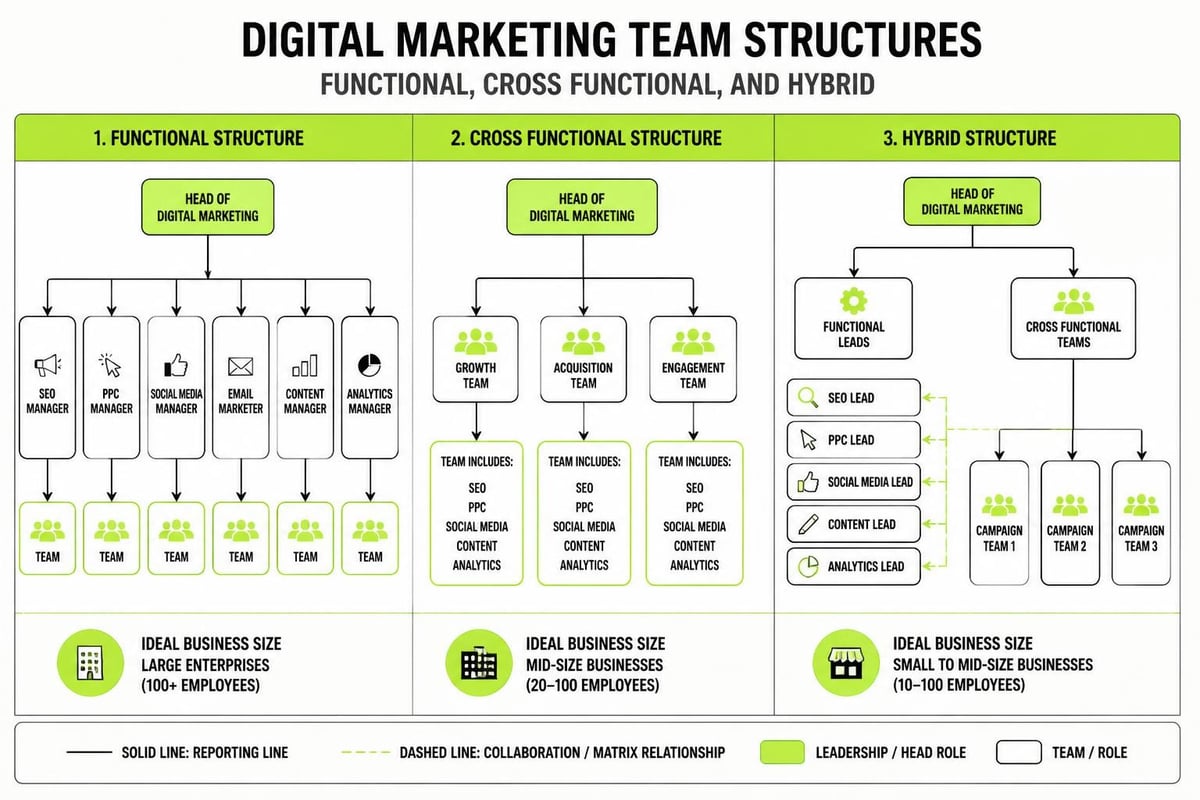
How you organize these roles depends on your size, complexity, and growth stage. There's no single right answer, but three common models show up repeatedly.
Functional Structure
Each specialist focuses on their discipline. SEO person does SEO. Content person does content. Paid media person does paid media. The marketing manager coordinates across functions.
Strengths:
- Deep expertise in each area
- Clear accountability
- Easier to hire and evaluate specialists
Weaknesses:
- Can create silos
- Requires strong coordination
- Specialists may optimize their channel without considering broader impact
This works well for businesses with consistent lead flow and established channels. If you know SEO, email, and paid ads are all core to your model, functional structure lets you build depth in each.
Cross Functional Teams
Instead of organizing by discipline, you organize by customer segment, product line, or campaign. Each team has a mix of skills (content, paid, automation) and owns results for their area.
Strengths:
- Better collaboration and knowledge sharing
- Teams own outcomes, not just outputs
- Faster iteration and decision making
Weaknesses:
- Can duplicate efforts across teams
- Harder to build deep expertise
- Requires more senior, versatile people
This model suits businesses with distinct customer segments or multiple service lines that need different marketing approaches. Each team acts like a mini agency focused on one audience.
Hybrid Structure
You maintain functional roles for specialized work (SEO, paid media) but organize project teams around campaigns or initiatives. People contribute their expertise to cross functional projects while maintaining their functional home.
Strengths:
- Balances specialization and collaboration
- Flexible for different projects
- Allows career growth in a discipline
Weaknesses:
- Can be confusing without clear project ownership
- Requires mature communication and planning
- People can feel pulled in multiple directions
Most mid sized teams end up here eventually. It gives you the benefits of both models if you manage it well. The key is clear project ownership and regular sync points so specialists don't work in isolation.
Building Your Team at Different Stages
You don't build the full team on day one. Here's how it typically evolves.
| Stage | Team Size | Key Roles | Focus |
|---|---|---|---|
| Startup | 1-2 people | Generalist marketer or founder + freelancer | Find product market fit, test channels |
| Early Growth | 2-4 people | Manager + content + paid specialist | Scale what works, build systems |
| Growth | 5-8 people | Manager + content + SEO + paid + automation | Multi channel, optimization, retention |
| Scale | 8+ people | Director + specialists + analysts + coordinators | Efficiency, attribution, team development |
At the startup stage, you need a versatile generalist who can run experiments across channels and figure out what actually drives results for your business. Hiring specialists too early just creates overhead.
Once you've validated channels, you start building specialist capability. Usually content and paid media come first because they drive immediate results. SEO follows once you have content capacity. Automation and analytics get added when manual processes become bottlenecks.
The common mistake is trying to hire senior specialists before you have clear channel product fit. You end up paying for expertise you can't fully leverage. Better to start with competent mid level people who can execute well, then upgrade as complexity increases.
When to Build In House vs. Using an Agency
Not every business needs a full internal digital marketing team. Sometimes a hybrid model makes more sense.
Build in house when:
- You have consistent, high volume marketing needs
- Your product or service requires deep industry knowledge
- You want complete control over messaging and brand
- You can afford competitive salaries for good people
- You have management capacity to lead a team
Use an agency when:
- You need expertise across multiple disciplines but don't have volume for full time hires
- You want faster access to senior capability
- Your marketing needs fluctuate seasonally
- You're testing new channels without long term commitment
- You need systems and infrastructure built quickly
Many service businesses work best with a lean internal team (1-2 people) supported by an agency for specialized work. The internal people own strategy, brand, and coordination. The agency brings execution power in content, ads, automation, and analytics.
This gives you flexibility without the overhead of managing a large team. You can scale spend up or down based on results. And you get access to senior expertise that would cost significantly more to hire full time. The trade off is less control over day to day execution and the need for clear communication to keep everyone aligned.
For businesses focused on structured growth, a framework like the 7-Step Marketing Plan creates the foundation both internal teams and agencies need. It covers goal setting, buyer personas, platform selection, opt in offers, CRM setup, customer experience, and referral systems. Each step builds on the previous one, creating a repeatable system that keeps generating leads.

Skills That Matter More Than Job Titles
When you're hiring or evaluating your digital marketing team, look past the resume bullet points. The skills that actually drive results often don't show up clearly in traditional job descriptions.
Systems Thinking
The best marketers see how pieces connect. They understand that email open rates don't matter if the CRM isn't capturing lead source data. They know that driving more traffic without improving conversion just increases wasted spend. They think in systems, not siloed tactics.
This skill is rare and hugely valuable. It's what separates people who execute tasks from people who build compounding growth engines. Look for candidates who ask about integration, data flow, and downstream effects before diving into tactics.
Commercial Awareness
Marketing exists to drive business results, not win creative awards. Your team needs to understand unit economics, customer lifetime value, payback periods, and how marketing spend connects to revenue.
This doesn't mean everyone needs an MBA. It means they should be able to explain how their work impacts the business in concrete terms. Can your content person connect their blog strategy to lead generation targets? Does your paid media specialist know the cost per lead threshold that makes campaigns profitable? That's commercial awareness.
Adaptability
Platforms change. Algorithms shift. What worked six months ago stops working. Your digital marketing team needs to learn continuously and adapt without waiting for perfect clarity.
This is especially true in paid media and SEO, where external factors constantly reshape the landscape. Hire people who read industry updates, test new features early, and adjust strategy based on evidence rather than attachment to old methods.
Communication and Collaboration
Even in a functional structure, marketing roles overlap constantly. Content needs to coordinate with SEO on keyword targeting. Paid media needs to align with automation on lead nurturing. Analytics needs to translate findings into actions for everyone else.
People who work well cross functionally, share knowledge generously, and communicate clearly create multiplier effects. People who hoard information or can't explain their work create friction. When you're hiring or building teams, assess collaboration skills as seriously as technical capability.
How systems thinking, commercial awareness, adaptability, and collaboration connect across digital marketing team functions
How to Evaluate Team Performance
Individual activity metrics matter less than collective business impact. Your digital marketing team should be measured on outcomes that connect to revenue and growth.
Lead Quality and Volume
Track both quantity and quality. More leads doesn't help if they're unqualified. Lower volume with higher close rates often beats high volume with poor fit. Look at lead source data to understand which channels and campaigns drive the best prospects.
Your CRM should capture this automatically. If it doesn't, that's your first infrastructure problem to fix. According to research on effective team structures, clear role alignment around lead quality metrics improves both marketing and sales performance.
Customer Acquisition Cost
Total marketing spend divided by new customers acquired. This number needs to be significantly lower than customer lifetime value for your business to work. Track it by channel so you know where to invest more and where to pull back.
CAC should decrease over time as you optimize campaigns, improve conversion rates, and build organic channels that don't require ongoing ad spend. If it's increasing, something's breaking down in your funnel or targeting.
Channel Performance and Attribution
Not all channels contribute equally. Some drive awareness. Some capture demand. Some nurture consideration. You need to understand the role each channel plays and how they work together.
Multi touch attribution is ideal but complex to implement. At minimum, track first touch (where did they come from?), last touch (what convinced them?), and any significant middle interactions. This helps you allocate budget intelligently and recognize channels that assist conversions even if they don't get the final click.
System Health Metrics
These are the operational indicators that predict future performance:
- Email deliverability and list growth rate
- Website speed and technical SEO scores
- CRM data quality and lead response time
- Content publication consistency
- Campaign testing velocity
If these metrics decline, your results will follow eventually. Monitor them as leading indicators, not just lagging outcomes.
Common Mistakes to Avoid
Most digital marketing team problems come from a handful of repeated mistakes.
Hiring for tactics before defining strategy. You bring on a social media specialist before knowing if social actually matters for your business model. Start with strategy, then build capability around validated channels.
Optimizing channels in isolation. Your SEO team drives more traffic but conversion rate drops because the content doesn't match buyer intent. Your paid media team lowers cost per click but lead quality falls. Always optimize for business outcomes, not channel metrics.
Neglecting systems and infrastructure. You invest heavily in traffic generation but your email sequences are broken and your CRM is a mess. Leads leak everywhere. The foundation matters more than the tactics.
Ignoring sales and customer team feedback. Marketing operates in a bubble, unaware that the leads they're so proud of are actually terrible fits. Regular feedback loops between marketing, sales, and customer success keep everyone grounded in reality.
Expecting immediate results from long term channels. SEO and content marketing take months to compound. If you expect instant ROI, you'll kill good work before it has time to pay off. Balance quick win channels (paid media) with longer term investments (organic).
What Good Looks Like
A well functioning digital marketing team has clear indicators. Leads come in consistently, not in random spikes. Your CRM contains clean, useful data. Campaign performance improves quarter over quarter as you learn and optimize. Marketing and sales trust each other and collaborate smoothly.
Your team should be able to articulate exactly how their work connects to business goals. They should know which metrics matter and ignore vanity numbers. They should spot problems early through system health indicators before they show up in results.
Most importantly, your marketing should feel like a system that runs, not a constant fire drill. There will always be optimization work and new tests to run. But the foundation should be stable, documented, and repeatable.
When you reach that point, marketing becomes a genuine growth engine instead of an expense you tolerate. That's when service businesses break through growth plateaus and build predictable, scalable demand.
Building a digital marketing team that actually drives growth requires more than collecting specialists. You need clear strategy, the right structure for your stage, and systems that turn individual effort into compounding results. At MDO Digital, we help service businesses build the infrastructure, clarity, and systems that make marketing work reliably. Whether you need to structure your team better or build the automation and CRM foundation they need to succeed, we focus on removing chaos and creating growth that compounds over time.