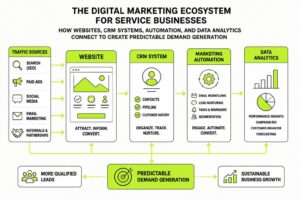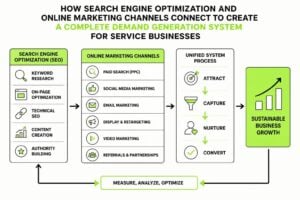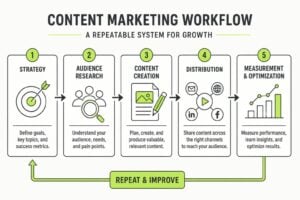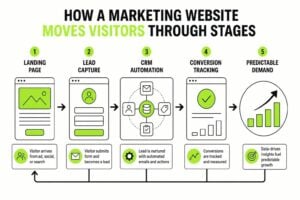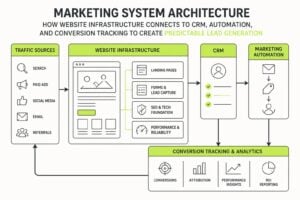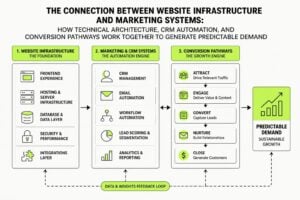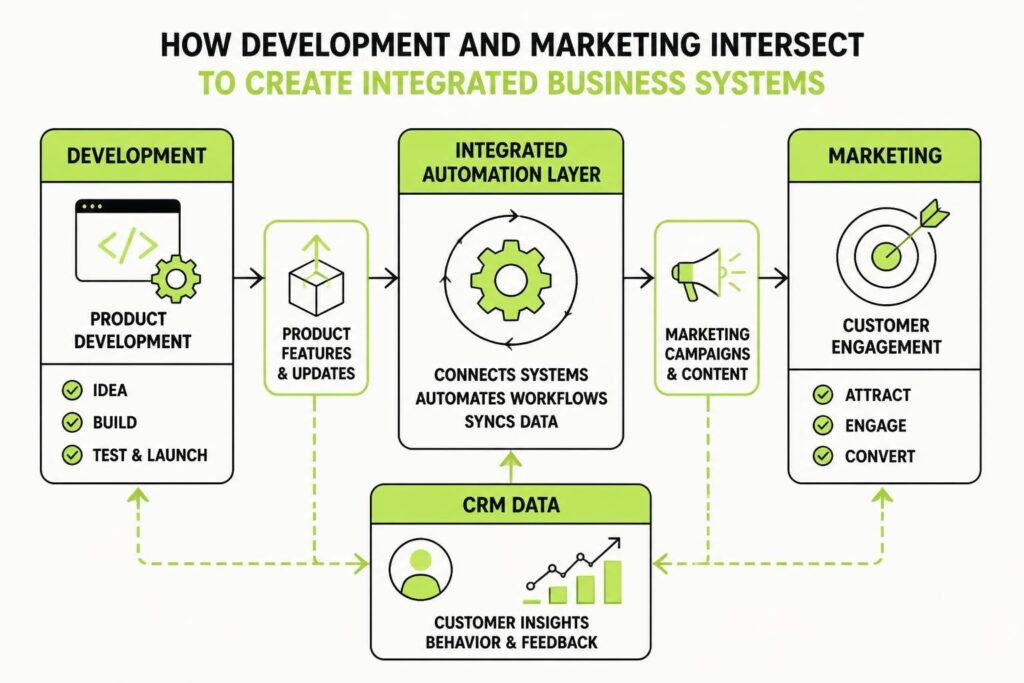
Most service businesses treat development and marketing as separate departments. One team builds the thing, another team sells it. That split creates friction, duplicated effort, and missed opportunities. When development and marketing operate in isolation, you end up with products that don't match what buyers actually want, and campaigns that can't articulate what makes your service valuable. The businesses that scale sustainably are the ones that treat these two functions as parts of one system.
Why Development and Marketing Need Each Other
Development without marketing builds in a vacuum. You might create something technically brilliant, but if you haven't validated demand or understood the language your buyers use, you're guessing. Marketing without development creates promises you can't keep. You generate leads, but if your service delivery, systems, and processes can't handle the volume or match expectations, growth becomes chaos.
The relationship between development and marketing should be reciprocal:
- Marketing informs what to build through customer research, feedback loops, and demand signals
- Development enables what marketing can promise by creating reliable, scalable systems
- Both share data to refine positioning, pricing, and product direction
- Customer experience becomes the testing ground for both functions
When service businesses integrate these disciplines, they create a feedback loop that compounds over time. Your marketing reveals what clients actually need, your development builds systems to deliver it efficiently, and the results feed back into sharper positioning.
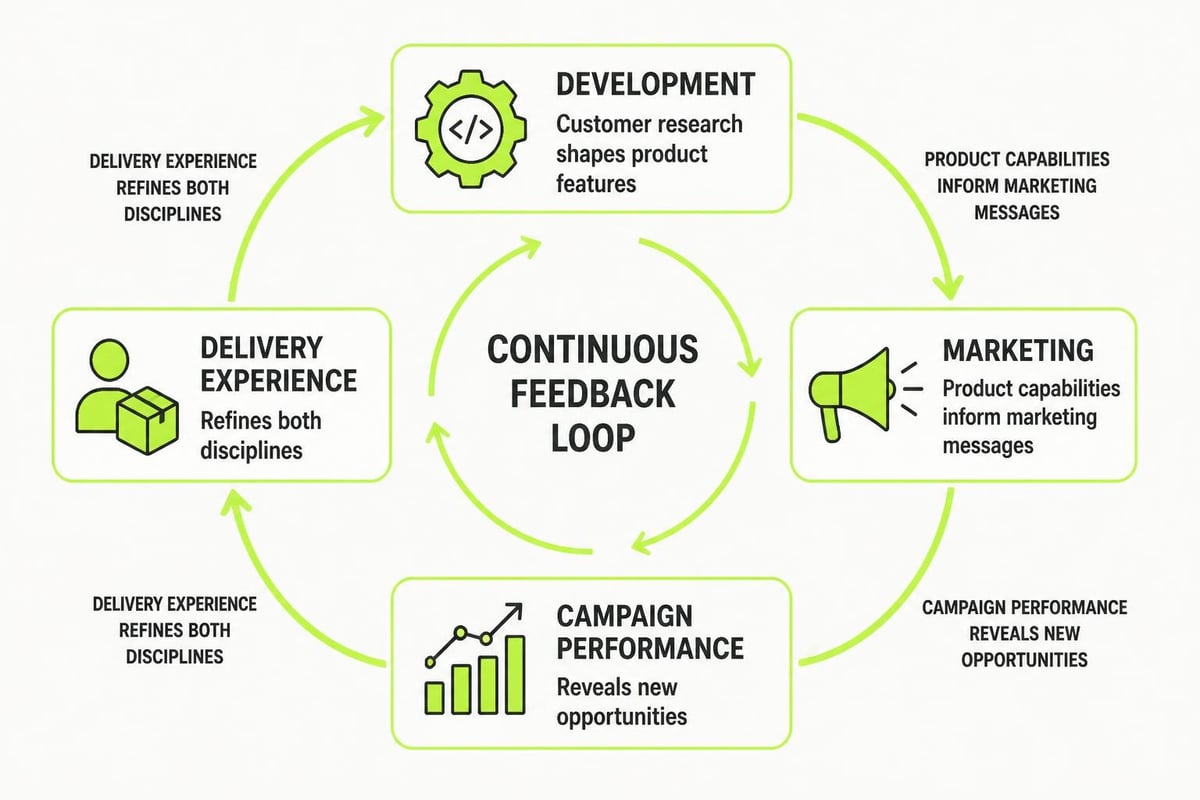
The Data Flow Between Teams
Development and marketing both generate valuable data, but most businesses don't connect the dots. Your CRM tracks lead behaviour, campaign performance, and conversion patterns. Your development process tracks delivery times, common support requests, and where clients get stuck. When you combine these datasets, patterns emerge.
Look for questions like:
- Which marketing channels bring clients who are easiest to onboard?
- What features or services do high-value clients ask about most?
- Where do prospects drop off in your sales process, and why?
- What delivery bottlenecks could automation solve?
- Which client segments have the highest lifetime value?
This isn't about collecting data for its own sake. It's about letting real behaviour guide both what you build and how you talk about it. Integrating R&D and marketing in new product development has been studied extensively, and the pattern holds across industries: collaboration between these functions directly impacts product success.
Building Marketing Systems That Scale
Marketing without systems is just activity. You post on social media, send emails, maybe run some ads. But without structure, nothing compounds. Development and marketing alignment means building infrastructure that gets smarter over time.
Core Components of a Marketing System
| Component | Development Role | Marketing Role |
|---|---|---|
| CRM | Build workflows, automation, data structure | Define lead scoring, segment criteria, nurture sequences |
| Content | Create templates, publishing systems, analytics | Research topics, write copy, optimise for conversion |
| Lead Capture | Design forms, integrate tools, ensure data flows correctly | Craft offers, test messaging, analyse conversion rates |
| Reporting | Build dashboards, connect data sources, automate reporting | Interpret metrics, adjust strategy, communicate results |
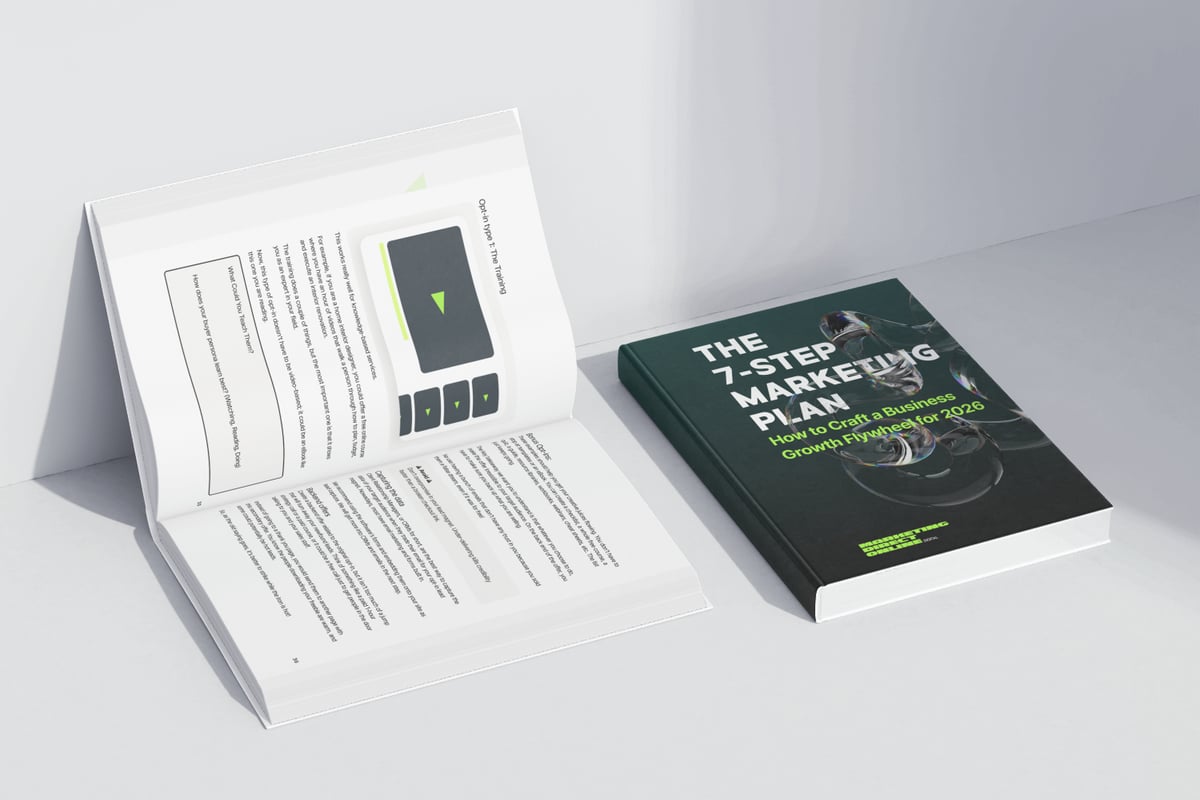
A 7-Step Marketing Plan provides a practical framework that connects these components into a repeatable system. Each step feeds the next, creating a flywheel that generates predictable demand rather than random activity.
The technical infrastructure matters more than most marketers realise. If your forms don't reliably sync to your CRM, if emails bounce because of DNS issues, if tracking breaks halfway through a campaign, you're burning budget and trust. Development and marketing need shared accountability for system reliability.
Automation That Actually Works
Automation gets a bad reputation because most businesses implement it poorly. They automate too early, before they understand the manual process. Or they automate everything, removing the human touch where it matters most.
Good automation follows a pattern:
- Document the manual process first and identify genuine bottlenecks
- Start with high-frequency, low-judgment tasks like data entry or email responses
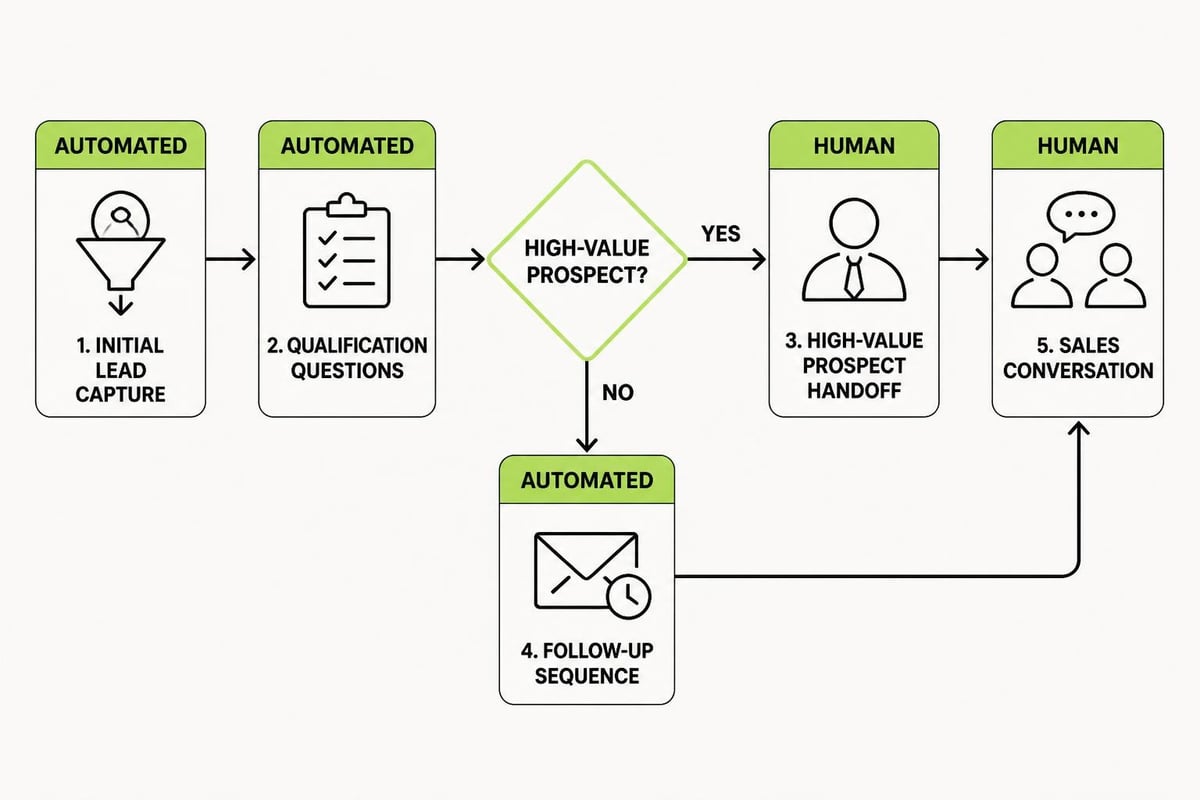
- Keep humans in the loop for complex decisions or relationship building
- Monitor for drift where automated systems start producing poor results over time
Development and marketing teams should jointly decide what to automate. Marketers understand where personalisation matters. Developers understand what's technically feasible and maintainable. The overlap is where you find automation that actually improves outcomes rather than just reducing costs.
Product Development Informed by Marketing Intelligence
The best product decisions come from market feedback, not internal brainstorming. Development and marketing collaboration means your roadmap reflects what buyers actually want, not what you think they should want.
Using Campaign Data to Guide Development
Every marketing campaign generates signals about product-market fit:
- Search terms reveal the language prospects use and problems they're trying to solve
- Ad performance shows which benefits resonate and which fall flat
- Email engagement indicates which topics generate genuine interest versus polite ignoring
- Sales objections highlight gaps in your offering or mismatches in positioning
When developers have access to this information, they can prioritise features and improvements that directly impact conversion and retention. When marketers understand development constraints, they can set realistic expectations and position limitations as intentional choices rather than shortcomings.
This approach aligns with business development best practices that emphasise market intelligence and client value as core operating principles. Your development roadmap should be shaped by evidence, not assumptions.
Building for Marketability
Some products are technically impressive but impossible to market. Others are easy to explain but hard to deliver. Development and marketing alignment means building things that are both deliverable and sellable.
Ask these questions during development:
- Can we explain this in one sentence?
- Does this solve a problem prospects know they have?
- Can we demonstrate the value quickly?
- What proof would make someone believe this works?
- How does this differentiate us from alternatives?
If you can't answer these clearly, you're building something that marketing will struggle to sell. That doesn't mean you shouldn't build it, but you need to adjust positioning, pricing, or packaging to match how buyers actually make decisions.
Marketing That Respects Developer Audiences
If you're marketing to technical audiences, traditional B2B tactics often backfire. Developers, engineers, and technical decision-makers spot marketing fluff immediately. Strategies for marketing developer tools emphasise authenticity, usability, and proof over hype.
For service businesses working with technical clients, development and marketing need to speak the same language:
- Show your work with case studies, technical documentation, and transparent processes
- Avoid jargon unless it's industry-standard terminology your audience actually uses
- Demonstrate competence through helpful content, not claims
- Respect their time with clear, direct communication
Technical audiences value substance. They'll read a 3,000-word technical guide if it solves their problem, but they'll bounce from a sales page full of vague promises. Your development team can help marketing create content that demonstrates real expertise rather than performing it.
Building Trust Through Content
Content marketing works when it genuinely helps people. Development and marketing teams can collaborate on resources that showcase your capabilities while providing immediate value:
- Technical guides that solve specific problems in your domain
- Process documentation that shows how you approach common challenges
- Case studies with real numbers, real obstacles, and honest lessons
- Tools and templates that prospects can use immediately
This approach builds trust and authority, which matter more than reach. You don't need millions of visitors. You need the right people finding you at the right time. MDO Digital’s approach to branding and digital marketing focuses on creating high-trust touchpoints that convert attention into predictable demand.
Structuring Teams for Collaboration
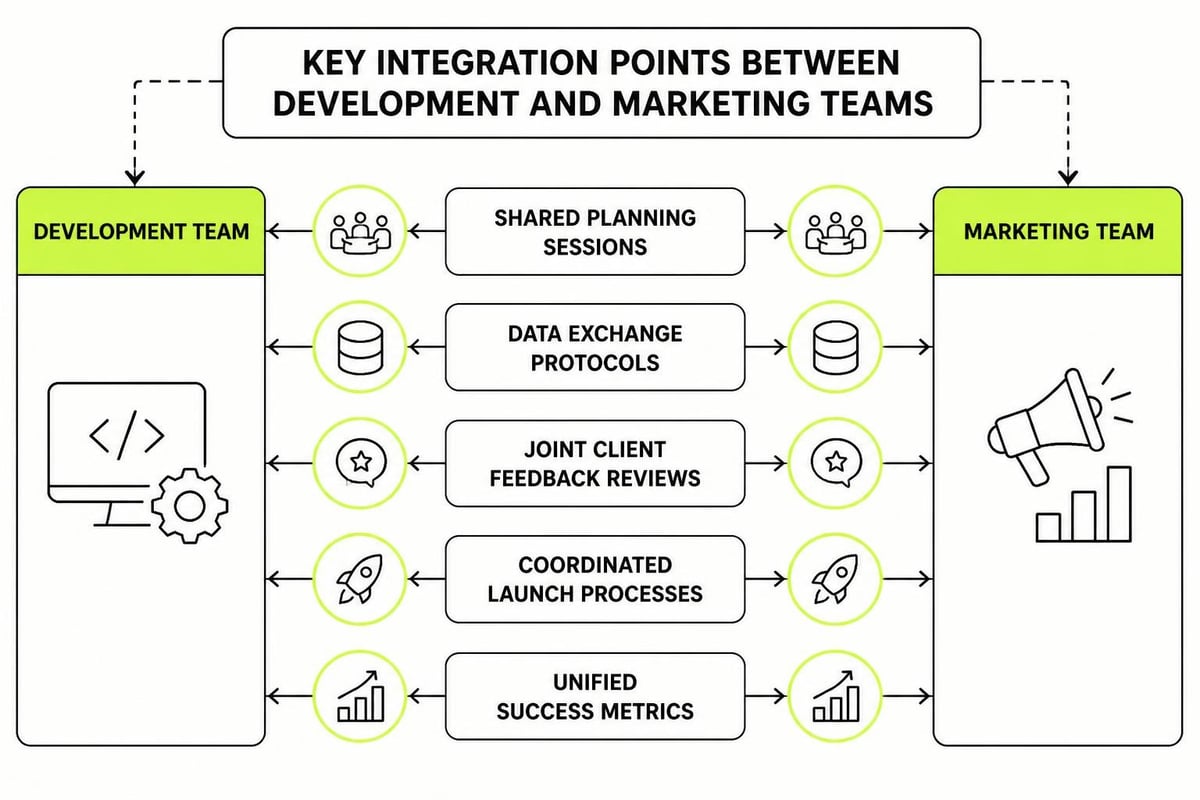
Development and marketing collaboration doesn't happen by accident. It requires intentional structure, shared goals, and regular communication.
Practical Integration Points
| Integration Point | Frequency | Purpose |
|---|---|---|
| Joint planning sessions | Quarterly | Align roadmaps, share priorities, identify dependencies |
| Data review meetings | Monthly | Analyse campaign and delivery metrics, spot patterns |
| Launch coordination | Per project | Ensure technical readiness matches marketing timeline |
| Retrospectives | After major campaigns | Learn what worked, what didn't, what to change |
| Shared documentation | Ongoing | Maintain single source of truth for positioning, features, processes |
Some businesses create hybrid roles that bridge development and marketing. Product marketers, marketing technologists, or growth engineers understand both disciplines well enough to translate between them. These roles reduce friction and speed up execution.
Shared Metrics That Matter
When development and marketing have different success metrics, they optimise for different outcomes. Revenue and client retention should be shared goals. Both teams need visibility into:
- Lead to client conversion rate (not just lead volume)
- Client lifetime value by acquisition channel
- Time to value from first contact to realising benefits
- Churn rate and primary reasons for cancellation
- Referral rate as a proxy for genuine satisfaction
These metrics force both teams to care about the full customer journey, not just their isolated piece of it. Marketing can't just dump leads over the wall. Development can't just ship features without considering adoption.
Common Mistakes That Break the System
Even businesses that understand the importance of development and marketing alignment make predictable mistakes.
Building before validating demand. You spend months developing a new service offering, then discover no one actually wants it at your price point. Validate with small tests and real conversations before committing major resources.
Marketing promises the development team can't keep. This destroys trust with clients and creates internal friction. Marketing should have a clear understanding of capacity, timelines, and realistic outcomes.
Siloed tools and data. When development uses one set of tools and marketing uses another, with no integration, you lose the compound effect of connected systems. Invest in infrastructure that shares data between functions.
Ignoring feedback loops. Clients tell you what's working and what isn't, but if that information stays trapped in support tickets or sales calls, you can't improve. Create systematic ways to surface feedback to both teams.
Optimising for vanity metrics. Website visits, social followers, and email list size matter less than revenue per channel, conversion rates, and client retention. Focus on metrics that reflect actual business health.
Developer marketing best practices emphasise the importance of clear messaging and authentic communication, which applies beyond technical audiences. When development and marketing align on metrics that matter, both functions become more effective.
Making It Work in Practice
Theory is easy. Execution is where most businesses struggle. Here's how to actually implement better development and marketing alignment without reorganising your entire company.
Start Small and Iterate
Pick one integration point and do it well:
- Weekly sync between marketing and delivery leads to review pipeline health and identify issues
- Shared dashboard showing key metrics both teams care about
- Joint review of client feedback once per month to spot patterns
- Cross-team participation in campaign planning so developers understand messaging and marketers understand constraints
Once one integration point becomes routine, add another. The goal is sustainable progress, not a complete overhaul that creates chaos.
Document Shared Processes
Written processes reduce friction and misunderstanding. Create documentation for:
- How marketing requests development work (timeline, priority, required information)
- How development communicates technical constraints or opportunities to marketing
- What data gets shared between teams, where it lives, and how often it updates
- How campaign launches coordinate with technical readiness
- What happens when things go wrong (errors, missed deadlines, poor results)
This isn't bureaucracy. It's removing the need for constant negotiation about how you work together. Best practices for software maturity improvement often emphasise documentation and process clarity as foundational to effective collaboration.
Invest in Shared Tools
The right tools make collaboration natural rather than forced. Prioritise:
- CRM that both teams use for client data, pipeline visibility, and campaign tracking
- Project management that shows work across both functions
- Analytics platforms that combine marketing and delivery metrics
- Communication tools that keep relevant people informed without overwhelming everyone
Tools should reduce friction, not create it. If a tool requires constant manual work to keep data current, it won't get used consistently. Automation and integration matter more than features.
The Compound Effect Over Time
Development and marketing alignment isn't a one-time project. It's an operating philosophy that creates advantages over time.
When these functions work together, you build systems that get better with every iteration. Your marketing becomes more precise because you understand what actually converts. Your development becomes more focused because you're building what the market values. Client acquisition costs decrease as your positioning sharpens and your delivery improves.
This is how service businesses move from chaos to predictable growth. Not through individual heroics or random tactics, but through structured systems that compound over time. Online business and marketing success in 2026 requires this level of integration.
The businesses that treat development and marketing as separate functions will keep spinning their wheels, wondering why growth feels so hard. The ones that integrate these disciplines will build momentum that's difficult for competitors to match.
Development and marketing aren't separate disciplines. They're two parts of one system that either reinforce each other or work against each other. When you align them around shared goals, connected data, and customer outcomes, you create the foundation for sustainable growth. MDO Digital helps service businesses build exactly these kinds of integrated systems, removing chaos and creating structure that compounds over time. If you're ready to stop treating marketing and development as separate problems and start building systems that scale, let's talk.