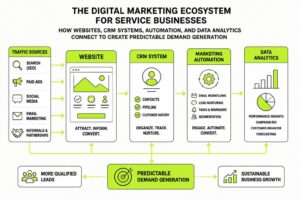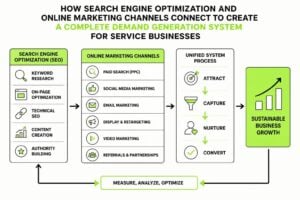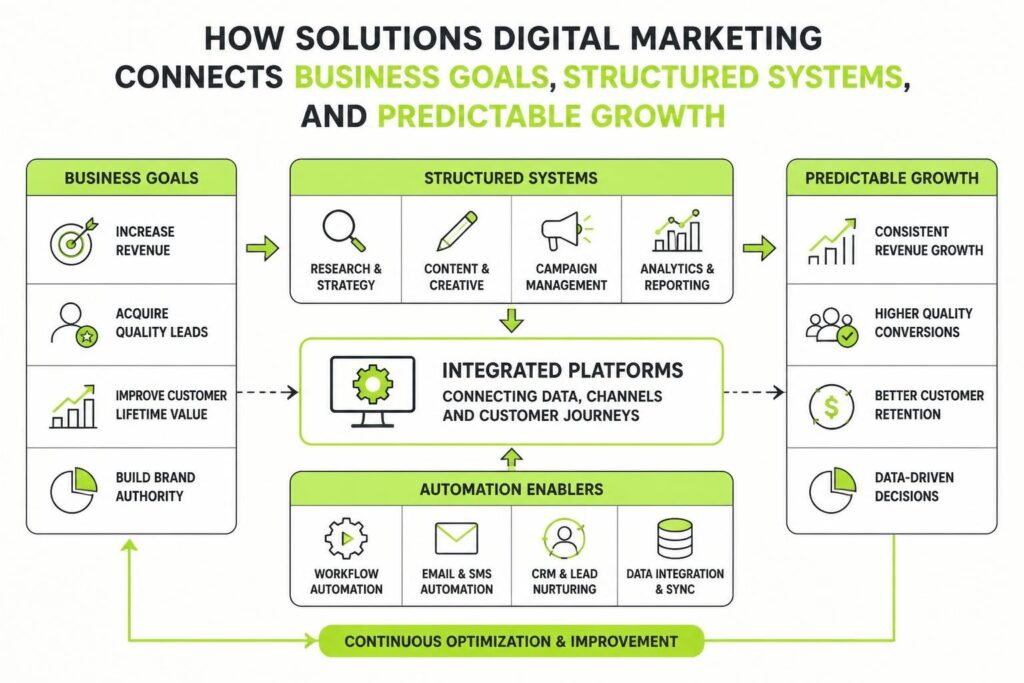
Most service businesses approach digital marketing like a buffet. They grab a bit of social media, try some email, maybe run an ad or two, then wonder why nothing sticks. The problem isn't effort. It's the lack of a proper system. Solutions digital marketing is about building infrastructure that works together, not cobbling together random tactics that compete for your attention. When you shift from chasing platforms to designing systems, your marketing becomes predictable, scalable, and far less chaotic.
What Solutions Digital Marketing Actually Means
Solutions digital marketing isn't a buzzword. It's a framework for treating your marketing like the business asset it should be.
Most businesses think digital marketing means being present on every platform. Post on Instagram. Send newsletters. Run Google Ads. But presence without structure creates noise, not results. Solutions digital marketing focuses on building connected systems where each piece feeds the next.
Here's what that looks like in practice:
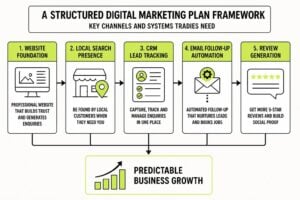
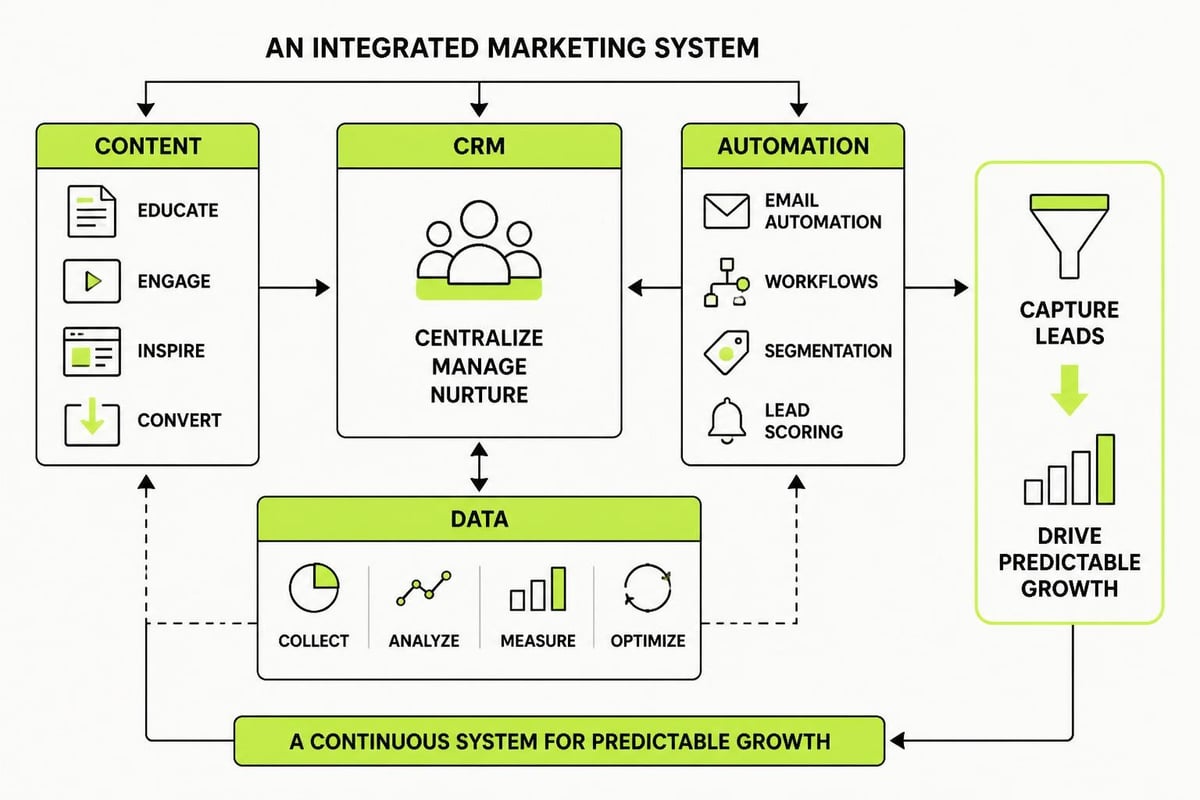
- CRM infrastructure that captures and tracks every lead
- Automation sequences that nurture prospects without manual work
- Data pipelines that show what's working and what's wasting money
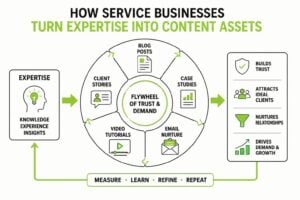
- Content systems that create once and distribute everywhere
- Conversion paths designed to move people from attention to action
The goal is simple. Remove the guesswork. Protect your leads. Create a marketing machine that compounds over time instead of burning out every quarter.
Why Service Businesses Need System-Level Thinking
Service businesses face a unique challenge. You're not selling widgets. You're selling expertise, trust, and outcomes. That means longer sales cycles, higher ticket values, and more touchpoints before someone buys.
Traditional digital marketing advice doesn't account for this. It's built for e-commerce. Fast clicks. Quick conversions. Low consideration purchases.
When you're selling strategy, coaching, consulting, or technical services, you need a different approach. You need systems that:
- Qualify leads early so you're not wasting time on tyre kickers
- Nurture over weeks or months without constant manual follow-up
- Build authority through consistent, valuable content
- Track attribution so you know which efforts actually drive revenue
- Scale without proportional time investment from you or your team
This is where solutions digital marketing separates from tactic-chasing. You're not just running ads. You're building a demand generation engine.
The Core Components of a Marketing System
Let's break down what actually goes into a marketing system that works. Not theory. Not fluff. The actual infrastructure.
CRM and Lead Management
Your CRM is the foundation. It's not just a contact list. It's the single source of truth for every prospect, customer, and interaction.
Key functions:
- Capture leads from every source (website, ads, referrals, events)
- Track behaviour (emails opened, pages visited, content downloaded)
- Segment audiences based on interest, stage, or demographics
- Trigger automation based on actions or time delays
- Report on pipeline value and conversion rates
Without a proper CRM, you're flying blind. You might know someone filled out a form, but you don't know what they did next, whether they engaged, or if they're worth following up with. Quality content influences buyer decisions, but only if you can track who's consuming it and respond accordingly.
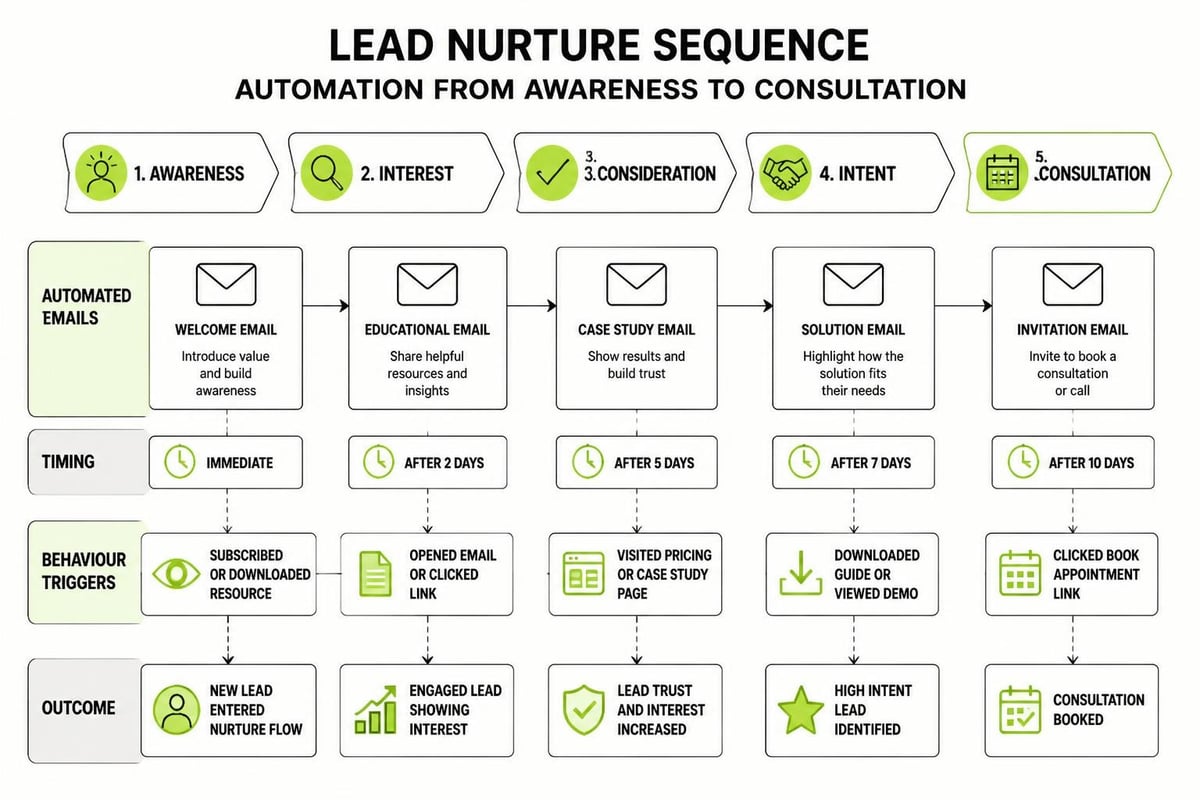
Automation and Nurture Sequences
Automation does the repetitive work so you don't have to. It's not about being robotic. It's about consistency.
A proper nurture sequence might look like this:
| Day | Action | Purpose |
|---|---|---|
| 0 | Welcome email + resource delivery | Establish value immediately |
| 2 | Educational email on common problem | Build authority |
| 5 | Case study or success story | Demonstrate proof |
| 9 | Soft offer or consultation invite | Create opportunity to convert |
| 14 | Final value email + clear CTA | Capture motivated prospects |
This runs automatically. Every lead gets the same high-quality experience. You focus on the conversations that matter, not manually sending the same emails over and over.
Content That Compounds
Most content is disposable. A social post gets 48 hours of visibility, then vanishes. Solutions digital marketing prioritises content that builds value over time.
High-compound content formats:
- Long-form guides that rank in search and stay relevant for years
- Email courses that deliver value in sequence and build authority
- Case studies that demonstrate real outcomes and overcome objections
- Video tutorials that get embedded, linked, and shared repeatedly
- Templates or frameworks that people save and refer back to
Create once. Distribute everywhere. Let it work for months or years. That's how you build momentum without burning out.
Understanding how link building improves search rankings is part of this equation. Good content attracts links naturally. Links improve authority. Authority drives more visibility. The system feeds itself.
Building Your First Marketing System
You don't need to build everything at once. Start with the basics, then layer complexity as you scale.
Step One: Audit Your Current State
Before you build, know where you are. Map out:
- Every place leads currently come from
- How those leads are tracked (or not tracked)
- What happens after someone shows interest
- Where leads get lost or go cold
- Which sources actually convert to revenue
Most businesses discover they're losing 40-60% of leads simply because there's no follow-up system. That's not a marketing problem. That's an infrastructure problem.
Step Two: Choose Your Core Platform
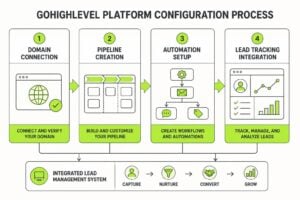
You need a central hub. For most service businesses, that's a CRM with built-in automation. Popular options include HubSpot, ActiveCampaign, or Go High Level.
What matters:
- Can it capture leads from all your sources?
- Does it handle email automation well?
- Can you segment and tag contacts easily?
- Does it integrate with your other tools?
- Can you actually afford it without breaking the budget?
Don't overcomplicate this. Pick something solid, learn it properly, and use it fully before chasing the next shiny tool.
Step Three: Design Your Conversion Path
Map out the journey from stranger to customer. Be specific.
- Awareness: How do people find you? (Search, ads, referrals, social)
- Interest: What do they do first? (Read blog, watch video, download guide)
- Consideration: How do they evaluate you? (Email sequence, case studies, testimonials)
- Decision: What's the clear next step? (Book call, start trial, request quote)
- Experience: How do you deliver and retain them? (Onboarding, results, referrals)
Each stage needs specific content and clear calls to action. If there's a gap, people fall through. If there's friction, they bounce.
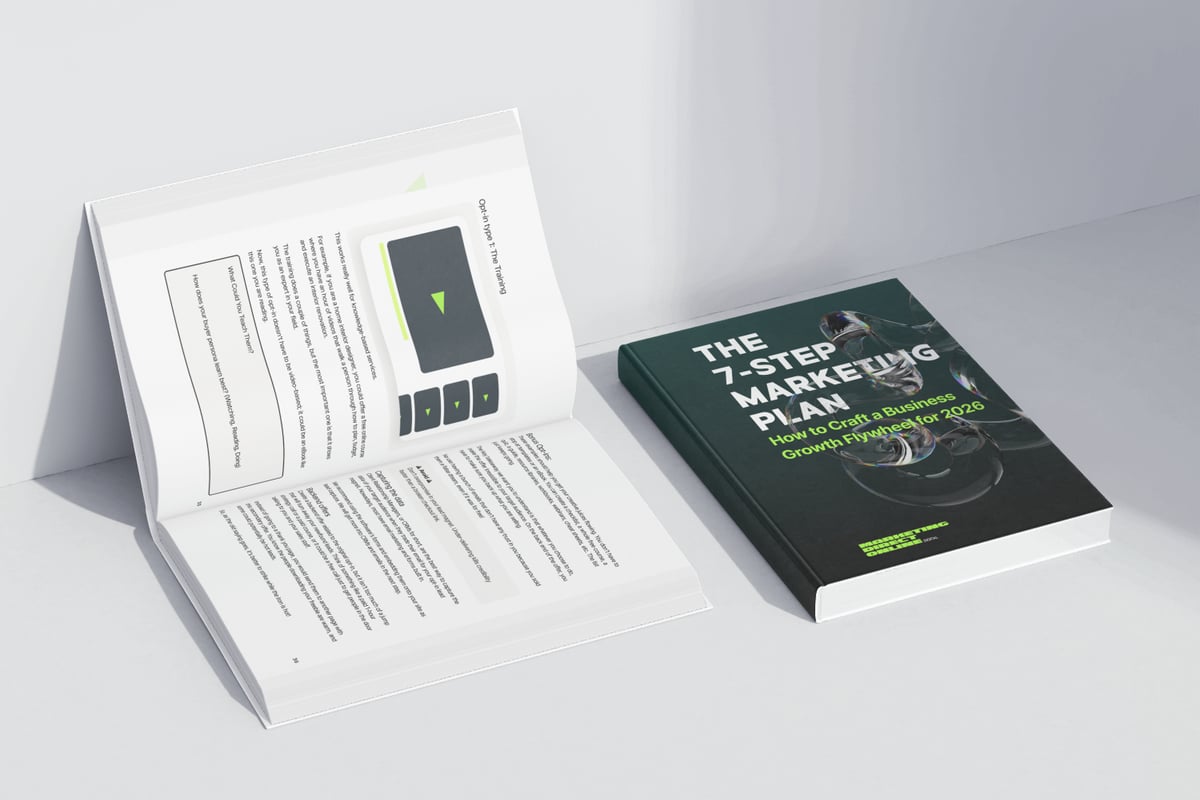
A practical approach like the 7-Step Marketing Plan can help you structure this journey systematically, covering everything from defining your buyer persona to building nurture campaigns that convert.
Data and Optimisation
Solutions digital marketing runs on data, not assumptions. You need to know what's working, what's not, and where to invest next.
Metrics That Actually Matter
Forget vanity metrics. Track what moves the business forward.
| Metric | Why It Matters | How To Use It |
|---|---|---|
| Lead source ROI | Shows which channels are profitable | Shift budget to winners |
| Conversion rate by stage | Identifies bottlenecks in your funnel | Fix weak points first |
| Cost per qualified lead | Tells you what you can afford to spend | Set acquisition budgets |
| Customer lifetime value | Reveals how much you can invest upfront | Justify longer nurture cycles |
| Time to conversion | Shows how long your sales cycle is | Plan cash flow and follow-up |
Most businesses track none of this. They run ads, hope for the best, and wonder why growth feels random. When you build systems, you get visibility. When you have visibility, you can optimise. When you optimise, you scale.
Testing and Iteration
Marketing systems aren't set-and-forget. They're living infrastructure that improves over time.
Test regularly:
- Email subject lines and send times
- Landing page headlines and layouts
- Offer positioning and pricing presentation
- Nurture sequence timing and content
- Ad creative and audience targeting
Small improvements compound. A 5% lift in conversion rate doesn't sound exciting, but over 100 leads a month, that's 5 more customers a year. Over five years with compounding improvements, that's exponential growth.
Research shows that AI-driven systems can analyse and improve marketing content by scoring designs and extracting insights that enhance customer engagement. While you don't need neural networks to start, the principle holds. Measure, learn, improve.
Common Mistakes That Kill Marketing Systems
Even good intentions can create bad systems. Here's what to avoid.
Building Before Strategy
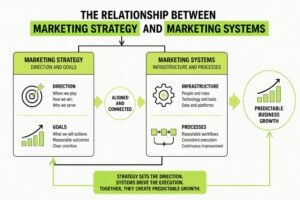
Don't start with tools. Start with outcomes. What are you actually trying to achieve? More leads? Better leads? Higher conversion rates? Faster sales cycles?
Your infrastructure should support your goals, not dictate them. Too many businesses buy a CRM, realise they don't know how to use it, and let it sit empty while they go back to spreadsheets.
Over-Automating Too Soon
Automation is powerful, but it's not a substitute for understanding. Before you automate, do it manually. Send the emails yourself. Have the conversations. Learn what works.
Once you know the process converts, then automate it. Automating a broken process just scales the damage faster.
Ignoring the Human Element
Systems don't replace relationships. They enable them. The best solutions digital marketing setups use automation to handle repetitive work so humans can focus on high-value interactions.
Your automation should feel helpful, not robotic. Emails should sound like you wrote them, because you did. They just get sent automatically.
Neglecting Maintenance
Marketing systems need ongoing attention. Links break. Forms stop working. Integrations fail. Content goes stale.
Schedule quarterly audits. Check that every automation still fires. Test every form. Review performance data. Update content that's outdated.
This isn't glamorous work, but it's what keeps systems running reliably for years instead of months.
The Shift From Chaos to Structure
Most service businesses operate in constant reaction mode. A lead comes in, they scramble to respond. A campaign ends, they panic about what's next. Revenue feels like a rollercoaster because marketing feels like guesswork.
Solutions digital marketing changes that dynamic. When you build proper systems, marketing becomes:
- Predictable: You know how many leads you'll generate and what they'll cost
- Scalable: Adding budget or team doesn't create proportional chaos
- Durable: Systems keep working even when you're focused elsewhere
- Measurable: You can see exactly what drives results and what doesn't
This doesn't happen overnight. Building marketing infrastructure takes time. But every piece you add makes the whole system stronger.
Start with one complete funnel. Get it working. Then add another. Layer in complexity gradually. Building digital authority through consistent, quality work compounds over time, just like your marketing systems.
The businesses that thrive long-term aren't the ones with the flashiest campaigns. They're the ones with systems that quietly, consistently generate demand while everyone else is still chasing the next tactic. That's the real value of solutions digital marketing. It's infrastructure, not inspiration. And infrastructure is what scales.
If you're tired of marketing that feels chaotic and want systems that actually work, explore how structured digital marketing can transform your approach. The shift from random tactics to integrated systems isn't just better marketing. It's better business.
Solutions digital marketing isn't about doing more. It's about building systems that work harder than you do. When you focus on infrastructure over tactics, marketing becomes predictable, scalable, and far less stressful. If you're ready to remove the chaos and build marketing systems that actually compound over time, MDO Digital can help you design the infrastructure your business needs to scale with clarity.