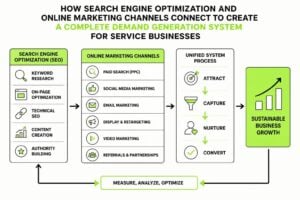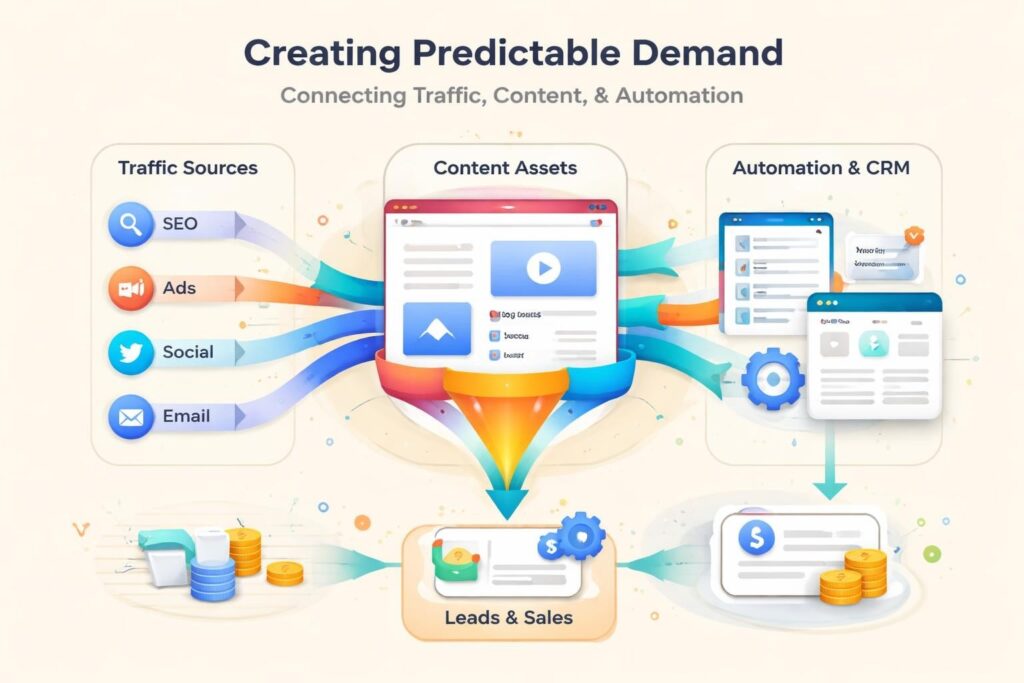
Most service businesses treat digital and content marketing as separate activities. One team runs ads. Another writes blog posts. Someone else handles the CRM. The result is scattered effort that doesn’t compound. What actually works is treating these as connected parts of a system where each component feeds the others. When your content supports your digital channels and your digital strategy amplifies your content, you create momentum that builds over time rather than evaporating the moment you stop posting.
The Real Job of Digital and Content Marketing
Digital and content marketing isn’t about being everywhere or posting constantly. It’s about creating a structured path from stranger to customer that you can measure, improve, and scale.
Think of it this way: digital marketing gets attention. Content marketing holds that attention and builds trust. Together, they create conditions where people choose to buy from you without needing constant convincing.
The core functions break down into:
- Attention: Paid ads, SEO, social platforms that put your business in front of people
- Trust: Educational content, case studies, and resources that demonstrate competence
- Infrastructure: Systems that capture leads, nurture relationships, and track what works
- Conversion: Clear offers and friction-free paths to becoming a customer
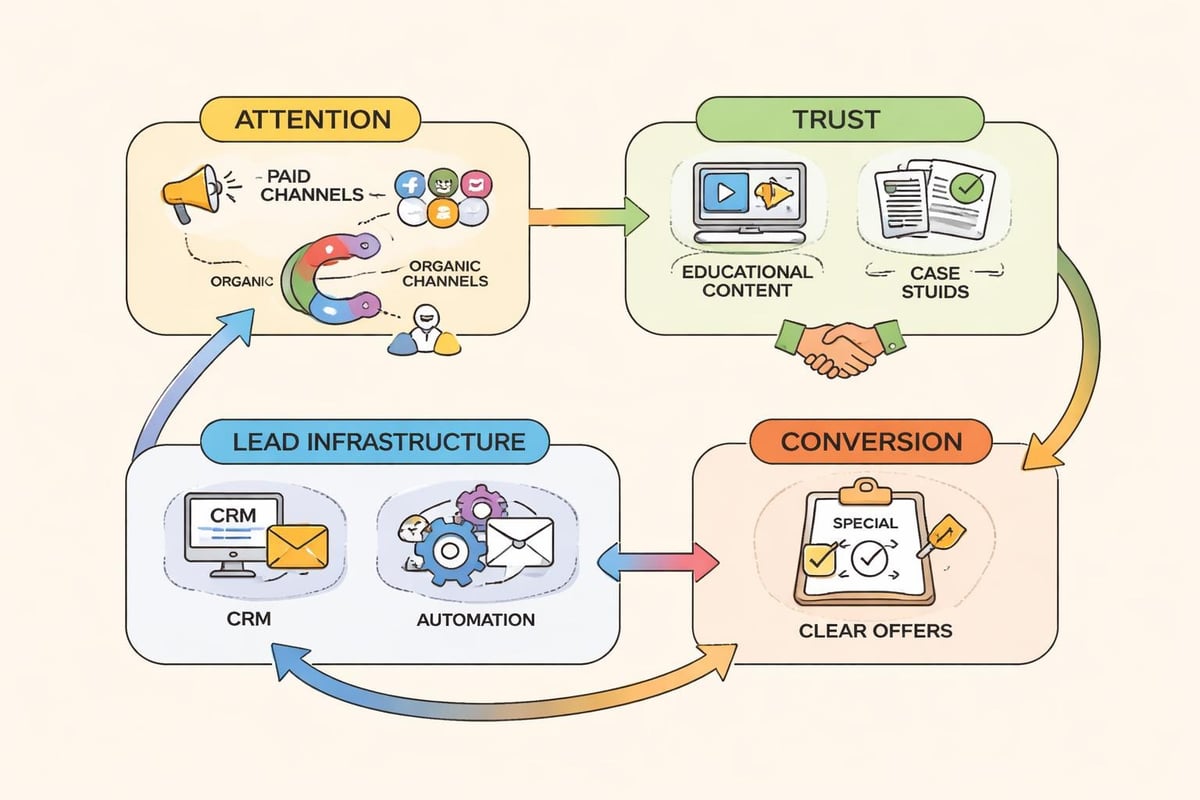
None of these steps work in isolation. Running ads without good content wastes money on clicks that don’t convert. Creating brilliant content that no one sees wastes talent. Building elaborate automation without quality leads feeding it wastes time. The role of content marketing within digital marketing becomes clear when you see how each element depends on the others.
Why Most Businesses Get This Wrong
The typical pattern: someone attends a webinar about Facebook ads and starts running campaigns. Revenue doesn’t move much, so they try SEO. That takes too long, so they pivot to LinkedIn content. Nothing gets traction because there’s no connected system.
Common disconnects we see:
- Ad traffic landing on generic homepage with no specific offer
- Blog content written without keyword research or audience intent
- CRM systems that collect leads but don’t nurture them
- Multiple point solutions that don’t share data or create a customer view
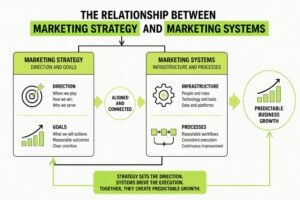
You can’t fix these problems by adding more tactics. You fix them by building infrastructure that connects your activities into a coherent system. That’s what separates businesses that scale from those that stay stuck at the same revenue level year after year.
Building Content That Supports Digital Strategy
Content marketing often gets reduced to “write blog posts and hope for traffic.” That’s backward. Effective content starts with understanding what your audience needs at different stages of awareness, then creating assets that move them toward a buying decision.
Content Types That Actually Convert
| Content Type | Purpose | Best For | Conversion Path |
|---|---|---|---|
| Educational guides | Build authority, capture search traffic | Cold audience, SEO | Email capture, long-term nurture |
| Case studies | Demonstrate results, overcome skepticism | Warm prospects evaluating options | Direct inquiry, sales calls |
| Process breakdowns | Show methodology, reduce perceived risk | Prospects comparing vendors | Contact form, consultation request |
| Data reports | Establish thought leadership, earn backlinks | Industry reputation, referral sources | Newsletter signup, share/amplify |
The key is matching content to intent. Someone searching “what is CRM” needs different content than someone searching “best CRM for accounting firms.” The first query signals learning. The second signals buying readiness.
Your digital and content marketing strategy should map content assets to each stage. Top-of-funnel content answers questions and builds awareness. Middle-funnel content addresses objections and demonstrates competence. Bottom-funnel content makes the buying decision easier with clear differentiation and proof.
Establishing thought leadership through content requires consistency and depth. Surface-level content might drive some traffic, but it won’t position you as the obvious choice when someone is ready to buy.
Content Creation That Scales
Most service businesses can’t sustain publishing three blog posts per week. They don’t need to. Better to publish one substantial piece monthly that actually helps your audience than churn out weekly posts that say nothing.
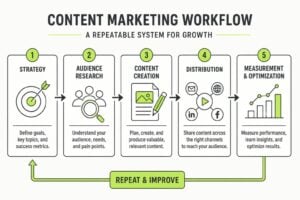
Practical content workflow:
- Research what your prospects actually ask (sales calls, support tickets, initial consultations)
- Validate keyword demand using search data and competitor analysis
- Create comprehensive content that fully addresses the topic
- Distribute strategically through email, social, and paid amplification
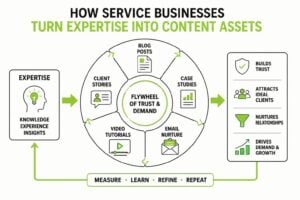
- Repurpose into multiple formats (video, social posts, email sequences)
- Measure impact on traffic, leads, and revenue
This approach creates content assets that compound in value rather than one-off posts that get buried. A well-researched guide continues driving traffic and leads for years. A rushed blog post gets ignored within days.
The relationship between content marketing and SEO matters because search visibility creates sustainable traffic that doesn’t disappear when you stop paying for ads. But it only works when your content actually answers what people are searching for.
Digital Channels That Amplify Content
Creating content without distribution is like printing brochures and leaving them in a warehouse. Digital channels turn your content into a lead generation system.
Paid Distribution Strategies
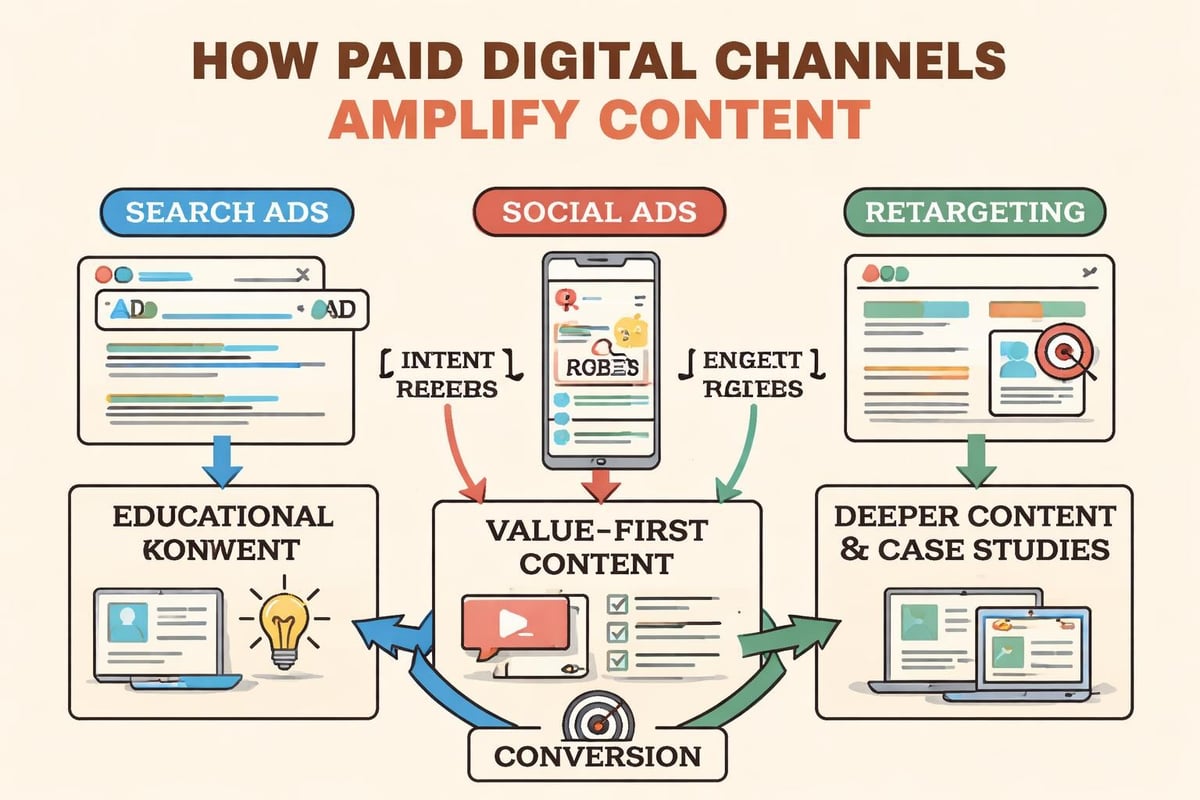
Search ads put your content in front of people actively looking for solutions. Instead of sending ad traffic to a generic landing page, route it to content that addresses their specific question, then capture contact information once they’re engaged.
Social ads work differently. Most people on Facebook or LinkedIn aren’t actively shopping. They’re scrolling. Your ad needs to interrupt that scroll with a relevant problem or insight, then the content needs to deliver immediate value that builds trust.
Retargeting is where digital and content marketing create real leverage. Someone reads your guide on marketing automation. They don’t convert immediately. Retargeting keeps your business visible while they evaluate options, pointing them to case studies and deeper content that addresses objections.
Organic Distribution That Compounds
SEO remains the most reliable source of traffic that improves over time. Ranking for relevant keywords means people find your content when they need it. But it requires patience and technical foundations most businesses skip.
- Site structure that makes content discoverable to search engines
- Internal linking that distributes authority across your content
- Technical optimization that ensures fast load times and mobile usability
- Backlink development from authoritative sources in your industry
This isn’t sexy work. It’s systems work. The kind that creates compounding returns. Our services focus on this infrastructure because it’s what separates predictable growth from constant hustle.
Email gives you direct access to people who’ve expressed interest. When you publish new content, your email list is the first distribution channel. When you have an offer, they’re your warmest audience. Email converts better than any other channel because it reaches people who’ve already raised their hand.
Social platforms work for distribution when you’re realistic about their role. Posting links to your content on LinkedIn or Twitter won’t drive massive traffic, but it keeps you visible to your network and creates opportunities for engagement that can lead to referrals or direct inquiries.
Systems That Connect Everything
This is where most digital and content marketing strategies fall apart. Lots of activity, no connected system to capture and convert the attention you’re generating.
The Technical Infrastructure That Matters
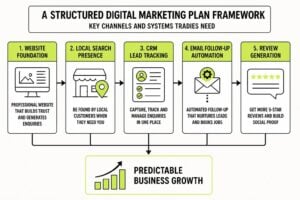
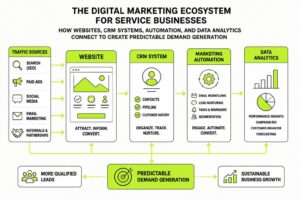
You need these components working together:
- Website that loads fast, looks credible, and makes conversion paths obvious
- CRM that captures every lead and tracks their journey through your content
- Email platform integrated with your CRM for automated nurture sequences
- Analytics that show which content and channels drive actual customers
- Forms and CTAs strategically placed in content to capture contact information
Without this infrastructure, you’re generating interest you can’t capture. Someone reads your article, finds it helpful, closes the tab, and forgets about you. Proper systems turn that reader into a tracked lead who enters a nurture sequence designed to build relationship until they’re ready to buy.
Building marketing systems isn’t glamorous, but it’s what allows your digital and content marketing to scale. When everything connects, each piece of content you create feeds your automation. Each ad campaign you run adds qualified leads to your database. Each email you send moves prospects closer to conversion.
Data You Actually Need to Track
| Metric | What It Tells You | Why It Matters |
|---|---|---|
| Traffic sources | Where your audience finds you | Guides channel investment |
| Content engagement | What topics and formats resonate | Informs content strategy |
| Lead source | Which channels drive qualified leads | Shows true ROI by channel |
| Conversion rate by source | Quality of traffic from each channel | Reveals where to double down |
| Customer acquisition cost | Total spend to acquire a customer | Determines campaign profitability |
| Lifetime value by source | Long-term value of customers from each channel | Strategic channel prioritization |
Most businesses track vanity metrics like page views and social followers. Those numbers feel good but don’t predict revenue. Track what matters: leads, customers, and the paths they took to become customers.
Understanding authoritative sources in content marketing helps you build credibility that translates to conversions. When your content cites data, references industry research, and demonstrates expertise, trust builds faster and objections decrease.
Content Formats That Drive Demand
Not all content serves the same purpose. Strategic businesses use different formats for different outcomes.
Long-Form Guides and Resources
Comprehensive guides (2000+ words) that fully address a topic serve multiple purposes:
- Rank for competitive keywords by demonstrating expertise
- Capture email addresses in exchange for PDF versions
- Position your business as knowledgeable and thorough
- Generate backlinks from others who reference your research
These take time to produce but create assets that drive results for years. One well-researched guide often outperforms dozens of shallow blog posts.
Case Studies That Overcome Objections
Service businesses live and die on proof. Case studies show prospects exactly how you solve problems similar to theirs. Effective case studies include:
Specific numbers and outcomes rather than vague claims of improvement. “Increased qualified leads by 127% in 90 days” beats “helped them grow significantly.”
The process you followed so prospects understand your methodology and feel confident you can replicate results.
The client’s initial skepticism and how you addressed it, which helps prospects see their own objections being handled.
Publishing case studies as part of your digital and content marketing strategy creates social proof that supports every other channel. Your ads can reference them. Your email sequences can include them. Your sales team can send them.
Video and Visual Content
Not everyone wants to read. Video explanations, screen recordings showing your process, and visual breakdowns of complex topics reach different learning styles.
Video also creates repurposing opportunities. A 20-minute video becomes:
- Blog post transcript optimized for SEO
- 5-6 social media clips highlighting key points
- Audio podcast episode
- Email series expanding on each section
This is how you scale content production without scaling effort proportionally.
Making Digital and Content Marketing Work Together
The magic happens when these elements connect into a system that runs with minimal daily intervention.
Example workflow:
Someone searches for “marketing automation for consulting firms” and finds your comprehensive guide. The content answers their questions and positions automation as essential for growth. A strategically placed CTA offers a free audit or assessment. They provide their email.
Now they’re in your CRM. An automated sequence sends them:
- Day 1: The resource they requested
- Day 3: A case study showing results for a similar business
- Day 7: An article addressing common implementation concerns
- Day 14: An invitation to schedule a consultation
Meanwhile, retargeting ads keep your brand visible on other platforms. Your email signature links to relevant content. LinkedIn posts continue demonstrating expertise.
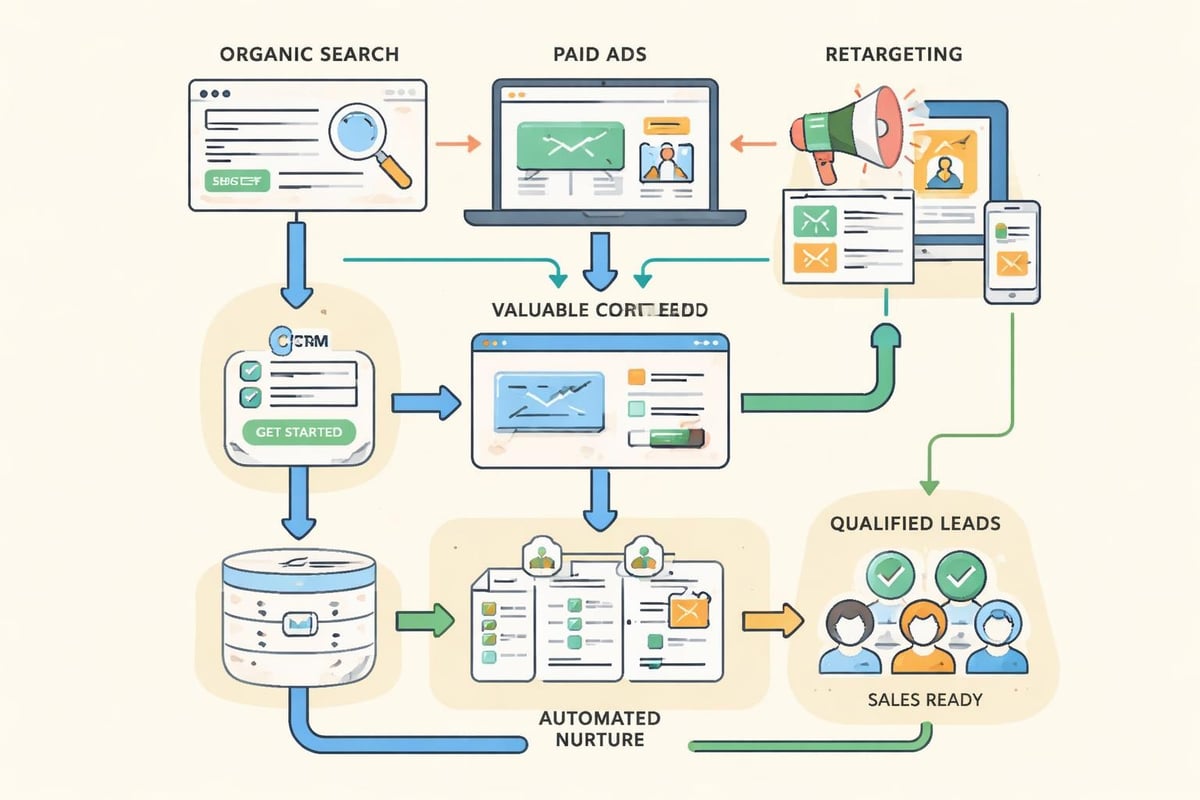
This isn’t complicated, but it requires everything working together. The content must be good enough to build trust. The technical systems must capture and route leads properly. The automation must deliver relevant messages at appropriate timing. The tracking must show what’s working.
Our approach to digital branding focuses on building these connected systems rather than running isolated campaigns that don’t compound.
Common Mistakes That Kill Results
Inconsistency destroys momentum. Publishing intensely for two months, then going silent for four, means starting from zero repeatedly. Better to commit to a sustainable pace you can maintain.
Ignoring the technical foundation limits what your content can achieve. Fast hosting, mobile optimization, proper analytics implementation, these aren’t optional extras. They’re requirements for digital and content marketing that actually performs.
Creating content for yourself rather than your audience wastes effort. You already know your industry terminology and assumptions. Your prospects don’t. Write for where they are, not where you wish they were.
Measuring the wrong things leads to bad decisions. Celebrate traffic growth if you want, but track leads and revenue. Those numbers fund your business.
Giving up too early because “content marketing doesn’t work.” It works, but not instantly. SEO takes months. Trust builds gradually. Systems require tuning. Businesses that succeed commit to the process long enough to see compounding results.
The evolution of digital marketing shows consistent patterns: tactics change, but strategy remains. Build trust, demonstrate competence, make buying easy, measure everything, improve continuously.
Infrastructure Before Volume
Most businesses think they need to create more content. What they actually need is better infrastructure to maximize the content they already have.
Before you commit to publishing weekly, ensure you have:
- Analytics showing which existing content drives leads
- Forms and CTAs converting visitors to contacts
- Email sequences nurturing those contacts toward conversion
- CRM tracking the journey from first touch to customer
- Regular review process improving what isn’t working
With that foundation, every piece of content you add feeds a system designed to convert. Without it, you’re just adding to the pile of content the internet doesn’t need.
Digital and content marketing works when it’s treated as connected systems rather than random tactics. The businesses that scale aren’t necessarily creating more content or running bigger ad campaigns. They’re building infrastructure that turns attention into demand, then into predictable revenue.
Digital and content marketing only creates predictable growth when all the pieces work together: content that builds trust, digital channels that drive traffic, and systems that capture and convert attention. If you’re tired of scattered tactics that don’t compound, MDO Digital builds the infrastructure that turns your marketing into a system that actually scales.