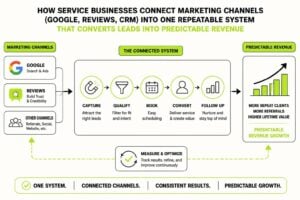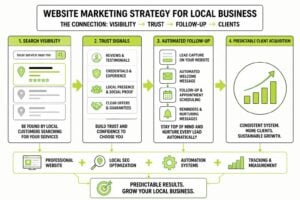
When you're choosing between platforms, the ghl vs hubspot gohighlevel vs hubspot debate matters more than ever. Both systems promise to centralise your marketing, manage leads, and automate follow-up. But they're built for different businesses, scaled differently, and priced in ways that can catch you off guard. If you're a service business trying to decide which CRM and marketing platform will actually help you grow without burning cash or needing a developer on retainer, this guide walks through what each does well, where they fall short, and how to pick the right one for your situation.
What Each Platform Actually Does
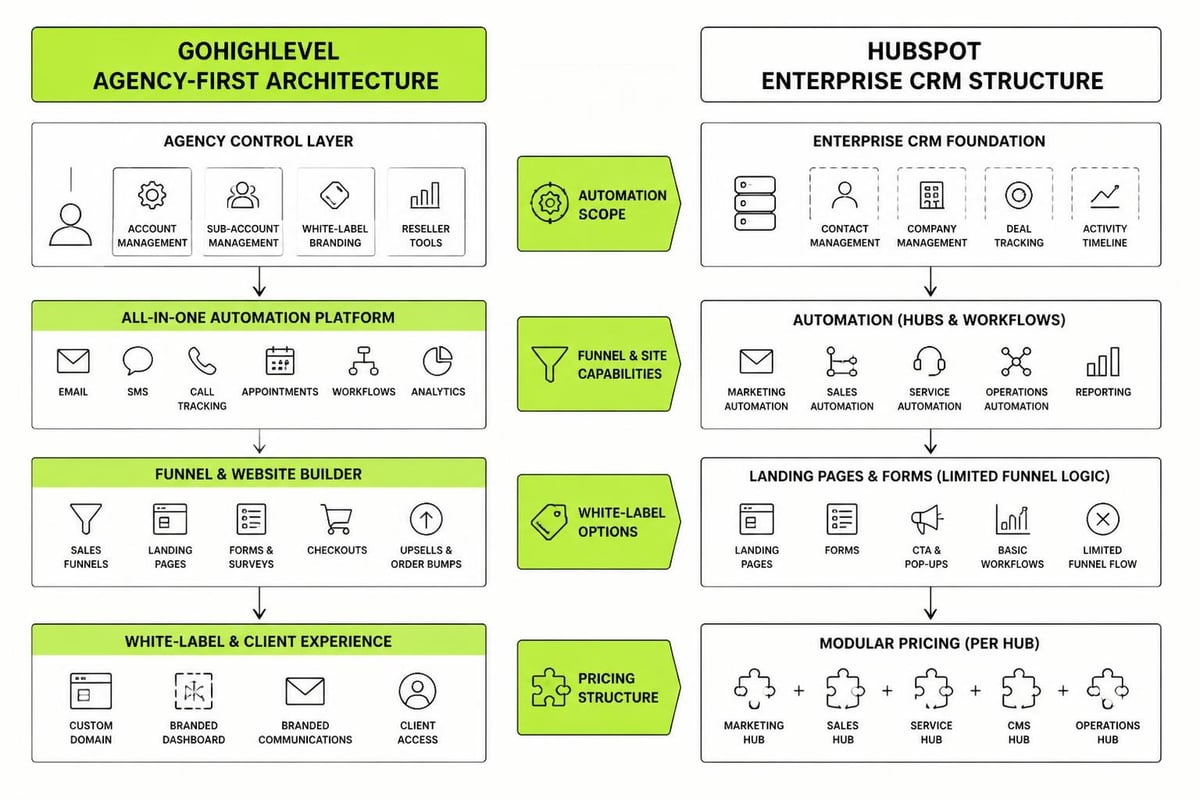
HubSpot started as an inbound marketing tool and grew into a full customer platform. It covers marketing automation, sales CRM, service tickets, content management, and reporting. It's modular, meaning you can start with free tools and add hubs as you grow. The appeal is breadth. Everything lives in one ecosystem, from your blog posts to your pipeline stages.
GoHighLevel (GHL) came from a different angle. It was built for marketing agencies who manage multiple clients and need white-label tools. Think landing pages, funnels, SMS campaigns, appointment booking, and client dashboards all under one roof. Over time, it's become popular with service businesses who want agency-grade automation without hiring an agency. The pitch is simplicity and speed, with most features included at a flat monthly rate.
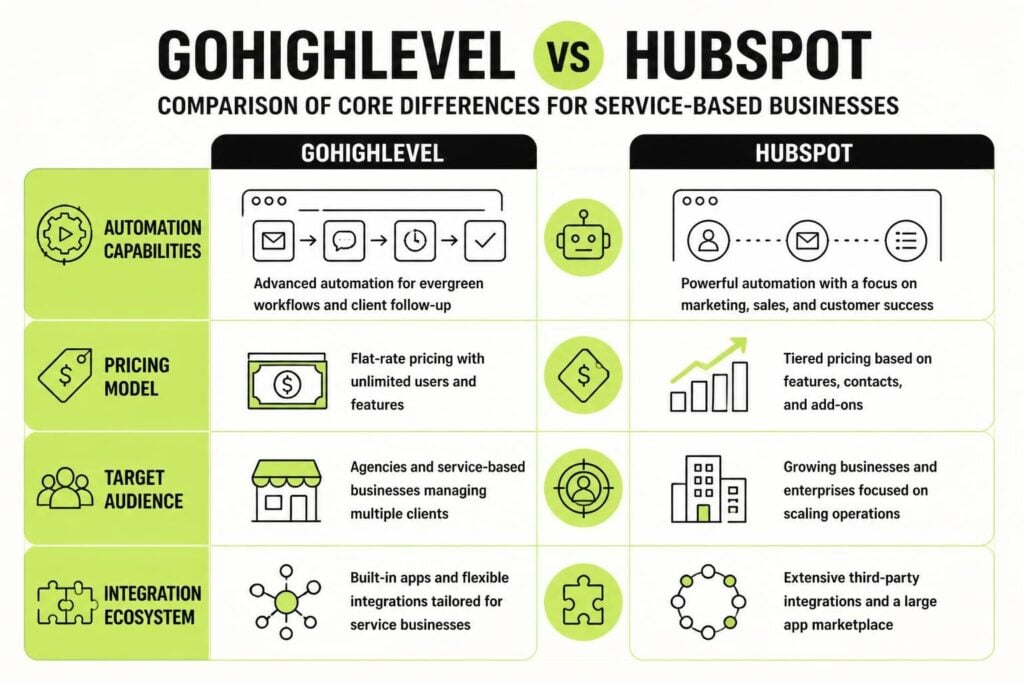
Target Audience and Design Philosophy
HubSpot is designed for companies that want to scale inbound marketing and align sales, marketing, and service teams. It assumes you'll have dedicated people managing campaigns, content, and data. The interface is polished, the reporting is deep, and the learning curve reflects that. It's a corporate tool that works for solo operators if they're willing to invest time.
GoHighLevel targets agencies, consultants, and service businesses who need to move fast. The builder is drag-and-drop, the templates are ready to deploy, and the assumption is you're wearing multiple hats. You're not hiring a marketing ops specialist. You're the one setting up the funnel on a Tuesday night. That difference in philosophy shows up everywhere, from onboarding to how features are bundled.
Features and Functionality Breakdown
Both platforms handle core CRM tasks (contact records, pipeline tracking, task management), but the details diverge quickly.
Marketing Automation and Campaigns
| Feature | HubSpot | GoHighLevel |
|---|---|---|
| Email campaigns | Advanced segmentation, A/B testing, reporting | Standard automation, templates, deliverability tools |
| SMS marketing | Add-on required, basic features | Native, included in base plans |
| Landing pages | Drag-and-drop, responsive, SEO tools | Funnel-focused, templates, fast setup |
| Workflows | Visual builder, complex logic, deep integrations | Simple triggers, actions, SMS/email focus |
| Forms and pop-ups | Native tools, progressive profiling | Built-in, appointment booking integrated |
HubSpot's workflows let you build intricate nurture sequences based on behaviour, list membership, lifecycle stage, and custom properties. You can trigger actions in connected apps, delay steps by days or weeks, and split paths based on engagement. It's powerful if you need that level of control.
GoHighLevel keeps workflows simpler but adds speed. You can spin up a text-based nurture campaign, book appointments through two-way SMS, and connect it to a pipeline in minutes. The trade-off is depth for velocity. For most service businesses, velocity wins.
Sales Pipeline and CRM
HubSpot's CRM is built for team selling. You get deal stages, forecasting, activity tracking, email templates, and sequences. The free tier is genuinely useful, and paid tiers add automation, predictive lead scoring, and custom reporting. It integrates tightly with Gmail, Outlook, and hundreds of third-party tools through Zapier, making it a hub (pun intended) for sales data.
GoHighLevel's pipeline is lighter but functional. You can track deals, assign tasks, and automate follow-up based on stage changes. It doesn't have the forecasting depth or the enterprise reporting, but it handles what a small service business actually needs: knowing where leads are, what's next, and whether follow-up happened.
Reporting and Analytics
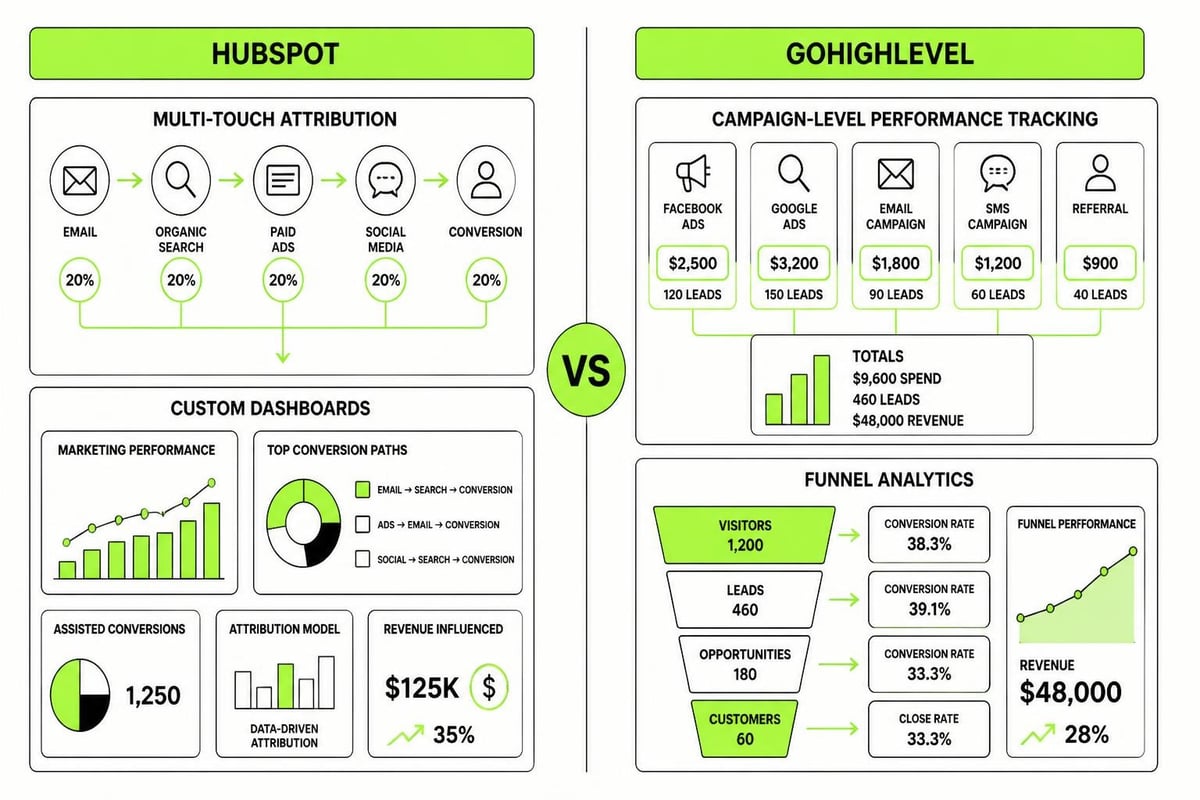
HubSpot gives you dashboards for everything. Campaign performance, attribution models, traffic sources, conversion paths, and revenue reports. The HubSpot developers documentation also shows how deeply you can customise and pull data via API. If you're making decisions based on multi-touch attribution or need to prove ROI to a board, HubSpot delivers.
GoHighLevel's reporting is straightforward. You see campaign stats, funnel performance, call logs, and SMS delivery. It's enough to optimise what's working and kill what's not. It won't satisfy a data analyst, but it won't overwhelm a plumber either.
Pricing Models and Total Cost
The ghl vs hubspot gohighlevel vs hubspot conversation gets heated when you look at what things actually cost.
HubSpot Pricing Structure
HubSpot's pricing is modular and scales with contacts and features. The CRM is free forever. Marketing Hub starts at $20/month for basic tools, but most service businesses need Professional ($890/month) or Enterprise ($3,600/month) to unlock workflows, A/B testing, and reporting. Add Sales Hub ($100 to $1,500/month) and Service Hub ($100 to $1,500/month) if you want the full platform. The HubSpot Marketing Hub pricing explainer breaks down how contact tiers and add-ons push costs higher as you grow.
You're also paying per user on higher tiers, and features like custom reporting, advanced automation, and predictive lead scoring sit behind paywalls. For a small team, you could be at $1,200/month within six months.
GoHighLevel Pricing Structure
GoHighLevel has two main plans: Agency Starter ($97/month) and Agency Unlimited ($297/month). The Starter plan covers most features but limits sub-accounts (used for clients or locations). Unlimited removes caps and adds white-label options. There are no contact limits, no user fees, and SMS/email are pay-as-you-go but affordable. For one location or business, you're at $97 to $297/month, full stop.
The simplicity is the point. You're not calculating seat fees or worrying about hitting a contact threshold that doubles your bill.
| Cost Factor | HubSpot | GoHighLevel |
|---|---|---|
| Entry price | Free (CRM only) to $20/month | $97/month (all features) |
| Mid-tier (useful features) | $890/month (Marketing Professional) | $97 to $297/month |
| Contact limits | Tiered pricing, scales with contacts | Unlimited |
| User fees | Yes, on Professional and Enterprise | No |
| SMS and calling | Add-on, extra cost | Pay-as-you-go, included infrastructure |
Integration and Extensibility
HubSpot's ecosystem is massive. It connects to Salesforce, Shopify, WordPress, Slack, Stripe, and thousands of apps through native integrations and Zapier. The HubSpot API is well-documented, and there's a marketplace of certified partners building custom integrations. If your stack is complex or you're in a niche that needs specific tools, HubSpot probably plays well with it.
GoHighLevel integrates with Zapier, Stripe, Google Calendar, and a handful of others. It's not as broad, but the built-in tools reduce the need for third-party apps. You're not bolting on an appointment scheduler or an SMS tool because they're already native. The trade-off is flexibility for simplicity. Most service businesses don't need 500 integrations. They need the six that matter to work without fuss.
Who Should Choose HubSpot
HubSpot makes sense if you're building a marketing team, need deep reporting, or want a platform that can grow with enterprise-level needs. It's ideal for B2B companies, SaaS, and anyone running complex inbound campaigns where attribution and multi-channel nurture matter. If you've got the budget and the people to manage it, HubSpot is a solid long-term play.
It also suits businesses that already have a content engine. If you're publishing blog posts, running webinars, and nurturing leads over months, HubSpot's CMS, SEO tools, and email workflows shine. The platform assumes you're doing inbound the way HubSpot teaches it, and if you are, the features align.
Who Should Choose GoHighLevel
GoHighLevel fits service businesses that need speed, simplicity, and all-in-one functionality without a big team. Trades, home services, consultants, coaches, and agencies managing multiple clients get the most value. If your sales cycle is short, you rely on calls and texts more than email nurture, and you need to book appointments fast, GoHighLevel is built for that.
A recent GoHighLevel review from PlainlyReviewed highlights its strengths for agencies and small teams who want agency-grade tools without enterprise complexity. The white-label options also make it a smart choice if you're offering marketing services under your own brand.
If you're a service business looking to remove chaos, protect leads, and build a repeatable marketing system, GoHighLevel's speed-to-value is hard to beat.
For businesses ready to move on GoHighLevel, you can sign up here and get started with a trial.
The Middle Ground: When Hybrid or Niche Tools Win
Not every business fits neatly into HubSpot or GoHighLevel. Some need HubSpot's reporting but can't justify the cost. Others want GoHighLevel's simplicity but need better email deliverability or CRM depth. That's when hybrid stacks or niche platforms come into play.
You might run GoHighLevel for funnels and SMS, but use a tool like ActiveCampaign for email automation. Or keep HubSpot's free CRM and bolt on cheaper marketing tools. The Techoble overview of SaaS marketing-automation platforms shows how crowded the space is in 2026, and how many businesses are mixing tools to get what they need without overpaying.
The downside is integration headaches and data silos. Every extra tool is another login, another subscription, and another place where leads can slip through. That's the tax you pay for flexibility.
Common Mistakes When Choosing Between Platforms
Overbuying Features You Won't Use
HubSpot's Professional tier includes features most small businesses never touch. If you're not running A/B tests, building custom reports, or managing a content library, you're paying for unused seats at the table. GoHighLevel's flat pricing removes that temptation, but some users still sign up for Unlimited when Starter would do.
Buy for what you'll use in the next 90 days, not what you might need in two years.
Ignoring Migration and Setup Costs
Switching platforms takes time and often requires help. Migrating contacts, rebuilding automations, retraining your team, and testing everything before going live can take weeks. HubSpot's onboarding is more involved because there's more to configure. GoHighLevel is faster to launch but still needs thought around funnel structure and messaging.
Budget for setup, not just subscription fees.
Choosing Based on Brand, Not Fit
HubSpot has the brand. It's trusted, widely adopted, and backed by Forrester research on marketing-automation trends. That doesn't mean it's the right fit for a solo electrician or a three-person consultancy. GoHighLevel doesn't have the same shine, but it solves the problems service businesses actually face.
Don't buy the logo. Buy the tool that fits your workflow.
Real-World Use Cases
Home Services Business
A plumbing company needs to capture leads from Google ads, follow up via text within five minutes, book appointments, send reminders, and track which jobs close. GoHighLevel handles this end-to-end with SMS automation, calendar booking, and pipeline tracking. HubSpot could do it, but you'd need add-ons for SMS, a third-party booking tool, and a higher-tier plan for workflows. The cost and complexity don't match the need.
For trades and service businesses where speed and contact matter more than nurture, GoHighLevel is the obvious pick.
B2B Consultancy
A consultancy selling $50k engagements runs webinars, publishes case studies, and nurtures leads over 60 to 90 days. They need email workflows, lead scoring, content management, and reporting to show which channels drive revenue. HubSpot's Marketing and Sales Hubs give them the tools to track every touchpoint, score engagement, and hand warm leads to sales with full context. GoHighLevel's lighter CRM and reporting wouldn't support that level of detail.
Marketing Agency Managing 20 Clients
An agency needs separate dashboards, funnels, and automations for each client, all under the agency's branding. GoHighLevel's white-label sub-accounts make this easy at $297/month. HubSpot would require individual portals per client at $890+ each. The math is simple.
What's Changed in 2026
Both platforms have evolved. HubSpot added more AI features, including content generation, predictive analytics, and smarter segmentation. The HubSpot blog on pricing also notes they've introduced more flexible contact tiers to reduce surprise bills, though high-growth businesses still hit limits fast.
GoHighLevel rolled out better email deliverability, expanded integrations, and improved its mobile app. It's still primarily an agency tool, but the feature set now competes with platforms that cost five times as much. The gap between "agency tool" and "small business CRM" is narrowing.
The broader trend, covered in Databox’s attribution report, is that businesses care less about perfect attribution and more about speed to lead, response time, and conversion rate. That shift favours platforms like GoHighLevel that prioritise action over analysis.
Making the Decision
The ghl vs hubspot gohighlevel vs hubspot choice comes down to a few questions:
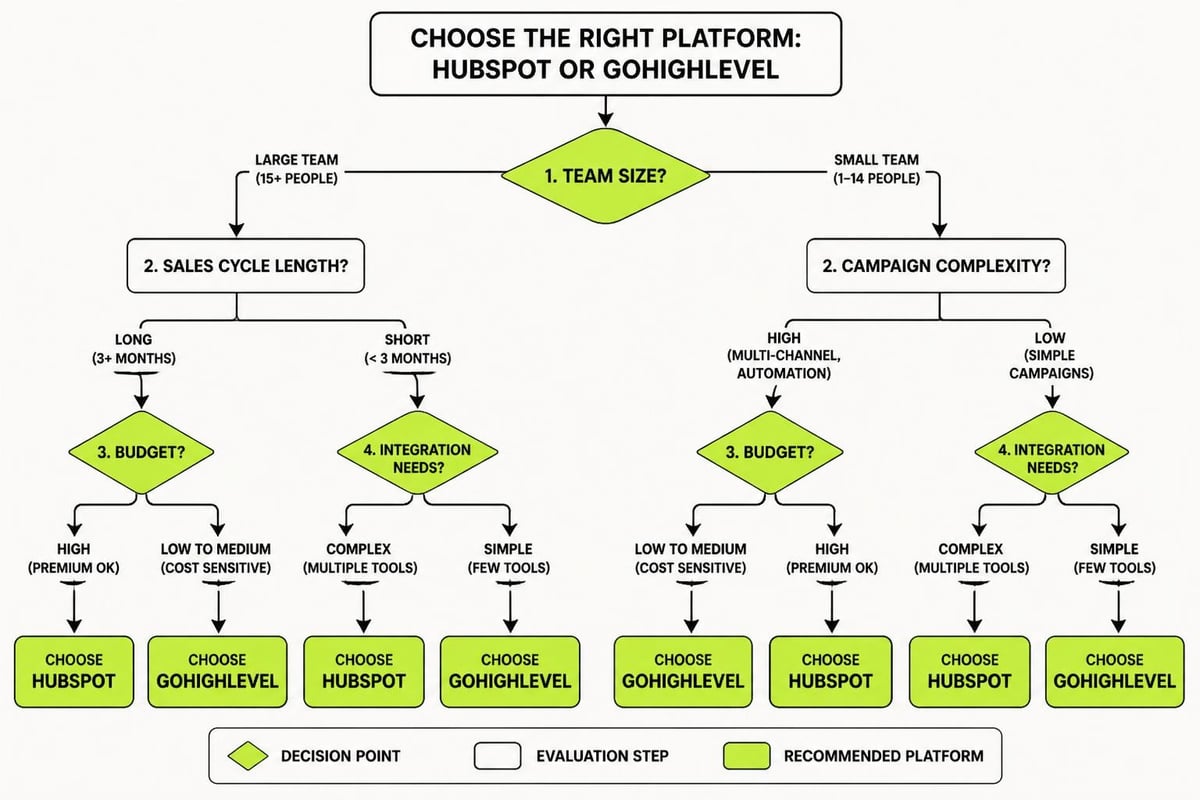
- How complex is your sales process? Long B2B cycles favour HubSpot. Short service-based cycles favour GoHighLevel.
- What's your budget? Under $500/month points to GoHighLevel. Over $1,000/month with a team points to HubSpot.
- Do you need deep reporting or fast execution? Reporting: HubSpot. Execution: GoHighLevel.
- Is your team technical? HubSpot assumes some technical skill or a dedicated person. GoHighLevel assumes you're doing it yourself.
- What's your integration footprint? Big, complex stack: HubSpot. Streamlined, all-in-one: GoHighLevel.
Neither platform is bad. They're just built for different buyers. If you're still unsure, trial both. HubSpot offers free CRM access and trial periods on paid hubs. GoHighLevel offers a 14-day trial. Spend a week building a funnel, setting up automation, and seeing which one feels like it removes friction instead of adding it.
Why This Matters for Service Businesses
Most service businesses don't fail because they lack features. They fail because leads slip through, follow-up doesn't happen, and there's no system to convert attention into appointments. Both HubSpot and GoHighLevel can solve that, but only if they match how you actually work.
At MDO Digital, we see businesses choose platforms based on hype or what their competitor uses, then struggle because the tool doesn't fit their rhythm. The best CRM is the one you'll actually use, that your team will adopt, and that makes follow-up automatic instead of aspirational.
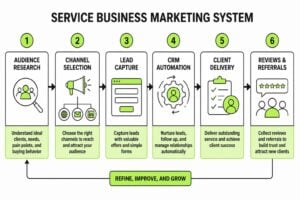
If you're running a service business and need help designing a marketing system that turns leads into predictable demand, the platform is just one piece. The structure around it, the messaging, the follow-up cadence, and the funnel all matter more than whether you picked HubSpot or GoHighLevel.
The ghl vs hubspot gohighlevel vs hubspot debate isn't about finding a universal winner. It's about choosing the platform that fits your business model, budget, and team. If you need help building a CRM and automation system that protects leads and removes chaos, we specialise in exactly that. We'll help you pick the right tools, build the infrastructure, and create a marketing system that compounds over time. Get in touch with MDO Digital and let's build something that works.