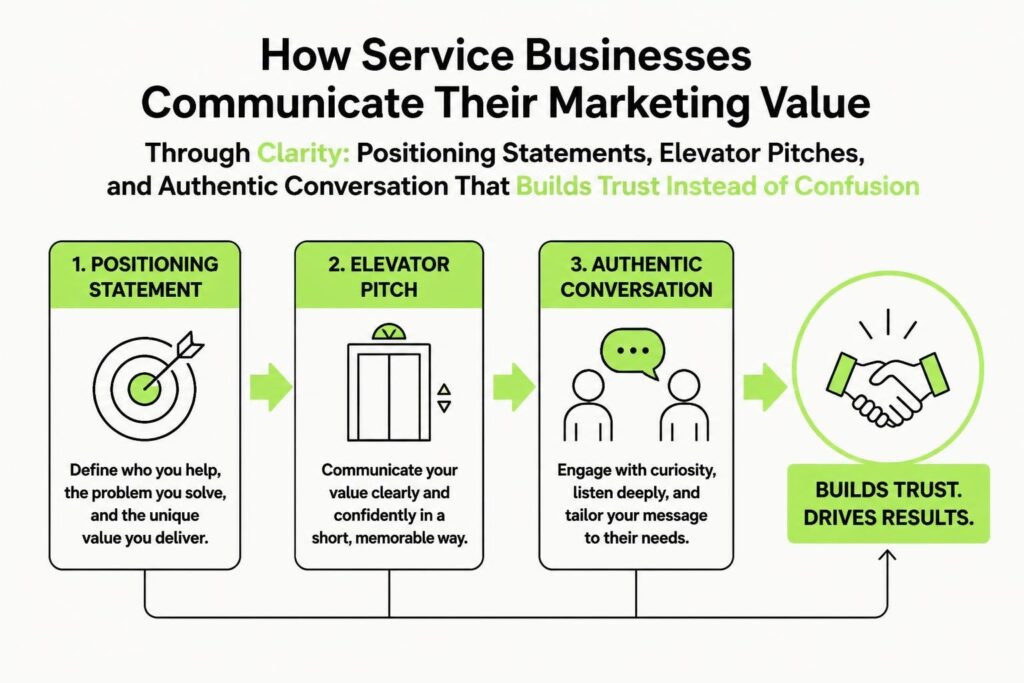
The question "marketing what do you do" comes up more often than you'd think. At a networking event, on a sales call, or even at a family barbecue, people want to know what you actually do all day. The trouble is, most marketing professionals fumble the answer. They either oversimplify to the point of meaninglessness or overcomplicate things with jargon that makes eyes glaze over. Getting this right matters because how you answer shapes whether people understand your value, refer you to others, or dismiss you as just another person who "does social media."
Why Answering "Marketing What Do You Do" Is Harder Than It Should Be
Marketing covers an absurdly wide territory. You could be running paid ads, building websites, writing copy, managing automation systems, creating content, or any combination of the above. The scope of marketing roles has expanded dramatically over the past decade, making it genuinely difficult to pin down what any one marketer actually does.
The challenge gets worse when your audience doesn't work in marketing. To them, marketing might mean billboards, Super Bowl ads, or spammy emails. They don't necessarily understand CRM infrastructure, conversion funnels, or demand generation. Bridging that gap without sounding condescending or vague is the real skill.
Here's what usually goes wrong:
- Too broad: "I help businesses grow" tells them nothing
- Too technical: "I optimise multi-touch attribution models" loses them immediately
- Too modest: "I just do some social media stuff" undersells your expertise
- Too salesy: Launching into a pitch before they've asked makes it awkward
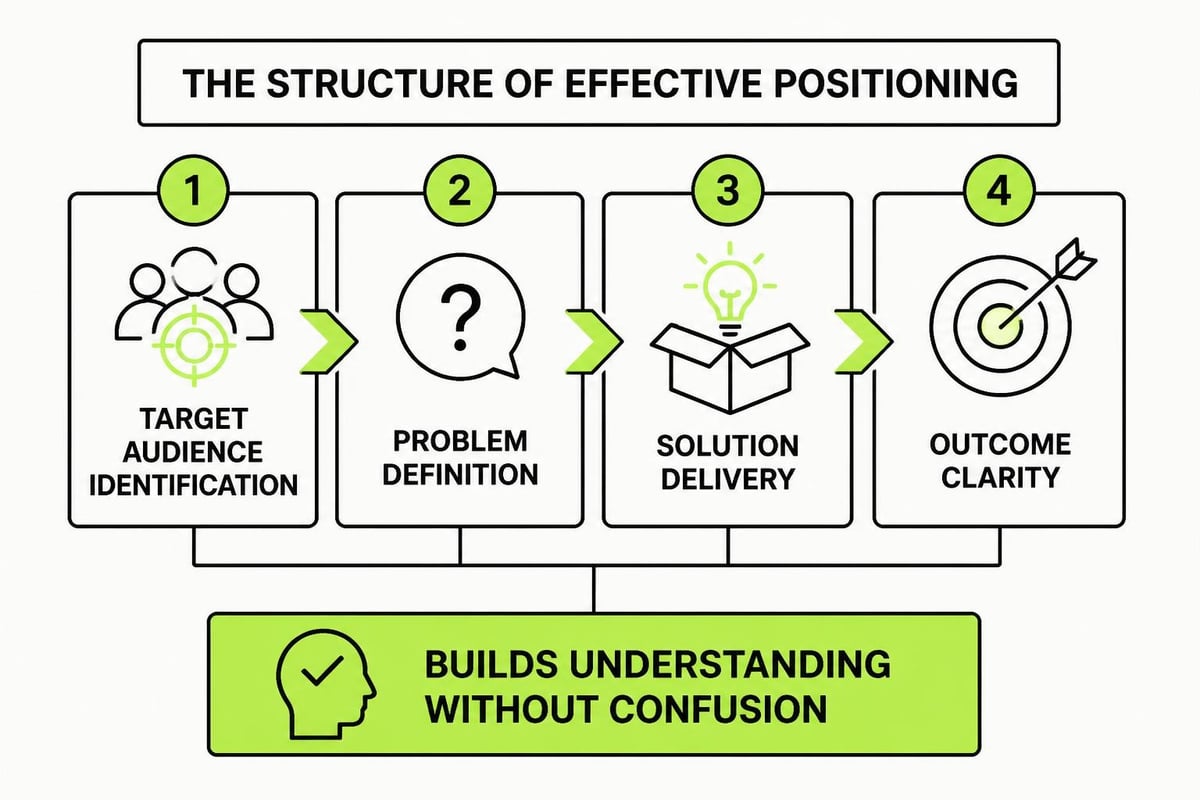
The best answer depends on context, but the underlying structure stays consistent. You need to communicate who you help, what problem you solve, and how you solve it without requiring a marketing degree to understand.
The Framework: Three Layers of Answering "Marketing What Do You Do"
Most situations call for one of three response levels. Think of them as gears. First gear for casual encounters, second for interested prospects, third for serious conversations.
First Gear: The Cocktail Party Answer
This is your 10-second version. Clear, memorable, human. Not a slogan, just a straightforward explanation someone can repeat to others.
Structure: "I help [specific audience] [achieve specific outcome] through [your method]."
Examples:
- "I help service businesses turn website traffic into booked appointments through automation and nurture campaigns"
- "I help SaaS companies get predictable leads from content instead of relying on paid ads"
- "I help coaches clarify their message so the right clients find them and actually book calls"
Notice what these don't include: buzzwords, technical terms, or anything requiring follow-up questions to understand. Your mum should get it. So should a potential client at a barbecue.
Second Gear: The Interested Prospect Answer
Someone's asked a follow-up question. They want to know more. Now you can add one layer of specificity about how you do it.
This is where you mention your process, tools, or methodology, but only after establishing the outcome. People care about results first, methods second.
Example expansion:
"I help service businesses turn traffic into appointments. Most businesses leak leads because they don't have a system to follow up. I build CRM infrastructure and email automation that nurtures people until they're ready to buy. It's not flashy, but it stops revenue from slipping through the cracks."
You've added:
- The specific problem (leaking leads)
- Your tools (CRM and automation)
- The philosophy (systematic, not flashy)
Still accessible. Still grounded in outcomes. Just one level deeper.
Third Gear: The Deep Dive Answer
This happens in actual sales conversations or when someone's genuinely curious about your craft. Here you can talk shop. Discuss strategy, share case studies, get into the weeds of your approach.
But even here, structure matters. Don't just brain-dump everything you know about digital marketing. Walk them through a logical progression:
- Diagnosis: What you look for when assessing a business
- Strategy: How you decide what to build
- Execution: What you actually implement
- Measurement: How you track whether it's working
This framework keeps you organised and helps them follow along. It also positions you as someone who thinks systematically, not just throws tactics at walls.
Common Scenarios and How to Handle Them
| Situation | Response Strategy | Key Points to Hit |
|---|---|---|
| Networking event | First gear + one specific example | Who you help, memorable outcome |
| Family gathering | First gear, avoid all jargon | Simple comparison to something they know |
| Sales discovery call | Second gear → third gear as they engage | Lead with their problem, not your process |
| LinkedIn message | Second gear in writing | Concise, specific, outcome-focused |
| Podcast interview | Third gear with storytelling | Share frameworks and real examples |
The mistake most people make is using the same answer everywhere. Context dictates depth. Read the room.
What Not to Say When Someone Asks "Marketing What Do You Do"
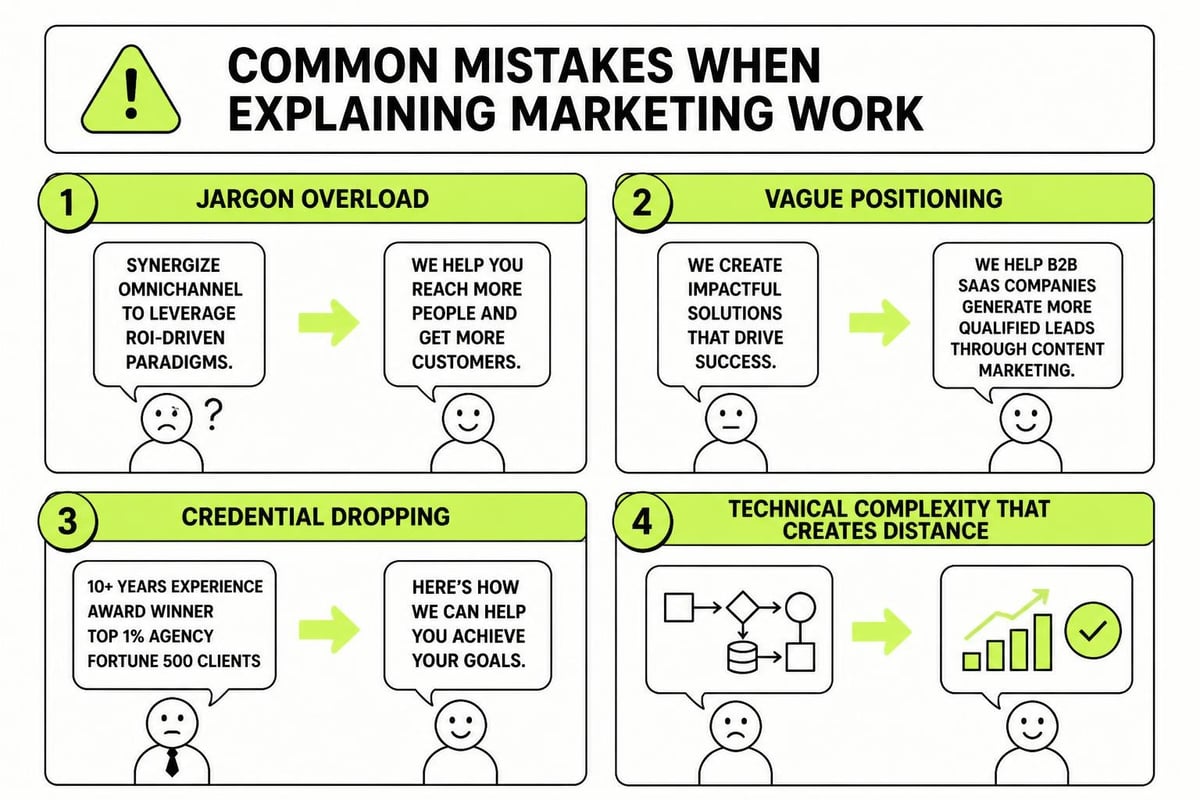
Some answers are worse than saying nothing. They create confusion, distrust, or instant dismissal. Here's what to avoid.
"I'm a marketing guru/ninja/wizard"
Instant credibility loss. These terms signal insecurity masked as confidence. Professionals don't need fantasy job titles.
"I do everything"
This tells potential clients you specialise in nothing. Even if you're capable across multiple channels, pick the thing you're best at and lead with that.
"It's complicated"
If you can't explain it simply, you probably don't understand it well enough yet. Complexity is often a hiding place for unclear thinking.
A job title with no context
"I'm a marketing automation specialist" means nothing to most people. Always translate titles into outcomes.
Jargon soup
"I leverage synergistic multi-channel touchpoints to optimise the customer journey and drive engagement metrics." Nobody talks like this in real life. Don't start now.
Building Your Personal Answer to "Marketing What Do You Do"
Let's workshop this properly. Grab a piece of paper or open a doc. Answer these questions honestly:
- Who do you primarily work with? (Industry, size, stage, or problem)
- What's the main problem they face that you solve? (One sentence)
- What do you build or implement to solve it? (Systems, campaigns, content, strategy)
- What outcome do they get? (More leads? Better conversions? Time saved?)
Now construct your first-gear answer:
"I help [answer to #1] [answer to #4] by [answer to #3], which solves [answer to #2]."
Edit ruthlessly. Remove filler words. Cut anything that sounds like marketing speak. Read it aloud. If it sounds unnatural, simplify further.
For your second-gear answer, add:
- One specific method or tool you use
- Why that method matters (the insight most people miss)
- A brief example or stat if you have one handy
Don't write a script. Just get clear on the core structure so you can adapt naturally in conversation.
The Role of Clarity in Marketing Success
Here's something most people miss: how you answer "marketing what do you do" directly reflects the clarity of your business and marketing positioning overall. If you can't articulate your value in simple terms, your website probably can't either. Neither can your proposals, your case studies, or your sales conversations.
Clarity compounds. When you're clear about what you do, several things happen:
- Better referrals: People can actually explain what you do to others
- Qualified leads: The right people reach out because they understand if you're a fit
- Easier sales: You're not fighting confusion, just objections
- Stronger positioning: You own a specific space in people's minds
This applies whether you're an independent consultant or part of an agency. Understanding different marketing career paths helps, but what matters more is being able to articulate your specific lane within that landscape.
Many service businesses struggle with this exact problem. They know they need marketing, but they can't explain what kind or why. That's where a structured approach helps. The 7-Step Marketing Plan breaks down the entire marketing system into clear, sequential steps that anyone can understand and implement, from setting goals to generating referrals.

Adapting Your Answer for Different Audiences
Not everyone needs the same level of detail. Here's how to adjust based on who's asking.
Fellow Marketers
You can get tactical. Discuss channels, tools, strategies. They understand the context. But still lead with outcomes. Even marketers care more about what works than what sounds impressive.
Business Owners (Your Ideal Clients)
Focus entirely on problems and results. They don't care about your tech stack. They care about whether you can help them grow without adding chaos. Speak to their pain points: wasted ad spend, inconsistent leads, complicated systems that nobody uses.
People Outside Business Entirely
Use analogies. "You know how most businesses have no idea where their customers come from? I build the tracking systems that show them exactly what's working." Or: "I'm like a plumber for marketing. When leads are leaking, I find the gaps and fix them."
Technical Stakeholders (Developers, Data Analysts)
Here you can discuss integration, data structure, and technical requirements. But still frame it around business outcomes. They respect technical competence, but they also need to understand why it matters.
Making Your Answer Memorable
People forget most of what they hear within minutes. If you want your answer to stick, you need a hook. Not a gimmick, just something that creates a mental anchor.
Use specific numbers: "I help businesses recover the 70% of leads that usually fall through the cracks" is more memorable than "I help with lead nurture."
Paint a before/after: "Most of my clients were manually following up with spreadsheets. Now it's automated and nothing gets missed."
Name the enemy: "I help service businesses escape the feast-or-famine cycle" positions you against a clear problem.
Tell a micro-story: "A client came to me spending $10k a month on ads with no idea which ones worked. We built proper tracking and cut their spend in half while doubling leads."
These techniques work because they're concrete. Abstract descriptions fade. Specific images stick.
The Connection Between Personal Clarity and Marketing Systems
When you can clearly answer "marketing what do you do," you're actually demonstrating the same skill your clients need. They need to articulate their value clearly too. Your ability to do this for yourself proves you can do it for them.
This is why branding and advertising work hand in hand. Your brand is what you stand for. Your advertising is how you communicate it. If the brand's unclear, the advertising becomes noise.
The same applies to your personal positioning. If you can't distill what you do into a clear statement, you're asking prospects to do mental work they won't bother with. They'll move on to someone who makes it easy.
Strong marketing systems start with clarity about who you serve and what you deliver. Everything else builds from there: your website, your automation, your content, your ads. Remove the confusion at the foundation and everything else gets simpler.
Skills That Support Better Answers
Being able to answer "marketing what do you do" well requires more than just wordsmithing. It draws on several underlying skills worth developing:
Active listening: Pay attention to what prompts the question. Are they making small talk or genuinely curious? Tailor accordingly.
Empathy: Understand what your audience cares about and what confuses them. Meet them where they are.
Storytelling: Not fake marketing stories, just the ability to illustrate a point with a real example.
Self-awareness: Know what you're actually good at versus what you think sounds impressive.
Editing: The ability to cut unnecessary words and get to the point faster.
These skills also make you better at your actual marketing work. Research into marketing skill requirements shows that communication clarity consistently ranks among the most valued capabilities across all marketing roles.
Testing and Refining Your Answer
You won't nail this on the first try. That's fine. Treat it like any other marketing asset: test, measure, refine.
Pay attention to reactions when you answer. Do people:
- Ask follow-up questions? (Good sign they're engaged)
- Nod and change subjects? (You lost them or weren't interesting)
- Say "Oh, that's cool" with no emotion? (Too vague or expected)
- Immediately think of someone to refer? (You've nailed it)
Record yourself answering the question. Listen back. Note where you hesitate, use filler words, or lose momentum. Those are the spots to tighten.
Try different versions in low-stakes situations. See which explanations land and which fall flat. Keep what works, drop what doesn't.
The goal isn't a perfect script. It's a solid framework you can adapt naturally based on context. You should be able to give a clear answer whether you're caught off guard at the shops or prepared for a podcast interview.
Industry-Specific Variations
The approach stays consistent, but the content changes based on what kind of marketing you do. Here's how different specialties might answer "marketing what do you do."
Content Marketing
"I help SaaS companies become the trusted answer in their space through strategic content. Instead of fighting for attention with ads, we build authority that attracts the right people."
Marketing Automation
"I help service businesses stop losing leads in the follow-up gap. We build systems that nurture people automatically until they're ready to buy."
Brand Strategy
"I help businesses clarify exactly what they stand for so their marketing actually connects instead of just adding to the noise."
Paid Advertising
"I help online retailers scale profitably with paid ads. We focus on the numbers: cost per customer, lifetime value, and return on spend."
Notice each version includes:
- Specific audience
- Clear problem
- Concrete outcome
- Distinguishing approach
That structure works across all marketing disciplines. The details change, but the framework holds.
Beyond the Initial Answer
Once you've answered clearly, be ready for the natural follow-up: "How's that going for you?" or "Is there much demand for that?"
This is where you can share a quick win, mention client types you work with, or note a trend you're seeing. Keep it conversational. You're not pitching, you're just talking shop with someone who showed interest.
If they're a potential fit, this naturally opens the door to deeper conversation. If not, you've still planted a clear seed about what you do that they can share with others.
The best networkers don't treat every conversation as a sales opportunity. They focus on being clear, helpful, and memorable. The business follows from that foundation.
Getting clear on "marketing what do you do" isn't just about having a better elevator pitch. It's about understanding your own value well enough to communicate it simply. That same clarity should run through your entire marketing system, from how you position yourself to how you deliver results. If you're building a service business and need help creating that clarity alongside the systems that convert it into predictable demand, MDO Digital specialises in exactly that: removing chaos, protecting leads, and building structured growth that actually compounds.