Online marketing has shifted from a nice-to-have to the primary way service businesses find and qualify clients. But the landscape in 2026 looks different than it did even two years ago. Platforms change their algorithms weekly, AI is rewriting content creation, and buyers are more skeptical than ever. The businesses that win aren't chasing every new tactic. They're building systems that turn attention into predictable demand, regardless of which channel is flavour of the month.
What Online Marketing Actually Means Now
The term gets thrown around loosely, but online marketing is simply the process of using digital channels to attract, convert, and retain customers. That includes everything from search engines and social platforms to email, paid ads, and your website.
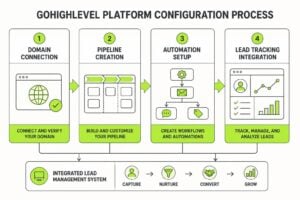
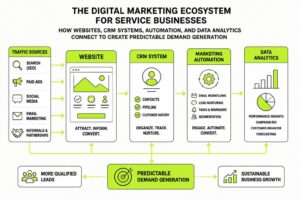
What matters in 2026 is integration. A Facebook ad without a landing page is wasted spend. A beautiful website without traffic is a digital brochure. A CRM without automation is just an expensive spreadsheet. The businesses getting results treat online marketing as a connected system, not a collection of random tactics.
The Channels That Still Matter
Not every platform deserves your time. Here's where service businesses should focus:
- Search (Google): Still the highest-intent traffic you can get. Someone searching for "accounting services Melbourne" is ready to buy.
- LinkedIn: For B2B, it's the only social platform worth serious effort. Organic reach has dropped, but paid targeting is sharp.
- Email: The channel you own. No algorithm changes, no platform risk. Direct access to people who've said yes to hearing from you.
- Paid Search & Display: When done right, these generate leads faster than anything organic. But they require proper tracking and a clear funnel.
- YouTube: Video content still cuts through, especially for educational or demonstration-heavy services.
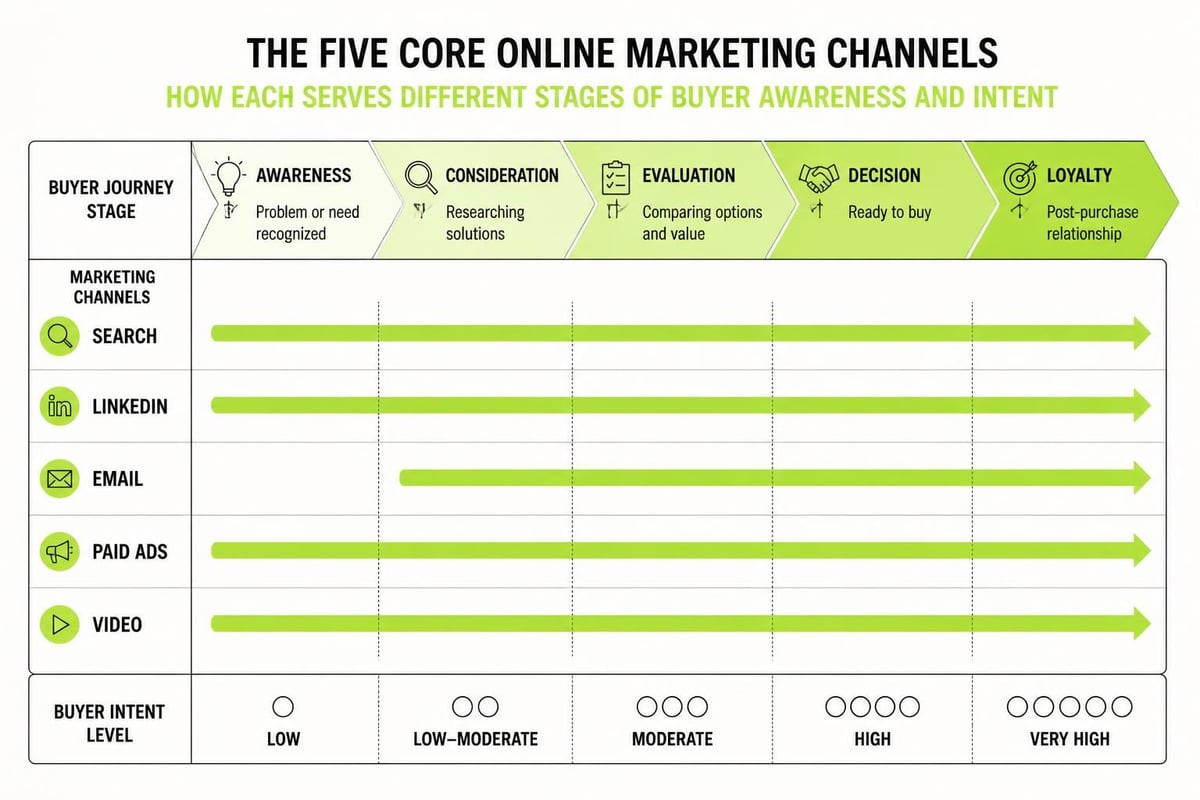
Skip TikTok unless your buyers are under 30. Skip Twitter unless you're building a personal brand. Skip Instagram unless you're visually led. Focus beats spread every time.
Building Systems Instead of Running Campaigns
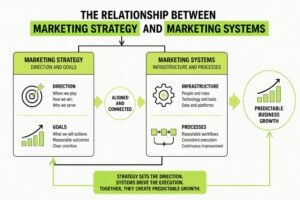
Most businesses approach online marketing like a series of one-off campaigns. Launch something, see what happens, move on. That creates chaos and makes it impossible to predict what's working.
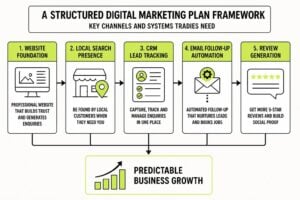
A system approach means every piece connects. Here's how that looks in practice:
| System Component | What It Does | Why It Matters |
|---|---|---|
| Traffic source | Brings visitors to your site | Predictable volume |
| Landing page | Captures contact info | Converts traffic to leads |
| CRM | Stores and segments leads | Prevents lead leakage |
| Nurture sequence | Builds trust over time | Converts interest to sales |
| Measurement | Tracks what's working | Guides budget decisions |
When these five pieces work together, you stop guessing. You know exactly how much a lead costs, how many convert, and what your return looks like. That's when marketing and business development start compounding instead of just consuming budget.
The Role of Automation
Automation isn't about being lazy. It's about being consistent at scale. A good automation system does three things:
- Responds instantly: When someone fills a form, they get an immediate reply. Not tomorrow. Not when you remember.
- Qualifies leads: Not every enquiry is ready to buy. Automation asks the right questions and routes people appropriately.
- Maintains momentum: A seven-email nurture sequence sent over 30 days keeps you front of mind without manual effort.
The trick is making automation feel human. Templates are fine. Robotic language isn't. Write like you'd talk to someone at a café, then let the system send it at the right time.
Content That Actually Converts
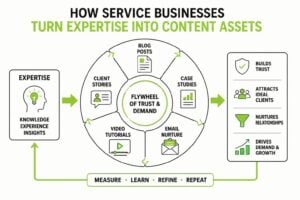
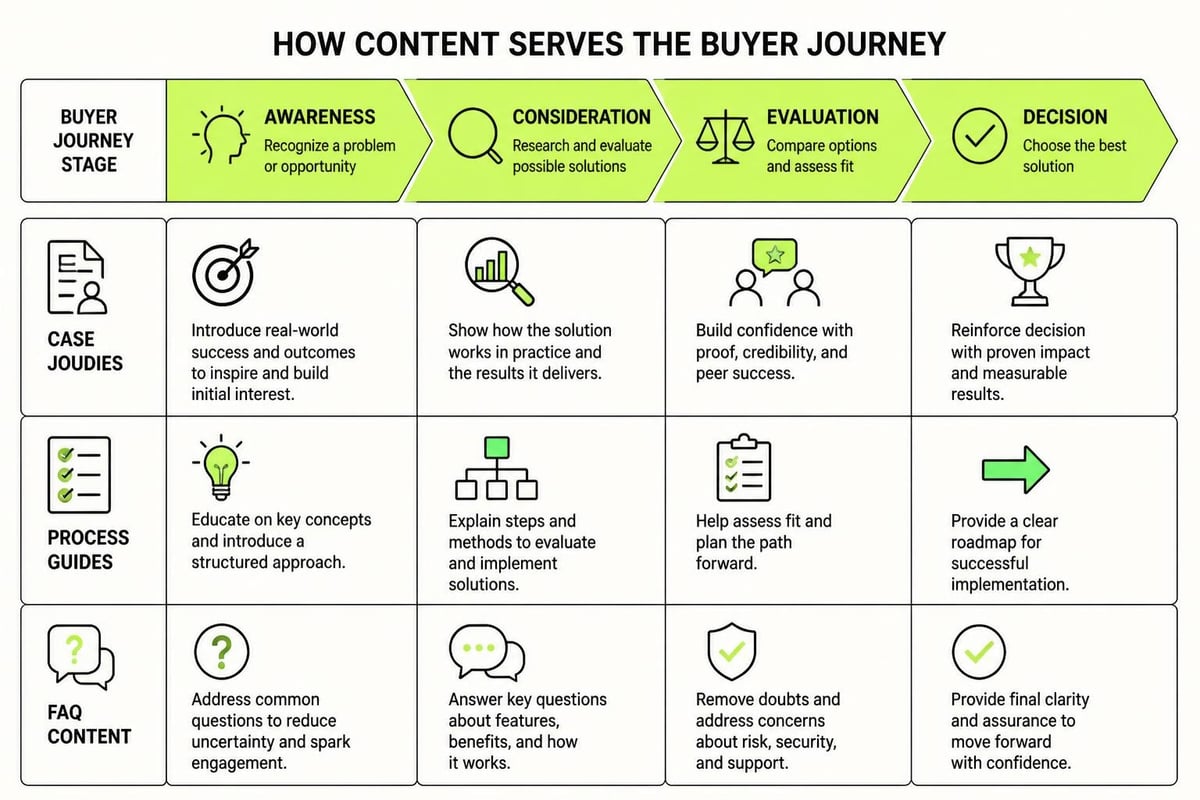
Content marketing has been oversold and misunderstood. You don't need a blog post every day. You don't need to go viral. You need content that moves people from awareness to decision.
That means matching content to intent. Someone searching "what is brand strategy" needs education. Someone searching "brand strategy agency Melbourne" needs proof and a clear next step. Different content for different stages.
High-converting content types for service businesses:
- Case studies: Show how you've solved the exact problem your prospect has
- Process guides: Demystify what working with you looks like
- Comparison content: Help buyers understand their options (including you)
- FAQs that address objections: Price, timing, results, risk
According to HubSpot’s marketing statistics, buyers consume an average of 11 pieces of content before making a purchase decision. Your job is to make sure some of that content comes from you, not just your competitors.
SEO Isn't Optional
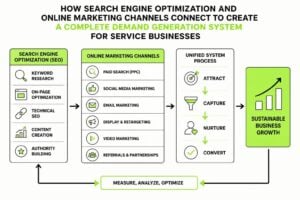
Search still drives the most qualified traffic for service businesses. But SEO in 2026 requires more than stuffing keywords into a page. Google's algorithms now prioritise experience, expertise, authority, and trust. That means real content from real people who know their subject.
The basics still apply. Fast site, mobile-friendly design, clean structure, proper headings. But the difference-maker is depth. Thin content doesn't rank anymore. A 300-word page about "branding services" will lose to a 2,000-word guide that actually helps someone make a decision.
Tools like those listed in TechRadar’s best link building tools can help you understand your backlink profile and identify opportunities, but the real work is creating content worth linking to in the first place.
Paid Advertising Without Burning Cash
Organic reach takes time. Paid ads buy speed. But most service businesses waste money on paid because they skip the fundamentals.
Before you spend a dollar on ads:
- Know your customer acquisition cost (CAC) and lifetime value (LTV)
- Have a landing page built specifically for the ad, not your homepage
- Set up conversion tracking properly (pixels, tags, events)
- Write copy that speaks to a specific problem, not generic benefits
- Start small, test, then scale what works
Google Ads and LinkedIn Ads work differently. Google catches people searching for a solution. LinkedIn interrupts people who match your targeting. Both can work, but the approach differs.
Testing and Iteration
No ad works perfectly from day one. You need to test headlines, images, targeting, and offers. Run A/B tests, but only change one variable at a time. Otherwise you won't know what shifted performance.
Track these metrics:
| Metric | What It Tells You | Target Range |
|---|---|---|
| Click-through rate (CTR) | How relevant your ad is | 2-5% for search, 0.5-1% for display |
| Cost per click (CPC) | How competitive your keywords are | Varies by industry |
| Conversion rate | How well your landing page works | 5-15% for B2B services |
| Cost per acquisition (CPA) | What a new customer costs you | Must be lower than LTV |
If your CPA is higher than what a customer is worth, you're losing money. Fix the funnel before you increase the budget.
Email Marketing That Doesn't Get Ignored
Email remains the highest ROI channel in online marketing, but only if people actually open and read it. That means skipping the corporate jargon and writing like a human.
Subject lines matter more than you think. Keep them under 50 characters, create curiosity without clickbait, and test different approaches. "Q4 strategy session available" will beat "Newsletter #47" every time.
Inside the email:
- One clear message per email. Don't try to cover five topics.
- Write for scanners. Short paragraphs, bullet points, bold text on key phrases.
- Include one call to action. Two maximum. More than that and people do nothing.
- Make it easy to reply. Conversational emails get responses. Corporate announcements get deleted.
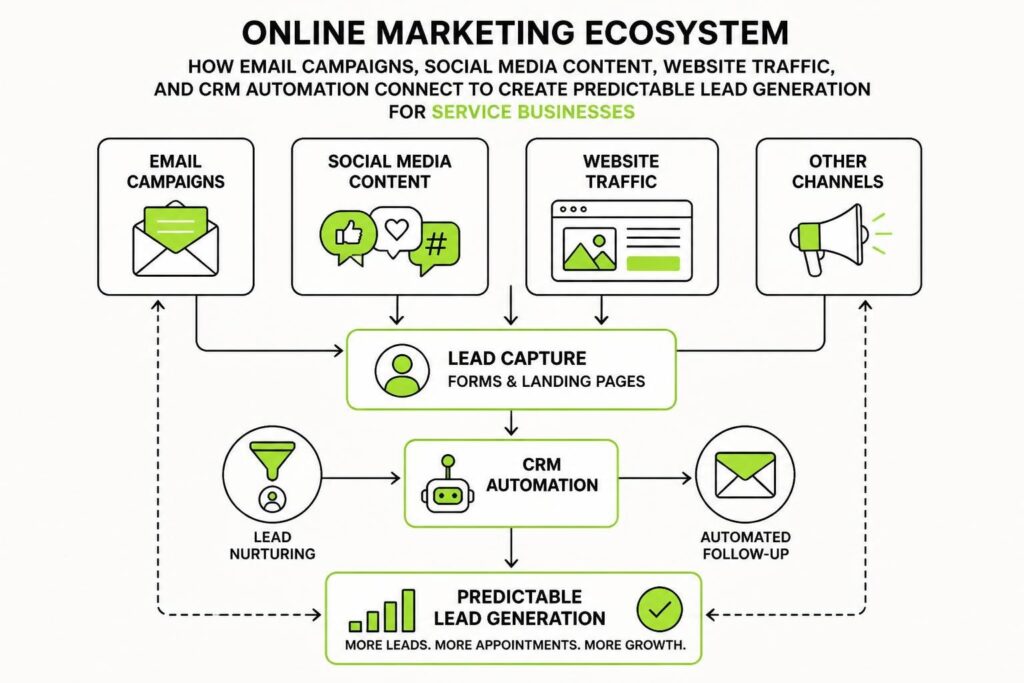
Segmentation is where email gets powerful. Don't send the same message to everyone. A cold lead needs education. A warm lead needs proof. A past client needs to stay connected. Your CRM should make this automatic.
Building a structured system that captures leads and nurtures them consistently is exactly what the 7-Step Marketing Plan helps businesses implement, from defining your buyer through to creating referral loops that compound growth.
Measurement and What to Actually Track
Data without decisions is noise. Track metrics that connect to revenue, not vanity numbers that make you feel good.
Website traffic is interesting. Leads generated is useful. Customers acquired is what matters. Work backwards from revenue to understand what drives it.
The Metrics That Matter
- Lead volume: How many new enquiries per month
- Lead source: Which channels are generating them
- Conversion rate: Percentage of leads that become clients
- Customer acquisition cost: Total marketing spend divided by new customers
- Lifetime value: Average revenue per customer over their relationship with you
If you're not measuring these, you're guessing. And guessing doesn't scale.
Tools like Google Analytics 4 track behaviour on your site. Your CRM tracks lead progression. Your accounting software tracks revenue. Connect them and you've got a clear picture of what's working. Resources like Reboot Online’s insights offer practical experiments and research that can sharpen how you interpret and act on that data.
Common Mistakes That Kill Results
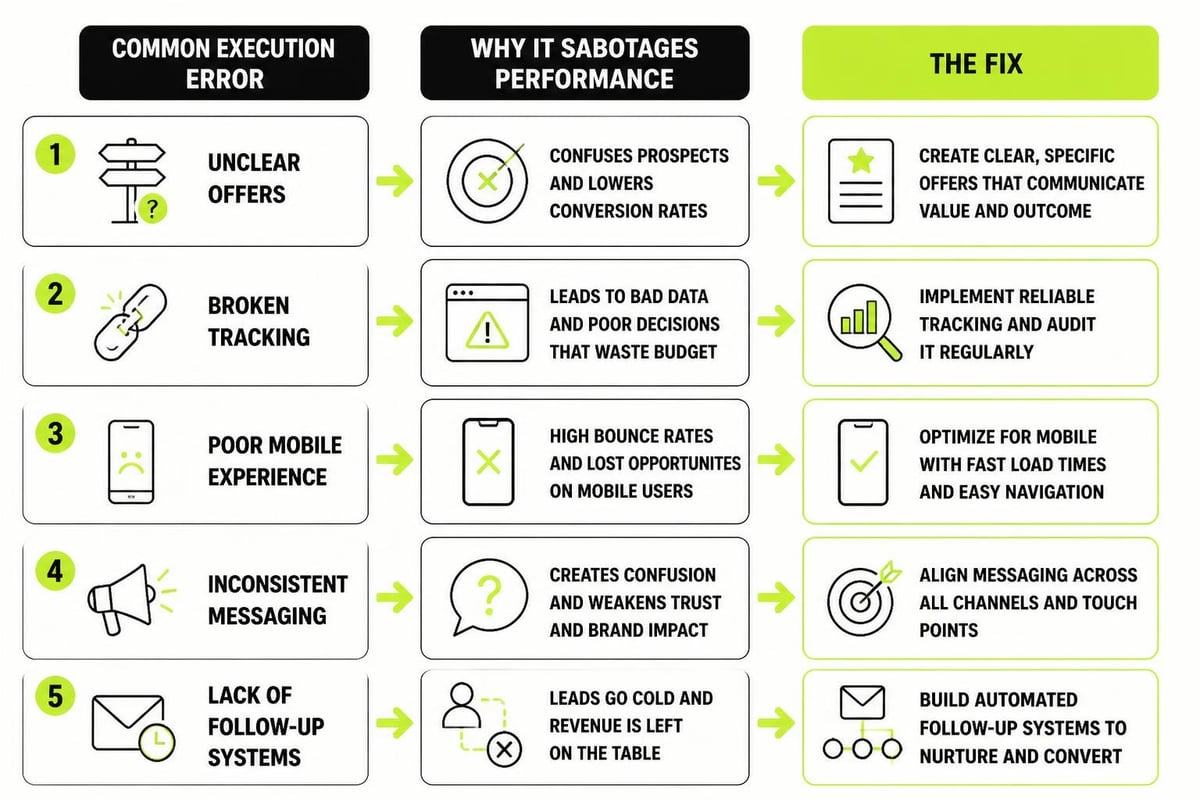
Even businesses with decent strategy sabotage themselves with execution errors. Here's what to avoid:
- No clear offer: "Contact us to learn more" isn't compelling. Give people a specific reason to act now.
- Broken tracking: If you can't measure it, you can't improve it. Fix your pixels and tags.
- Ignoring mobile: Over 60% of traffic is mobile. If your site doesn't work on a phone, you're losing leads.
- Inconsistent messaging: Your ad, landing page, and follow-up email should sound like they're from the same company.
- No follow-up system: Most leads don't convert on first contact. Without nurture, you're wasting the traffic you paid for.
According to research on credible marketing data sources, proper citation and verification of claims builds trust. In online marketing, trust is currency. Lose it and nothing else matters.
Platform Strategy for Service Businesses
You can't be everywhere. Pick two, maybe three platforms and own them. Here's how to choose:
LinkedIn works for B2B services, consultancy, and anything sold to decision-makers. Post consistently (three times a week minimum), engage with your network, and use it to build authority. Paid ads let you target by job title, company size, and industry.
Google Search works for high-intent services. People searching for what you do are ready to buy. Invest in SEO for long-term gains and paid search for immediate leads.
Email works for everyone. It's the channel you control. Build your list, segment properly, and send valuable content regularly.
Skip platforms where your buyers aren't. A plumber doesn't need LinkedIn. A B2B SaaS company doesn't need Instagram. Focus beats presence.
Integration Across the Funnel
Online marketing fails when channels operate in silos. Your website should capture emails. Your emails should drive website visits. Your ads should feed your CRM. Your CRM should trigger nurture sequences.
Map the journey:
- Awareness: Ad, social post, or search result
- Interest: Landing page or content piece
- Consideration: Email sequence, case studies, reviews
- Decision: Sales conversation, proposal, contract
- Retention: Onboarding, delivery, upsell, referral
Each stage needs different content and different tactics. Treating a cold lead like a warm one wastes time. Treating a warm lead like a cold one loses sales.
This kind of structured thinking separates digital marketing experts from people just running tactics. It's the difference between campaigns that burn budget and systems that build equity.
The AI Factor in 2026
AI tools are changing how content gets created, how ads get targeted, and how leads get qualified. But they're not magic. They amplify good strategy and expose bad strategy faster.
Use AI for:
- Drafting content (but always edit for voice and accuracy)
- Analysing campaign data and spotting patterns
- Personalising email content at scale
- Generating ad copy variations for testing
Don't use AI for:
- Final content without human review
- Strategy decisions without context
- Anything requiring empathy or nuance
- Replacing the thinking that drives differentiation
The businesses winning with AI are using it to handle repetitive work so they can focus on strategy, relationships, and creative problem-solving.
Building for the Long Term
Online marketing isn't a quarterly project. It's infrastructure. The businesses that treat it that way build compounding advantages.
Create content that stays relevant. Build email lists that grow every month. Improve conversion rates incrementally. Layer on automation that saves time without losing the human touch.
Short-term tactics (flash sales, gimmicky ads, growth hacks) create short-term results. Systems create momentum that builds year over year. That's what separates businesses that scale from businesses that hustle.
Guidance from sources like 12AM Agency’s authoritative SEO websites helps you stay grounded in proven practices while experimenting with new approaches. Balance matters.
Online marketing works when it's built as a system, not run as a series of disconnected tactics. The fundamentals haven't changed. Attract the right people, make a clear offer, nurture relationships, measure what matters, and remove friction from the buying process. If your current approach feels chaotic or unpredictable, it's probably because you're missing one of those pieces. MDO Digital helps service businesses build marketing systems that convert attention into predictable demand, using CRM infrastructure, automation, and data-driven strategy that removes chaos and protects every lead.