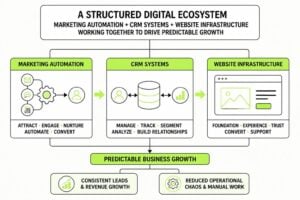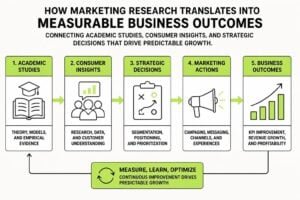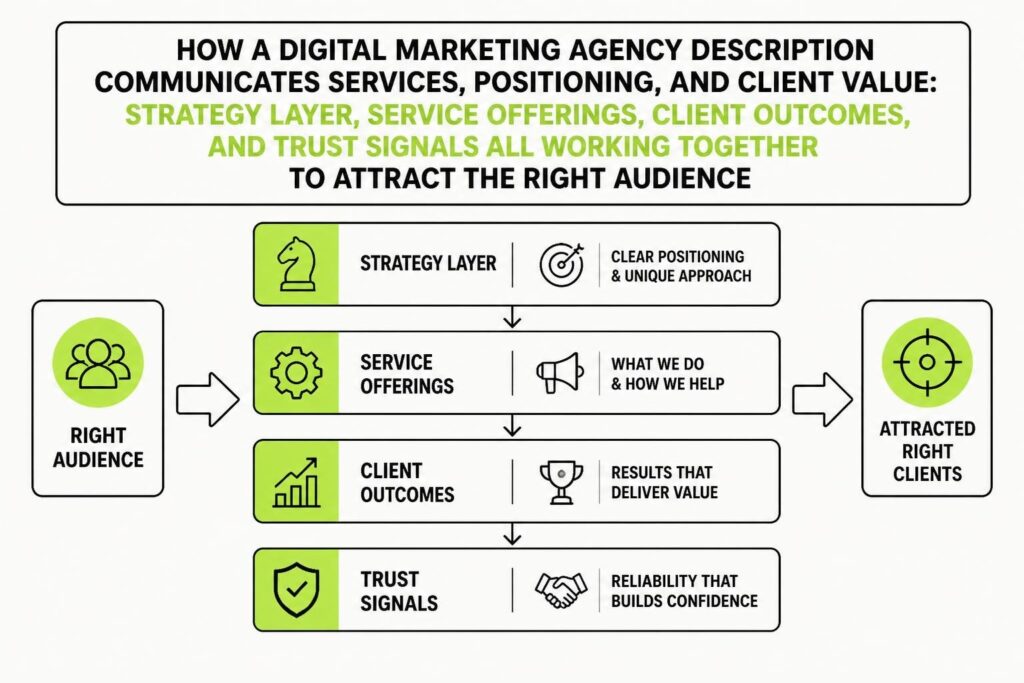
Writing a digital marketing agency description sounds straightforward until you sit down to do it. Most business owners freeze because they try to say everything at once. Services, values, processes, results, and differentiators all compete for space. The result is usually a paragraph that says nothing memorable. A good digital marketing agency description does one job well: it tells the right people what you do and why it matters to them. Everything else is noise.
Why Your Agency Description Matters More Than You Think
Your agency description shows up everywhere. Website homepages, LinkedIn profiles, directory listings, proposals, and pitch decks all need a version of it. Each placement has different space constraints and audience contexts, but the core message should remain consistent.
The description is often the first thing a potential client reads. It determines whether they keep reading or click away. In a market where service-based businesses are overwhelmed with options, clarity wins. A vague description blends into the background. A specific one cuts through.
Think about these common scenarios:
- A service business owner searches "marketing agency Sydney" and scans ten websites in three minutes
- A CFO reviews five agency proposals and needs to explain the difference to their team
- A founder asks for a referral and your past client tries to describe what you actually do
In each case, your description either makes the job easy or forces people to guess. Guessing rarely ends in a sale.
What a Digital Marketing Agency Description Must Cover
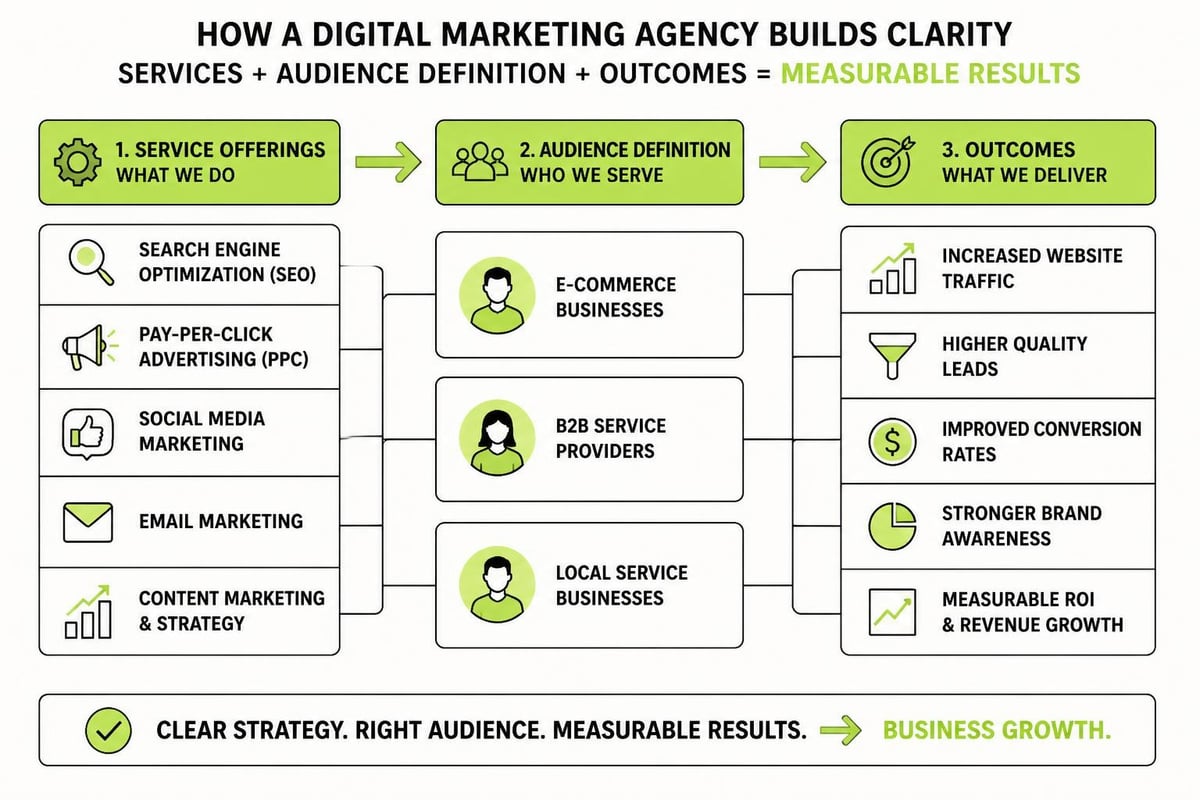
A working description answers three questions in order: what you do, who you serve, and what changes as a result. Skip any of these and the reader fills in blanks with assumptions.
The Service Layer
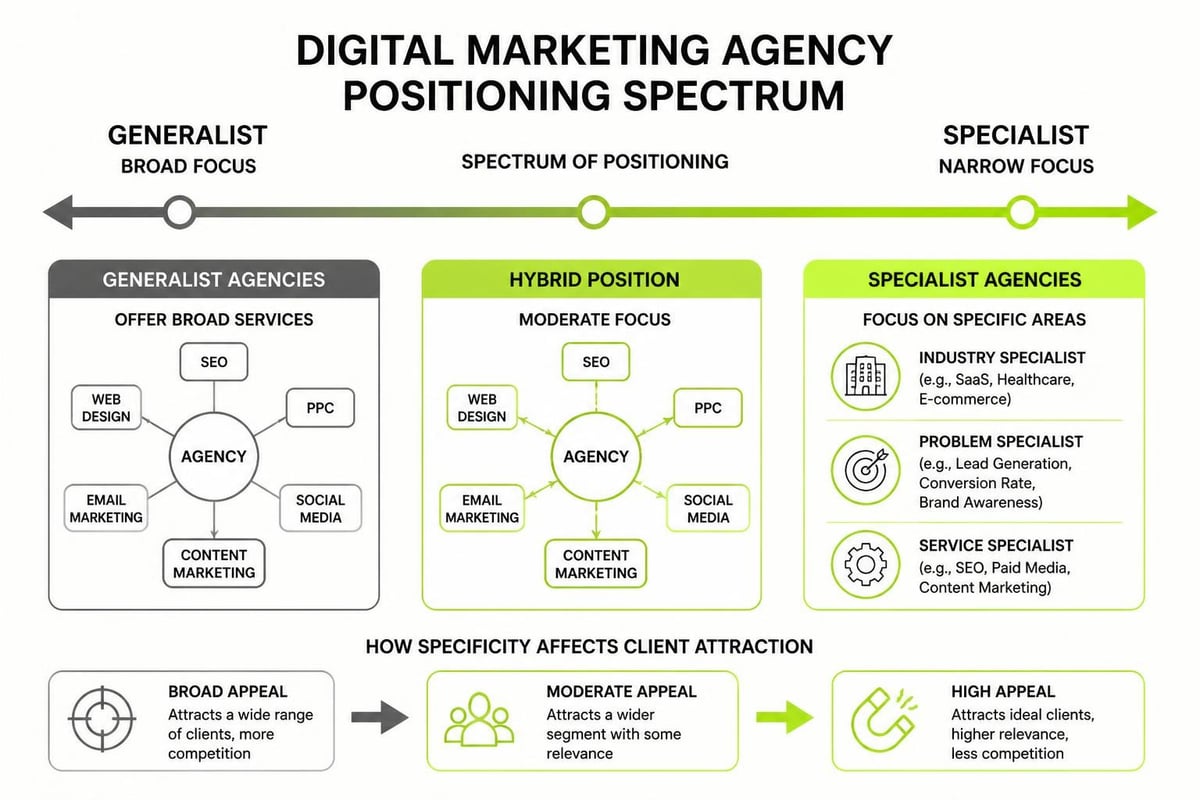
Start with what digital marketing actually includes in your specific case. Digital marketing is broad. SEO, paid advertising, email campaigns, content strategy, automation, analytics, and social media all fall under the umbrella. Listing everything makes you forgettable. Listing your actual focus makes you relevant.
If you build marketing systems, say that. If you run paid media campaigns, say that. If you design websites and connect them to CRM infrastructure, say that. Specificity filters out bad-fit clients and attracts good ones.
The Audience Layer
Who benefits most from your work? Service businesses, SaaS companies, e-commerce brands, professional services, or local trade businesses all have different needs. A description aimed at "small businesses" says nothing useful. A description aimed at "service-based businesses scaling past $500K revenue" says plenty.
Audience definition isn't about turning people away. It's about speaking directly to the problems your best clients actually face. When someone sees their situation reflected in your description, trust starts immediately.
The Outcome Layer
What changes when someone works with you? More leads is generic. Predictable demand generation is specific. Better branding is vague. High-trust positioning that shortens sales cycles is concrete.
Outcomes prove you understand the business problem, not just the marketing tactic. Clients don't buy SEO. They buy the revenue growth SEO enables when done properly. Frame your work around the change it creates.
Structuring Your Description for Different Contexts
You'll need multiple versions of your digital marketing agency description. A homepage needs 2-3 paragraphs. A LinkedIn summary needs 150 words. A directory listing gets one sentence. The core message stays the same but the structure adapts.
| Context | Length | Key Elements | Purpose |
|---|---|---|---|
| Homepage | 2-3 paragraphs | Full services, audience, process, outcomes | Establish positioning and credibility |
| 150 words | Core service, audience, differentiator | Professional networking and search | |
| Directory | 1-2 sentences | Service + audience in plain language | Quick filtering and discovery |
| Proposal intro | 1 paragraph | Service + relevant results + approach | Context for detailed scope |
Each version should compress cleanly. If your homepage description is three paragraphs and you can't condense it to two sentences for a directory, the message isn't clear enough yet.
The One-Sentence Version
This is the hardest to write and the most useful. It forces absolute clarity. Follow this pattern: "We help [specific audience] achieve [specific outcome] through [specific approach]."
For MDO Digital, that might be: "We help service-based businesses scale predictably by designing high-trust websites, building CRM infrastructure, and running data-driven marketing systems."
One sentence. Three elements. No fluff.
Common Mistakes That Weaken Agency Descriptions
Most agency descriptions fail in predictable ways. Recognising these patterns makes fixing them straightforward.
Mistake one: leading with values instead of services. Integrity, innovation, and customer-centricity tell a reader nothing about what you actually do. Values matter, but they belong later in the relationship.
Mistake two: using industry jargon as shorthand. "Full-funnel growth partner leveraging omnichannel strategies" sounds impressive and means nothing to the business owner trying to understand if you can help. Plain language wins.
Mistake three: listing credentials before demonstrating relevance. Awards, years in business, and team size matter after someone understands what you do and who you serve. Lead with the value, support with the proof.
Mistake four: treating all services equally. If you offer fifteen services, you probably do three well and twelve adequately. A description that lists everything equally suggests no real expertise in anything.
Positioning Within a Competitive Market
The digital marketing agency landscape is crowded. Global spending on digital advertising continues to grow, which means more agencies competing for attention. Your description is a positioning tool as much as an explanation.
Differentiation Through Specificity
Generic descriptions create generic positioning. "We help businesses grow through digital marketing" could describe 10,000 agencies. "We build marketing systems for service businesses that turn attention into predictable revenue" describes one specific approach.
Narrow beats broad in almost every case. You'll win fewer opportunities overall but close a higher percentage of the ones that matter.
Addressing Actual Client Problems
The best descriptions acknowledge the problem before presenting the solution. Service business owners don't wake up wanting a digital marketing agency. They wake up frustrated that leads are inconsistent, sales cycles are too long, or marketing spend disappears without measurable return.
Reference the real situation. "Most service businesses lose leads because their marketing and sales systems don't talk to each other. We fix that by building CRM infrastructure that captures, nurtures, and converts attention into closed deals."
You're not selling services. You're diagnosing a problem and explaining how you solve it.
The Role of Process in Your Description
How you work matters to certain clients. Others only care about results. A complete digital marketing agency description balances both.
Process language builds trust with detail-oriented buyers. "We start with a full audit of your existing systems, identify gaps in lead capture and nurture, then build a marketing plan that ties every tactic to a revenue outcome" tells someone exactly what to expect.
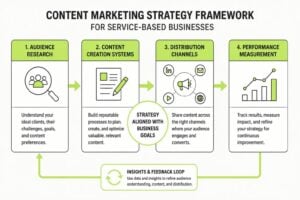
Frameworks and methodologies give structure to abstract services. At MDO Digital, we often reference our approach to marketing systems because it helps potential clients understand what they're buying. Having a structured way to talk about your work makes complex services feel manageable.
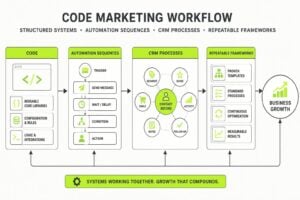
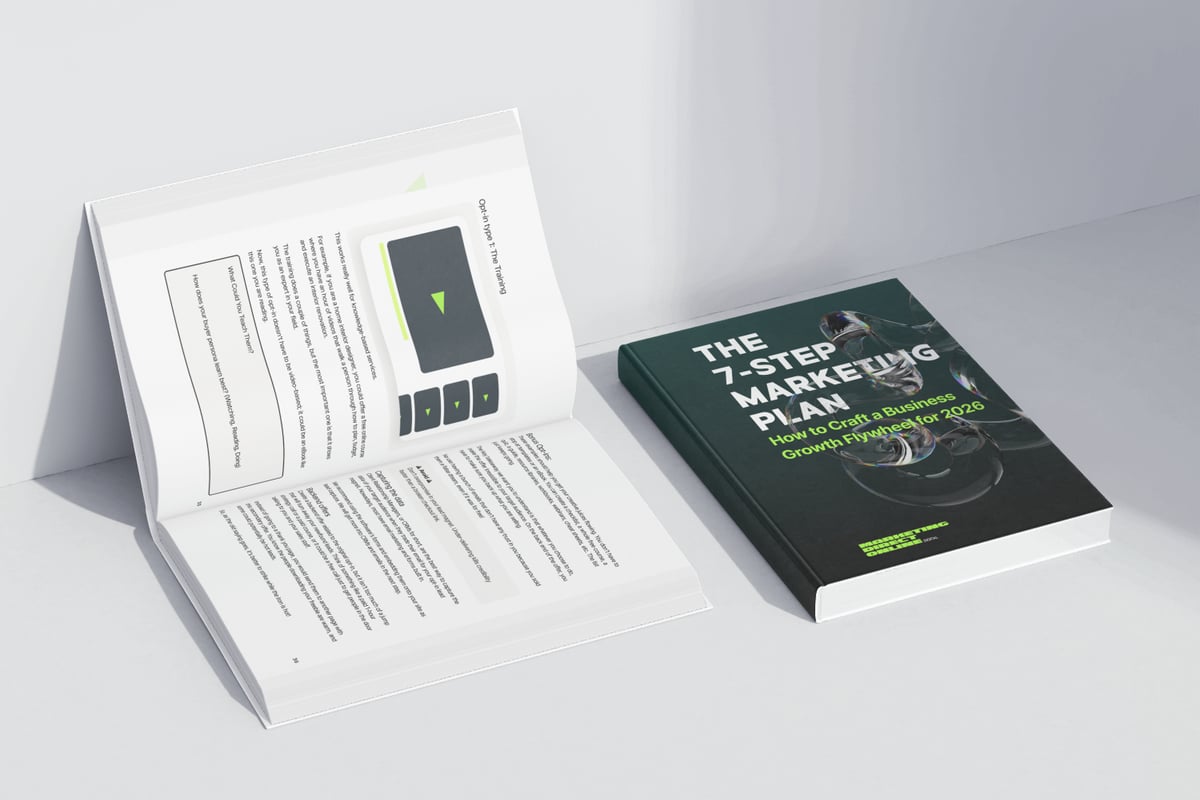
When discussing marketing systems and planning, it helps to have a clear framework that connects each step. The 7-Step Marketing Plan breaks down how to build a repeatable system from goal-setting through to generating referrals, creating a flywheel that compounds over time rather than starting from scratch each quarter.
Process descriptions work best in the middle of your full description, after you've established what you do and who you serve. Lead with relevance, support with methodology.
Testing and Refining Your Agency Description
Your first draft will not be your best. A digital marketing agency description improves through use and feedback. Test it in real conversations and watch where people ask clarifying questions.
Ways to test effectiveness:
- Use it in your next three client calls and note which parts generate questions
- Send it to past clients and ask what they'd add or remove
- Compare it against five competitor descriptions and identify overlap
- Read it aloud and mark anywhere you stumble or hedge
- Show it to someone outside your industry and ask them to repeat what you do
The areas where people get confused or ask for more detail show you where clarity is missing. If every prospect asks "so do you handle paid ads?" after reading your description, paid ads need clearer placement.
How Market Trends Shape Agency Descriptions
The way businesses buy digital marketing changes, which means how agencies position themselves evolves. AI-driven campaign management, first-party data strategies, and integrated marketing systems are reshaping what clients expect.
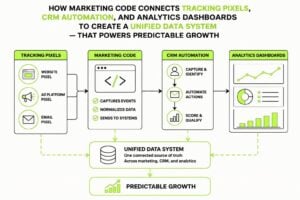
Your description should reflect current market reality without chasing every trend. If automation and CRM infrastructure are central to how you work, mention them. If you're still primarily a paid media shop, don't pretend otherwise.
Current shifts worth acknowledging:
- Businesses want systems, not scattered campaigns
- Data ownership and integration matter more than channel reach
- Efficiency and measurement outweigh volume and vanity metrics
- Long-term infrastructure beats short-term tactics
These themes show up in effective agency descriptions because they reflect what clients actually need in 2026.
Writing for Search and Discovery
Your digital marketing agency description serves two audiences: humans who read it and search algorithms that index it. Both matter, but humans come first.
Include relevant terms naturally. "Marketing agency," "digital marketing services," "CRM and automation," and "service-based businesses" all belong if they accurately describe your work. Keyword stuffing destroys readability and trust.
For businesses looking to understand digital marketing strategy and execution, clear descriptions help them identify the right agency faster. When your description matches how potential clients search and think, discovery improves naturally.
Structure also affects search. Headings, bullet points, and clear paragraphs make content scannable for both readers and crawlers. If your description lives on your homepage, it contributes to overall site SEO.
Agency Description Examples That Work
Looking at how other agencies describe themselves reveals patterns. The best ones balance specificity with accessibility.
| Agency Type | Weak Description | Strong Description |
|---|---|---|
| SEO-focused | "We do SEO and content marketing for businesses" | "We help B2B service businesses rank for high-intent keywords that bring in qualified leads, not just traffic" |
| Full-service | "Complete digital marketing solutions for all industries" | "We build integrated marketing systems for professional services firms scaling past $1M in revenue" |
| Paid media | "Expert Google and Facebook advertising management" | "We run performance campaigns for e-commerce brands targeting 3x ROAS through audience testing and creative iteration" |
The strong versions specify the service, the audience, and the outcome. The weak versions could apply to anyone.
Connecting Description to Brand Strategy
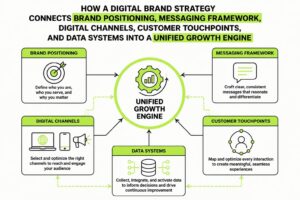
Your agency description should align with your overall digital brand strategy. If your brand emphasises systems and structure, the description should reflect that through language and tone. If your brand focuses on creative excellence, the description should demonstrate that immediately.
Consistency matters across all brand touchpoints. The way you describe your agency on your website should match how your sales team describes you in meetings, how past clients refer you, and how you position yourself in content.
When the description and the brand strategy pull in different directions, potential clients sense the disconnect. It creates doubt before the relationship even starts.
Making Your Description Actionable
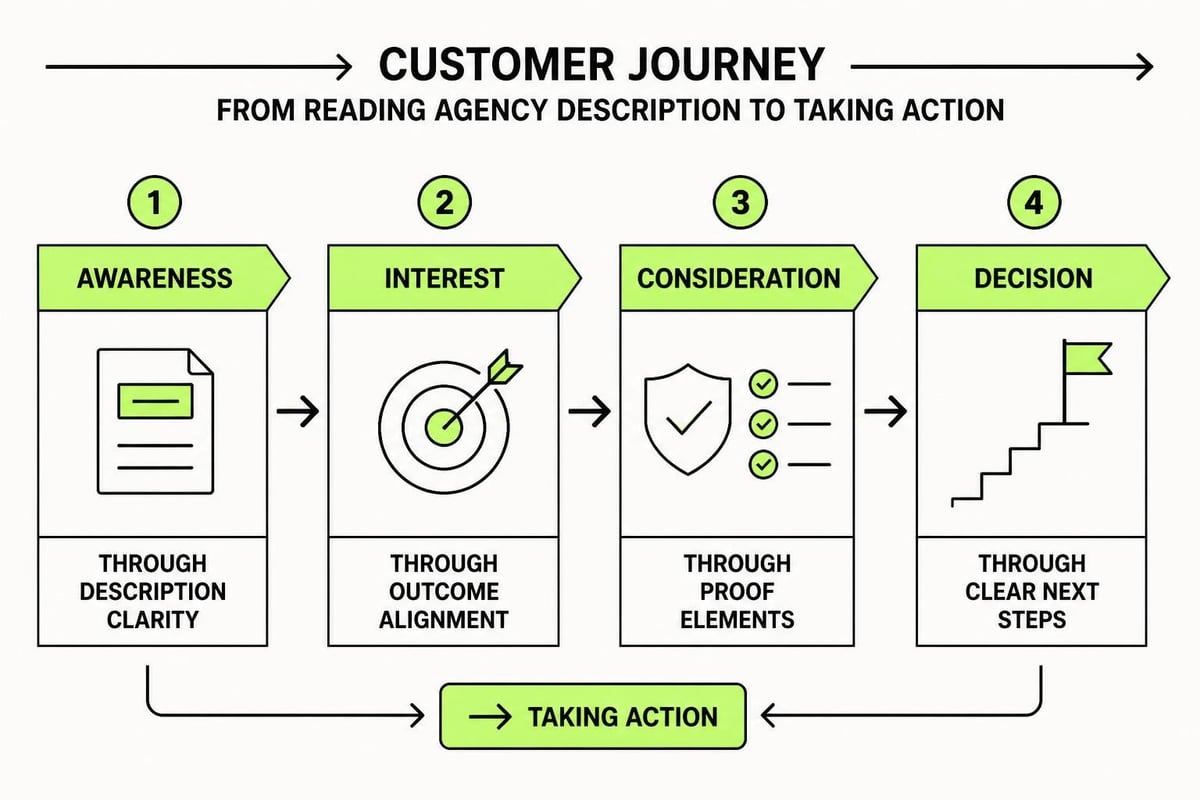
Every description should lead somewhere. On a website, that's usually a contact form or discovery call. In a proposal, it's the detailed scope. In a directory, it's a link to learn more.
The description creates interest. The call to action converts interest into engagement. Don't leave people wondering what to do next.
Be direct about next steps. "If you're a service business frustrated with inconsistent lead flow, let's talk about building a system that fixes it" works better than "contact us to learn more."
Internal Alignment on Your Description
Everyone on your team should be able to explain what your agency does. If your digital marketing agency description lives only on the website and your account managers can't articulate it in client meetings, you have a problem.
Use the description as an internal alignment tool. New hires should learn it as part of onboarding. Client-facing team members should practice delivering it naturally. When the entire team speaks consistently about what you do and who you serve, that clarity compounds externally.
Some agencies formalise this with messaging documents. Others keep it simple with a shared description everyone references. The method matters less than the consistency.
Adapting Descriptions for Proposals and Pitches
A website description sits still. A proposal description adapts to context. When responding to an RFP or pitching a specific project, your digital marketing agency description should emphasise the relevant parts of your work.
If you're pitching a website redesign project, lead with web design and development experience. If you're pitching a lead generation campaign, emphasise CRM systems and performance marketing. The core elements stay the same but the emphasis shifts.
This isn't dishonesty. It's relevance. You wouldn't describe every service you offer when someone asks about one specific need. Proposals work the same way.
The Evolution of Your Agency Description
As your agency grows, your description will change. Services evolve. Target audiences narrow or expand. Positioning sharpens. That's normal and healthy.
Review your description every six months. Ask whether it still accurately reflects what you do, who you serve, and what results you create. If the business has shifted but the description hasn't, update it.
Some agencies resist changing their description because it feels like admitting the old one was wrong. That's backwards thinking. A description that evolves with the business shows you're learning and improving.
Businesses searching for marketing and design expertise want to work with agencies that grow and adapt, not ones stuck repeating the same pitch from 2020.
When Your Description Needs Professional Help
Most agency owners can write their own descriptions with some effort. But if you've tried multiple times and it still feels wrong, bringing in outside perspective helps.
A brand strategist or copywriter who understands marketing positioning can often surface clarity you're too close to see. They ask the questions that force specificity. They spot the jargon you've stopped noticing.
This isn't admitting failure. It's recognising that writing about your own business is objectively hard. You know too much, which makes deciding what to include and what to cut nearly impossible.
Outside help works best when you've already done the internal work on defining services, audience, and positioning. A writer can shape the message but they can't create strategy from nothing.
Using Your Description as a Filter
A well-written digital marketing agency description repels as much as it attracts. That's a feature, not a bug. When someone reads your description and decides you're not the right fit, you both just saved time.
Low-quality leads drain resources. Clear descriptions reduce them by making expectations obvious upfront. If you specialise in service businesses and an e-commerce company reaches out anyway, your description did its job by setting the right expectation, even if they ignored it.
The goal is not maximum inquiries. The goal is maximum relevant inquiries. A description that generates five perfect-fit conversations beats one that generates twenty time-wasters.
A strong digital marketing agency description is a working asset, not a placeholder. It filters audiences, sets expectations, and starts relationships on clear ground. If your current description feels vague or generic, rebuilding it around specific services, defined audiences, and concrete outcomes makes everything else easier. MDO Digital helps service-based businesses cut through the chaos by building marketing systems that convert attention into predictable demand. If your marketing feels scattered and your leads inconsistent, let's build the infrastructure that fixes it.