Understanding digital marketing pricing can feel like navigating a maze of jargon, hidden costs, and confusing packages. Most service-based businesses want the same thing: clarity on what they're paying for, transparency around what results they should expect, and a pricing model that actually fits how they grow. The challenge is that digital marketing pricing models vary dramatically depending on the agency's structure, the scope of work, and whether you're paying for time, outcomes, or value delivered. In 2026, the landscape is more diverse than ever, with everything from old-school hourly billing to sophisticated performance-based arrangements. The good news is that once you understand the common models and what drives pricing up or down, you can make a choice that supports structured growth rather than creates more chaos.
The Main Digital Marketing Pricing Models
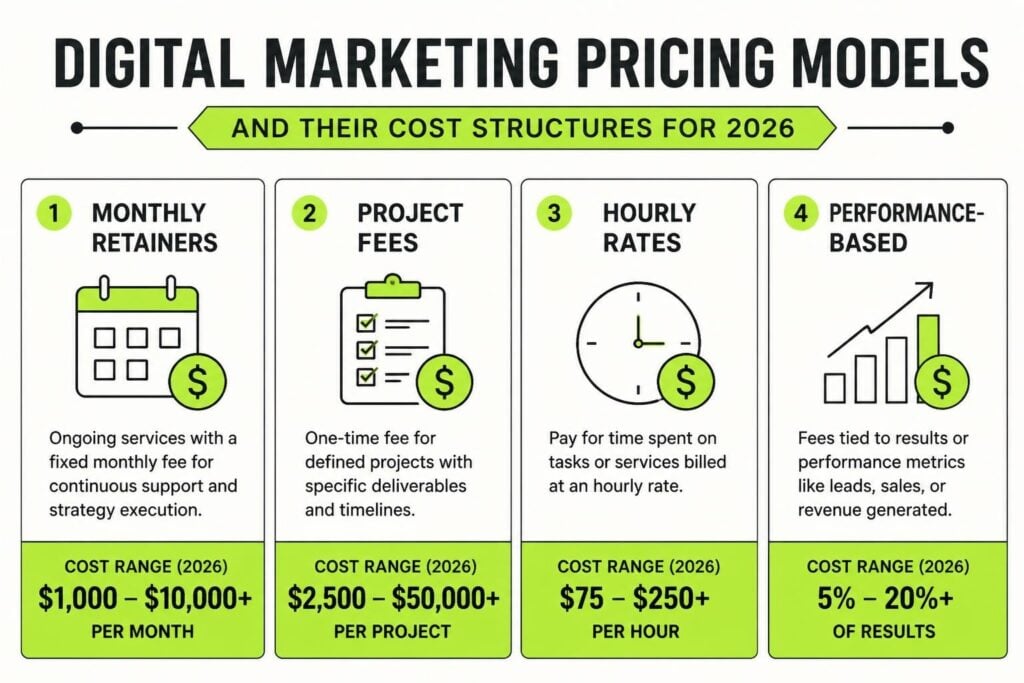
When agencies talk about digital marketing pricing, they're typically referring to one of several core structures. Each has trade-offs, and the right one depends on where your business is at and what you need next.
Hourly Rates
The simplest model is hourly billing. You pay for the time spent on your account.
In 2026, hourly rates for digital marketing services typically range from $100 to $300 per hour, depending on the agency's expertise and location. Junior marketers or generalists sit at the lower end. Senior strategists, CRM architects, or specialists in conversion rate optimisation sit at the upper end.
Advantages of hourly pricing:
- Complete transparency around what time is spent where
- Flexibility to scale work up or down without long-term commitments
- Good for one-off projects or early-stage testing
- Easy to compare across agencies
Limitations of hourly pricing:
- Incentivises time spent, not outcomes delivered
- Costs can spiral if scope isn't tightly managed
- Less predictability for budgeting
- Doesn't account for efficiency or strategic value
Hourly works well when you need a specific task completed, like a website audit or a single campaign build. It falls apart when you're trying to drive ongoing growth, because you're essentially penalising the agency for getting faster and better at their work.
Monthly Retainers
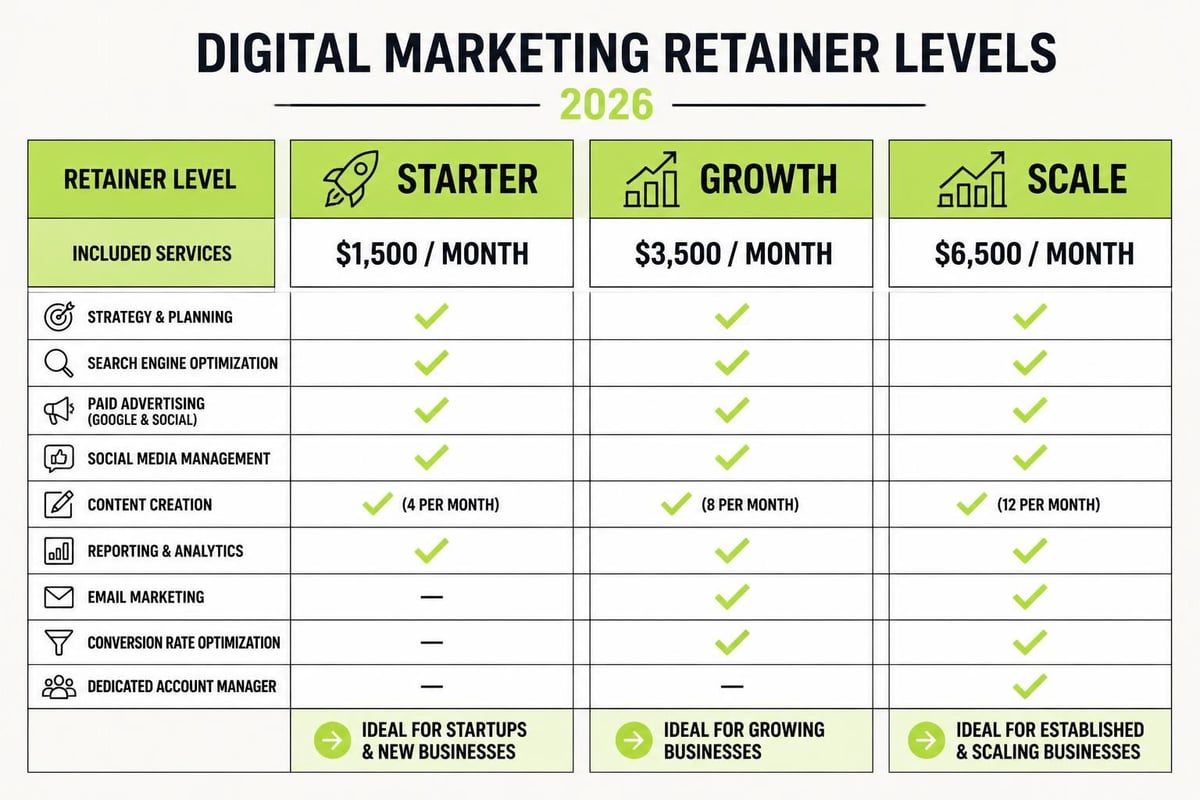
This is the most common structure for ongoing marketing and business development work. You pay a fixed monthly fee, and the agency delivers an agreed scope of services.
Retainers typically range from $2,500 to $15,000 per month, depending on the services included and the size of your business.
| Retainer Level | Monthly Investment | Typical Services Included |
|---|---|---|
| Starter | $2,500 – $5,000 | SEO basics, social media management, email campaigns |
| Growth | $5,000 – $10,000 | Multi-channel campaigns, CRM management, paid ads, content production |
| Scale | $10,000 – $15,000+ | Full-funnel strategy, automation, advanced analytics, brand development |
Monthly retainers create predictability. You know what you're paying, and the agency knows how much capacity to allocate to your account. This model works best when you need consistent, compound effort over time. Things like SEO, content marketing, and branding don't deliver overnight. They need sustained attention to build momentum.
The risk is paying for activity rather than progress. Some agencies fill retainers with busywork that looks good on a report but doesn't move the needle. The fix is clear deliverables tied to business outcomes, not just output.
Project-Based Pricing
If you have a defined project with a clear start and end, project-based pricing makes sense. This could be a website rebuild, a rebrand, a product launch campaign, or implementing a new CRM system.
Project-based fees in 2026 range from $5,000 for small projects up to $100,000+ for complex, multi-phase initiatives.
Common project pricing in 2026:
- Website design and development: $10,000 to $50,000
- Brand identity creation: $8,000 to $30,000
- CRM setup and automation: $7,500 to $25,000
- Campaign strategy and execution: $5,000 to $20,000
Project pricing removes the uncertainty of hourly billing while still giving you a fixed cost. It works well when scope is clearly defined and both parties understand what "done" looks like.
The downside is scope creep. If requirements change mid-project or if the initial brief was vague, costs can blow out or quality can suffer. Good agencies combat this with structured discovery phases and change request processes.
Performance-Based Pricing
This model ties fees directly to outcomes. You might pay a base retainer plus a commission on leads generated, sales closed, or revenue driven.
For example, an agency might charge $3,000 per month plus 10% of revenue generated from campaigns they manage. Or $2,000 per month plus $50 per qualified lead delivered.
Performance-based digital marketing pricing sounds appealing because the agency only wins when you win. But it's rarely that simple.
Challenges with performance pricing:
- Defining what counts as a "qualified lead" or attributing revenue accurately
- Agencies may prioritise short-term wins over long-term brand building
- Works best for direct-response campaigns, poorly for awareness or trust-building
- Can create misaligned incentives if metrics aren't carefully chosen
Performance models work when you have clear tracking, a short sales cycle, and campaigns designed for direct response. They struggle when attribution is messy or when the work is strategic rather than tactical.
What Influences Digital Marketing Pricing
Digital marketing pricing doesn't exist in a vacuum. Several factors push costs up or down, and understanding them helps you assess whether a quote is fair or inflated.
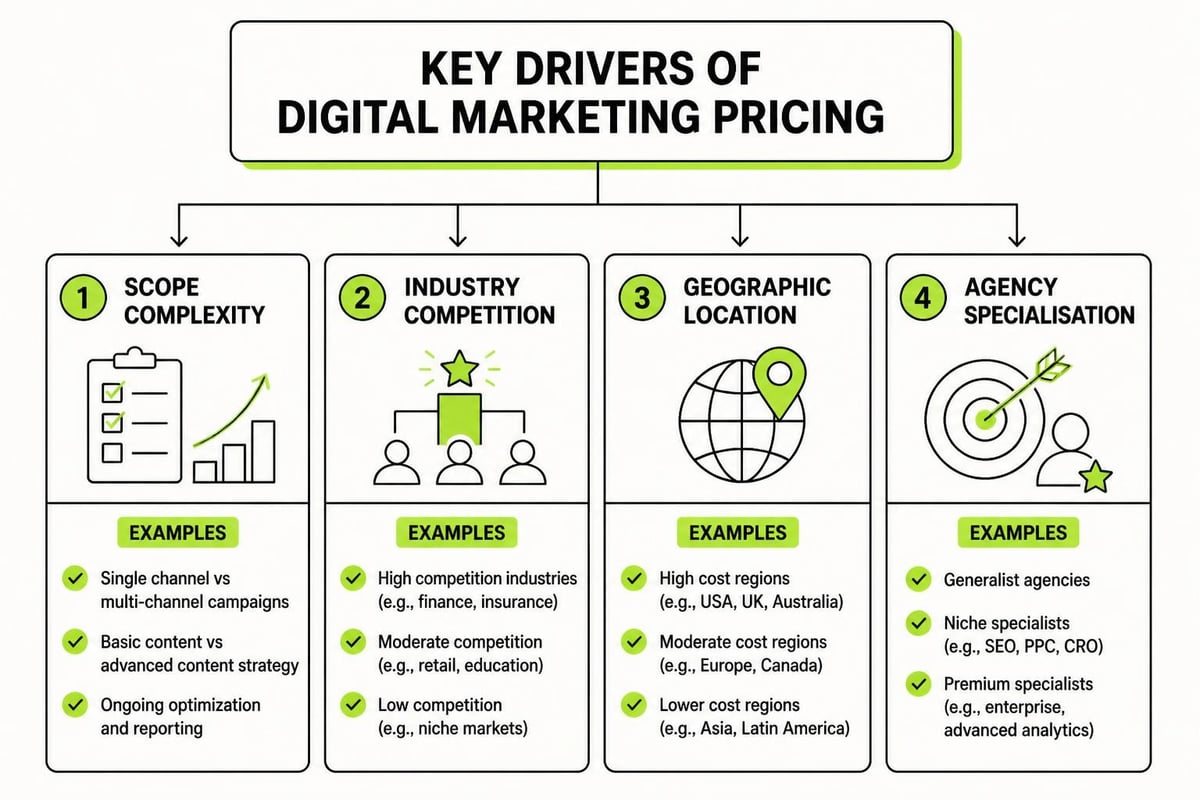
Scope and Complexity
A single-channel campaign costs less than a full-funnel marketing system. Managing Facebook ads is simpler than building an integrated CRM, automation workflow, email nurture sequence, and content engine.
The more moving parts, the higher the price. But complexity isn't always bad. Sometimes you're paying for infrastructure that removes chaos and creates compound growth. That's worth more than a quick-win tactic that delivers a short-term spike.
Industry and Competition
Some industries are more competitive, which drives up advertising costs and requires more sophisticated strategy. Finance, legal, and healthcare typically pay more than local service businesses or e-commerce.
If you're in a crowded market, expect to invest more in differentiation, positioning, and conversion optimisation. If you're in a niche with low competition, you might get results cheaper.
Geographic Location
Agencies in Sydney or Melbourne typically charge more than those in regional Australia. International pricing data shows agencies in North America and Europe command premium rates compared to Asia-Pacific markets, though the gap is narrowing as remote work becomes standard.
Location still matters for local expertise, but in 2026, many businesses work with remote agencies that deliver equal or better results at more competitive rates.
Agency Experience and Specialisation
Generalist agencies charge less than specialists. A team that focuses exclusively on service-based businesses will understand your challenges faster and build systems that actually fit your model. That expertise costs more, but it also delivers faster results and fewer false starts.
A junior agency learning on your account will charge less, but you'll pay in time and opportunity cost. Experienced teams charge more because they've made the mistakes already and know what actually works.
Choosing the Right Pricing Model for Your Business
The best digital marketing pricing model depends on where you are and where you're going.
If You're Just Starting Out
Hourly or small project-based pricing gives you flexibility. You can test different channels, learn what works, and avoid long-term commitments before you have clarity on your strategy.
Focus on foundation work first. Get your website design right, clarify your positioning, and set up basic tracking. Don't overpay for campaigns before you have infrastructure to capture and convert the leads.
If You're Ready to Scale
Monthly retainers make sense when you need consistent effort across multiple channels. This is where marketing systems start to compound. You're not just running campaigns. You're building a flywheel that captures attention, nurtures leads, and converts them into predictable demand.
At this stage, a structured approach beats random tactics. Look for agencies that talk about systems, automation, and processes, not just creative or traffic. Growth at scale requires infrastructure, not just volume.
For businesses looking to build that repeatable system, the 7-Step Marketing Plan provides a practical framework that covers everything from defining your buyer persona to creating nurture campaigns and generating referrals. Each step connects to the next, creating momentum rather than isolated wins.

If You Have Specific Projects
Use project-based pricing for defined initiatives. Website rebuilds, brand refreshes, CRM implementations, or campaign launches all have clear start and end points. Fixed pricing removes uncertainty and aligns incentives around delivering the project on time and on budget.
Just make sure the scope is clear before signing. Ambiguity kills projects and relationships.
If You Have Proven Unit Economics
Performance-based pricing can work if you have tight attribution, clear metrics, and campaigns designed for direct response. But be cautious. Most businesses overestimate how clean their data is and underestimate how long it takes to optimise campaigns.
Consider hybrid models instead. A base retainer to cover strategic work and infrastructure, plus performance bonuses for hitting agreed targets. This balances risk and reward without creating misaligned incentives.
Common Digital Marketing Pricing Mistakes to Avoid
Even with the right model, businesses make predictable mistakes that waste money and slow growth.
Mistake 1: Chasing the cheapest option
Low prices usually mean low experience, offshore teams with no context, or corners cut in strategy and execution. You'll spend more fixing problems than you saved upfront.
Mistake 2: Paying for outputs instead of outcomes
A hundred blog posts mean nothing if they don't drive traffic or convert visitors. Ten social posts a week don't matter if your audience isn't there. Focus on what moves your business forward, not what looks busy.
Mistake 3: No clarity on what success looks like
If you don't define success upfront, you'll never know if you're getting value. Set clear KPIs tied to business outcomes. Revenue, qualified leads, cost per acquisition, customer lifetime value. Not vanity metrics like impressions or followers.
Mistake 4: Ignoring infrastructure
Running campaigns without a CRM, automation, or lead nurture process is like pouring water into a bucket with holes. You'll generate activity, but you won't retain value. Invest in systems before volume.
Mistake 5: Treating marketing as a cost, not an investment
The cheapest option is often the most expensive in the long run. The right agency or system pays for itself many times over. But only if you commit long enough to see compound results.
Digital Marketing Pricing Packages and What They Include
Many agencies offer tiered pricing packages to simplify decision-making. These typically bundle services at different investment levels.
| Package Tier | Monthly Cost | What's Included |
|---|---|---|
| Essentials | $2,500 – $4,000 | Basic SEO, social media posting, monthly reporting |
| Professional | $5,000 – $8,000 | Multi-channel campaigns, content creation, email marketing, CRM management |
| Enterprise | $10,000+ | Full-funnel strategy, automation, paid media, advanced analytics, brand development |
These packages make comparison easier, but they can also create a one-size-fits-all problem. Your business isn't generic, and your marketing shouldn't be either.
Look for agencies willing to customise. The best partnerships start with understanding your specific challenges, then designing a solution that fits. Not forcing you into a pre-built package that sort of works.
Understanding ROI and Time to Value
Digital marketing pricing only makes sense when you understand what return you should expect and how long it takes to see it.
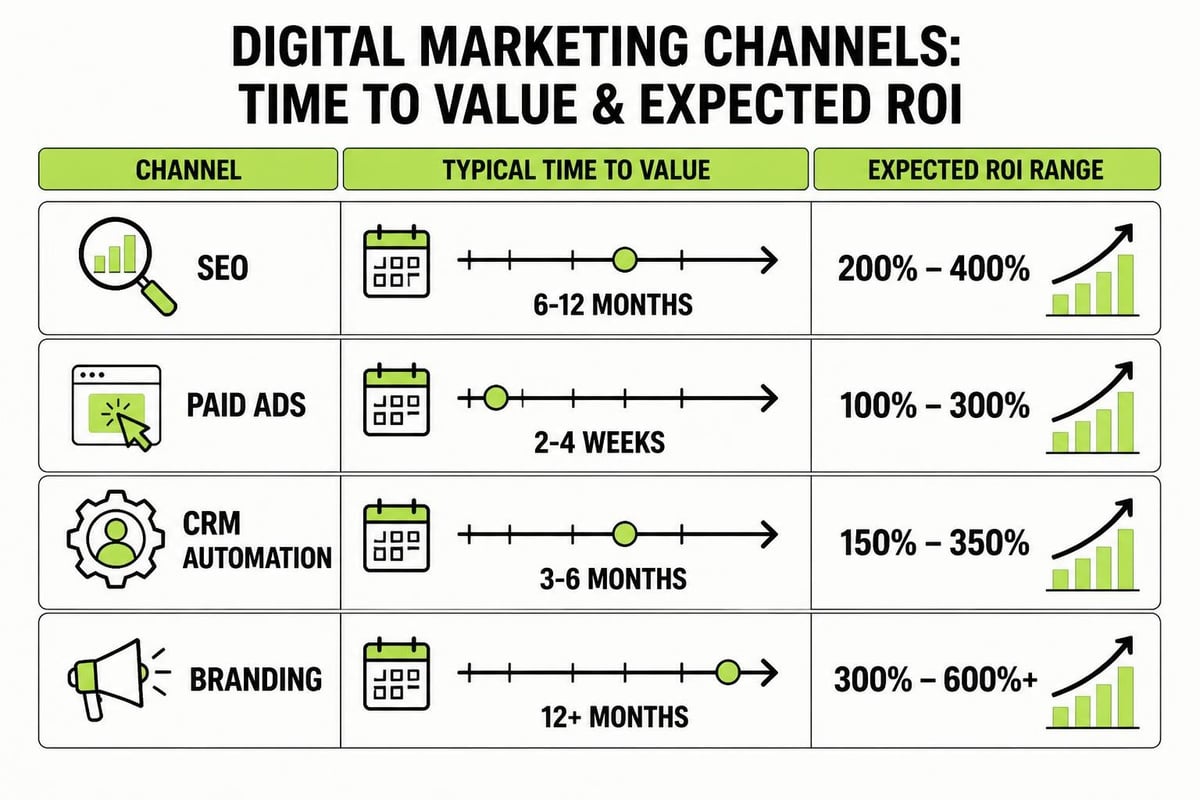
SEO and content marketing typically take 6 to 12 months to gain traction. You're building domain authority, publishing consistently, and earning trust. But once it compounds, the ROI is substantial. Organic traffic costs less to maintain than paid ads and converts better because it's earned, not bought.
Paid advertising delivers faster results, often within weeks. But it requires ongoing spend to maintain volume. ROI depends on your funnel efficiency and customer lifetime value. If your LTV is high and your funnel is tight, paid ads can scale profitably. If not, you're just renting attention without building equity.
CRM and automation pays back over time by improving conversion rates, reducing manual work, and protecting leads from falling through cracks. Research shows businesses with mature marketing systems see 20% to 40% higher conversion rates than those relying on manual processes.
Branding and positioning work creates long-term value but doesn't always show immediate ROI in spreadsheets. Better positioning reduces friction in sales, attracts higher-quality leads, and supports premium pricing. That value compounds over years, not quarters.
Understanding these timelines helps you set realistic expectations and commit long enough to see results. Most businesses quit too early, right before the work starts to pay off.
How to Evaluate Digital Marketing Pricing Proposals
When you're comparing agencies, price is important, but it's not the only factor.
Look for Clarity, Not Complexity
Good proposals explain what you're paying for in plain language. If an agency hides behind jargon or vague promises, that's a red flag. You should understand exactly what services are included, what outcomes they're targeting, and how they'll measure progress.
Check for Strategic Thinking
Anyone can run ads or post on social media. The value comes from strategy. How do they plan to position you? What's their hypothesis about what will work? How will they test and optimise? Agencies that lead with tactics rather than strategy rarely deliver sustainable growth.
Understand What's Not Included
The cheapest proposal often excludes critical components. Make sure you know what's covered and what costs extra. Software licenses, ad spend, content production, design work. Hidden costs add up fast.
Ask About Process and Communication
How often will they report? Who's your point of contact? How do they handle changes or requests? A cheap agency that's impossible to reach or slow to respond costs more in frustration than you save in fees.
Evaluate Track Record
Ask for case studies or references from businesses similar to yours. Not just any clients, but ones in your industry or with comparable challenges. Results in one sector don't always translate to another.
Hybrid and Value-Based Pricing Models
Beyond the standard models, some agencies offer hybrid or value-based structures that blend elements from multiple approaches.
Hybrid pricing might combine a base retainer with performance bonuses. For example, $4,000 per month plus $100 per qualified lead above a threshold. This balances predictable costs with upside for strong performance.
Value-based pricing ties fees to the value delivered rather than time or outputs. If an agency helps you increase revenue by $500,000 annually, they might charge 10% to 20% of that value. This model requires deep trust and clear attribution, but it aligns incentives perfectly.
Both models work best with mature businesses that have solid data and clear metrics. If you're still figuring out your unit economics or attribution, stick with simpler structures until you have clarity.
Building Long-Term Partnerships vs. Transactional Engagements
Digital marketing pricing also reflects the type of relationship you're building.
Transactional engagements are short-term. You hire an agency for a specific project, pay them, and move on. These work for one-off needs but don't build momentum.
Long-term partnerships create compound value. The agency learns your business, your customers, and your market. They spot opportunities, fix problems before they escalate, and refine systems over time. That depth of understanding is worth more than any individual tactic.
The best digital marketing pricing structures support partnerships, not transactions. Monthly retainers with quarterly reviews, performance bonuses for hitting milestones, and transparency around what's working and what's not.
If you're serious about growth, invest in a partner, not a vendor. The difference shows up in results.
Digital marketing pricing in 2026 comes down to understanding the models, knowing what drives costs, and choosing a structure that fits your business stage and growth goals. Whether you're starting with hourly projects or scaling with a full retainer, clarity and alignment matter more than finding the cheapest option. At MDO Digital, we help service-based businesses cut through the noise and build marketing systems that actually work: clear strategy, tight execution, and infrastructure that turns attention into predictable demand. If you're ready to remove the chaos and build something that compounds, let's talk.