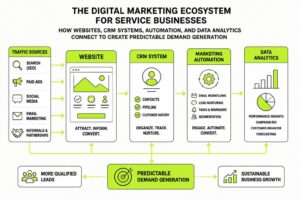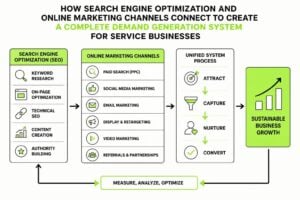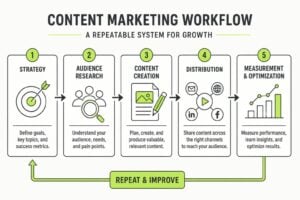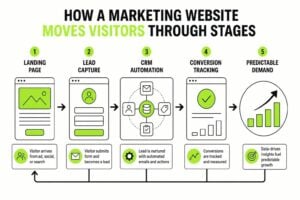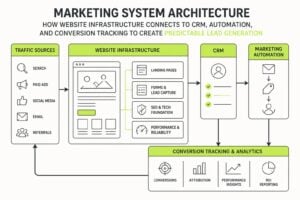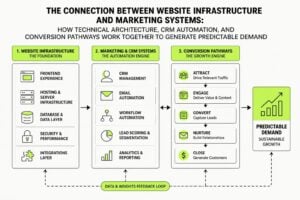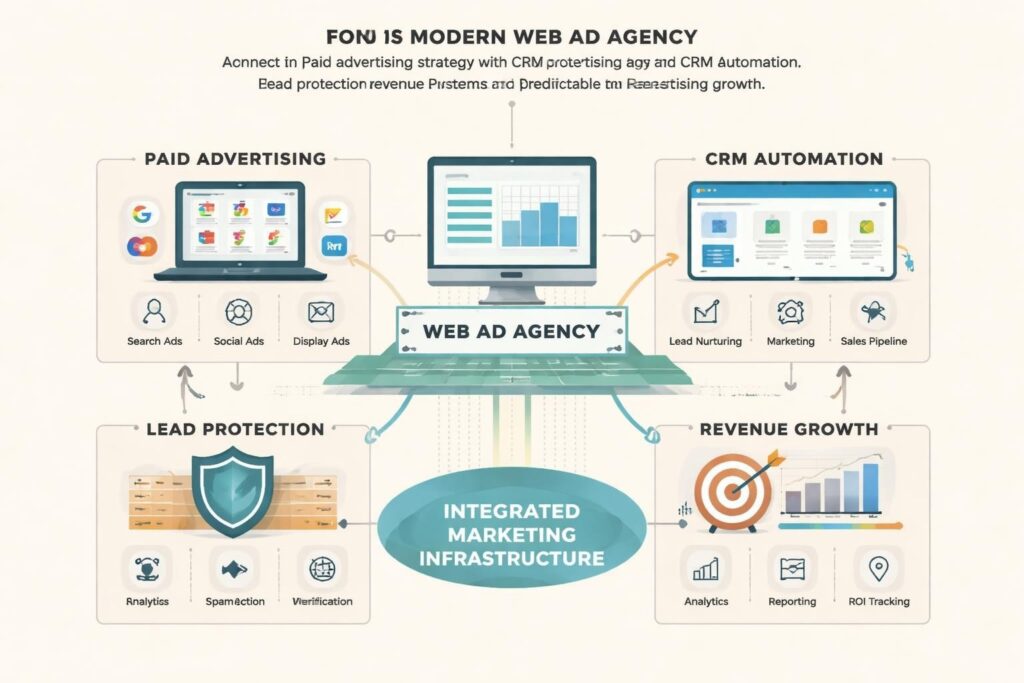
Choosing a web ad agency isn't about finding someone to run Facebook ads or manage your Google budget. It's about finding a partner who understands that advertising without infrastructure is just expensive noise. The real work happens after the click – in how leads are captured, nurtured, tracked, and converted into paying clients. Most agencies focus on impressions and engagement metrics while your actual revenue stays unpredictable. The gap between ad spend and business growth often comes down to missing systems, not missing creativity.
What Actually Defines a Modern Web Ad Agency
A web ad agency in 2026 looks different than it did five years ago. The discipline has split into two camps: those who chase platform features and those who build revenue infrastructure.
The first group talks about creative assets, audience targeting, and campaign optimization. The second group talks about lead flow, conversion architecture, and predictable demand generation. One treats advertising as a service. The other treats it as a system.
Here's what separates them:
- Infrastructure focus: CRM integration, tracking setup, attribution modeling before campaigns launch
- Lead protection: Every click is captured, tagged, and moved through a defined sequence
- Revenue alignment: Success measured by pipeline value and customer acquisition cost, not vanity metrics
- System design: Ads work as part of a broader marketing machine, not isolated tactics
The best web ad agency partners don't just place media. They design the entire demand generation system and use advertising as one lever within it.
The Core Components You Should Expect
When you're evaluating potential partners, look for these structural elements:
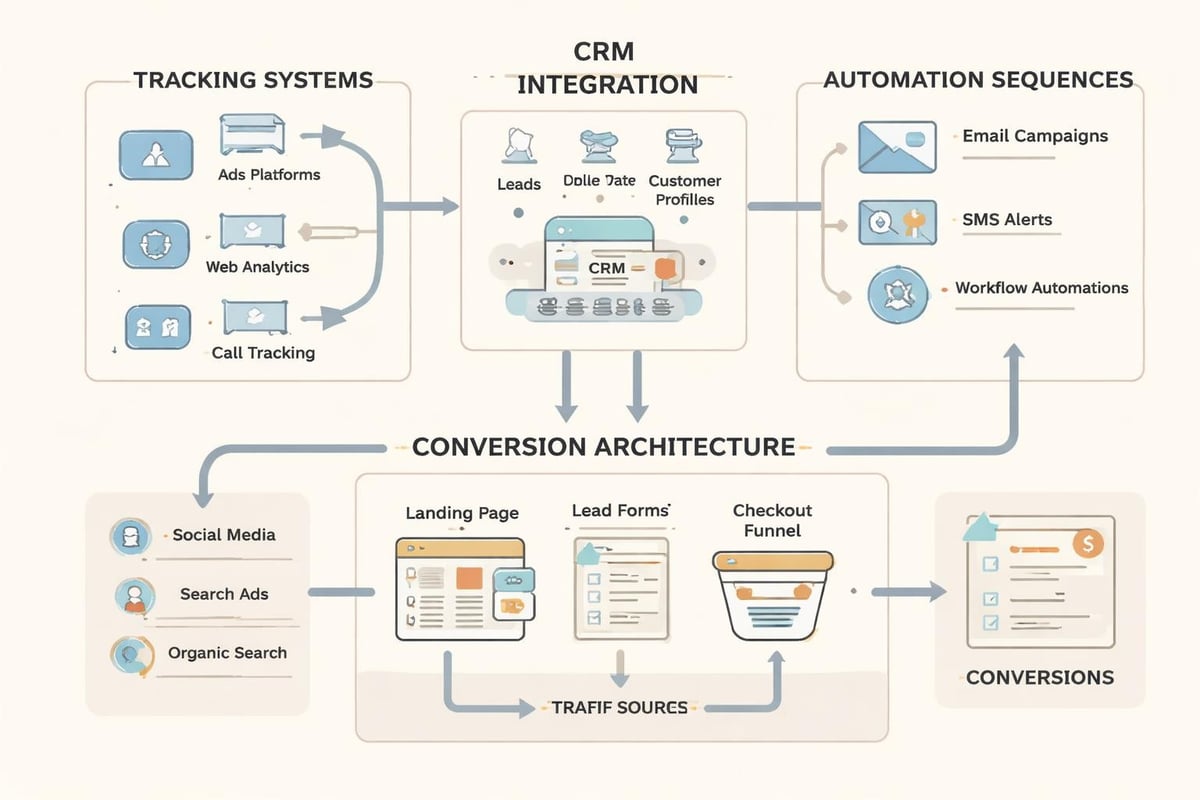
| Component | What It Actually Means | Why It Matters |
|---|---|---|
| Tracking Infrastructure | Server-side tracking, UTM taxonomy, multi-touch attribution | You know which ads drive revenue, not just clicks |
| CRM Integration | Native connections between ad platforms and your customer database | No leads fall through gaps between systems |
| Automation Sequences | Triggered follow-up based on ad source and behavior | Every lead gets appropriate nurture without manual work |
| Conversion Architecture | Landing pages, forms, and CTAs built for your funnel stage | Traffic converts at predictable rates |
| Reporting Dashboards | Real-time visibility into spend, leads, and pipeline value | You make decisions from data, not guesswork |
A proper web ad agency builds these before spending your first dollar on media. If they're pitching creative concepts before discussing tracking setup, you're talking to the wrong people.
Why Most Web Ad Agencies Leave Money on the Table
The gap between what agencies charge and what clients actually need has never been wider. Most web ad agency relationships fail not because campaigns underperform, but because there's no system to capitalize on the performance.
You'll see strong click-through rates and decent cost-per-click numbers. Traffic arrives. Then it disappears into a poorly designed website, a contact form that dumps into an unmonitored inbox, or a sales process that can't move fast enough. The advertising strategy was fine. The infrastructure wasn't there.
Common Structural Failures
No lead scoring or prioritization: Every inquiry gets treated the same, whether it's a tire-kicker or a qualified buyer. Your sales team wastes time on cold traffic while hot leads go stale.
Missing attribution data: You know you got 47 leads this month but have no idea which campaigns or ad sets generated them. Budget decisions become guesswork.
Broken handoff between marketing and sales: Leads arrive but there's no defined process for follow-up timing, messaging, or qualification. Conversion rates stay low regardless of traffic quality.
Campaign isolation: Each platform (Google, Meta, LinkedIn) runs independently with different messaging, offers, and tracking. There's no unified customer journey.
According to the Interactive Advertising Bureau’s revised 2025 ad forecast, economic headwinds are forcing businesses to scrutinize every marketing dollar. When budgets tighten, the agencies that survive are those who can prove direct revenue impact, not just campaign metrics.
How to Structure an Effective Web Ad Agency Engagement
The relationship model matters as much as the tactical execution. Most engagements fail because expectations weren't aligned at the start.
Define Success Metrics Before Launch
Skip the fluff. Here's what you actually track:
- Cost per qualified lead: Not just any lead – one that matches your ideal customer profile
- Lead-to-opportunity conversion rate: How many inquiries turn into real sales conversations
- Customer acquisition cost: Total ad spend divided by new customers acquired
- Pipeline value generated: Dollar value of opportunities created from paid traffic
- Revenue attribution: Actual closed revenue traced back to specific campaigns
Notice what's missing? Impressions, reach, engagement rate, brand lift. Those might matter for enterprise brands running awareness plays. For service businesses trying to scale predictably, they're distractions.
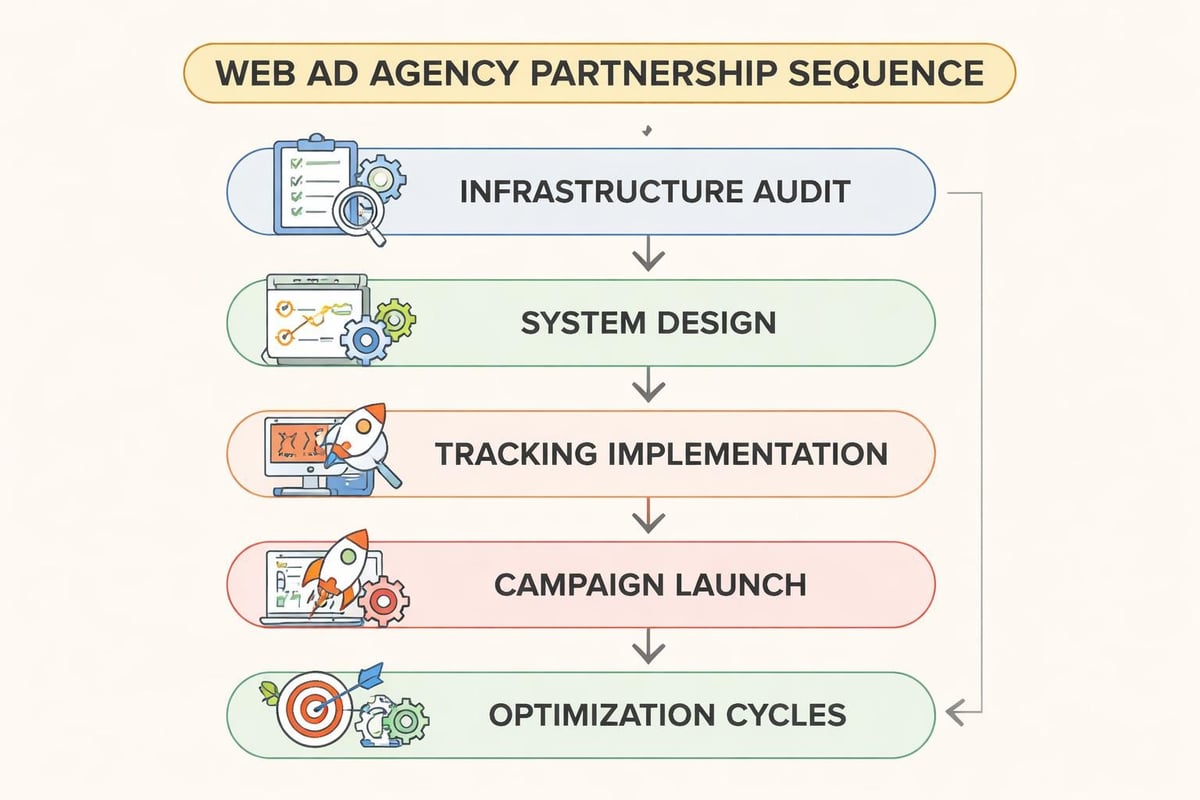
Require Infrastructure Audit First
Before any web ad agency touches your ad accounts, they should audit your current systems:
- What CRM or database are you using?
- How are leads currently captured and distributed?
- What tracking is already in place?
- Where are the gaps between inquiry and close?
- What's your current cost to acquire a customer through other channels?
This audit reveals whether you're ready for paid traffic. Often, the answer is no – not because you can't afford it, but because you'd be pouring water into a leaky bucket. The right agency will tell you to fix the infrastructure first, even if it delays their engagement.
Platform Selection and Channel Strategy
Not every business belongs on every platform. A competent web ad agency matches channel selection to your customer journey, deal size, and sales cycle length.
Google Ads for Active Intent
When someone searches "fractional CFO for SaaS companies," they have immediate intent. Google Ads captures existing demand. It works when:
- Your service solves a specific, searchable problem
- You can afford cost-per-click rates in your market
- You have enough search volume to matter
- Your sales process can convert cold inquiries quickly
It doesn't work well for brand new categories or services people don't know to search for yet.
Meta Ads for Audience Building
Facebook and Instagram excel at interruption-based targeting. You're reaching people based on demographics, interests, and behaviors – not active search intent. This works when:
- You need to create awareness before demand exists
- Your ideal customer fits a clear demographic or interest profile
- You can nurture leads over weeks or months
- Your creative can stop the scroll and educate quickly
The mistake most make is treating Meta like Google – expecting immediate conversions from cold traffic. It's a different game with different metrics.
LinkedIn Ads for B2B and Professional Services
LinkedIn costs more per click but delivers higher intent in B2B contexts. Makes sense when:
- You sell to specific job titles or company sizes
- Deal sizes justify $10-20+ CPCs
- Your sales cycle involves multiple stakeholders
- Content and thought leadership play a role in buying decisions
Trying to run high-volume, low-cost campaigns here usually fails. It's a precision tool, not a volume play.
| Platform | Best For | Typical CPC | Conversion Timeline | Infrastructure Requirement |
|---|---|---|---|---|
| Google Search | Active intent, immediate need | $3-15 | Days to weeks | Strong landing pages, fast follow-up |
| Meta (Facebook/Instagram) | Awareness, audience building | $1-5 | Weeks to months | Nurture sequences, retargeting |
| B2B, professional services | $8-25 | Weeks to months | Sales enablement content, multi-touch attribution | |
| YouTube | Education, demonstration | $0.10-0.30 (view) | Months | Video content library, remarketing |
The creator economy’s growing ad spend now exceeds traditional media channels, suggesting that influence-driven campaigns and partnership models deserve consideration alongside standard platform advertising.
Building Creative That Actually Converts
Creative isn't about winning design awards. It's about moving someone from their current state to the next step in your customer journey. A web ad agency worth working with understands this distinction.
Clarity beats cleverness every time. Your ad should communicate:
- Who it's for (specific audience)
- What problem it solves (real pain point)
- What happens next (clear call to action)
- Why now matters (urgency or consequence)
Most ads fail on the first point. They try to appeal to everyone and end up resonating with no one. The best digital marketing creative narrows focus ruthlessly.
The Landing Page Connection
Your ad creative and landing page must feel like the same conversation. When someone clicks "Download Free Sales Process Template" in your ad, they shouldn't land on your generic homepage.
The page should:
- Echo the exact headline and promise from the ad
- Remove navigation and other distractions
- Ask for appropriate information (don't demand a phone number for a PDF download)
- Explain what happens after they convert
- Load fast and work perfectly on mobile
According to display advertising best practices, many agency inefficiencies stem from disconnected creative and conversion assets. The ad team and landing page team need to be the same team, working from the same strategy.
Data Infrastructure and Attribution Modeling
This is where most web ad agency relationships break down. The agency reports metrics that look good. The client sees no meaningful revenue change. Both sides get frustrated.
The problem is measurement, not performance. Without proper attribution, you're flying blind.
Server-Side Tracking Implementation
Browser-based tracking is dying. iOS restrictions, cookie deprecation, and privacy regulations have made pixel tracking unreliable. You need server-side tracking where:
- Conversion data is sent directly from your server to ad platforms
- You own the first-party data relationship
- Tracking survives browser restrictions and ad blockers
- Attribution accuracy improves by 30-50%
A competent web ad agency implements this before launch, not after campaigns mysteriously stop working.
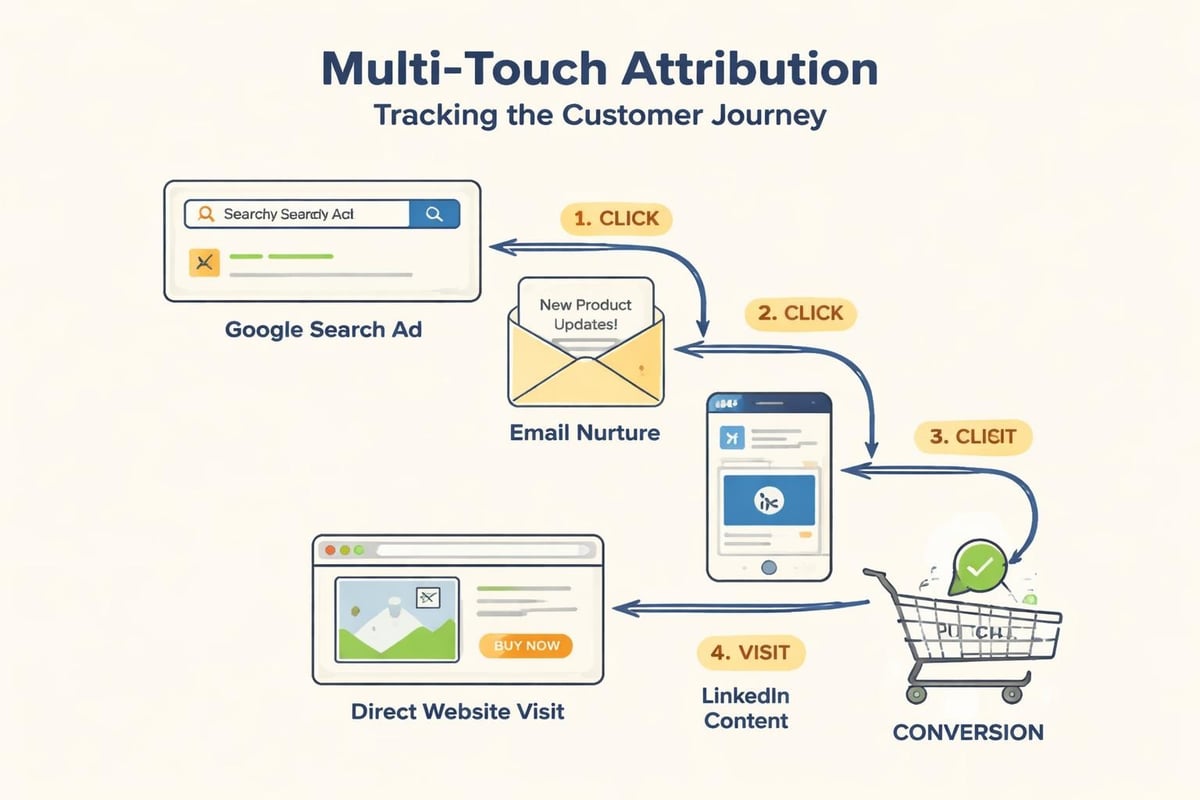
Multi-Touch Attribution Models
Most platforms take credit for every conversion. Google says it drove 100 customers. Facebook says it drove 110. LinkedIn claims 45. You actually closed 60.
Multi-touch attribution assigns fractional credit across the actual customer journey:
- First touch: Which campaign introduced them to you?
- Middle touches: What kept them engaged?
- Last touch: What triggered the final conversion?
This reveals which channels work together and how your customer journey actually flows. A web ad agency should build these reports, not rely on platform-native attribution.
The Real Cost of Working With a Web Ad Agency
Pricing models vary wildly, but the underlying economics are consistent. You're paying for three things: strategic planning, execution time, and media spend.
Percentage of ad spend models (typically 15-25%) align agency incentives with media buying but create conflicts around budget optimization. The agency makes more when you spend more, even if smaller budgets might work better.
Fixed monthly retainers ($3,000-15,000+ depending on scope) provide predictability but can lead to scope creep or underdelivery if the relationship isn't clearly defined.
Performance-based models (pay per qualified lead or acquisition) sound attractive but often fail because "qualified" means different things to agencies and clients. The agency optimizes for their definition, not yours.
The best arrangements combine retainer (for strategic work and infrastructure) with performance bonuses tied to actual revenue metrics. Both parties win when results improve.
What You Should Actually Budget
For service businesses with average customer values above $5,000:
- Minimum $2,500-5,000/month in ad spend to generate meaningful data
- Agency fees of $2,500-7,500/month depending on platform complexity
- Initial setup investment of $5,000-15,000 for tracking, landing pages, and CRM integration
Trying to run paid advertising for less than this usually means cutting corners on infrastructure, which undermines the entire effort. Recent analysis of revised local ad outlook shows increased pressure on smaller budgets, making strategic spending even more critical.
Evaluating Web Ad Agency Partners
When you're talking to potential agencies, here's what to ask:
"Walk me through how you'd set up tracking and attribution before running our first ad." If they gloss over this or suggest starting with campaigns and adding tracking later, walk away.
"Show me an example of how you integrate with CRM systems." They should have specific technical knowledge, not vague promises about "seamless integration."
"What happens to leads that don't convert immediately?" There should be a defined nurture process, not just "we'll retarget them."
"How do you determine which platforms to use?" The answer should involve your customer research, not their platform preferences or existing expertise.
"What does month one look like versus month six?" Early months focus on testing and data gathering. Later months focus on scaling what works. If they promise immediate results, they're either lying or planning to game metrics.
For context on maintaining quality standards, review these best practices for thriving at an ad agency to understand what separates strong operational cultures from chaotic ones.
Building Internal Capacity Alongside Agency Work
The best web ad agency partnerships transfer knowledge, not just provide service. You should be getting smarter about your marketing systems, not more dependent.
Look for agencies that:
- Document their processes and share access to all tools
- Train your team on campaign management basics
- Explain strategic decisions rather than just reporting results
- Build assets you own (landing pages, creative libraries, tracking systems)
- Create frameworks you can eventually run internally if you choose
The goal isn't to replace the agency, it's to develop internal fluency so you can make informed decisions and spot problems early.
Some service businesses eventually bring advertising in-house after 12-24 months with a good agency. Others maintain the relationship indefinitely because the agency provides specialized expertise they don't want to hire for. Both outcomes are fine if the infrastructure is yours.
Integration With Broader Marketing Systems
A web ad agency doesn't operate in isolation. Paid advertising should connect to your content marketing and branding efforts, your organic search strategy, your email database, and your sales process.
The handoff points matter most:
- Ad to landing page (messaging consistency)
- Landing page to CRM (data capture and routing)
- CRM to sales team (lead notification and qualification)
- Sales team to nurture sequence (for not-yet-ready prospects)
- Nurture sequence back to sales (when engagement indicates readiness)
When these connections work smoothly, your cost per acquisition drops because less falls through the cracks. When they're broken, even great ads produce disappointing revenue.
Your agency should be asking about these systems, not just your ad budget. If they focus solely on campaign setup without understanding the broader infrastructure, you're working with tacticians, not strategists.
Common Mistakes That Kill ROI
Even with good agencies, these patterns undermine results:
Pulling the plug too early: Paid advertising requires 90-120 days to generate meaningful data. Shutting down after 30 days because immediate ROI isn't there means you paid for education but left before applying it.
Ignoring creative refresh cycles: The same ad creative fatigues after 30-60 days depending on audience size. Conversion rates drop not because targeting failed, but because people have seen your ad twelve times. Plan for regular creative updates.
Optimizing for the wrong metrics: Agencies report what makes them look good. Make sure they're tracking what actually matters to your business, even if those numbers look less impressive initially.
Scaling before validation: Finding one winning ad set doesn't mean you're ready to 10x your budget. Scale gradually while maintaining efficiency. Rapid budget increases often crater performance.
Disconnecting ad messaging from sales conversations: Your sales team needs to know what promises your ads make. When messaging doesn't align, prospects feel bait-and-switched.
What Good Actually Looks Like
After 90-180 days with a competent web ad agency, you should see:
- Predictable lead flow at consistent cost per lead
- Clear attribution showing which campaigns drive actual customers
- Documented processes for lead handling and follow-up
- Improving conversion rates as landing pages and sequences are optimized
- Declining customer acquisition cost as the system matures
- Sales team confidence in lead quality
The numbers won't be perfect. Testing continues indefinitely. But the trend should be clear: increasing predictability and improving efficiency.
That's the difference between working with an order-taker who runs campaigns and a true partner who builds systems. The order-taker delivers activity. The partner delivers compounding infrastructure that makes every marketing dollar work harder over time.
Understanding website design best practices helps you evaluate whether your agency's conversion assets meet modern standards or need rebuilding.
Running paid advertising without proper systems is expensive hope disguised as marketing. The web ad agency you choose should build infrastructure first, then use advertising as one component of predictable demand generation. If you're ready to move past campaign chaos and build marketing systems that actually compound over time, MDO Digital helps service businesses design the tracking, automation, and conversion architecture that turns ad spend into scalable revenue. We remove the guesswork and protect every lead you pay for.