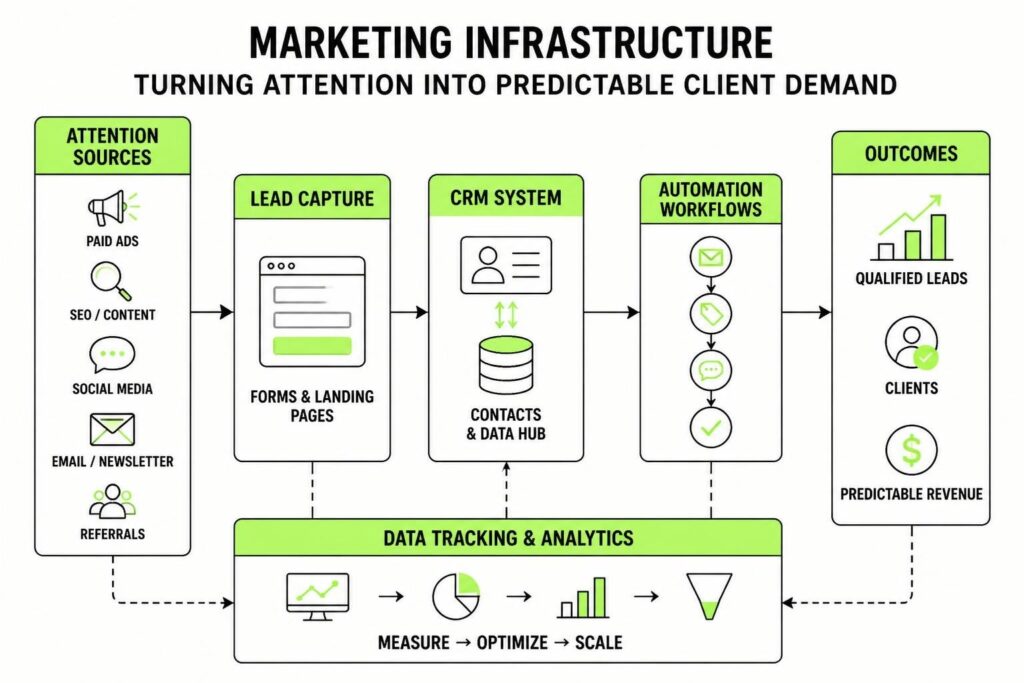
Most service businesses run their marketing like a series of disconnected experiments. A bit of content here, some Facebook ads there, maybe an email when they remember. It works until it doesn't. When growth happens, it feels random. When leads dry up, there's no clear lever to pull. The missing piece isn't creativity or effort. It's marketing infrastructure.
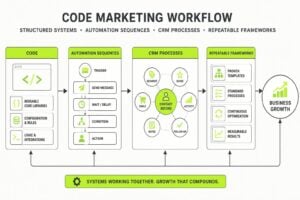
Marketing infrastructure is the foundation of systems, tools, and processes that captures attention, nurtures relationships, and converts leads predictably. It's not glamorous. It's the plumbing behind every successful service business that scales without constant firefighting. Think CRM databases, automation sequences, lead scoring workflows, tracking pixels, form submissions, email sequences, and the connections between them all.
Why Most Businesses Skip Infrastructure
Service businesses want clients today. Infrastructure feels like a tomorrow problem.
The reality is simpler and harder. Without structured systems, every lead is handled manually. Every follow-up requires someone to remember. Every conversion relies on luck and timing rather than design. You end up with:
- Enquiries sitting in generic email inboxes
- No clear view of which marketing activities generate revenue
- Manual tasks eating time that should go to delivery
- Inconsistent client experiences
- Zero ability to predict next month's pipeline
The cost isn't obvious immediately. You lose leads you never knew you had. Relationships decay because follow-up doesn't happen. Growth stalls because you can't identify what's working. Building marketing systems becomes urgent only after enough revenue slips through the cracks.
Infrastructure creates compound returns. Each lead captured feeds your database. Each automation you build runs forever. Each insight from your data improves the next campaign. The businesses that grow predictably aren't working harder. They built systems early that handle the repetitive work while they focus on strategy and delivery.
Core Components of Marketing Infrastructure
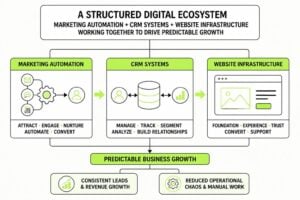
Marketing infrastructure isn't a single tool. It's a collection of connected systems that work together. Understanding the core components of your marketing tech stack helps you build deliberately rather than reactively.
Customer Relationship Management (CRM)
Your CRM is the central nervous system. Every contact, every interaction, every conversion lives here. It's not just a contact database. It's your source of truth for:
- Who entered your world and when
- What content they engaged with
- Where they are in the buying journey
- Which team member owns the relationship
- What actions triggered automatically
Choose based on how you actually work. A complex enterprise CRM creates friction if you're a small team. A spreadsheet creates chaos if you're handling dozens of leads monthly. The right CRM matches your volume, complexity, and growth trajectory.
Marketing Automation Platform
Automation handles the repetitive touches that build relationships at scale. Someone downloads a guide at 2am on Sunday. Your automation acknowledges it immediately, delivers the resource, and begins a nurture sequence designed around their specific interest.
This isn't about tricking people. It's about consistency. Every lead gets the same quality experience whether they arrive during your busiest week or slowest month. Your automation platform connects to your CRM, email system, website forms, and advertising platforms to orchestrate these sequences.
| Infrastructure Layer | Primary Function | Key Metrics |
|---|---|---|
| CRM Database | Store and manage contact relationships | Contact growth, data completeness, engagement history |
| Marketing Automation | Execute campaigns and nurture sequences | Email open rates, click rates, conversion rates |
| Analytics & Tracking | Measure performance and attribution | Traffic sources, conversion paths, ROI by channel |
| Content Management | Publish and organize marketing assets | Page views, time on site, content engagement |
| Lead Capture Tools | Convert visitors to contacts | Form completion rate, lead quality score |
Data and Analytics Layer
You can't improve what you don't measure. The analytics layer tracks how people find you, what they do on your site, which emails they open, what content resonates, and ultimately what converts them to clients.
Reliable marketing data infrastructure means you can answer questions like: Which blog posts generate qualified leads? What's the average time from first contact to conversion? Which advertising campaigns pay for themselves?
Tracking pixels, UTM parameters, form submissions, and conversion events all feed into this layer. The goal is connecting activity to outcomes. Not vanity metrics. Revenue metrics.
Communication Channels
Email remains the workhorse for most service businesses, but your infrastructure needs to support wherever your audience lives. This might include:
- Email sequences for nurture and conversion
- SMS for time-sensitive updates
- Web chat for immediate questions
- Social messaging for community building
The infrastructure ensures these aren't siloed. A conversation started in web chat appears in your CRM. An email reply triggers a task for your team. Everything connects.
Building Your Marketing Infrastructure
Start with the minimum viable system that solves your biggest bottleneck. For most service businesses, that's lead leakage. Enquiries that never get followed up. Interested prospects who fall through gaps.
Step One: Audit Current State
Map every way a potential client can contact you. Website forms, email addresses, phone numbers, social media messages, referrals. Then trace what happens to each.
Be brutally honest. If enquiries from your contact form sometimes sit unread for days, write that down. If you have no system for following up with people who weren't ready to buy six months ago, acknowledge it. The gaps are your roadmap.
Step Two: Choose Your Core Stack
You need three foundational pieces:
- CRM to centralise contacts and relationships
- Automation platform to execute sequences consistently
- Analytics to measure what matters
Many platforms combine these functions. Others integrate cleanly. Building a marketing tech stack that matches your specific needs matters more than following trendy tool recommendations.
Consider total cost of ownership. This includes licensing, integration costs, training time, and maintenance. A free tool that requires 10 hours monthly to manage costs more than a paid solution that runs itself.
Step Three: Design Your Lead Flow
Every contact should enter a deliberate journey. Not random. Not manual. Designed.
Someone fills your contact form requesting information about your services. What happens next?
- Immediate acknowledgment email confirming receipt
- CRM entry with source tracking and lead score
- Task created for team member to review within 24 hours
- Automated education sequence begins if no immediate response
- Follow-up reminders at planned intervals
- Re-engagement campaign if contact goes cold
This isn't complex automation for its own sake. It's ensuring no opportunity dies from neglect. A structured marketing plan helps you think through each stage of the client journey and what systems need to support it.

Step Four: Implement Progressive Profiling
You don't need to know everything about someone the moment they enter your world. Progressive profiling means collecting information gradually as the relationship develops.
First visit: Just email and name
After downloading a guide: Industry and company size
Requesting a consultation: Specific challenges and timeline
Becoming a client: Full profile completion
This reduces friction at each stage while building a complete picture over time. Your infrastructure supports this by tracking what you know and what you still need to learn.
Step Five: Connect Your Data
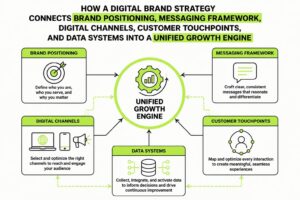
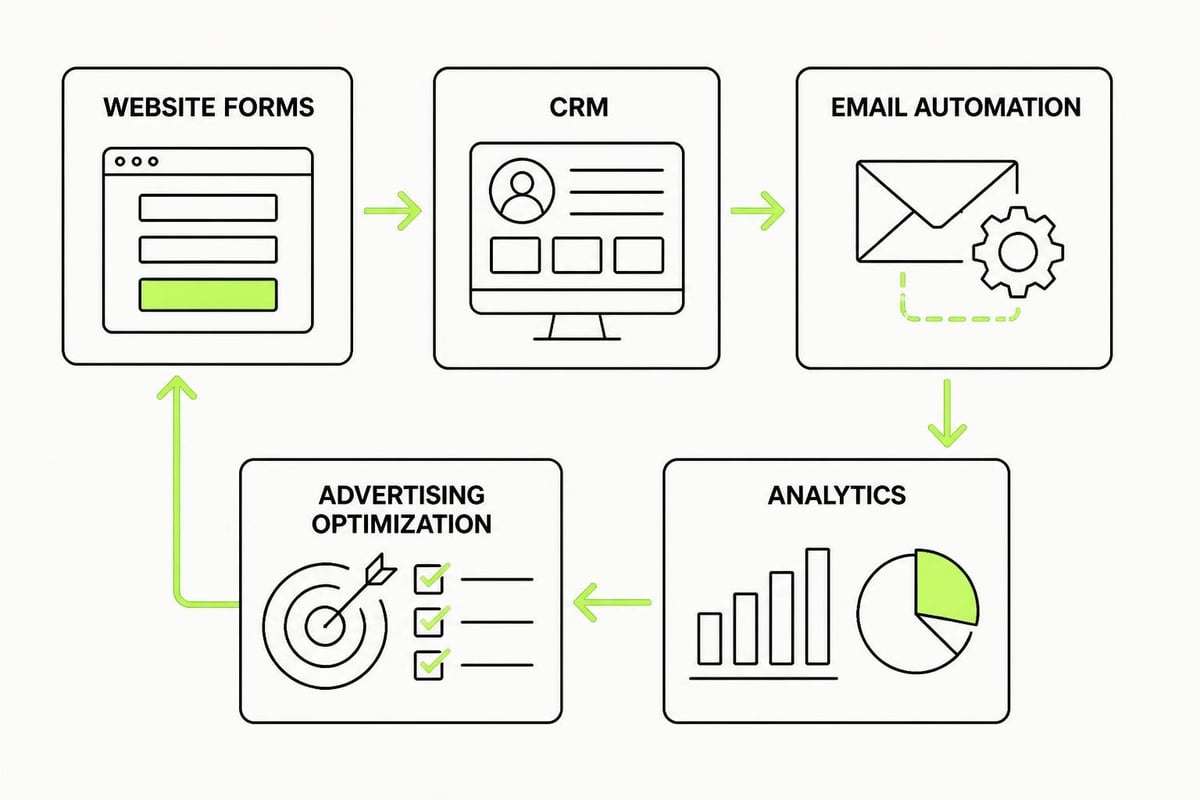
The power of marketing infrastructure comes from integration. When your website talks to your CRM, your CRM triggers your email platform, your email platform reports to your analytics, and your analytics inform your advertising, you create a system that learns and improves.
Technical marketing infrastructure focuses on these connections. Tracking codes that follow visitors across devices. Webhooks that pass data between systems instantly. APIs that sync contact records. UTM parameters that attribute conversions accurately.
This technical layer feels invisible when working properly. That's the point. Your team interacts with simple interfaces while complex data flows happen automatically beneath the surface.
Common Infrastructure Mistakes
Building marketing infrastructure wrong costs time and money. Here's what breaks most often.
Over-Engineering Too Early
Buying enterprise-grade tools before you have enterprise-grade volume creates friction. You spend more time managing the system than using it. Start simple. Scale when you feel genuine constraint, not anticipated future needs.
The best infrastructure grows with you. A CRM that handles 100 contacts beautifully might buckle at 10,000. Plan the migration path, but don't build for problems you don't have yet.
Under-Investing in Data Quality
Your infrastructure is only as good as the data inside it. Duplicate contacts, incomplete records, outdated information, and inconsistent formatting all degrade system performance.
Set data standards early:
- Required fields for new contacts
- Naming conventions for campaigns and tags
- Regular cleanup schedules
- Validation rules on forms
Clean data compounds. Dirty data multiplies problems.
Ignoring User Adoption
The fanciest infrastructure means nothing if your team doesn't use it. Choose tools that match how your team actually works. Provide training. Create simple processes. Remove barriers to adoption.
If adding a contact to your CRM requires 15 clicks and four dropdown menus, people will use a spreadsheet instead. Friction kills good systems.
Measuring Everything, Learning Nothing
Analytics can track hundreds of metrics. That doesn't mean you should watch them all. Focus on metrics that inform decisions. Revenue by source. Cost per acquisition. Lead to client conversion rate. Customer lifetime value.
Data driven marketing requires both collection and analysis. The infrastructure captures everything. You choose what to act on.
Infrastructure Maintenance and Evolution
Marketing infrastructure isn't set and forget. Regular maintenance keeps it performing.
| Maintenance Task | Frequency | Purpose |
|---|---|---|
| Data cleanup and deduplication | Monthly | Maintain database accuracy |
| Automation sequence review | Quarterly | Update messaging and offers |
| Integration testing | Monthly | Catch broken connections early |
| User access audit | Quarterly | Remove old users, assign new ones |
| Performance benchmarking | Monthly | Track improvement over time |
| Stack evaluation | Annually | Assess if tools still fit needs |
Technology changes fast. Tools that seemed permanent get acquired, deprecated, or surpassed. Stay current without chasing every new shiny object. Evaluate major changes annually. Make small optimizations quarterly.
Your infrastructure should feel slightly ahead of current needs but not overwhelmingly complex. This balance shifts as you grow. What felt robust at $500K revenue might feel constraining at $2M. Plan for evolution.
When to Expand Your Infrastructure
You'll know it's time to add capability when manual work consistently blocks growth. Common trigger points include:
- Lead volume exceeding team capacity to respond personally
- Multiple team members needing access to contact history
- Inability to track which marketing generates actual revenue
- Customer experience becoming inconsistent
- Hours spent on repetitive tasks that could automate
- Missing opportunities because follow-up doesn't happen
Don't wait for a crisis. Building marketing and business systems works best as steady evolution rather than emergency response.
Add one capability at a time. Implement it properly. Let your team adapt. Then consider the next addition. Rushed infrastructure deployment creates more problems than it solves.
Infrastructure as Competitive Advantage
Most service businesses compete on expertise and relationships. Marketing infrastructure doesn't replace these. It amplifies them.
When you respond within minutes instead of days, you win clients from slower competitors. When you nurture relationships consistently for months, you're top of mind when someone's ready to buy. When you can predict pipeline three months out, you make better hiring and investment decisions.
The businesses that feel effortless are running serious infrastructure behind the scenes. Every email arrives on time. Every lead gets acknowledged. Every conversion gets tracked. Every insight informs the next campaign. Implementing effective marketing governance ensures these systems run reliably over time.
This creates a moat. Competitors can copy your offer. They can mimic your positioning. They can't quickly replicate years of refined infrastructure, clean data, and automated workflows.
Practical Next Steps
If you're running marketing without proper infrastructure, start here:
- Document your current lead flow from first contact to paying client
- Identify the biggest gap where leads or opportunities get lost
- Choose one foundational tool (likely a CRM) that solves that gap
- Implement it properly with clean data and clear processes
- Build one automation that handles repetitive work
- Measure the impact on lead conversion and team time
- Add the next capability when this one runs smoothly
Marketing infrastructure isn't about having the most tools. It's about building systems that work reliably without constant attention. Systems that capture every opportunity. Systems that turn attention into predictable client demand. Systems that let you focus on delivery and strategy instead of firefighting and manual follow-up.
Marketing infrastructure transforms chaotic growth into predictable systems. When leads flow into structured workflows, automation handles consistent follow-up, and data guides your decisions, you create compound returns that accelerate over time. At MDO Digital, we help service businesses build the CRM, automation, and tracking infrastructure that removes chaos and creates scalable growth. If you're ready to stop losing leads and start building systems that work while you focus on delivery, let's talk about what infrastructure your business actually needs.