Most tradies run their marketing the same way they run their first job site. Reactive, stressed, and hoping the phone rings. One week you're flat out, the next you're chasing invoices and wondering where the next job's coming from. Marketing for tradies isn't about creating viral content or running complicated ad campaigns. It's about building a system that protects your pipeline, captures demand when it shows up, and turns attention into predictable work. The difference between tradies who stay busy and tradies who scale is simple. Systems beat hustle every time.
Why Most Tradie Marketing Fails Before It Starts
The problem isn't effort. Most tradies work harder than anyone else in their supply chain. The problem is structure. You're running marketing like a side project instead of treating it like the infrastructure that feeds your business.
Here's what usually happens:
- Someone gets your number from a mate
- You quote the job over text
- They ghost you or go with someone cheaper
- You forget to follow up because you're on site
- Six months later they book someone else
No CRM. No follow-up. No system to protect the lead.
Effective marketing for tradies starts with accepting that word of mouth alone won't scale your business. Referrals are brilliant when they happen, but they're not a strategy you can control. A proper system captures demand from multiple sources, nurtures prospects who aren't ready yet, and converts attention into booked work without you chasing every lead manually.
The Real Cost of Ignoring Marketing
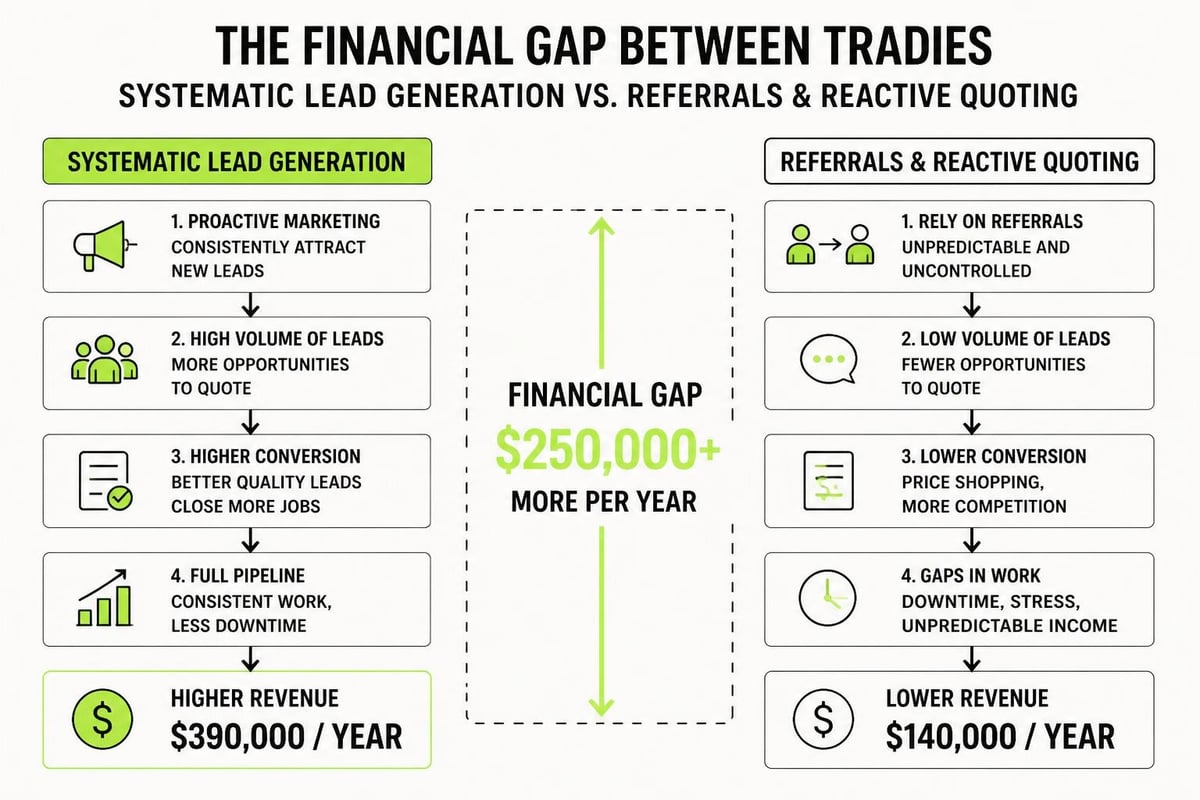
When you don't have a marketing system, you're not just losing leads. You're bleeding margin. You take every job that comes through because you're never sure when the next one will land. You can't plan capacity, hire confidently, or turn down bad-fit clients. That's not growth, that's survival mode with a ute.
What Marketing for Tradies Actually Looks Like
Forget the fluff. Marketing for tradies comes down to being visible when someone needs you, looking credible when they check you out, and staying front of mind until they're ready to book. That's it. Three clear objectives that require specific infrastructure.
Your Website Isn't a Brochure
Most tradie websites are digital business cards. Name, phone number, maybe some photos from 2019. That's not enough in 2026. Your website needs to do three jobs:
- Prove you're legitimate (testimonials, before/after shots, clear service areas)
- Capture contact details (quote forms, phone clicks, chat widgets)
- Answer objections before they happen (pricing guides, process explanations, guarantees)
Your website is the first filter in your system. It should qualify leads, set expectations, and make booking you the obvious next step. If someone lands on your site and leaves without a way for you to follow up, your system's broken at step one.
| Website Element | Purpose | Conversion Impact |
|---|---|---|
| Quote form | Capture lead details | High |
| Before/after gallery | Build credibility | Medium |
| Service area map | Qualify location | High |
| Testimonials with photos | Reduce buying friction | High |
| Clear pricing guide | Filter budget fit | Medium |
Local SEO Is Your Steady Pipeline
When someone in your area searches "plumber near me" or "electrician Sunshine Coast," you either show up or you don't. Local SEO for tradies is the single highest-ROI channel you can build because the intent is perfect. They need what you do, right now, in your area.
Here's the non-negotiable setup:
- Google Business Profile optimised with current photos, services, and posts
- Consistent NAP (name, address, phone) across every online directory
- Reviews flowing in monthly through automated requests
- Service pages targeting local suburbs you actually work in
The best part? Once it's set up properly, local SEO compounds. Every review, every job, every piece of content makes you more visible. It's infrastructure that gets stronger over time, not a cost you pay forever.
The CRM You're Probably Not Using
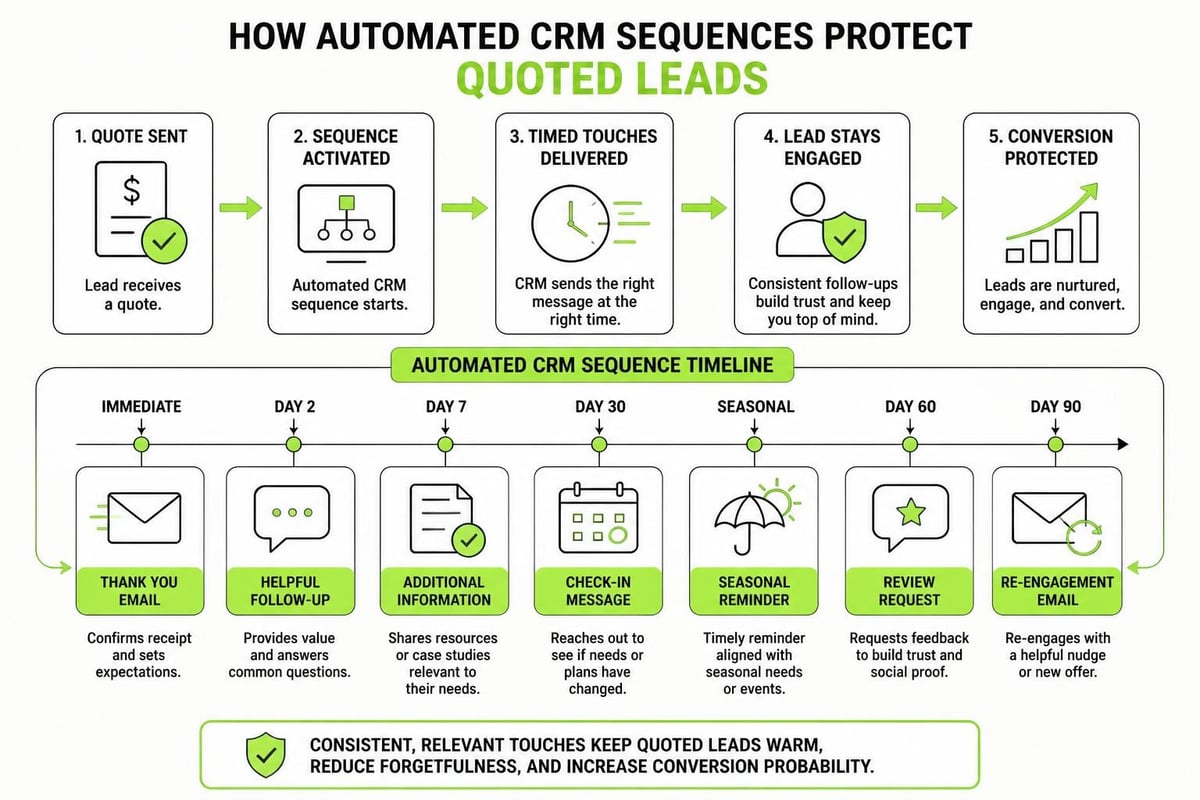
If you're storing leads in your phone or a spreadsheet, you're losing money daily. A proper CRM doesn't just store contacts. It automates the follow-up that separates you from every other tradie who quotes and forgets.
Here's what a basic tradie CRM should handle:
- Automatic follow-up sequences for quoted jobs
- Reminders for seasonal work (gutter cleaning, aircon servicing)
- Post-job review requests sent at the right time
- Lead source tracking so you know what's actually working
You don't need Salesforce. You need something simple that runs in the background and makes sure no lead falls through the cracks. The ROI isn't in winning every lead. It's in not losing the ones you've already paid to generate.
Building a Marketing System That Actually Converts
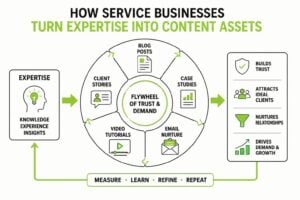
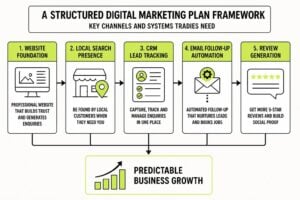
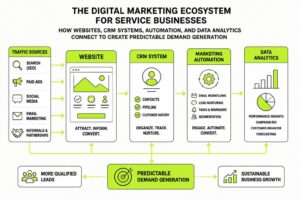
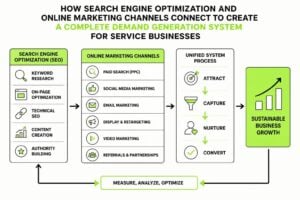
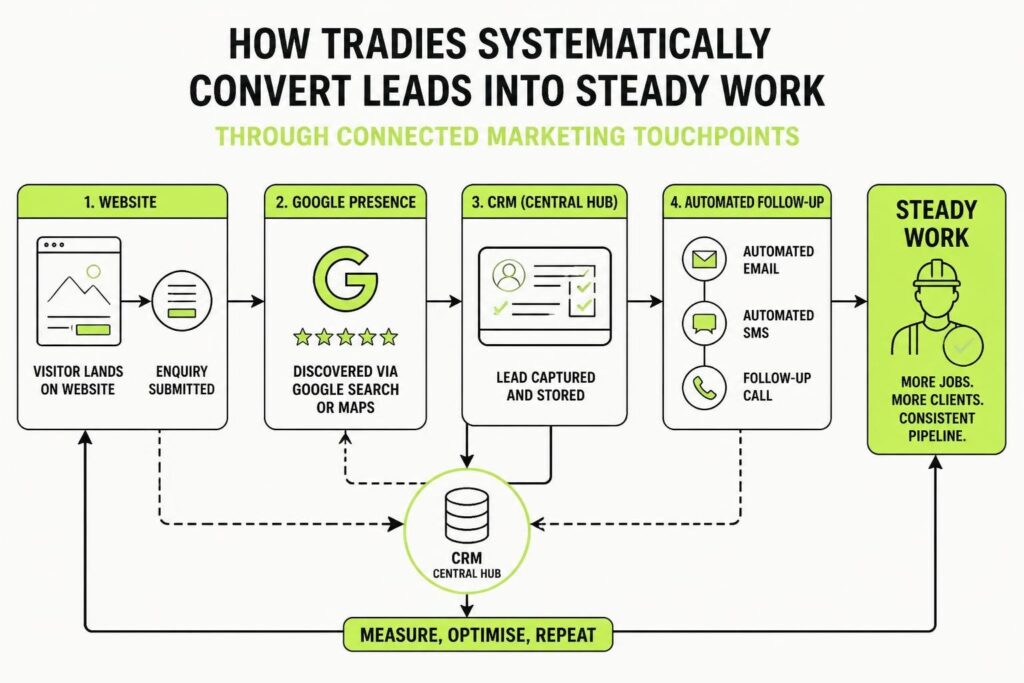
Marketing for tradies works when you treat it like a system, not a series of random tactics. Each piece connects to the next. Traffic sources feed your website. Your website feeds your CRM. Your CRM protects leads and generates reviews. Reviews improve your SEO and social proof. The flywheel compounds.
Step One: Fix Your Foundation
Before you spend a dollar on ads or post another photo on Instagram, fix the basics. That means a website that converts, a Google Business Profile that's complete, and a CRM that follows up automatically. Building structured marketing systems starts with infrastructure, not campaigns.
Most tradies skip this step and wonder why their ads don't work. You're driving traffic to a leaky bucket. Fix the bucket first.
Step Two: Choose Your Lead Sources
You don't need to be everywhere. You need to own 2-3 channels that consistently deliver qualified leads. For most tradies in 2026, that's:
- Google (organic + Business Profile): High intent, local, ready to book
- Meta ads (Facebook/Instagram): Broad reach, brand awareness, retargeting
- Strategic partnerships: Builders, real estate agents, property managers
Pick the channels that match how your ideal clients actually find tradies. If you're in residential plumbing, Google and Facebook win. If you're doing commercial fit-outs, LinkedIn and partnerships matter more. Don't spray and pray.
Step Three: Automate What Repeats
Every quote you send manually, every follow-up you forget, every review you don't ask for is margin you're leaving on the table. The goal isn't to automate everything. It's to automate the repeatable parts so you can focus on the work that actually requires your expertise.
What to automate in 2026:
- Quote follow-ups (3 days, 7 days, 14 days)
- Review requests (sent 48 hours post-job)
- Seasonal service reminders (based on last job type)
- Lead nurture for quoted-but-not-booked prospects
- Social proof emails showing recent work in their area
If you're following up with a simple framework that predictably moves prospects from quote to booking, you're already ahead of 90% of tradies in your market. That structure is what proven marketing strategies are built on.
The Channels That Matter in 2026
Let's cut through the noise. Some channels work for tradies. Some don't. Here's what's actually converting in 2026.
Google Business Profile (Non-Negotiable)
If you only do one thing, make it this. Your Google Business Profile is the most valuable piece of digital real estate you own. When optimised properly, it shows up in local searches, displays your reviews, and lets people book or call with one tap.
Weekly maintenance tasks:
- Post photos of completed jobs
- Respond to every review (good and bad)
- Update services and hours seasonally
- Add Google Q&A answers for common questions
Meta Ads (When You're Ready to Scale)
Once your foundation is solid, Meta ads let you control your pipeline. You can target specific suburbs, income brackets, and homeowner demographics. The key is sending traffic to a proper landing page, not just your homepage.
Ads work when you're capturing leads, not just getting likes. If you're running traffic to a quote form connected to your CRM, ads become predictable. If you're boosting posts hoping for calls, you're gambling.
Content That Builds Trust
You don't need to become an influencer. But showing your work, explaining your process, and educating your market builds trust faster than any sales pitch. Short-form video works brilliantly for tradies because you can show the before/after, the problem/solution, the thing most people get wrong.
| Platform | Best For | Posting Frequency | Content Type |
|---|---|---|---|
| Residential clients | 3-4x per week | Reels, Stories, project photos | |
| Local community building | 2-3x per week | Before/afters, tips, community posts | |
| YouTube | Educational content | 1x per week | Process videos, how-tos, FAQs |
| Commercial/B2B work | 1-2x per week | Case studies, industry insights |
The goal isn't virality. It's consistency. Regular content keeps you top of mind with past clients and proves expertise to new ones. When someone's ready to book, you're the obvious choice because they've been watching you nail jobs for months.
Where Most Tradies Waste Money
Marketing for tradies goes sideways in predictable ways. Avoid these and you'll save thousands.
Paying for Leads You Can't Close
Lead gen services sound great until you realise you're competing with five other tradies for the same lukewarm prospect. The lead quality's ordinary, the conversion rate's terrible, and you're paying per lead whether they book or not.
If you're going to pay for leads, own the source. Run your own ads, build your own list, control the experience. You'll pay less per lead and close at higher rates because you're not fighting other tradies for attention.
Inconsistent Branding Across Channels
Your van says one thing, your website says another, your Instagram looks like it's run by someone else entirely. Strong branding isn't about fancy logos. It's about looking like a business that has its act together across every touchpoint.
When your branding's consistent, trust builds faster. When it's all over the place, prospects wonder if you'll be just as disorganised on their job.
Ignoring the Numbers
Most tradies have no idea which marketing channel actually generates profit. They know they got a job "from Facebook" or "from Google," but they can't tell you cost per lead, conversion rate, or ROI per channel.
If you're not tracking lead source, quote-to-close rate, and customer lifetime value, you're flying blind. You might be doubling down on channels that lose money while ignoring the ones that print it.
The Follow-Up System That Separates You
Here's the truth. Most jobs aren't lost because your quote was too high. They're lost because you didn't follow up and someone else did. A proper marketing system for tradies includes structured follow-up that runs automatically.
The basic sequence:
- Quote sent (immediate)
- Follow-up email (3 days): "Just checking if you had any questions about the quote"
- Follow-up SMS (7 days): "Still happy to help with [specific job]. Let me know if timing's changed"
- Final touchpoint (14 days): "Moving you to our waitlist. If anything changes, I've kept the quote valid for 30 days"
After that, they move into a nurture sequence. Seasonal reminders, helpful content, case studies of similar jobs. You stay front of mind without being pushy. When they're ready, you're the first call.
Building a structured marketing plan around this kind of systematic follow-up means you're not leaving revenue on the table every time a prospect goes quiet. You're protecting every dollar you spend generating leads in the first place.
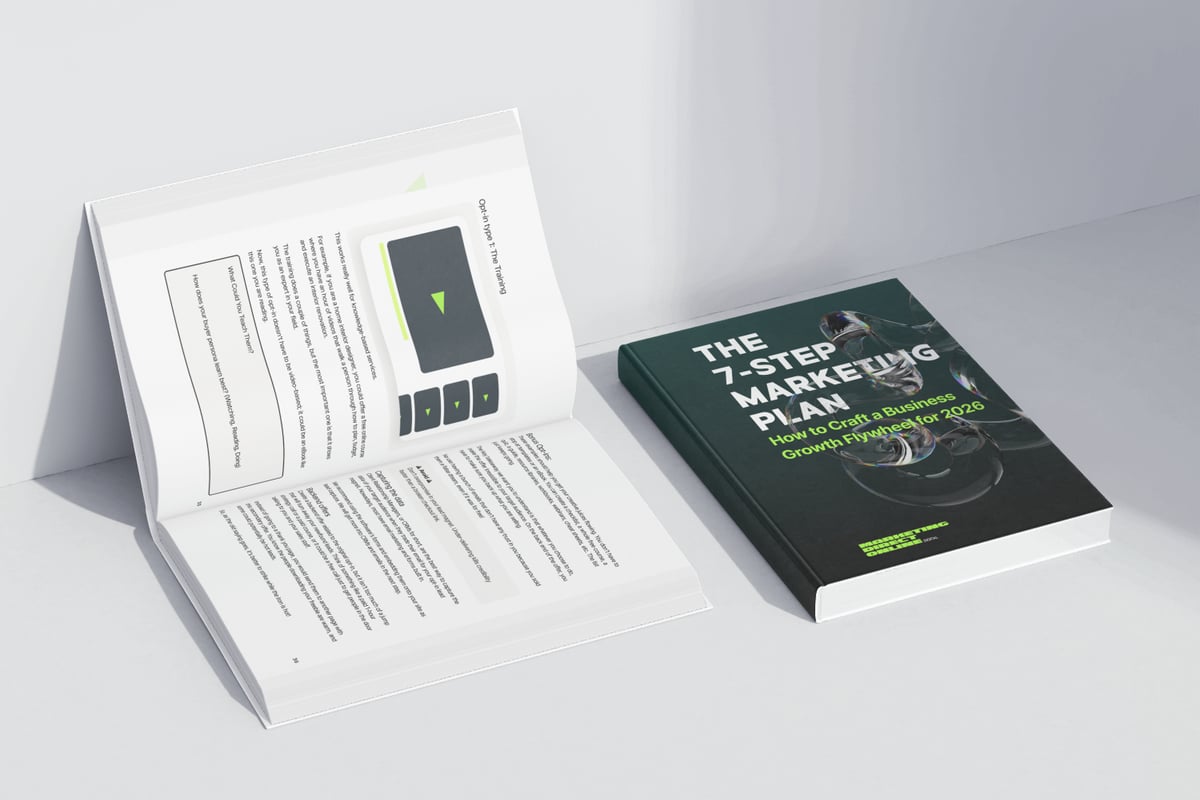
If you want a practical framework that connects all these pieces into a repeatable system, the 7-Step Marketing Plan walks through exactly how to structure your marketing from goal-setting through to referral generation. Each step feeds the next, creating a flywheel that keeps delivering leads and clients.
What Good Marketing for Tradies Actually Costs
Let's talk numbers. Marketing isn't free, but it shouldn't be a mystery either. Here's what realistic investment looks like in 2026 for a tradie business turning over $300K-$1M annually.
Foundation Setup (One-Time)
- Website build/rebuild: $3,000-$8,000
- CRM setup and automation: $1,500-$3,000
- Branding refresh (if needed): $2,000-$5,000
- Google Business Profile optimisation: $500-$1,000
Monthly Running Costs
- Ad spend (Google/Meta): $500-$2,000
- CRM subscription: $50-$200
- Website hosting/maintenance: $50-$150
- Content creation: $300-$800
- SEO maintenance: $400-$1,200
Total monthly investment: $1,300-$4,350 depending on scale and channels.
That feels like a lot until you compare it to what one lost job costs you. If proper marketing systems generate even two extra jobs per month at $2,000 average value, you're looking at $4,000 in revenue against $2,000 in costs. The math works when the system works.
Common Objections (And Why They're Wrong)
"Word of mouth works fine for me." Great. But what happens when your best referrer moves interstate or your main builder switches suppliers? Word of mouth is brilliant supplementary revenue. It's terrible as your only lead source.
"I don't have time for marketing." You don't have time not to. Every hour you spend fixing your marketing system saves you ten hours chasing bad leads or filling gaps in your calendar. Time spent building infrastructure always pays back.
"My customers aren't online." Yes they are. 97% of Australians research services online before booking, even if they heard about you offline. If you're not showing up in that research phase, you're losing to tradies who are.
The Competitive Advantage You're Missing
Most tradies in your market are doing exactly what you used to do. Posting occasionally, hoping for referrals, quoting and forgetting. That's your opportunity. While they're stuck in reactive mode, you build the system that captures demand they're missing.
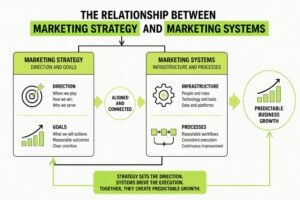
Systematic marketing for service businesses isn't complicated. It's just structured. When you treat marketing like infrastructure instead of a cost, everything changes. You're not chasing work, you're managing pipeline. You're not competing on price, you're winning on process.
The tradies who scale aren't the best marketers. They're just the ones who stopped treating marketing like a side project and started treating it like the system that feeds everything else. That shift alone is worth more than any single tactic you'll ever run.
Marketing for tradies works when you build systems that protect leads, automate follow-up, and create predictable demand. If you're tired of the feast-or-famine cycle and ready to build marketing infrastructure that actually compounds over time, that's exactly what we do at MDO Digital. We help service-based businesses remove chaos, structure their growth, and turn attention into revenue that scales. Let's build something that works.