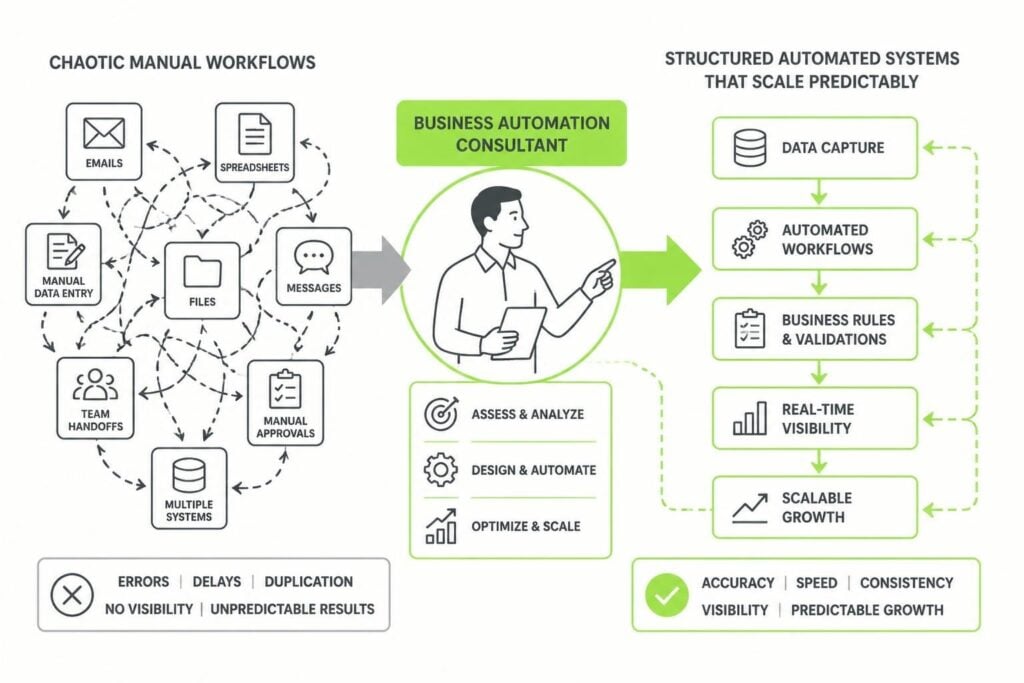
Most service businesses hit the same wall. You're growing, but everything takes twice as long as it should. Manual data entry. Spreadsheets that don't talk to each other. Leads falling through gaps. Your team's chasing their tails, and you're trying to scale using the same processes that got you here. That's where a business automation consultant steps in. Not to sell you software. To rewire how work actually gets done.
What a Business Automation Consultant Actually Does
A business automation consultant maps your current processes, finds the bottlenecks, and builds systems that run without constant human input. They're not coders or project managers. They're translators between your business reality and the tools that can fix it.
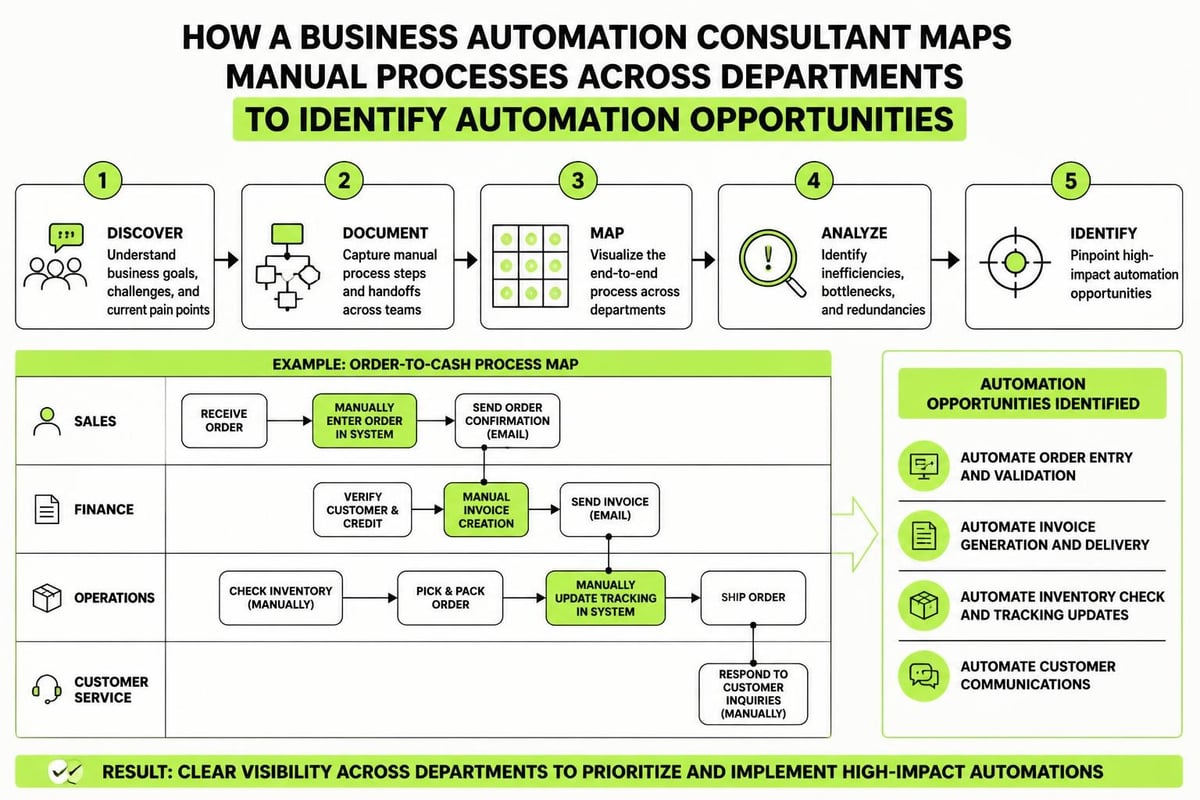
Their job starts with observation. They'll shadow your team, audit your workflows, and document where time disappears. Then they identify what's worth automating. Not everything should be. Some tasks need human judgement. Others are perfect candidates: repetitive, high-volume, rule-based work that drains energy without adding value.
Here's what they typically focus on:
- Lead capture and CRM workflows
- Client onboarding sequences
- Invoice generation and payment tracking
- Report creation and distribution
- Data transfer between platforms
- Appointment scheduling and reminders
According to IBM’s overview of business automation, automation solutions manage repetitive tasks to streamline workflows and drive revenue. A good consultant doesn't just implement tech. They redesign the workflow first, then find the right tools to support it.
When You Actually Need a Business Automation Consultant
You don't need a consultant if you're just starting out. Early on, manual work teaches you what matters. But there are clear signs it's time to bring someone in.
Your team's doing the same tasks over and over
If your staff spend hours each week copying data, sending similar emails, or updating multiple systems with the same information, that's a red flag. Time spent on repetitive admin is time not spent serving clients or growing the business.
Leads are slipping through the cracks
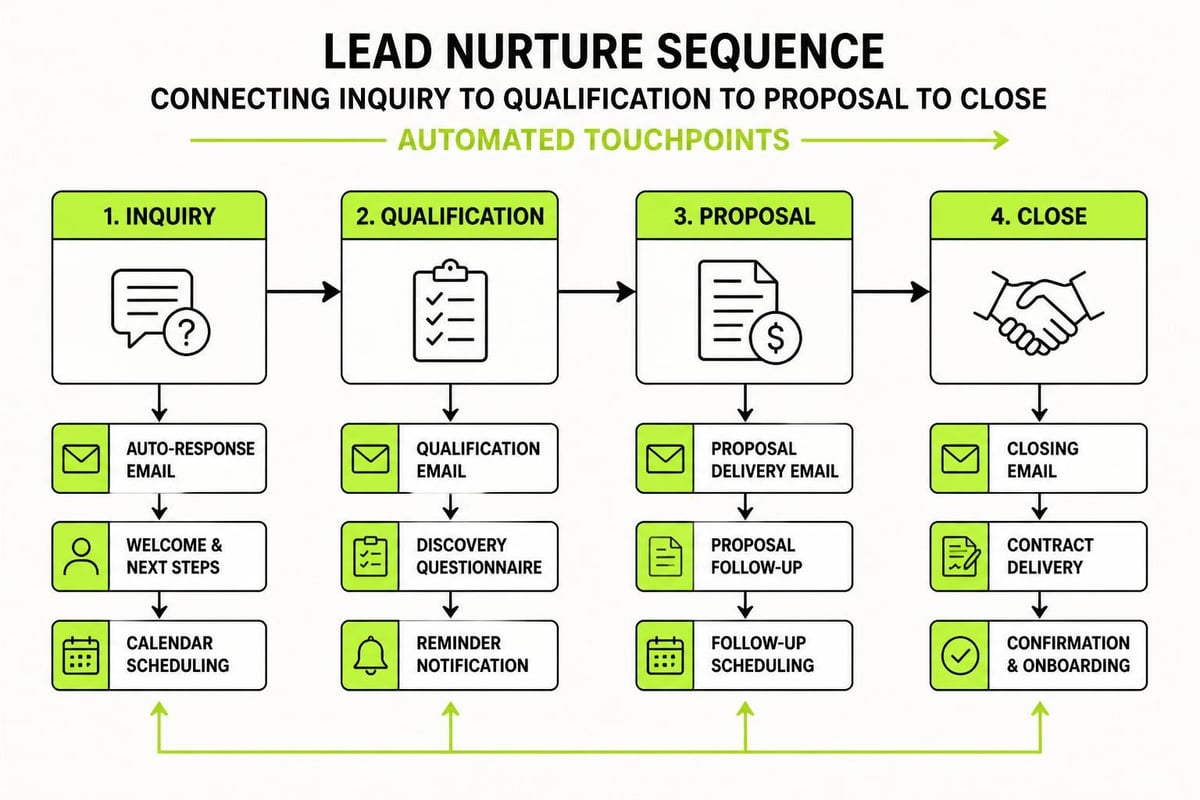
When someone fills out a form and doesn't hear back for days, or inquiries sit in an inbox no one monitors, you're losing money. A business automation consultant builds systems that capture, route, and nurture leads without relying on someone remembering to check their email.
You can't get clear reporting
If you need to manually compile data from three different places just to see how you're tracking, your systems aren't talking to each other. Consultants connect the dots so you get real-time visibility without the busywork.
| Problem | Manual Approach | Automated Solution |
|---|---|---|
| New lead arrives | Check email, copy to CRM, send follow-up | Lead auto-captured, tagged, nurture sequence triggered |
| Client onboarding | Send emails manually, track in spreadsheet | Automated welcome sequence, task creation, document delivery |
| Monthly reporting | Pull data from 4 systems, build in Excel | Dashboard updates in real-time, reports auto-generated |
The role of business automation in operational efficiency has expanded beyond simple task automation to encompass intelligent systems that adapt and scale. That's the shift a consultant helps you navigate.
How Business Automation Consultants Work With Service Businesses
Service businesses are different from product companies. You're selling time, expertise, and relationships. The automation needs to support that, not replace it.
A business automation consultant working with service providers focuses on three core areas: protecting leads, removing admin friction, and creating predictable client experiences.
Protecting leads means no inquiry goes unanswered. Forms connect to your CRM. Responses go out instantly. Follow-ups are scheduled automatically. You're present even when you're not actively working.
Removing admin friction tackles the tasks that don't require your expertise but eat your day. Invoicing, scheduling, file sharing, contract signing. These can all run in the background while you focus on delivery.
Creating predictable client experiences ensures every client gets the same quality journey. Onboarding emails, check-in reminders, review requests. It happens consistently because it's built into the system, not dependent on your team remembering.
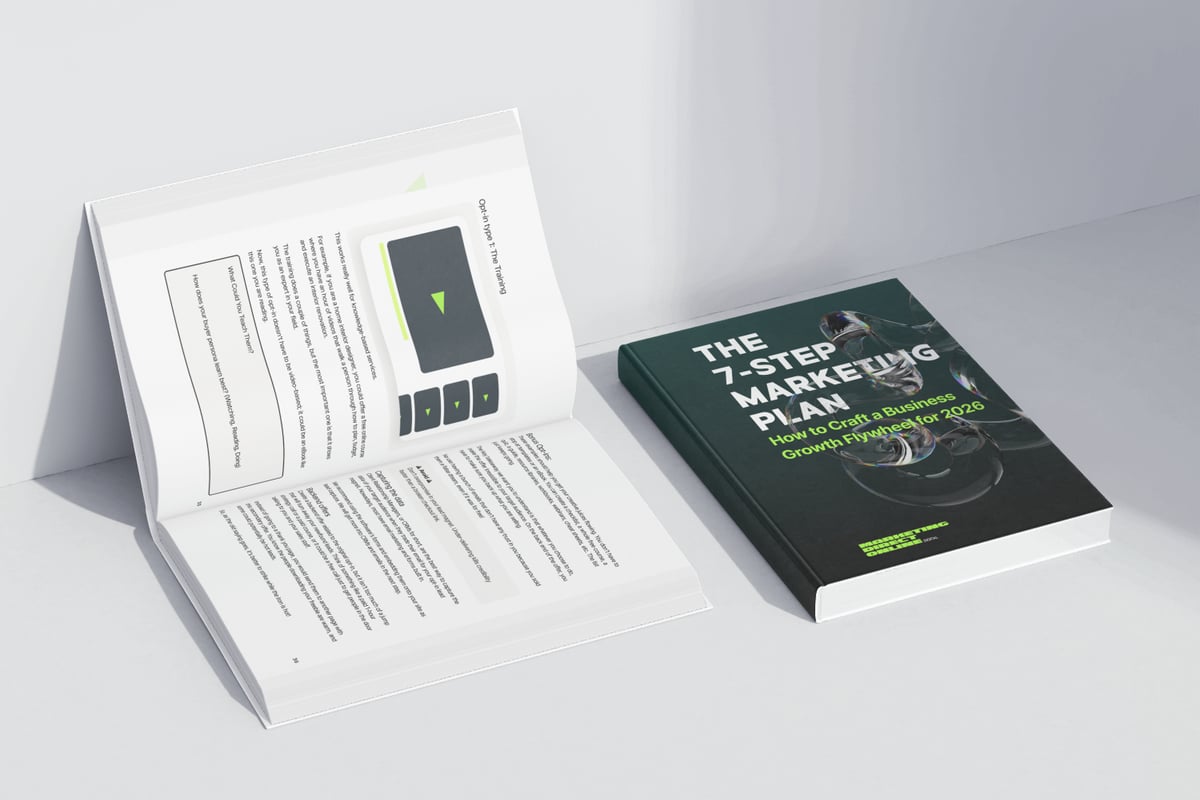
This is where frameworks like the 7-Step Marketing Plan become valuable. When you combine strategic marketing structure with automation infrastructure, you build a system that reliably turns attention into demand. A consultant helps wire those pieces together so they reinforce each other.
The Difference Between Tools and Strategy
Most businesses make the same mistake. They buy software first, then try to force their processes to fit. That's backwards, and it's expensive.
A business automation consultant starts with strategy. What outcome are you after? Faster response times? Higher conversion rates? Better client retention? The tool is just the delivery mechanism.
Common automation platforms they work with
- CRM systems: HubSpot, Salesforce, Pipedrive
- Marketing automation: ActiveCampaign, Mailchimp, ConvertKit
- Workflow builders: Zapier, Make, Integromat
- Project management: ClickUp, Asana, Monday.com
- Document automation: PandaDoc, DocuSign, Proposify
The right platform depends on your existing stack, team size, and where your bottlenecks actually are. A consultant evaluates all of that before recommending anything.
They also know how to connect systems that weren't designed to talk to each other. Your CRM might not natively sync with your project management tool, but a consultant can build that bridge using middleware or custom integrations.
According to research on business process automation, understanding automation capabilities across different vendors is crucial for successful implementation. That's exactly what a specialist brings to the table.
What to Expect During an Automation Engagement
The process isn't complicated, but it does require honesty about what's actually happening in your business.
Discovery phase
This is where the consultant gets their hands dirty. They interview your team, review your current systems, and document your workflows. Expect this to take a few weeks if you're a small operation, longer if you're more complex.
You'll be asked uncomfortable questions. Why do you do it that way? Who owns this process? What happens when someone's on leave? The answers reveal where the weak points are.
Design phase
Once they understand your reality, they'll map out the future state. This includes process redesigns, system recommendations, and integration plans. You'll see flowcharts, data maps, and timelines.
Good consultants show you the trade-offs. More automation means less flexibility in some areas. Tighter integration means more dependence on certain platforms. They'll help you decide what matters most.
Implementation phase
This is where the building happens. Consultants configure your systems, build the automations, and test everything before it goes live. They'll also train your team so people understand what's changing and why.
- Set up core systems (CRM, automation platform, integrations)
- Build individual workflows and sequences
- Test each automation with real data
- Train team members on new processes
- Go live with monitoring and support
Optimisation phase
Automation isn't set and forget. A consultant worth working with sticks around to monitor performance, fix issues, and refine workflows based on real-world use. This phase typically lasts a few months.
The Real Cost of Not Automating
It's easy to put off automation. It feels like a nice-to-have when you're busy serving clients. But the cost of waiting compounds over time.
Revenue leakage happens when leads don't get followed up, proposals sit unsent, or clients churn because they felt neglected. If your systems can't keep pace with demand, you're leaving money on the table.
Team burnout comes from doing the same tasks repeatedly. When smart people spend their days on admin work, they disengage. Good staff leave. You're stuck rehiring and retraining, which costs far more than automation ever would.
Growth ceiling hits when you realise you can't take on more work without hiring more people to do the same manual tasks. Your business becomes a job creation scheme instead of a scalable operation.
The article from Forbes on business automation analysts highlights how this role bridges business processes and technology during digital transformation. For service businesses, that bridge is the difference between chaos and clarity.
| Manual Workflow | Time Per Task | Monthly Volume | Hours Wasted |
|---|---|---|---|
| Lead entry to CRM | 5 minutes | 200 leads | 16.7 hours |
| Client onboarding emails | 20 minutes | 20 clients | 6.7 hours |
| Invoice creation | 10 minutes | 50 invoices | 8.3 hours |
| Total | 31.7 hours |
That's nearly a full week every month spent on work that could run automatically. Scale that across a year, across your whole team, and the real cost becomes clear.
Comparing manual task hours versus automated workflow efficiency across team members and departments
Choosing the Right Business Automation Consultant
Not all consultants are equal. Some are tech-focused and miss the business context. Others sell a specific platform and force everything through that lens. You want someone who starts with your goals and works backwards.
Questions to ask before hiring
What's your process? If they jump straight to tools, walk away. Good consultants start with discovery, not demos.
What industries have you worked with? Service businesses have different needs than e-commerce or SaaS. Find someone who understands your model.
How do you measure success? Look for specific metrics: time saved, conversion rate improvements, reduced errors. Vague promises don't cut it.
What happens after implementation? You need ongoing support, not a handover and goodbye. Clarify what that looks like and what it costs.
Can you show me examples? Real case studies, with real numbers, from businesses similar to yours. If they can't, keep looking.
The guide on business automation consultant roles and selection offers practical advice on what to look for when evaluating consultants. Pay attention to their communication style as much as their technical skills. You need someone who can explain complexity simply.
Common Automation Wins for Service Businesses
Some automations deliver fast results. Others take time but compound. Here are the ones that tend to move the needle quickly.
Lead response automation ensures every inquiry gets acknowledged within minutes, not hours or days. This alone can lift conversion rates by 20-30% because speed matters more than most businesses realise.
Client onboarding sequences remove the manual back-and-forth. Once someone signs up, they automatically receive welcome emails, access instructions, and next steps. Your team focuses on delivery, not admin.
Appointment scheduling eliminates email tennis. Clients book directly into your calendar based on actual availability. Reminders go out automatically. No-shows drop because people get timely nudges.
- Automated proposal generation based on client inputs
- Payment reminders for overdue invoices
- Post-project review requests
- Referral request sequences
- Internal task assignment based on project stage
These aren't flashy, but they free up hours every week. And they're the foundation for more sophisticated systems down the track.
Integration vs. Replacement: What Should Change
One mistake businesses make is thinking automation means ripping everything out and starting fresh. Usually, that's overkill.
A smart business automation consultant audits what you already have. If your CRM works but doesn't talk to your email platform, the fix is integration, not replacement. If your project management tool is clunky and no one uses it, that's a different story.
The goal is to build on what's working and fix what's broken. Wholesale change creates disruption, resistance, and usually fails. Targeted improvements stick because they solve real pain points without upending everything.
Insights from Latenode’s discussion on business process automation consulting emphasise the importance of evaluating which processes are worth automating versus managing manually. That evaluation is where a consultant earns their fee.
Building Systems That Scale With You
Automation isn't just about doing things faster. It's about building infrastructure that grows with your business without requiring proportional increases in headcount.
When you bring on a business automation consultant, you're investing in systems that compound. A good lead nurture sequence brings in clients this month and next year. A solid onboarding process works for client one and client one hundred.
The best automation feels invisible. Clients don't know they're in a sequence. They just experience consistency, professionalism, and speed. Your team doesn't think about the system. They work within it naturally because it removes obstacles instead of creating them.
That's the difference between bolting on software and building operational infrastructure. One adds complexity. The other removes it. A business automation consultant focused on marketing systems and clarity helps you build the latter, not the former.
What Good Automation Feels Like
You'll know automation is working when things happen without you thinking about them. A lead comes in at 9pm. They get a response immediately. They book a call for Tuesday. A reminder goes out Monday afternoon. You show up prepared because their details are already in your CRM.
It feels simple. But that simplicity is the result of careful design, proper integration, and ongoing refinement. It doesn't happen by accident, and it doesn't happen overnight.
The businesses that scale sustainably are the ones that invest in systems before they desperately need them. They hire a business automation consultant when things are working, not when everything's on fire. That gives them the breathing room to do it properly.
If you're still managing growth through effort alone, eventually you'll hit a ceiling. Either your team burns out, your quality drops, or you turn down opportunities because you can't handle more volume. None of those are good options.
Automation isn't a magic fix, but it's the closest thing to leverage most service businesses have access to. And when it's done well, by someone who understands both the technology and your business model, it's the difference between grinding and compounding.
Automation removes chaos and creates predictable systems that protect leads and scale with you. If you're ready to shift from manual effort to structured growth, MDO Digital can help. We build CRM and automation infrastructure for service businesses that want clarity, not complexity. Let's talk about what's slowing you down and how to fix it.