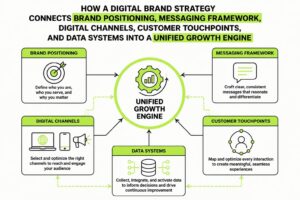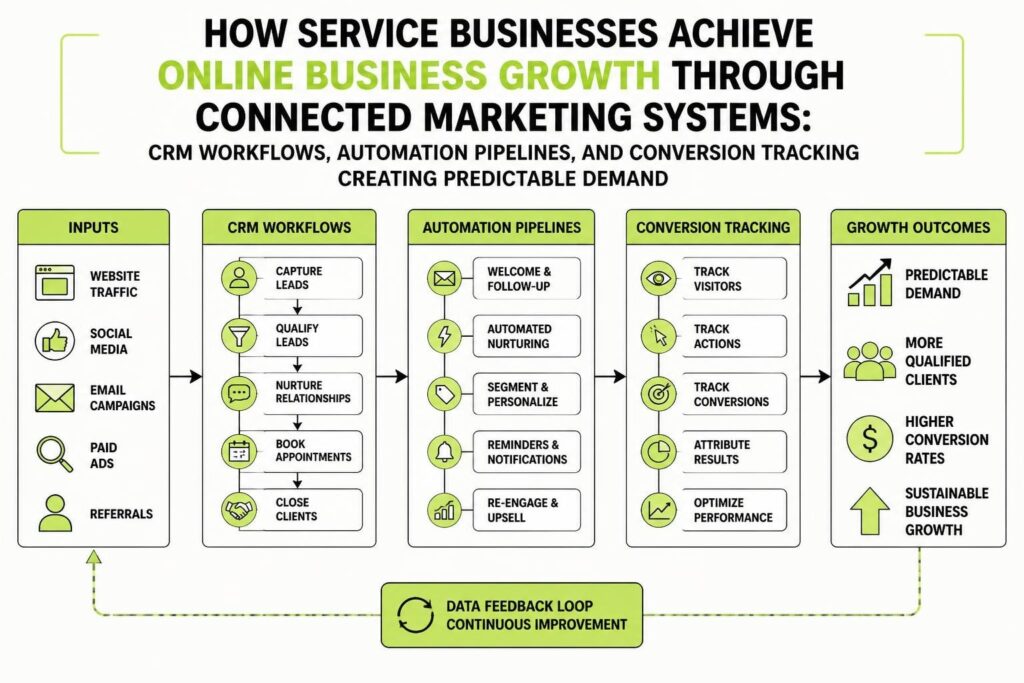
Most service businesses hit the same wall. Leads trickle in, some convert, and the rest disappear into a messy spreadsheet or forgotten inbox. You're working harder, not smarter. The path to online business growth isn't more effort. It's better systems. When you remove chaos and build infrastructure that captures, nurtures, and converts attention, growth stops being random and starts compounding. That's the shift from hustle to scale.
What Actually Drives Online Business Growth
Online business growth comes down to three things: attracting the right people, keeping them engaged, and converting them reliably. Everything else is noise.
The fundamentals haven't changed:
- You need visibility where your buyers are looking
- You need a way to capture interest before it evaporates
- You need systems that follow up without you remembering
- You need data that shows what's working and what isn't
What has changed is the infrastructure available to you. A decade ago, this required a development team and six-figure budgets. Now, with the right stack and strategy, a lean service business can punch well above its weight.
The Infrastructure Layer
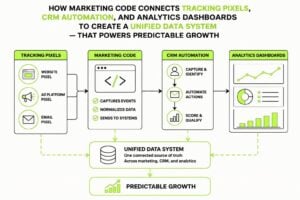
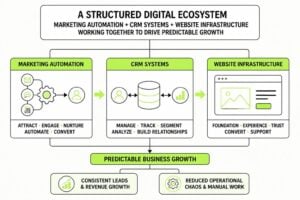
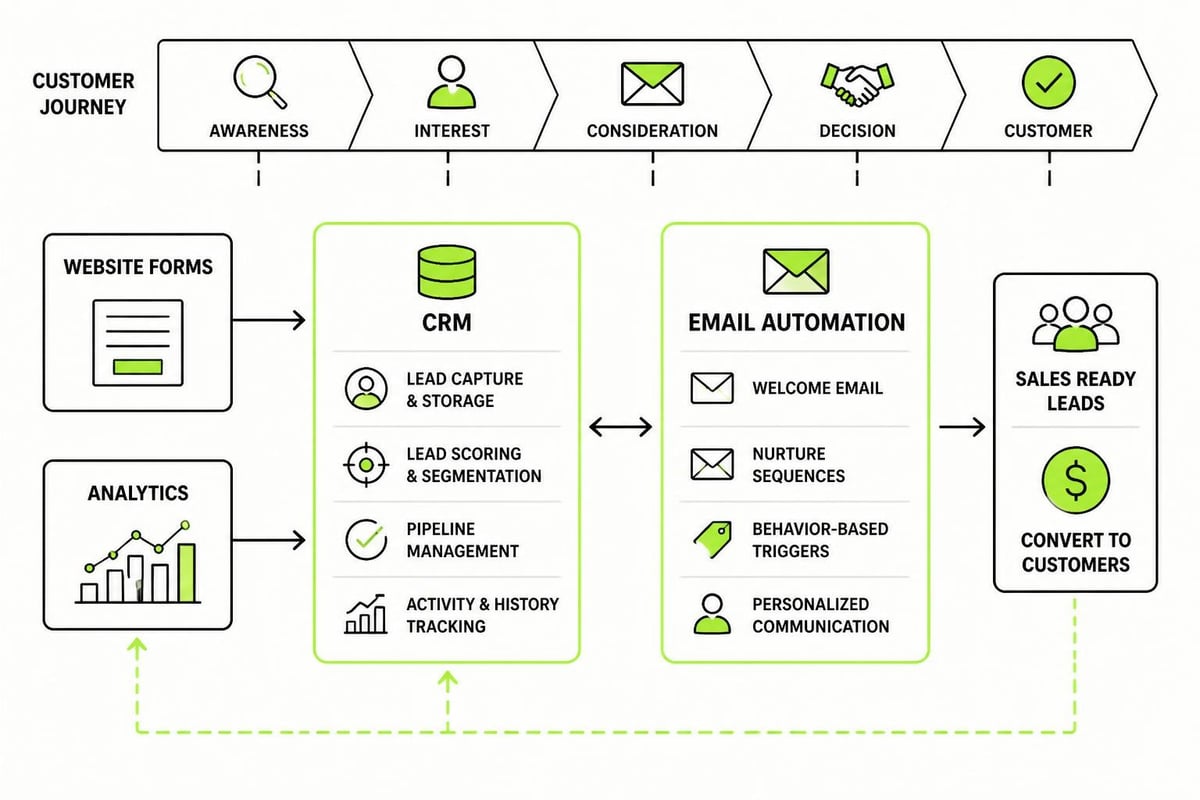
Growth doesn't happen in a vacuum. It happens when your website, CRM, email platform, and analytics talk to each other. When a lead fills out a form, your system should know who they are, what they're interested in, and what to send them next.
Most businesses leak leads because nothing's connected. Someone enquires, the email sits in a general inbox, and by the time you reply three days later, they've moved on. That's not a sales problem. It's a systems problem.
| System Component | Purpose | Impact on Growth |
|---|---|---|
| CRM | Centralise lead data and history | Prevents lost opportunities, enables personalisation |
| Marketing automation | Nurture leads without manual work | Maintains engagement, improves conversion rates |
| Analytics | Track behaviour and attribution | Shows what's working, guides budget decisions |
| High-trust website | Convert visitors into leads | Filters quality, builds credibility fast |
When these pieces connect, you create a flywheel. Traffic becomes leads, leads become customers, customers become referrals. Each layer feeds the next.
Building a Repeatable Marketing System
Random tactics don't scale. You need a framework that moves people from strangers to clients in predictable steps.
A structured approach starts with clarity. Who are you targeting? What problem do they need solved urgently? Where do they look for answers? Once you've nailed that, the rest follows a logical sequence.
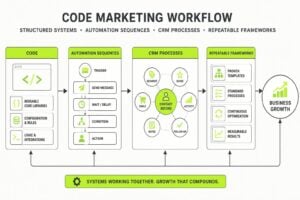
Here's how a repeatable system works:
- Set clear goals tied to revenue, not vanity metrics
- Define your ideal buyer with specificity (industry, stage, pain points)
- Choose the right platform where your buyers already spend time
- Create an opt-in offer that delivers immediate value
- Build a CRM and nurture campaign that warms leads over time
- Deliver an outstanding experience that exceeds expectations
- Generate reviews and referrals that fuel the next cycle
Each step builds on the last. Goals guide who you target. Your buyer persona determines where you show up. The platform choice shapes your opt-in offer. The CRM makes sure nothing falls through the cracks. The experience creates promoters. The reviews bring more of the right people.
If you want a practical framework to implement this, the 7-Step Marketing Plan breaks down exactly how to build this system from scratch. It's designed for service businesses that want structure without complexity.
The Role of SEO in Sustainable Growth
Paid ads work, but they stop the moment you stop paying. Organic search, done properly, compounds. A well-optimised site that ranks for the terms your buyers actually search keeps delivering leads months and years later.
SEO isn't magic. It's technical hygiene, content that answers questions, and signals that prove you're trustworthy. Google’s official SEO documentation covers the fundamentals, and they're remarkably straightforward. Fast site, clear structure, helpful content, legitimate backlinks.
The biggest mistake is writing for search engines instead of humans. Google's algorithm is sophisticated enough now that it rewards clarity and usefulness. Answer the question properly, structure your page logically, and the rankings follow.
Service businesses often overlook local SEO, which is low-hanging fruit. If you serve a specific geography or industry, optimising for those terms puts you in front of people ready to buy. Combine that with digital marketing strategies that drive traffic to optimised pages, and you've built a lead engine that doesn't rely on ad spend.
Turning Attention Into Predictable Demand
Getting attention is the easy part. Turning it into revenue is where most businesses fail. The gap between a website visit and a closed sale is filled with trust-building, follow-up, and proving you understand the problem.
Capture Systems That Actually Work
Your website needs one job: collect contact details from people who might buy. That means offering something valuable enough to trade an email address for.
High-converting opt-ins:
- Frameworks or templates that solve a specific problem
- Diagnostic tools or assessments
- Case studies or proof from similar businesses
- Webinars or live training sessions
Generic "newsletter sign-ups" don't cut it anymore. You're asking someone to let you into their inbox. Give them a reason that's immediate and tangible.
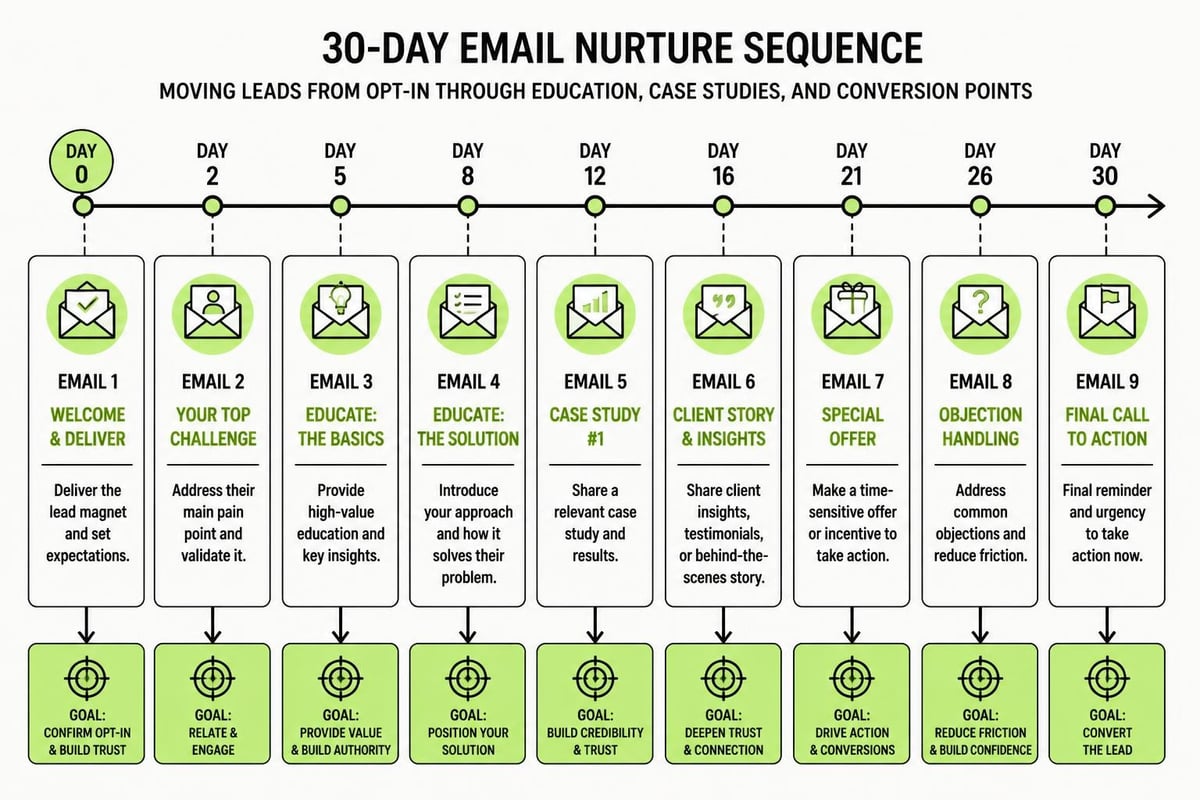
Once you've captured the lead, speed matters. According to research on email marketing best practices, responding within the first hour increases conversion likelihood by 7x compared to waiting even a few hours. Automation handles this. The moment someone opts in, they should receive the promised resource and enter a nurture sequence.
Nurture Without Being Annoying
Most email sequences are either too aggressive or too timid. The right balance is value-first communication that builds trust and demonstrates expertise.
A good nurture campaign isn't about pitching. It's about staying present while helping the lead move closer to a decision. Send case studies that match their situation. Share insights that reframe their problem. Provide frameworks that let them self-diagnose urgency.
Research from Nielsen Norman Group shows that emails designed around user intent, not brand broadcasting, convert significantly better. That means segmenting by behaviour, not just demographics. Someone who downloaded a pricing guide is further along than someone who read a blog post. Treat them differently.
| Nurture Stage | Content Type | Goal |
|---|---|---|
| Awareness | Educational content, frameworks | Build credibility, define problem |
| Consideration | Case studies, comparisons | Prove capability, address objections |
| Decision | Pricing, testimonials, direct offer | Remove friction, prompt action |
The sequence should feel like a conversation, not a campaign. Each email earns the right to send the next one.
Data That Drives Better Decisions
You can't optimise what you don't measure. Online business growth depends on knowing which channels, messages, and offers actually work. That requires tracking beyond vanity metrics like page views or social likes.
What to Measure
The metrics that matter tie directly to revenue. How many leads came in? What was the source? How many converted? What was the cost per acquisition? What's the lifetime value of a customer from each channel?
Most businesses drown in data but starve for insight. Analytics platforms like Google Analytics 4 show everything, but without context, it's just noise. The trick is building dashboards that surface the three to five numbers that actually move the business.
Key performance indicators for service businesses:
- Lead volume by source
- Conversion rate from lead to qualified opportunity
- Cost per acquisition (CPA) by channel
- Customer lifetime value (LTV)
- Return on ad spend (ROAS) for paid campaigns
Track these weekly. Monthly reviews miss trends. Daily tracking creates panic. Weekly gives you enough signal to spot patterns and enough distance to avoid knee-jerk reactions.
According to HubSpot’s marketing trends report, businesses that review performance data weekly grow 3x faster than those that don't. It's not the data itself. It's the habit of using it to make better calls.
Attribution and Feedback Loops
Attribution is messy. A lead might find you through organic search, visit via a Facebook ad a week later, then convert after reading an email. Which channel gets credit?
Most platforms default to last-click attribution, which overvalues bottom-of-funnel activity and ignores how awareness builds over time. A better model is multi-touch attribution, which assigns value across the entire journey.
Even simpler? Just ask. Include a field on your contact forms: "How did you hear about us?" You'll learn more from honest answers than from algorithmic guesses.
Feedback loops matter too. When someone becomes a client, track which content they engaged with, which emails they opened, and how long the sales cycle took. Feed that back into your strategy. If case studies consistently appear in the journey of your best clients, produce more case studies.
Protecting Leads and Removing Chaos
Growth without systems creates more problems than it solves. More leads mean more follow-ups to forget, more emails to misplace, and more opportunities to look unprofessional.
CRM as the Single Source of Truth
A CRM isn't optional infrastructure anymore. It's the difference between a business that scales and one that stays stuck. Every interaction, every email, every note should live in one place. When a lead re-engages six months later, you need to know the full history without digging through inboxes.
The best CRM is the one you'll actually use. Complexity kills adoption. For most service businesses, that means platforms like HubSpot, Pipedrive, or ActiveCampaign. They handle contacts, deals, automation, and reporting without requiring a systems administrator.
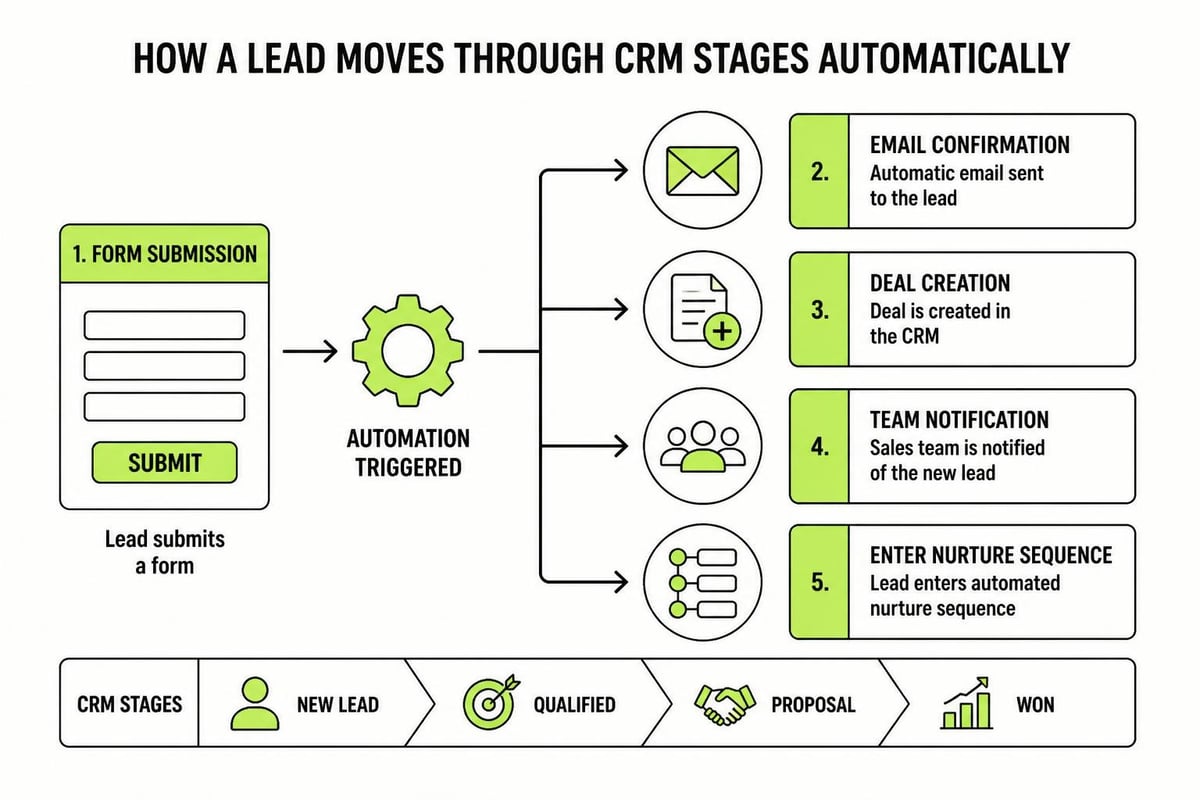
Automation removes the risk of human error. When a lead books a discovery call, the CRM should update the deal stage, send a confirmation email, add the person to a nurture sequence, and notify your team. No manual steps. No room for things to slip.
Privacy compliance matters too. With regulations tightening globally, you need consent workflows and data storage policies that meet standards. The UK ICO’s guidance on storage and access technologies outlines what's required. Ignoring this creates legal risk that can erase growth overnight.
Optimising the Customer Experience
Retention is cheaper than acquisition. A client who stays for three years is worth more than ten one-time buyers. That means the experience after the sale matters as much as the experience before.
Service businesses often focus so hard on winning clients that they forget to deliver exceptional results. But retention feeds growth. Happy clients refer. They leave reviews. They buy again.
Research from Bain & Company on customer loyalty shows that increasing retention by just 5% can boost profits by 25% to 95%. The math is simple. Retained clients cost less to serve, buy more over time, and become your best marketers.
Build feedback loops into your delivery process. Check in at 30, 60, and 90 days. Ask what's working and what isn't. Use that insight to refine your service and identify upsell opportunities. A client who's achieving results is far easier to grow than one who's quietly disappointed.
Compounding Growth Over Time
The businesses that scale sustainably don't chase hacks. They build systems that get better with every cycle. More leads improve your data. Better data improves targeting. Better targeting improves conversion. Higher conversion justifies more investment. More investment generates more leads.
That's compounding. Each input strengthens the next. It's slow at first. Most businesses quit before they see the curve start to climb. But once it does, growth becomes predictable.
Your job isn't to work harder. It's to build infrastructure that makes every effort count twice. Capture systems that don't leak. Nurture sequences that convert while you sleep. Analytics that show you where to double down. Client experiences that turn buyers into advocates.
Online business growth doesn't happen because you got lucky. It happens because you built systems that protect leads, remove chaos, and create repeatable results. That's the shift from random to reliable. That's how service businesses scale.
Online business growth comes from infrastructure, not effort. When you build systems that capture, nurture, and convert, growth stops being a grind and starts compounding. If you're ready to remove the chaos, protect your leads, and build marketing systems that actually scale, MDO Digital can help. We design high-trust websites, build CRM and automation infrastructure, and run data-driven campaigns that turn attention into predictable demand. Let's build something that lasts.