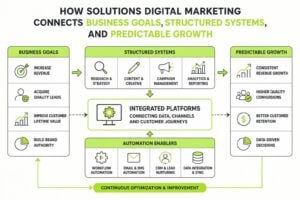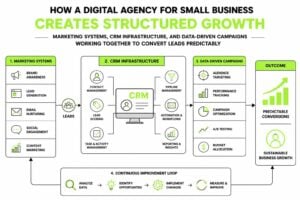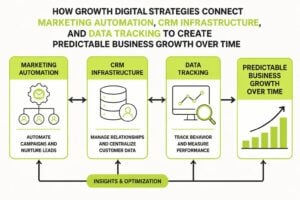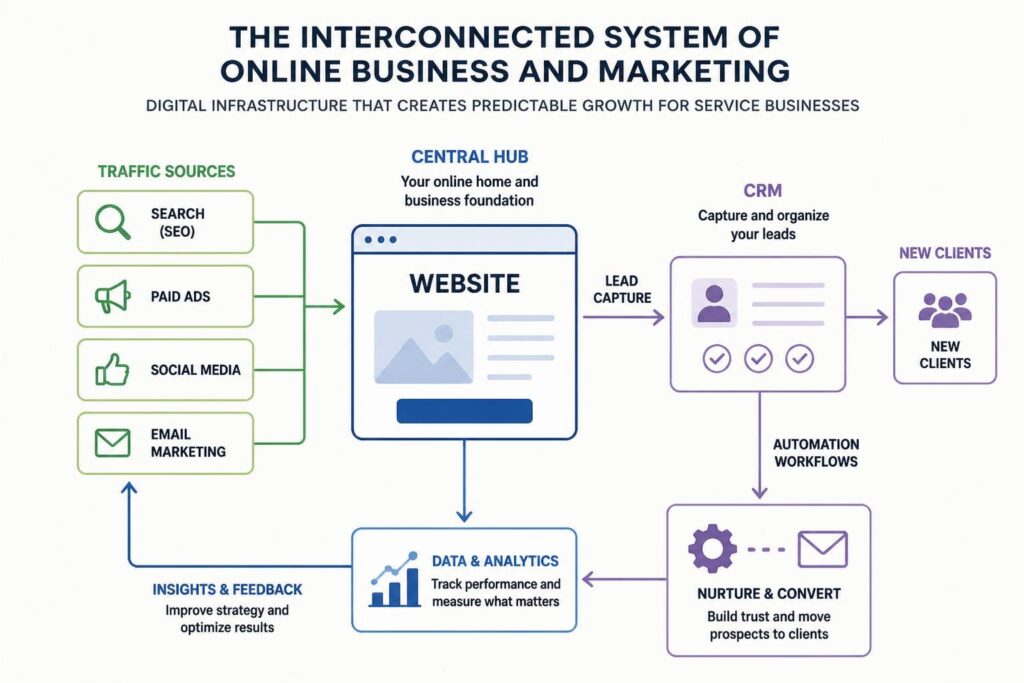
The gap between running an online business and actually growing one sits in your systems. Most service businesses jump straight to tactics, posting content, running ads, tweaking websites, without building the infrastructure that turns activity into reliable outcomes. Online business and marketing only work when they're connected through clear processes, not random acts of hustle. The difference between chaos and momentum is rarely more ideas. It's better systems.
Why Most Online Business and Marketing Efforts Leak Revenue
You've probably felt this. Leads come in from different channels. Some fill a form, others send a DM, a few email directly. They sit in your inbox, a spreadsheet, maybe a notebook. Follow-up happens when you remember. Half never hear back. The ones who do get inconsistent messages.
This isn't a motivation problem. It's a structural one.
Common breakpoints that kill conversion:
- No central place to capture and track enquiries
- Manual follow-up that depends on memory
- Disconnected tools that don't talk to each other
- No way to see which marketing actually drives revenue
- Lead nurture that stops after the first reply
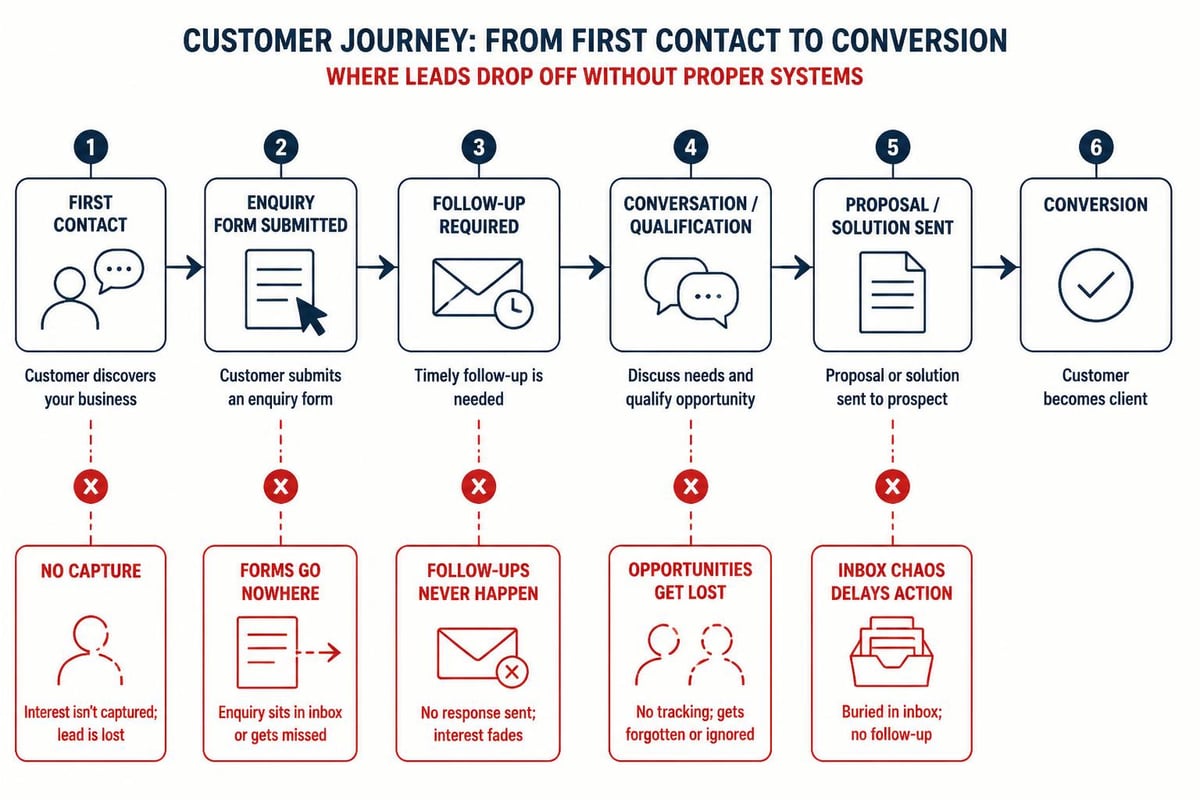
When someone visits your site, downloads something, or asks a question, what happens next shouldn't be a mystery. It should be automatic, tracked, and designed to build trust. According to research resources on marketing principles, businesses that implement systematic lead management see significantly higher conversion rates than those relying on ad-hoc processes.
The best online business and marketing setups treat every touchpoint as part of a larger system. Not individual tasks. A workflow.
Building Infrastructure Before Amplification
Here's the uncomfortable bit. Your marketing probably isn't broken because you need more traffic. It's broken because the traffic you're getting falls into a leaky bucket.
The Foundation Stack
| System Component | Purpose | Impact Without It |
|---|---|---|
| High-trust website | Establishes credibility, answers objections | Visitors bounce, trust never forms |
| CRM database | Captures and organises every lead | Leads lost, follow-up fails |
| Automation sequences | Nurtures prospects consistently | Manual work, inconsistent messaging |
| Analytics setup | Shows what's working and what's not | Guessing, wasted budget |
Most businesses skip straight to content calendars and ad campaigns. But content without capture is just noise. Ads without nurture are expensive impressions. You're paying to be forgotten.
The infrastructure comes first. Once it's in place, everything you do compounds instead of evaporates.
What a Proper System Looks Like
Let's map it out in plain terms. Someone finds you through Google, a referral, or social media. They land on a page that speaks to their specific problem, not vague promises. The page offers something valuable in exchange for their email. Could be a framework, a checklist, a diagnostic tool.
That opt-in triggers a sequence:
- Immediate delivery of what they requested (builds trust instantly)
- Welcome email that sets expectations and points to helpful resources
- Education sequence over the next week, addressing common questions
- Soft invitation to book a call or start a conversation
- Ongoing value through regular check-ins, not aggressive pitches
The 7-Step Marketing Plan walks through exactly this kind of system, from setting clear goals to building the CRM infrastructure that keeps prospects engaged until they're ready to buy. It's the difference between hoping someone remembers you and staying front of mind through structured value.
Each step feeds data back into your system. You see which emails get opened, which links get clicked, where people drop off. That insight tells you what to improve. Marketing becomes measurable, not mystical.
The Three Pillars of Effective Online Business and Marketing
Strip away the trends and tactics, and you're left with three things that actually matter: clarity, capture, and conversion. Get these right and most other problems solve themselves.
Clarity: Knowing Exactly Who You Serve and Why They Should Care
Vague marketing attracts vague prospects. If your website says you "help businesses grow" or "provide innovative solutions," you're saying nothing. Specificity builds trust.
Ask yourself:
- What problem do I solve better than anyone else?
- Who feels that problem most acutely?
- What language do they use to describe it?
- What outcome can I guarantee or strongly predict?
Your messaging should make someone think, "This is exactly what I need" within seconds. Not "This might be interesting." That precision comes from research, not guesswork. Understanding demographic and consumer data helps refine who you're actually talking to, not who you imagine.
Capture: Turning Attention Into Assets
Every visitor to your site is either captured or lost. There's no middle ground. If they leave without giving you a way to follow up, they're gone. You'll never see them again.
This is where most online business and marketing strategies fall apart. Beautiful websites with no mechanism to collect contact details. Social posts with no next step. Conversations that end in "I'll think about it."
Effective capture mechanisms:
- Opt-in offers that solve a specific, immediate problem
- Exit-intent popups for those about to leave
- Lead magnets that qualify interest (not just collect emails)
- Chat systems that route to your CRM automatically
- Clear calls to action on every page
The goal isn't just emails. It's qualified interest. Someone who downloads your "5-Step Client Onboarding Checklist" is more valuable than ten people who signed up for a generic newsletter.
Conversion: Moving Prospects Through Predictable Stages
Once someone's in your system, the work shifts from capture to conversion. This isn't about sales pressure. It's about education, trust-building, and timing.
Most service businesses lose deals because they try to close too early or wait too long. The right system creates natural momentum through stages:
| Stage | Prospect Mindset | Your Job |
|---|---|---|
| Awareness | "I have a problem" | Educate, build authority |
| Consideration | "I'm looking at options" | Differentiate, prove credibility |
| Decision | "I'm ready to choose" | Remove friction, make it easy |
| Advocacy | "This worked for me" | Deliver results, ask for referrals |
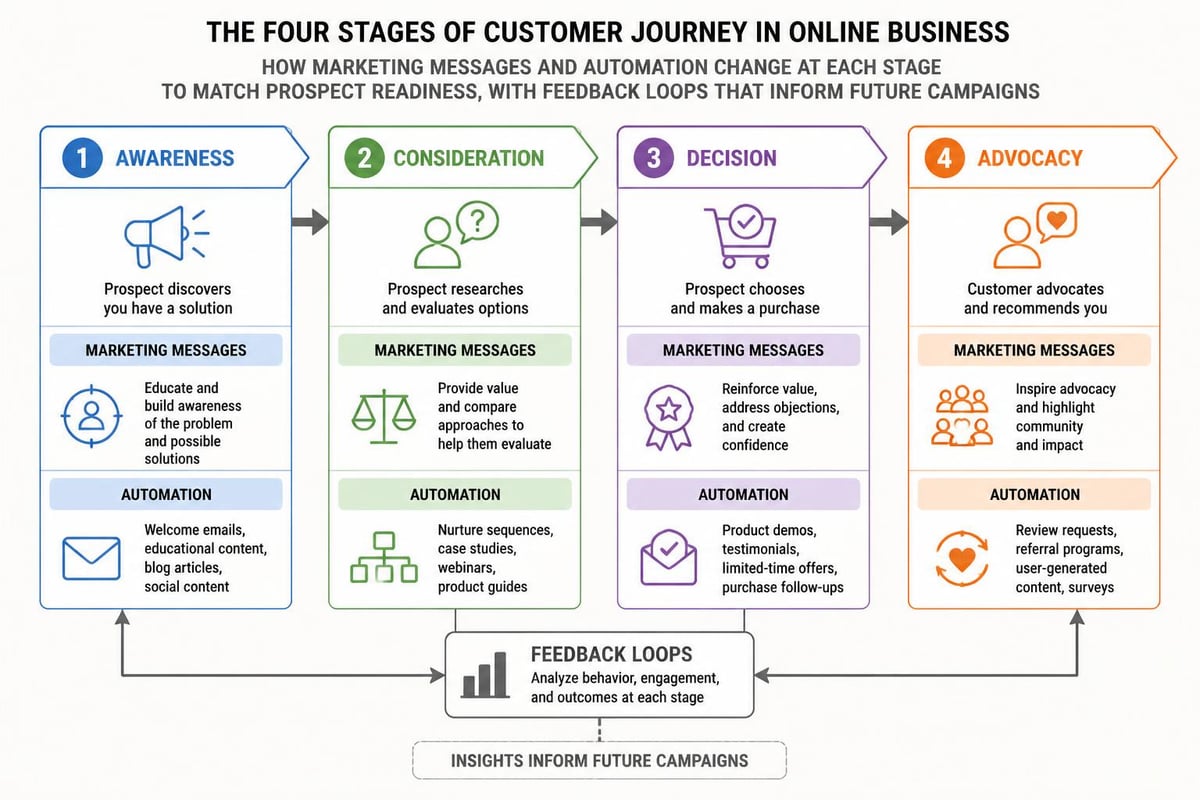
Automation moves people between these stages based on behaviour, not time. Someone who visits your pricing page three times is signalling readiness. Someone who opens every email but never clicks isn't. Your system should respond differently to each.
You can explore business and management resources to understand how different industries approach conversion optimisation and customer lifecycle management.
Data Driven Decisions vs. Hope Driven Marketing
Here's the difference. Hope-driven marketing sounds like: "Let's try Instagram Reels, everyone's doing it." Data-driven marketing sounds like: "Our CRM shows 60% of closed deals came from email nurture, so let's double down on lead magnets and automation."
One is guessing. The other is evidence.
Metrics that actually matter for service businesses:
- Lead source quality (which channels bring prospects who actually buy)
- Time to conversion (how long from first contact to close)
- Email engagement rates (who's opening, clicking, replying)
- Page conversion rates (which landing pages turn visitors into leads)
- Customer acquisition cost (how much you spend to win each client)
These aren't vanity numbers. They're operational intelligence. When you track them properly, you stop wasting budget on what feels good and start investing in what works.
The trap most businesses fall into is tracking activity instead of outcomes. Posts published, emails sent, followers gained. None of that matters if revenue doesn't move. Connect your marketing tools to your CRM, and connect your CRM to your revenue. That's the only way to see the full picture.
Building Systems That Scale Without Breaking
Growth exposes cracks. What works at 10 enquiries a month collapses at 50. Manual processes that felt manageable become impossible. This is where most online business and marketing approaches hit a ceiling.
Automation Without Losing the Human Touch
People worry that automation feels robotic. It does if you automate badly. Good automation is invisible. It handles repetitive tasks, tracks details you'd forget, and ensures nobody falls through gaps. But it doesn't replace judgement or relationship.
What to automate:
- Lead capture and CRM entry
- Initial follow-up and welcome sequences
- Appointment reminders and confirmations
- Content delivery and educational nurture
- Internal notifications when action is needed
What not to automate:
- Responses to specific questions
- Pricing or proposal conversations
- Relationship building after initial contact
- Custom recommendations or strategy
- Anything requiring empathy or nuance
The goal is to free yourself from administrative burden so you can focus on high-value conversations. Your CRM should tell you exactly who needs attention and why. Your automation should warm prospects until they're ready to talk. Then you step in.
Common Mistakes That Sabotage Online Business and Marketing
Even with good intentions, most businesses trip over the same issues. Recognising them early saves months of wasted effort.
Mistake one: Building on rented land. Your Instagram following isn't yours. Your LinkedIn connections aren't yours. Your email list is. Always drive traffic to assets you control, where you can capture contact details and continue the conversation.
Mistake two: No follow-up system. Someone enquires. You respond. They don't reply. You assume they're not interested and move on. In reality, 80% of sales require five or more follow-ups. Without automation, that never happens.
Mistake three: Treating all leads the same. A referral from your best client and a cold website visitor aren't the same. Your system should tag, segment, and route leads based on source and behaviour. One-size-fits-all messaging converts nobody.
Mistake four: Ignoring mobile experience. Over 60% of web traffic is mobile. If your forms are clunky, your emails render poorly, or your site loads slowly on phones, you're losing half your audience before they even engage.
Mistake five: No clear next step. Every email, every page, every piece of content should tell the reader exactly what to do next. Book a call. Download this. Read that. If you leave it vague, nothing happens.
For deeper insight into avoiding these pitfalls, the business information resources from research institutions provide case studies and analysis of what separates successful digital strategies from failed ones.
Choosing the Right Platform Mix
Not every business needs every platform. Trying to be everywhere spreads you thin and dilutes results. The right mix depends on where your buyers actually spend time and how they prefer to research.
| Business Type | Primary Platform | Secondary Platform | Why |
|---|---|---|---|
| B2B services | LinkedIn, email | Website, SEO | Decision-makers research professionally |
| Local services | Google Business, email | Facebook, reviews | Proximity and reputation matter most |
| Creative services | Instagram, website | Email, referrals | Visual proof builds trust |
| Consulting | Email, website | LinkedIn, podcasts | Authority and expertise drive decisions |
The pattern: every business needs a website and email. Everything else is supplementary. Your website is your hub. Your email list is your asset. Social platforms are distribution channels, not foundations.
Pick one or two channels, do them properly, and connect them back to your CRM. Better to own one channel than dabble in five.
Measuring What Matters in 2026
Online business and marketing has shifted. Cookies are dying. Privacy is tightening. Tracking is harder. But measurement isn't less important, it's just different.
Focus on first-party data:
- Email engagement and behaviour
- Website interactions and session data
- CRM activity and conversion milestones
- Direct attribution through UTM tags and source tracking
- Survey and feedback responses
You can't track everything anymore. But you can track enough. The businesses winning in 2026 are the ones who build direct relationships, own their data, and optimise based on actual customer behaviour, not ad platform estimates.
This also means getting better at asking. Post-purchase surveys. Referral source questions. Quick feedback forms. When you can't track digitally, ask directly. People will tell you how they found you if you make it easy.
Consult resources like marketing research guides to stay current on evolving best practices as the industry adapts to privacy-first tracking.
Creating Content That Feeds Your System
Content for content's sake is exhausting and pointless. Content that feeds your lead system is strategic and sustainable. The difference is intent.
Every piece of content should:
- Attract your ideal customer through search or sharing
- Demonstrate your expertise on their specific problem
- Lead to a next step that enters them into your CRM
Blog posts should end with relevant opt-ins. Videos should link to landing pages. Social posts should drive to valuable resources. Nothing exists in isolation. Everything connects back to the system.
Content types that convert:
- How-to guides that solve immediate problems
- Case studies that prove results
- Frameworks that simplify complex topics
- Comparisons that help decision-making
- Tools or templates that provide instant value
Notice what's missing: thought leadership without application, opinion pieces without utility, content that's interesting but not useful. If it doesn't move someone closer to understanding their problem and your solution, don't publish it.
The MDO Digital sitemap demonstrates how interconnected content structure supports both SEO and user journey, creating multiple paths to the same conversion goals.
The Role of Trust in Online Business and Marketing
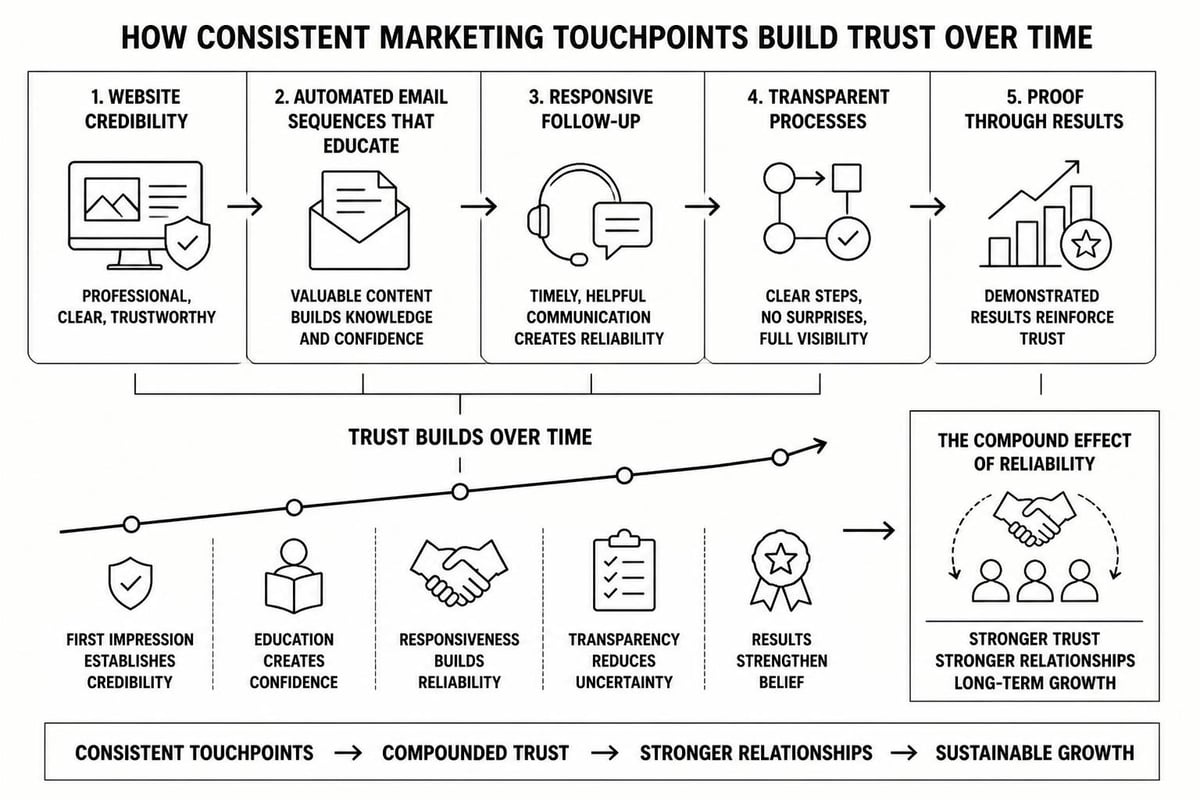
You can't shortcut trust. It builds through consistency, transparency, and delivering what you promise. Your website, your emails, your follow-up, all of it either adds to trust or chips away at it.
High-trust businesses don't need aggressive sales tactics. Their systems pre-sell. By the time someone gets on a call, they already believe you can help. They're there to confirm fit, not be convinced.
Trust builders:
- Clear, specific language (no jargon or fluff)
- Proof through case studies and results
- Transparency about process and pricing
- Fast, reliable follow-up
- Genuine value before asking for business
Trust killers:
- Overpromising results
- Slow or inconsistent communication
- Hidden costs or unclear terms
- Pushy sales tactics
- Generic, template responses
Your online business and marketing infrastructure should be designed to accumulate trust at every step. That's the only sustainable growth strategy.
Online business and marketing work when they're systems, not experiments. The businesses scaling with clarity in 2026 aren't the ones with the biggest budgets or the flashiest tactics. They're the ones who built infrastructure that captures leads, nurtures trust, and converts attention into predictable demand. If your current approach feels chaotic or inconsistent, MDO Digital helps service businesses remove that chaos through high-trust websites, CRM automation, and structured marketing that compounds. Let's build something that lasts.