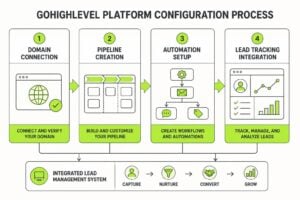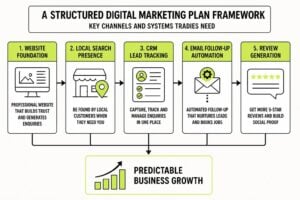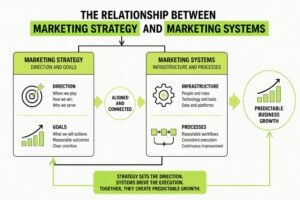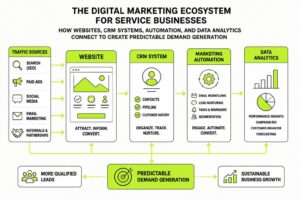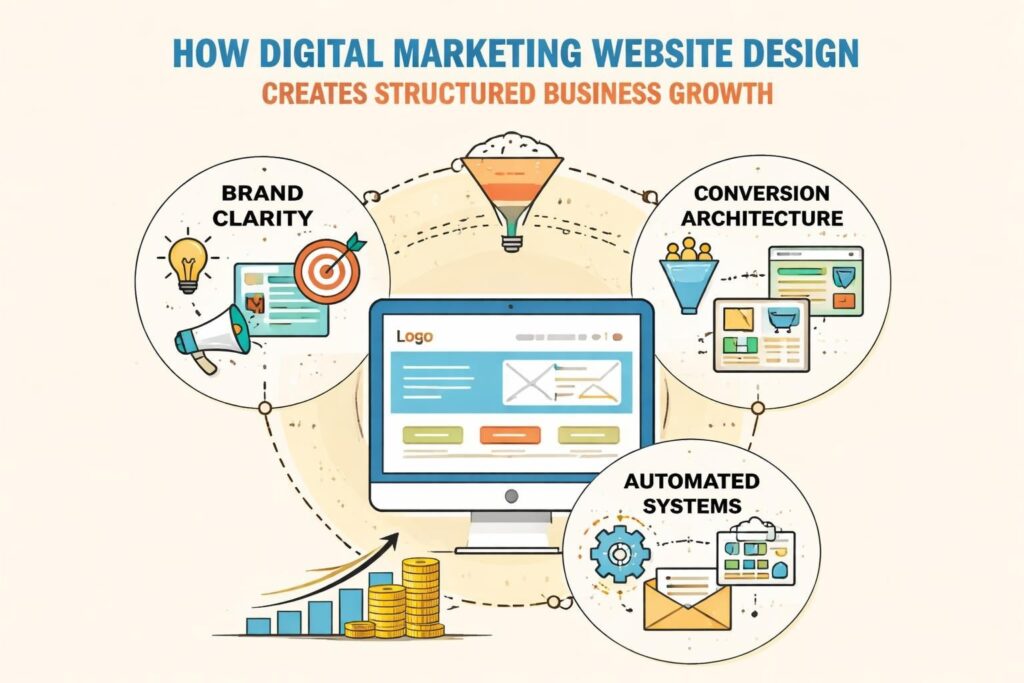
Your website isn't a brochure. It's the central infrastructure of your demand engine. Digital marketing website design brings together brand positioning, conversion architecture, and automation systems to turn traffic into predictable revenue. Most service businesses treat design and marketing as separate projects. That's where things fall apart. A high-converting website is both the message and the machine, designed to capture attention, qualify leads, and feed your CRM without manual chaos. The gap between a pretty site and a profitable one comes down to how well design serves your entire marketing system.
Why Digital Marketing Website Design Is Different
Traditional web design focuses on aesthetics and user experience. Digital marketing website design adds a third layer: conversion infrastructure. Every page becomes a strategic asset. Your homepage isn't just an introduction, it's a qualifying filter. Service pages aren't feature lists, they're trust-building sequences that address specific objections at each stage of buyer awareness.
The difference shows up in how visitors move through your site. Instead of browsing randomly, they follow intentional pathways. Forms aren't generic contact boxes, they're segmented by service type and buyer stage. Thank you pages don't just confirm submission, they trigger automation sequences and integrate with your CRM.
This approach requires thinking about design and marketing together from the start. When you separate them, you end up with a beautiful site that doesn't convert or a high-performing funnel that looks untrustworthy. Both kill momentum.
The Core Components That Make It Work
A proper digital marketing website design system has several interconnected parts:
- Brand clarity framework that defines positioning, messaging hierarchy, and visual identity
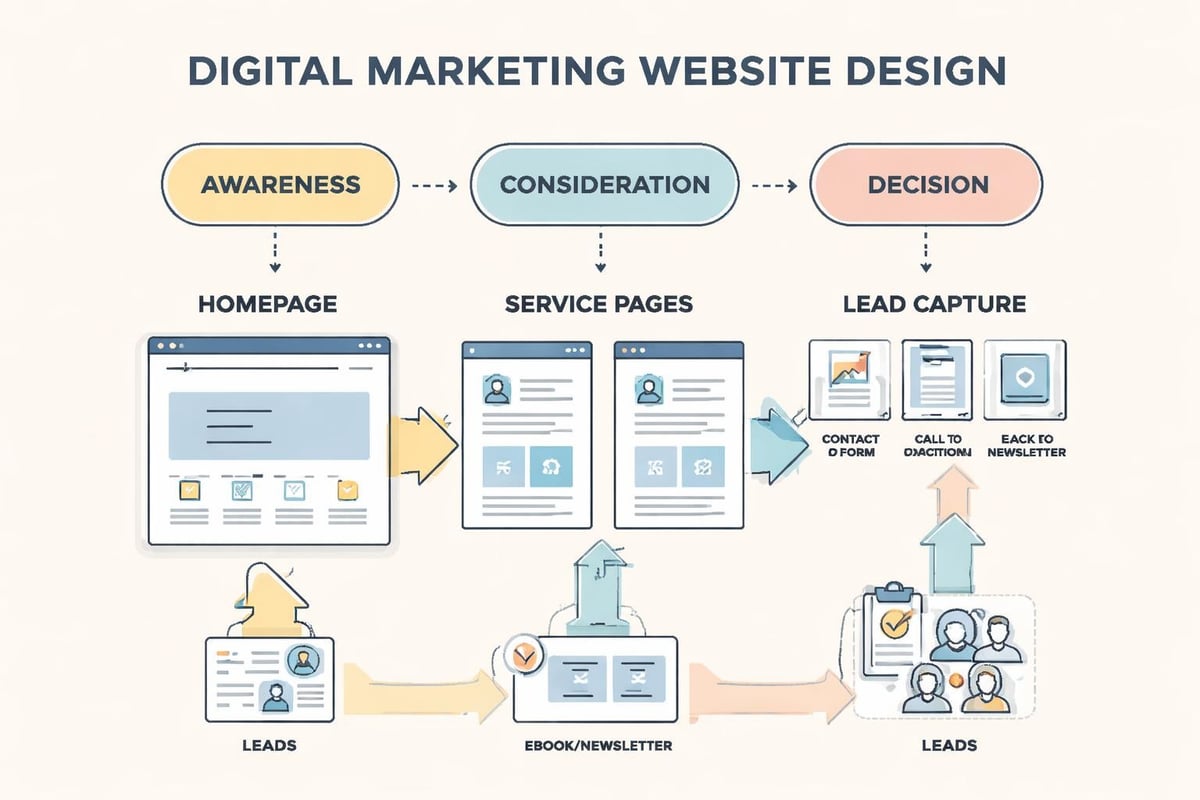
- Conversion architecture mapping visitor journeys from awareness to decision
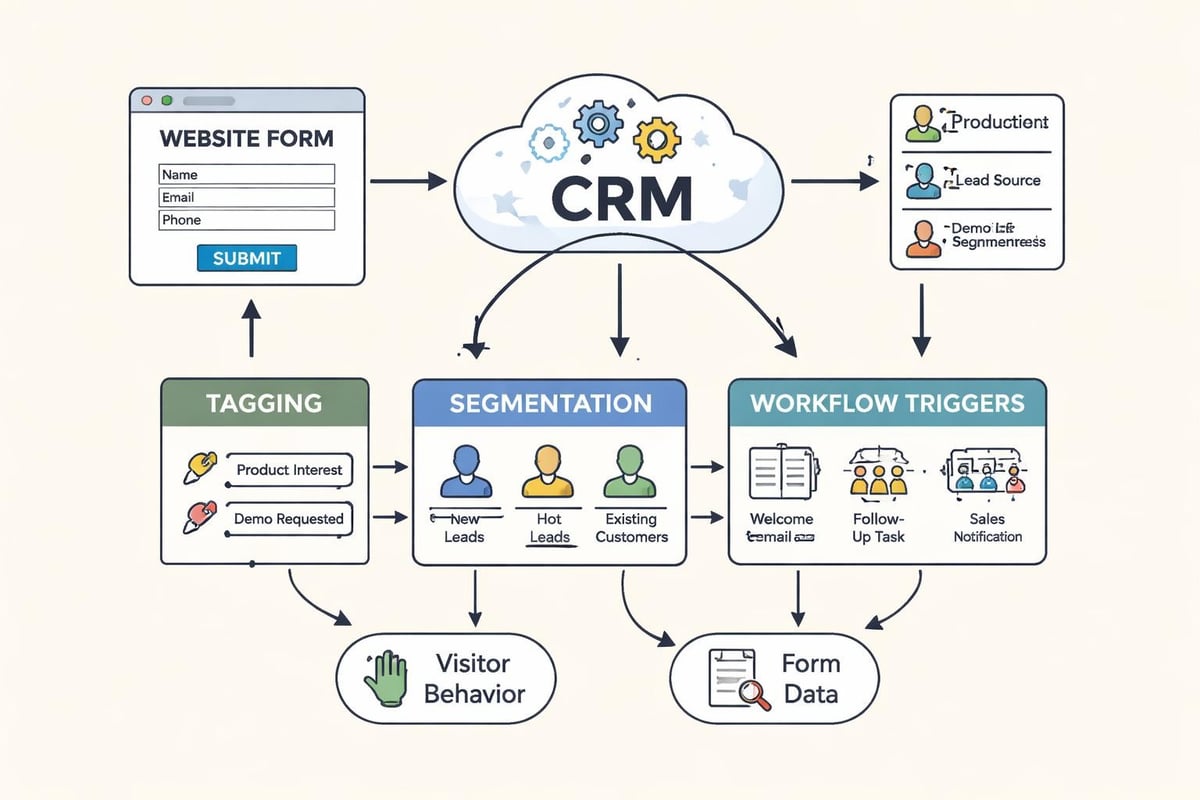
- Form and CRM integration that segments leads automatically
- Content structure optimized for both humans and search engines
- Analytics and tracking embedded at the design phase, not bolted on later
Each component informs the others. Your brand positioning determines which conversion paths you build. Your CRM structure shapes what information you collect in forms. Your content strategy drives how you organize navigation and internal linking.
Building Trust Before Asking for Anything
Service businesses live or die on trust. Digital marketing website design for professional services needs to establish credibility fast, especially when your average client value runs into five or six figures. The old approach of homepage hero, three benefits, and a contact form doesn't cut it anymore.
Your homepage needs to answer three questions within seconds:
- What do you do? Clear value proposition that speaks to a specific outcome
- Who is this for? Positioning that lets the right people self-identify
- Why should I trust you? Social proof, process transparency, or authority markers
After that, the design guides them deeper. Not to a contact form, but to content that addresses their actual decision-making process. Case studies for people evaluating capability. Process explanations for those worried about implementation. Pricing transparency for qualified buyers ready to move.
Creating a High-Trust Navigation Structure
Navigation isn't just wayfinding. It's a messaging framework. The labels you choose and the order you present them signal what you prioritize. For service-based businesses, a trust-building navigation might look like this:
| Navigation Item | Purpose | Trust Signal |
|---|---|---|
| Services | Clarify offering scope | Specialization over generalization |
| How We Work | Reduce perceived risk | Process transparency |
| Case Studies | Prove capability | Results with context |
| Resources | Demonstrate expertise | Give before asking |
| About | Establish credibility | Team, values, track record |
Notice "Contact" isn't in the main navigation. That's deliberate. Instead, contextual calls-to-action appear where they make sense: after a case study, within a service page, or at the end of a resource. This approach respects that people need to build confidence before they're ready to reach out.
The difference shows up in lead quality. You get fewer tire-kickers and more qualified conversations because your website does the filtering work upfront, as explained in website design best practices that build trust.
Conversion Architecture for Service Businesses
Digital marketing website design treats each page as a step in a broader system. A blog post isn't isolated content, it's an entry point that connects to relevant service pages and lead magnets. A service page isn't just information, it's a qualification tool that segments visitors based on their needs.
This requires mapping your entire buyer journey before you design anything. What questions do prospects ask at each stage? What objections come up? What information do they need to move forward?
Designing Pages Around Decision Points
Most websites are organized by what the business wants to say. Digital marketing website design organizes around what prospects need to decide. Here's how that translates into page strategy:
Awareness Stage
- Blog content addressing symptoms and problems
- Educational resources with no commitment required
- Clear navigation to topic clusters
Consideration Stage
- Service pages with detailed process explanations
- Case studies with specific results and contexts
- Comparison content that positions your approach
Decision Stage
- Pricing transparency or qualification criteria
- Team introductions and credentials
- Clear next steps with expected timelines
Each stage needs its own design treatment. Awareness content should feel open and accessible. Consideration pages need more structure and proof. Decision-stage content requires absolute clarity and direct CTAs.
The essential web design practices that support this approach emphasize creating design that fits your business model rather than following generic templates.
CRM Integration and Lead Intelligence
Here's where digital marketing website design separates from traditional approaches. Your website doesn't just collect leads, it enriches them with behavioral data before they hit your CRM. This intelligence changes how you follow up and dramatically improves conversion rates.
Basic lead capture:
- Name, email, message field
- All leads look identical in your CRM
- No context for follow-up prioritization
Intelligent lead capture:
- Service-specific forms on each landing page
- Hidden fields tracking referral source and pages visited
- Segmentation based on company size, industry, or urgency
- Automatic tagging for workflow triggers
This level of integration requires planning the connection between your website platform, form tools, and CRM from the design phase. You can't bolt it on afterward without breaking the user experience.
Forms That Actually Convert
Form design in digital marketing website design balances two competing priorities: collecting enough information to qualify leads while maintaining conversion rates. Too many fields and people bounce. Too few and you waste time on unqualified conversations.
The solution is progressive disclosure and contextual forms:
- Homepage: Simple email capture with one clear benefit
- Service pages: 3-4 fields including service interest and timeline
- Case study downloads: Email only, tag with content topic
- Pricing/consultation requests: 5-7 fields with budget and urgency
Each form feeds your CRM differently and triggers appropriate follow-up sequences. Someone downloading a case study gets nurture content. Someone requesting a pricing consultation gets direct sales outreach within hours.
At MDO Digital, we structure forms based on where they sit in the conversion architecture. The design reinforces the commitment level. Quick captures look simple and frictionless. Consultation requests feel more substantial because they are.
Mobile-First Design for Professional Audiences
More than 60% of B2B research happens on mobile devices, even for high-value services. Digital marketing website design needs to work flawlessly on small screens while maintaining the trust signals and conversion architecture that drive decisions. This isn't about making things smaller. It's about restructuring content hierarchy for touch and scroll.
The challenges with mobile conversions:
- Trust signals (logos, testimonials, certifications) can feel cluttered
- Multi-step forms frustrate users on small keyboards
- Navigation complexity increases bounce rates
- Page speed issues compound on cellular connections
Solutions for mobile conversion:
- Prioritize your most important trust element above the fold
- Use single-column layouts with clear visual breaks
- Implement sticky CTAs that don't obstruct content
- Break long forms into logical steps with progress indicators
- Optimize images aggressively without quality loss
Mobile design also affects your technical marketing infrastructure. If your website loads slowly on mobile, your ad costs increase and your SEO rankings drop. Google's mobile-first indexing means your mobile experience is your ranking, detailed further in how built-in tools grow website traffic.
Content Structure and SEO Integration
Digital marketing website design and content strategy aren't separate workstreams. The way you structure pages, organize navigation, and link internally directly impacts your organic visibility. Design decisions about headings, content blocks, and page templates determine how well search engines understand and rank your content.
Building Topic Authority Through Design
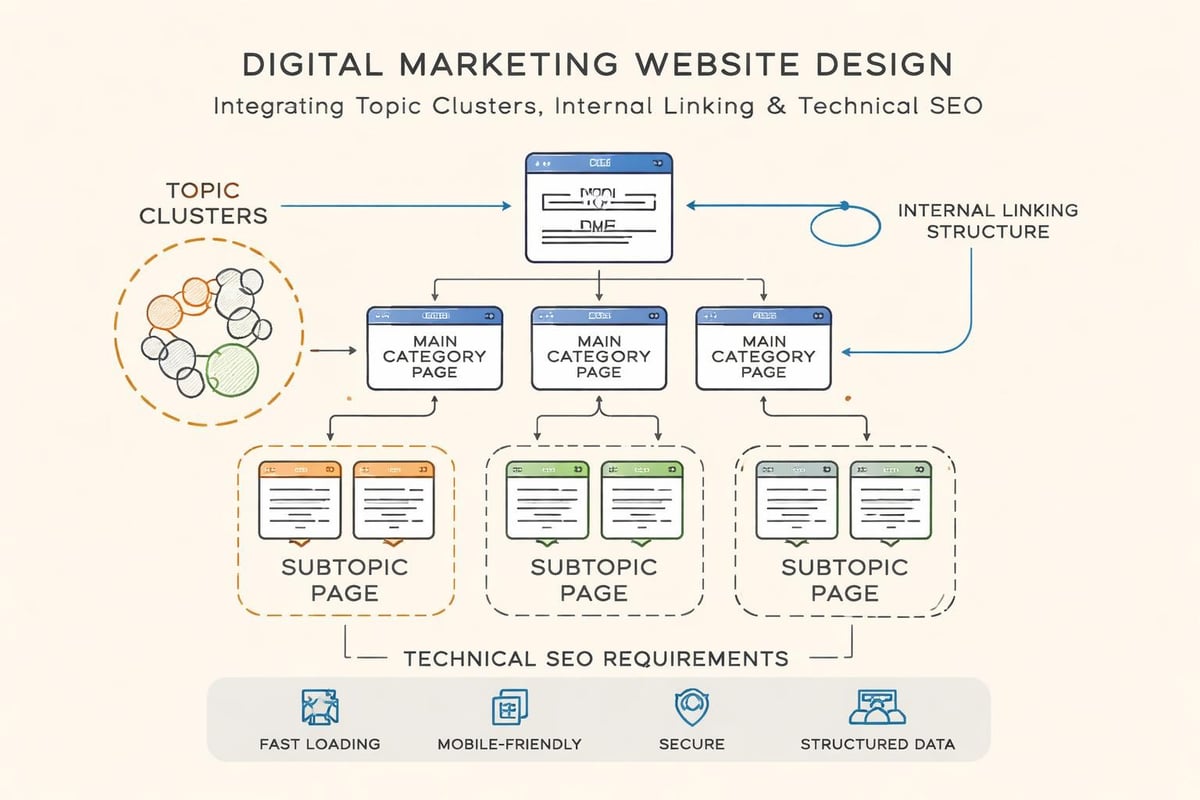
Instead of creating isolated pages, effective digital marketing website design organizes content into topic clusters. Your main service page acts as a pillar, linking to supporting content that addresses specific aspects, questions, or use cases.
Example structure for a branding agency:
- Pillar page: Brand Strategy Services
- Cluster content: Brand positioning guides, messaging frameworks, visual identity development, brand audit processes
- Supporting content: Case studies, tools, templates
This architecture serves both users and search engines. Visitors can explore deeply into topics that matter to them. Search engines see clear topical authority and understand your content relationships.
The design implements this through contextual internal linking, related content modules, and breadcrumb navigation that reveals the content hierarchy. Every design element reinforces the structure. You can explore more about this in our website design category.
Technical SEO in the Design Phase
Digital marketing website design needs to account for technical SEO requirements before development starts:
| SEO Element | Design Consideration | Impact on Performance |
|---|---|---|
| Page Speed | Image optimization, lazy loading | Ranking factor and conversion rate |
| URL Structure | Navigation hierarchy, page relationships | Crawlability and user clarity |
| Schema Markup | Content types and metadata fields | Rich results visibility |
| Internal Linking | Content blocks and sidebar modules | Authority distribution |
| Heading Tags | Content templates and hierarchy | Content understanding |
These aren't backend concerns. They shape how you design templates, organize content blocks, and structure pages. Ignoring them during design means expensive retrofitting later or permanently compromised performance.
Measuring What Actually Matters
Analytics in digital marketing website design goes beyond traffic and bounce rates. You need to track business outcomes: lead quality, conversion paths, revenue attribution, and system efficiency. The design phase is when you define what gets measured and how tracking gets implemented.
Vanity metrics that don't help:
- Total page views
- Social media shares
- Time on site (without context)
Actionable metrics for service businesses:
- Qualified lead conversion rate by source
- Cost per qualified lead
- Form completion rate by type
- Revenue by first-touch and last-touch pages
- CRM stage progression time
Your digital marketing website design should make these metrics easy to capture. That means implementing event tracking for key interactions: scrolling past trust signals, clicking service-specific CTAs, viewing pricing information, or engaging with case studies.
Setting Up Conversion Tracking Properly
Most businesses track the wrong things or track them incorrectly. A form submission isn't success if it leads to an unqualified conversation. A consultation booking is only valuable if it shows up for qualified prospects.
Smart tracking in digital marketing website design:
- Tag form submissions by source, page, and form type
- Create goals for micro-conversions (content downloads, video plays)
- Set up funnel visualization for multi-step processes
- Implement cross-domain tracking if you use external tools
- Connect website analytics to CRM data for closed-loop reporting
This level of measurement tells you which design elements actually drive business results, not just engagement. You can make confident optimization decisions based on revenue impact rather than guessing based on clicks.
Design Systems That Scale
As your service offering expands and your content library grows, digital marketing website design needs to scale without creating chaos. That's where design systems come in: reusable components, consistent patterns, and clear rules that maintain quality as you add pages and features.
A design system for digital marketing websites includes:
- Component library: Buttons, forms, content blocks, navigation patterns
- Template structure: Page types with defined purposes and layouts
- Content guidelines: Tone, formatting, image specs, heading hierarchy
- Brand elements: Color usage, typography scale, spacing rules
- Conversion patterns: CTA placement, form design, trust signal implementation
This isn't just designer documentation. It's operational infrastructure that lets your team create new pages, update content, and maintain consistency without constant oversight. More importantly, it protects your conversion architecture as the site evolves.
Many service businesses using resources from digital marketing expertise find that inconsistent implementation kills conversion rates over time. A page created in 2023 follows different patterns than one built in 2026, confusing visitors and diluting brand trust.
When to Rebuild vs. Optimize
Not every website needs a complete redesign. Sometimes your digital marketing website design just needs strategic optimization. The decision depends on whether your current foundation can support what you need.
Optimize your current site when:
- Core structure works but conversion rates need improvement
- Brand positioning is clear and doesn't need major changes
- Technical infrastructure is sound (speed, mobile, security)
- CRM integration exists and functions properly
- Main issues are content, messaging, or isolated page problems
Rebuild when:
- Your website doesn't reflect your current positioning or services
- Technical infrastructure is outdated (security, speed, mobile issues)
- No CRM integration or tracking exists
- Navigation and site structure confuse visitors
- You've outgrown your platform's capabilities
The rebuild vs. optimize decision also depends on business stage. If you're shifting from generalist to specialist positioning, a rebuild protects you from mixed messaging. If you're refining an already working system, optimization preserves what's functioning while improving weak points. Understanding high-converting website practices can help determine which path makes sense.
Choosing the Right Platform and Tools
Your platform choice determines how easily you can implement digital marketing website design principles. Not all website builders support the integration, customization, and tracking that service businesses need. The wrong choice locks you into workarounds and limitations.
Platform requirements for digital marketing websites:
- CRM integration: Native or reliable third-party connections to your sales tools
- Form flexibility: Conditional logic, hidden fields, multi-step capabilities
- Template control: Ability to create custom layouts without breaking responsive design
- SEO capabilities: Clean code, customizable metadata, schema markup options
- Speed optimization: CDN support, image optimization, caching
Beyond the platform itself, you need marketing tools that connect seamlessly: email automation, analytics, heatmaps, A/B testing, and lead tracking. These integrations should work reliably without constant maintenance.
Many businesses underestimate this during platform selection, choosing based on ease of setup rather than long-term capability. Six months later, they're fighting their tools instead of focusing on growth. Selecting the right foundation from the start, as detailed in expert insights on website builders, saves enormous time and money.
Getting Implementation Right
Even perfect digital marketing website design fails if implementation is poor. Code quality, attention to detail, and quality assurance make the difference between a system that compounds value and one that creates constant friction.
Critical implementation standards:
- Cross-browser testing on Chrome, Safari, Firefox, Edge
- Device testing across mobile, tablet, desktop viewports
- Form validation that's helpful, not hostile
- Error handling that doesn't break user experience
- Load testing under realistic traffic conditions
- Accessibility compliance for inclusive design
- Security protocols especially for form data and integrations
These aren't optional extras. They're baseline requirements for professional service websites. A form that breaks on Safari doesn't just lose that lead, it damages brand perception. Slow loading times don't just hurt SEO, they signal lack of professionalism to high-value prospects.
Quality assurance should happen throughout development, not as a final step. Catching structural issues early prevents expensive rework and launch delays.
Content Migration and Preservation
If you're rebuilding your digital marketing website design, content migration deserves careful planning. You're not just moving text and images, you're preserving SEO value, maintaining user bookmarks, and protecting your content investment.
Migration strategy checklist:
- Audit existing content for relevance and performance
- Map old URLs to new structure with 301 redirects
- Update internal links to new architecture
- Reoptimize content for current keyword strategy
- Preserve or improve metadata (titles, descriptions)
- Maintain image alt text and file names
- Test all redirects and links before launch
Poor migration destroys SEO rankings and creates broken user experiences. Visitors following old links hit 404 errors. Search engines see your content as disappeared. Months of ranking recovery follow what should have been a strategic upgrade. Proper planning through resources at MDO Digital prevents these issues entirely.
The Ongoing System
Digital marketing website design isn't a project with an end date. It's a system that requires ongoing attention: content updates, performance optimization, conversion testing, and strategic refinement. The most successful service businesses treat their website as infrastructure, not a marketing expense.
Monthly maintenance includes:
- Content additions aligned with keyword strategy
- Form and CTA testing based on conversion data
- Technical audits for speed and security
- CRM integration checks and workflow updates
- Analytics review and optimization priorities
This systematic approach compounds results over time. Small improvements to conversion rates multiply across hundreds of visitors. Better lead qualification reduces sales cycle length. Stronger SEO rankings decrease cost per acquisition. The website becomes more valuable every month instead of slowly degrading.
Digital marketing website design works when it connects brand clarity, conversion architecture, and automated systems into one coherent demand engine. Your website should remove chaos, qualify leads automatically, and create structured growth that builds momentum over time. If your current site isn't doing that work, you're leaving predictable revenue on the table. MDO Digital builds marketing systems that turn websites into conversion infrastructure, connecting design, CRM automation, and data-driven strategy into growth that compounds.