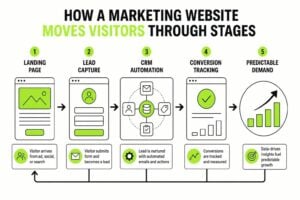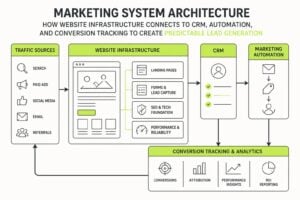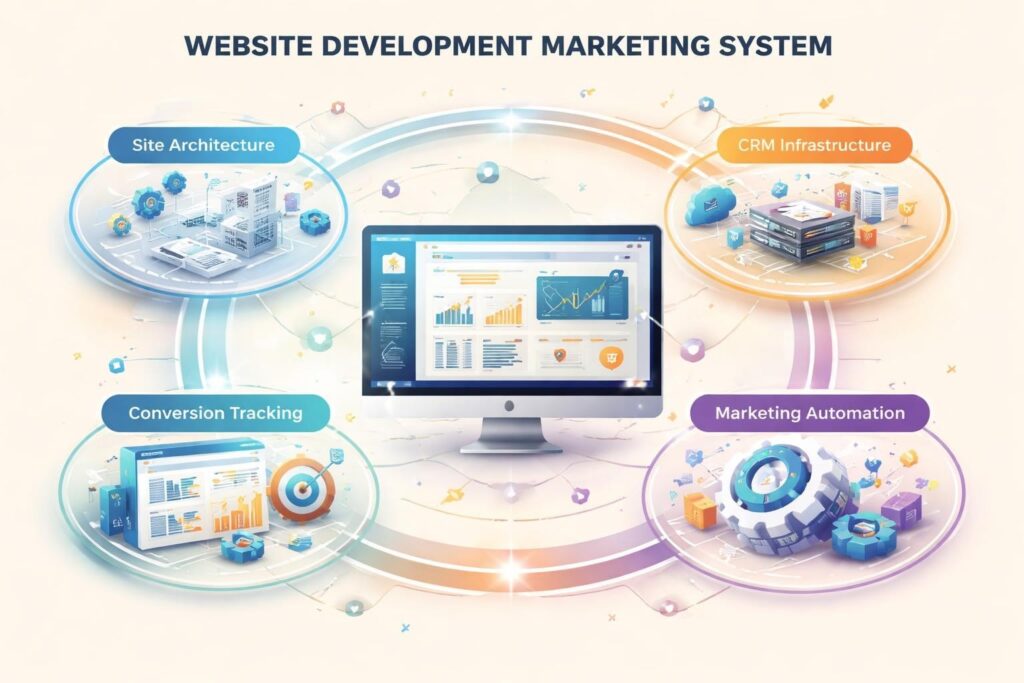
Most service businesses treat their website like a digital brochure. They launch it, add some copy, maybe throw some traffic at it, and wonder why leads don’t show up consistently. The truth is simpler than most want to admit: your website isn’t a marketing asset until it’s connected to systems that track, qualify, and convert attention into revenue. Website development marketing bridges the gap between what a site looks like and what it actually does for your business. It’s where design meets infrastructure, where code meets conversion strategy, and where chaos gets replaced with predictable demand.
What Website Development Marketing Actually Means
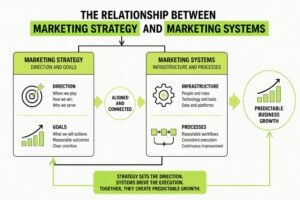
Website development marketing isn’t just building a site and hoping people find it. It’s the practice of designing, building, and optimising your digital presence as a connected system that supports your entire marketing operation.
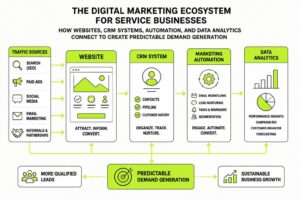
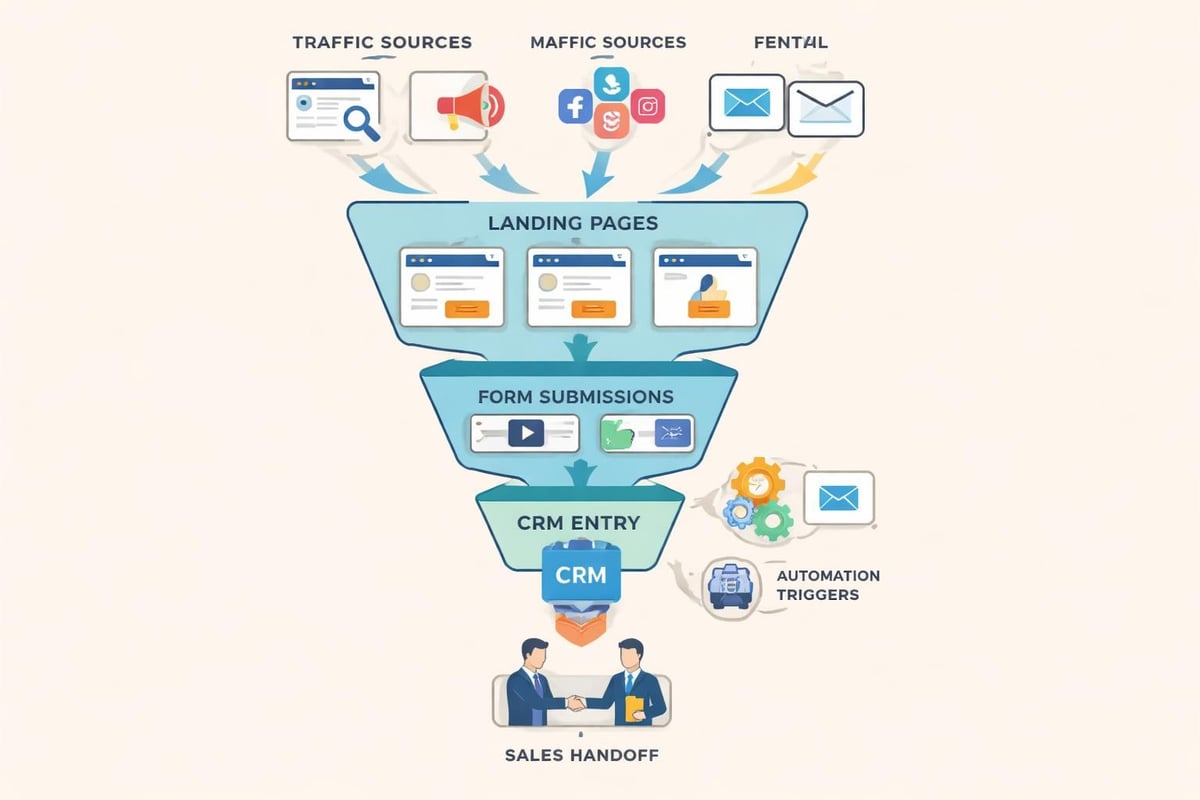
Think of it this way: development handles the structure, speed, and technical foundation. Marketing defines the strategy, messaging, and conversion paths. When these two disciplines work together from the start, you get a site that doesn’t just sit there looking pretty. You get infrastructure that captures leads, feeds your CRM, triggers automation, and generates data you can actually use.
The Technical Foundation That Marketing Depends On
Your marketing strategy is only as strong as the infrastructure supporting it. A slow site kills conversion before your copy gets a chance. Broken forms lose leads you’ve already paid to attract. Poor mobile experience turns away half your traffic before they see your offer.
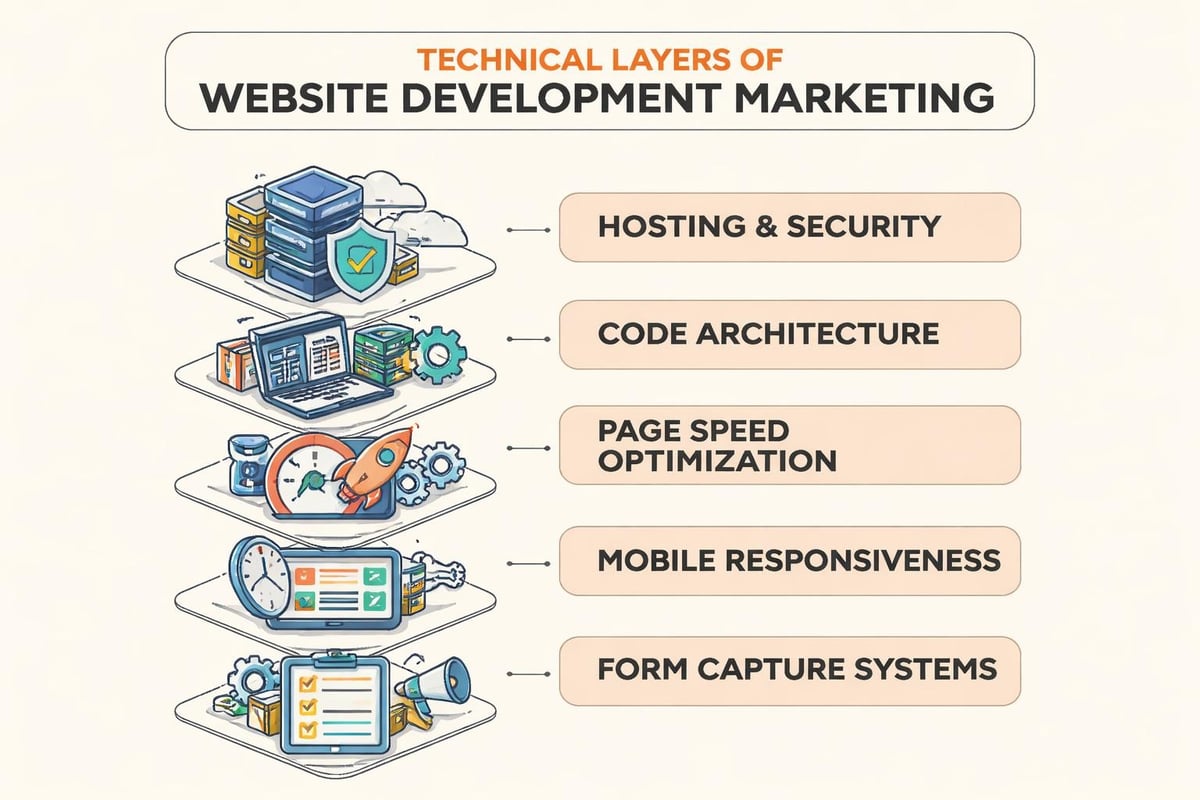
Website development marketing starts with these fundamentals:
- Page speed optimisation that keeps bounce rates low and engagement high
- Mobile-responsive design that works across every device and screen size
- Clean code architecture that search engines can crawl and index properly
- Secure hosting and SSL that builds trust and protects user data
- Form an infrastructure that captures leads reliably and feeds them into your systems
When web development influences digital marketing strategies, it creates a foundation where every marketing dollar works harder because the infrastructure isn’t fighting against you.
Building Websites That Support Real Marketing Systems
A website built for marketing does more than display information. It qualifies visitors, moves them through decision stages, and hands clean data to your sales and marketing systems.
Conversion Architecture vs Visual Design
Most agencies focus on what the site looks like. Website development marketing focuses on what it accomplishes. Every page needs a job. Every element serves the conversion path.
Your homepage isn’t there to win design awards. It’s there to sort visitors into segments and push them toward the next logical step. Service pages don’t just explain what you do, they overcome objections and move qualified prospects toward contact. Case studies aren’t portfolio pieces, they’re proof that de-risks the buying decision.
This is where MDO Digital’s approach to services differs from typical web agencies. We build sites as systems, not art projects.
| Marketing Function | Development Requirement | System Integration |
|---|---|---|
| Lead Capture | Form validation, spam filtering, conditional fields | CRM auto-population, lead scoring triggers |
| Conversion Tracking | Event tracking, goal configuration, UTM handling | Analytics dashboards, attribution reporting |
| Personalization | Dynamic content blocks, user segmentation | Behavioral triggers, automated journeys |
| A/B Testing | Variant deployment, traffic splitting | Statistical analysis, automated winner selection |
CRM and Automation Integration
Your website should talk to your CRM without manual data entry. Every form submission, every content download, every pricing page visit should flow directly into your marketing automation platform.
This isn’t optional nice-to-have functionality anymore. It’s the difference between guessing what prospects care about and knowing exactly where they are in your funnel.
When someone fills out a contact form, your system should:
- Create or update their CRM record instantly
- Tag them based on which service they inquired about
- Trigger an automated email sequence specific to their interest
- Alert your sales team if they meet qualification criteria
- Track every subsequent interaction across email, site visits, and content engagement
The key is removing friction between attention and action. Every manual step you eliminate is another chance for leads to slip through gaps in your process.
Strategic Development Decisions That Impact Marketing Performance
The choices you make during development directly determine what’s possible in your marketing. Pick the wrong platform or skip critical integrations, and you’ll spend years working around limitations instead of scaling what works.
Platform Selection and Marketing Capability
Not all website platforms are built for serious marketing operations. Some are great for blogs. Others handle e-commerce well. Only a few support the kind of integrated marketing systems that service businesses need to scale predictably.
When evaluating platforms for website development and marketing, consider:
- Native CRM integrations that don’t require constant maintenance
- Marketing automation compatibility with tools like HubSpot, ActiveCampaign, or Salesforce
- Custom field and database architecture that supports complex segmentation
- API access for building custom integrations as you grow
- Tracking and analytics flexibility beyond basic Google Analytics
WordPress, with the right stack, can handle enterprise-level marketing. So, can headless CMS options be paired with the right frontend framework? The platform matters less than whether it supports the systems you’re building.
Performance Optimisation as a Marketing Multiplier
Site speed isn’t a technical detail. It’s a conversion factor. Every second of load time costs you visitors, engagement, and revenue.
Optimising loading speed and user experience directly impacts how many people stick around long enough to see your offer. It affects your search rankings, which determines how much free traffic you get. It influences how your paid ads perform, since platforms like Google factor landing page experience into ad costs and placement.
Practical performance wins include:
- Image compression and lazy loading to reduce initial page weight
- Code minification and bundling to reduce HTTP requests
- CDN implementation to serve assets from servers close to users
- Database query optimisation to speed up dynamic content
- Caching strategies that balance performance with personalisation
These aren’t one-time fixes. Website development marketing treats performance as an ongoing optimisation process, not a launch checklist item.
Content Infrastructure and SEO Foundation
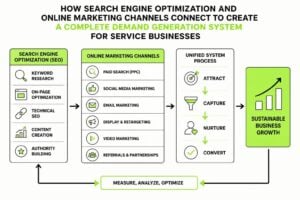
You can’t run effective content marketing without the technical foundation to support it. SEO isn’t something you sprinkle on after launch. It’s built into the site architecture from day one.
Technical SEO as Development Work
Search visibility starts with how your site is built. Clean URL structures, proper heading hierarchy, schema markup, XML sitemaps, these are development decisions that determine whether search engines can find and rank your content.
Website development marketing ensures:
- Crawlable site architecture with logical internal linking and clear hierarchy
- Semantic HTML that helps search engines understand content context
- Structured data markup that enables rich snippets and improved SERP display
- Canonical tag implementation that prevents duplicate content issues
- Mobile-first indexing compatibility since Google prioritises mobile versions
Your sitemap structure needs to be clean, comprehensive, and automatically updated as you add content. Search engines should be able to discover and index new pages within hours, not weeks.
Content Management Systems That Support Marketing
Your CMS needs to make it easy for marketing teams to publish, update, and optimise content without developer involvement for every change. But it also needs guardrails that prevent them from breaking SEO, performance, or conversion infrastructure.
The right setup allows:
- Template-based page building that maintains design consistency and conversion architecture
- Custom field structures that support different content types and their specific SEO needs
- Version control and draft workflows for content review before publishing
- Media optimisation that automatically compresses and formats images
- Meta data management built into the publishing workflow, not an afterthought
This is where most DIY website solutions fall apart. They’re either too rigid to support real marketing or so flexible that non-technical users can accidentally destroy performance and SEO with a few clicks.
Tracking, Analytics, and Data Infrastructure
You can’t optimise what you don’t measure. Website development marketing builds tracking into every conversion point, every user journey, every piece of content that matters to your business goals.
Conversion Tracking Beyond Basic Analytics
Google Analytics tells you how many people visited. It doesn’t tell you which visitors are worth following up with, which traffic sources generate qualified leads, or which pages convince prospects to take action.
Proper tracking architecture captures:
- Traffic source and campaign data that persists through the entire customer journey
- Behavioural events like scroll depth, video plays, PDF downloads, and pricing page visits
- Lead quality indicators that help prioritise follow-up and forecast close rates
- Attribution data that shows which touchpoints contribute to conversion
- Form abandonment so you can optimise fields and reduce friction
This data feeds your CRM and automation infrastructure, creating feedback loops that get smarter over time. You learn which messaging works, which offers convert, which traffic sources waste money, and which ones scale profitably.
Privacy-Compliant Data Collection
Cookie consent isn’t optional anymore. GDPR, CCPA, and similar regulations require transparent data collection with user consent. Your website development marketing approach needs to balance tracking capability with privacy compliance.
Modern solutions include:
- Cookie consent management that blocks tracking until users opt in
- First-party data strategies that reduce dependence on third-party cookies
- Server-side tracking that improves accuracy while maintaining privacy
- Data retention policies that automatically clean old user data
- Privacy-focused analytics alternatives when traditional tools create compliance headaches
Website Development Marketing in Practice
Theory is easy. Execution is where most businesses struggle. Website development marketing requires coordination between developers, marketers, designers, and business stakeholders who often speak different languages and prioritise different outcomes.
Building Cross-Functional Workflows
Successful website development marketing projects start with shared goals and clear ownership. Developers shouldn’t be making marketing strategy decisions. Marketers shouldn’t be writing database queries. But both teams need to understand enough about the other’s work to spot problems early and collaborate effectively.
Effective workflows include:
- Joint discovery sessions where marketing goals inform technical requirements
- Wireframes and prototypes that show conversion paths before visual design starts
- Staged launches that allow testing and optimisation before full traffic exposure
- Documentation that marketing teams can reference for ongoing content and campaign work
- Regular optimisation reviews where performance data drives development priorities
Many businesses find that working with integrated agencies like MDO Digital eliminates the coordination overhead of managing separate development and marketing vendors who don’t share systems or priorities.
Common Website Development Marketing Mistakes
Even businesses that understand the concept often stumble in execution. These patterns show up repeatedly:
| Budget for ongoing optimisation | Impact | Fix |
|---|---|---|
| Prioritizing design over infrastructure | Beautiful site that doesn’t convert | Start with conversion architecture, layer design on top |
| Skipping CRM integration | Leads lost in spreadsheets and inboxes | Build automation before you need it |
| Treating site as one-time project | Performance and relevance decay | Budget for ongoing optimization |
| Separating development and marketing teams | Misaligned goals and wasted effort | Integrate workflows or use single vendor |
| Ignoring mobile experience | Lost leads from 50%+ of traffic | Design mobile-first, enhance for desktop |
The most expensive mistake is launching without proper tracking. You can’t improve what you can’t measure, and reconstructing user journey data after the fact is nearly impossible.
Scaling Website Development Marketing Over Time
Your website isn’t static. Your business grows, your market shifts, your offers evolve. Website development marketing treats your site as living infrastructure that scales with your business needs.
Building for Current Needs and Future Growth
Overbuilding early wastes resources on features you don’t need yet. Underbuilding creates technical debt that slows growth later. The balance is building core infrastructure that supports expansion without premature optimisation.
Start with:
- Solid technical foundation that won’t need rebuilding as you scale
- Modular architecture that makes adding new features and pages straightforward
- Clear documentation so future developers can work efficiently
- Performance headroom that accommodates traffic growth without emergency optimisation
- Integration hooks for tools you’ll add as marketing sophistication increases
As you grow, you’ll add complexity in personalisation, segmentation, and automation. Your site architecture should make that progression natural, not a constant fight against limitations baked into early decisions.
Continuous Optimisation as Competitive Advantage
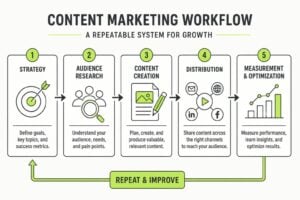
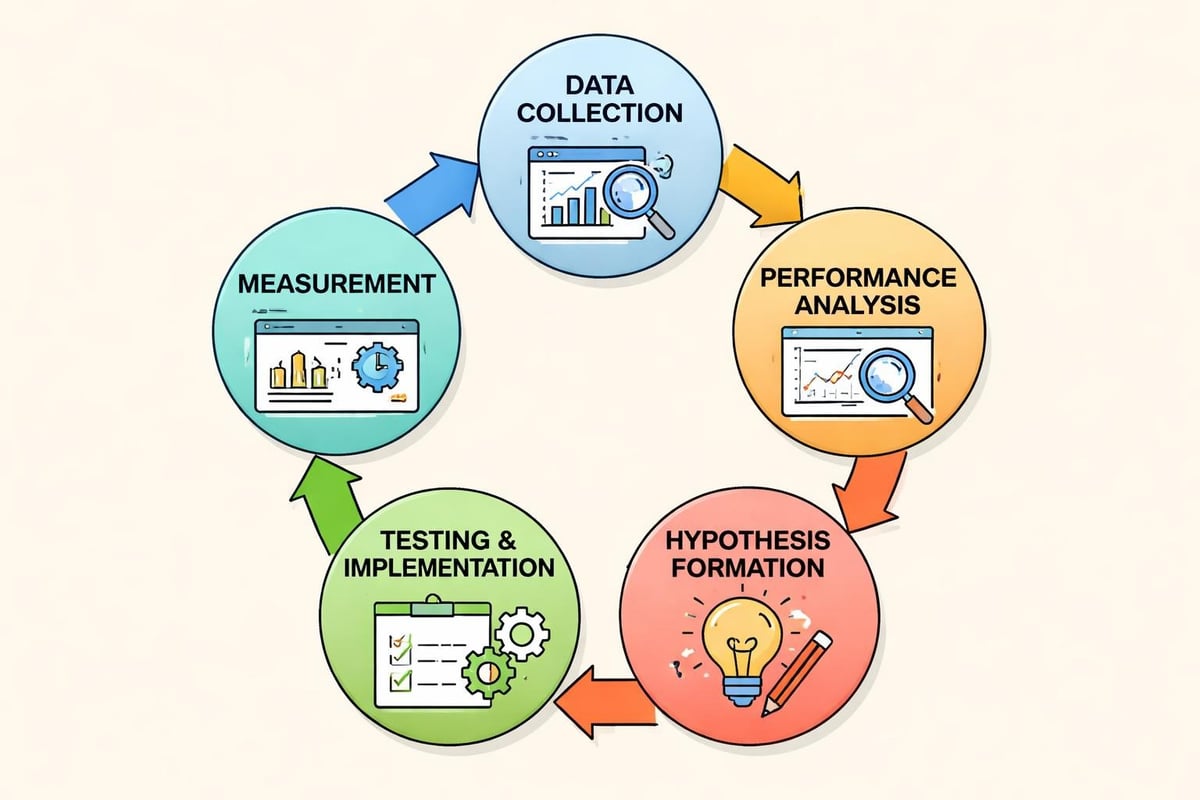
Most businesses launch a site and touch it once a year. That’s leaving money on the table. Website development marketing embraces continuous improvement, treating every month as an opportunity to test, learn, and optimise.
Effective website marketing strategies include regular A/B testing of headlines, calls-to-action, form fields, and page layouts. Small improvements compound. A 10% increase in conversion rate might seem modest, but over twelve months it represents significant revenue growth from the same traffic investment.
Your optimisation roadmap should include:
- Monthly review of analytics to identify underperforming pages
- Quarterly testing of major conversion points like contact forms and service pages
- Annual audits of site performance, SEO health, and competitive positioning
- Ongoing content updates to maintain search rankings and relevance
- Regular infrastructure updates to maintain security and performance
Integrating Paid Traffic with Website Infrastructure
Your website is where paid marketing either proves its value or wastes your budget. Every dollar you spend on ads depends on what happens after someone clicks. Website development marketing ensures your site converts traffic you’ve paid for instead of just collecting visits.
Landing Page Architecture for Paid Campaigns
Sending paid traffic to your homepage is usually a mistake. The homepage serves too many audiences and tries to accomplish too many things. Dedicated landing pages matched to specific campaigns convert better because they eliminate distractions and maintain message match from ad to page.
Effective landing page infrastructure includes:
- Template systems that make creating new campaign pages fast and consistent
- Dynamic content insertion that personalises headlines and copy based on traffic source
- Conversion-focused layouts that remove navigation and guide visitors toward single actions
- UTM parameter handling that tracks campaign performance accurately
- Fast loading since paid traffic users have lower patience than organic visitors
When marketing tactics like personalisation are built into your development infrastructure, launching new campaigns becomes faster and more effective.
Attribution and ROI Measurement
You need to know which campaigns, keywords, and channels generate revenue, not just traffic. Website development marketing builds attribution tracking that connects ad clicks to closed deals, even when the sales cycle spans weeks or months.
This requires:
- Persistent tracking that survives cookie deletion and device switching
- CRM integration that ties website activity to sales outcomes
- Multi-touch attribution models that credit all touchpoints appropriately
- Clear reporting that shows marketing ROI by channel and campaign
- Feedback loops that automatically optimize ad spend based on conversion data
Without this infrastructure, you’re making budget decisions based on incomplete data. You might be cutting the channels that drive your best customers and doubling down on vanity metrics that don’t pay bills.
Website development marketing works when technical infrastructure and strategic execution align around business outcomes that matter: qualified leads, predictable demand, and scalable growth. Most service businesses patch together websites, CRMs, and marketing tools without real integration, then wonder why results feel random. If you’re ready to build systems that convert attention into revenue reliably, MDO Digital removes the chaos and creates marketing infrastructure that compounds over time.