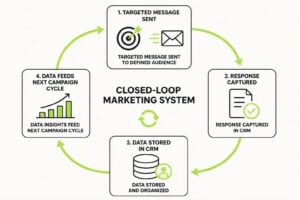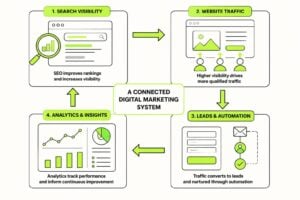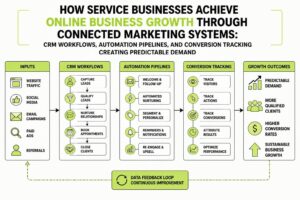
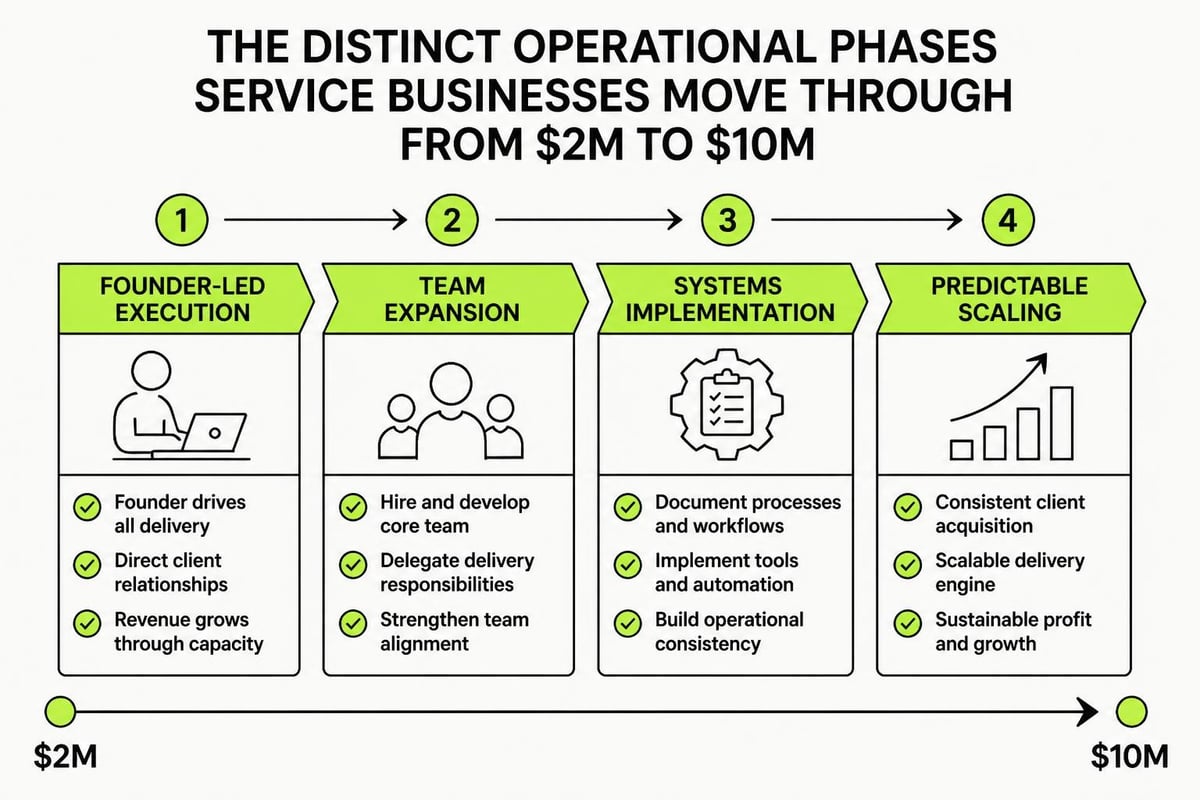
The jump from $2 million to $10 million in annual revenue isn't just about doing more of what got you there. It's a complete rebuild of how your service business operates, makes decisions, and attracts clients. Most 2m to 10m revenue service businesses hit this zone and either stall out or scale in ways that feel chaotic and unsustainable. The difference between the two outcomes usually comes down to whether you're willing to replace founder instinct with structured systems.
The Reality of Scaling Through the $2M to $10M Range
When you cross $2 million in revenue, you've proven your service works and the market wants it. But scaling beyond that point requires different infrastructure entirely. Your CRM needs to handle more complex pipelines. Your team structure needs clear ownership. Your marketing can't just be "whatever worked last quarter."
The service businesses that make it through this range share a few patterns. They stop treating marketing as a creative exercise and start treating it as a measurable system. They invest in automation early, not after they're drowning. And they accept that growth means letting go of control over every client conversation.
Between $2 million and $10 million, service firms often struggle to scale because they lack the financial visibility needed to make confident decisions. You can't manage what you don't measure, and most founders in this range are still running on gut feel.
What Changes as You Move Through Revenue Milestones
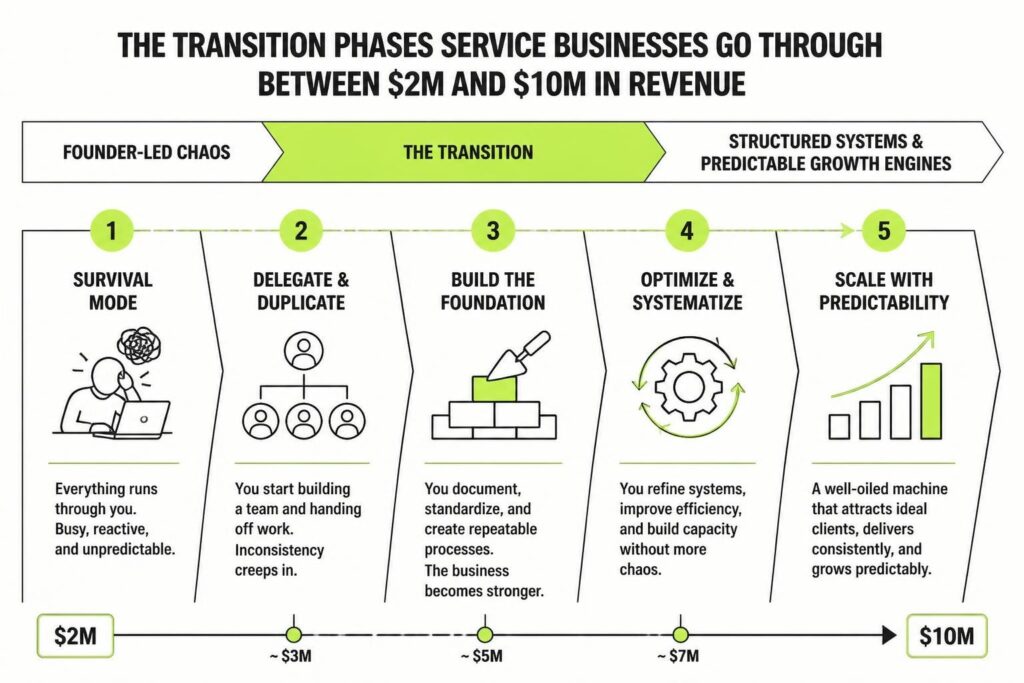
$2M to $3M: Building Your First Real Systems
This is where most service businesses realise spreadsheets won't cut it anymore. You need a proper CRM that tracks every lead, every conversation, every proposal. You need documented processes so new hires don't just "figure it out." And you need to start thinking about how to build a marketing funnel that feeds consistent opportunities into your pipeline.
Key shifts at this stage:
- Hiring your first non-delivery roles (operations, marketing, admin)
- Moving from project-based thinking to client lifetime value
- Creating repeatable onboarding and offboarding processes
- Setting up basic financial forecasting
The mistake most make here is hiring more delivery people instead of building the infrastructure to support them. You end up with more capacity but the same operational chaos.
$3M to $5M: Systemising Client Acquisition
Once you've got the basics in place, the next challenge is making your marketing predictable. 2m to 10m revenue service businesses that succeed here stop relying on referrals and word of mouth as their primary growth engine. They build outbound systems, content engines, and structured marketing systems that generate demand whether or not the founder is networking.
This is where you need to get serious about data. What's your cost per lead? What's your close rate by channel? How long does your sales cycle actually run? If you can't answer those questions with numbers, you're guessing.
Many businesses at this stage bring in a fractional CFO around the $2M mark to get financial clarity. It's one of the smarter investments you can make, because it forces you to run the business like a business instead of a lucrative hobby.
| Revenue Stage | Primary Focus | Common Bottleneck | Key Investment |
|---|---|---|---|
| $2M-$3M | Systems foundation | Founder capacity | CRM + processes |
| $3M-$5M | Marketing predictability | Lead generation consistency | Marketing systems + data |
| $5M-$7M | Team structure | Middle management gap | Leadership hiring |
| $7M-$10M | Operational efficiency | Process standardisation | Automation + integration |
$5M to $7M: Professionalising Leadership
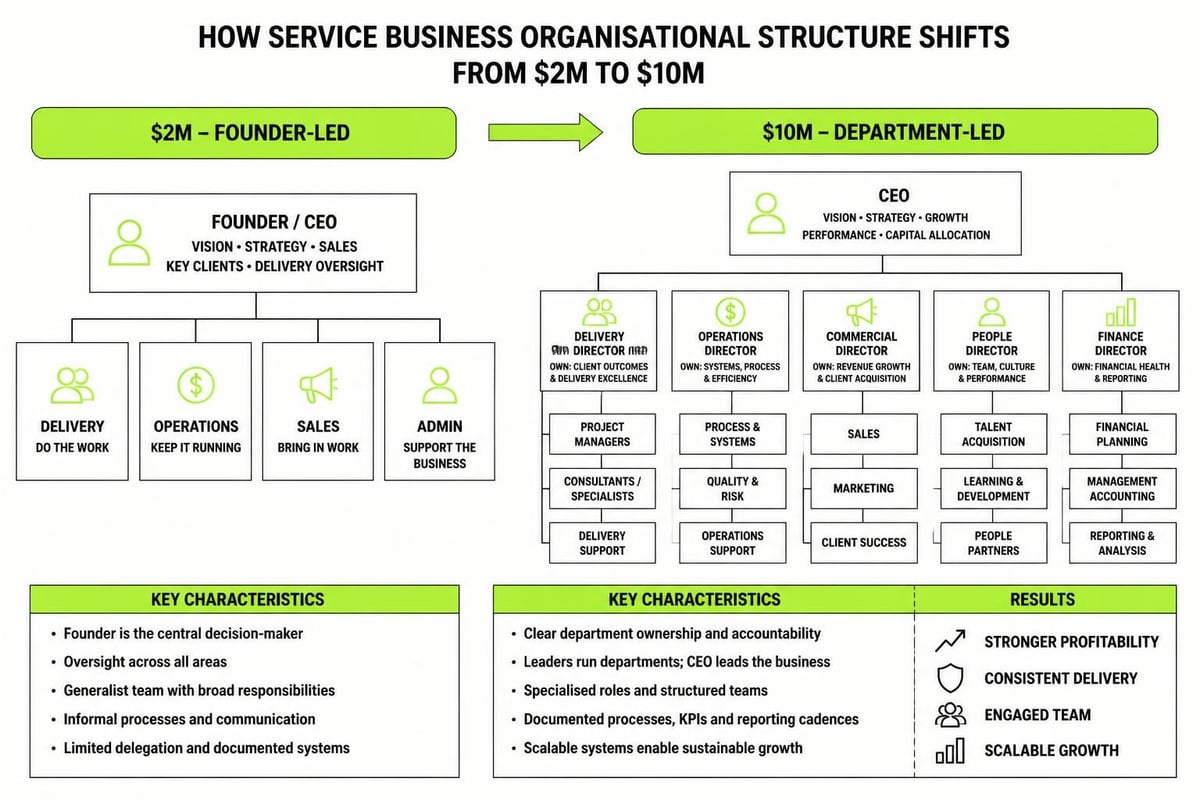
This is the phase where you stop being a hands-on operator and start being a proper CEO. That means hiring people smarter than you in their domains and actually letting them run things. For most founders, this is uncomfortable as hell.
The businesses that scale through this range successfully build out a leadership team that can make decisions without constant input. They create clear departmental ownership and start running the business through metrics dashboards instead of daily check-ins.
Your marketing at this stage should be systematised enough that it runs whether you're involved or not. That means documented strategies, clear campaign calendars, automated nurture sequences, and regular performance reviews. If your marketing still depends on your personal network or your gut instinct about what to post, you're holding yourself back.
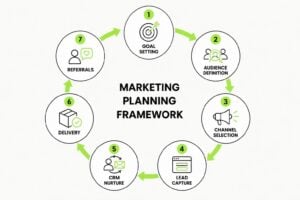
A practical framework like the 7-Step Marketing Plan can give you the structure to move from reactive to strategic. It walks through setting goals, defining your ideal buyer, choosing platforms, creating lead magnets, building CRM workflows, delivering great client experiences, and generating referrals. Each step feeds into the next, creating a system that compounds over time. You can grab the full framework at this link.
$7M to $10M: Scaling What Works
By this point, you know what works. The challenge is doing more of it without breaking what you've built. This means investing heavily in automation, integration, and process refinement. Your tech stack needs to talk to itself. Your team needs clear playbooks. Your clients need consistent experiences regardless of who's serving them.
2m to 10m revenue service businesses often stall at the $10M mark because they try to scale without upgrading their systems. You can't run a $10 million business on $2 million infrastructure. It just doesn't work.
This is where you start thinking about:
- Marketing attribution across multiple channels
- Client segmentation and tiered service models
- Predictive analytics for pipeline forecasting
- Cross-functional automation between sales, delivery, and finance
The businesses that make it past $10M are the ones that treat operational systems as a competitive advantage, not just back-office necessities.
The Marketing Shifts That Actually Matter
Most 2m to 10m revenue service businesses underinvest in marketing because they're still riding the momentum of early word-of-mouth growth. That works until it doesn't. Here's what needs to change as you scale.
Early stage ($2M-$4M) marketing priorities:
- Build a proper website that converts, not just looks nice
- Set up lead capture and nurture automation
- Create one content channel that works consistently
- Track every lead source and conversion point
- Document what messaging actually closes deals
Mid stage ($4M-$7M) marketing priorities:
- Expand to multiple acquisition channels
- Build sophisticated nurture sequences by buyer stage
- Create sales enablement content that shortens cycles
- Invest in brand positioning that commands premium pricing
- Start building marketing attribution models
Late stage ($7M-$10M) marketing priorities:
- Optimise cost per acquisition across all channels
- Build predictive models for pipeline forecasting
- Create self-service educational content to reduce sales load
- Develop partner and referral programs with tracking
- Test new channels with structured experiments
The difference between these stages isn't just budget. It's sophistication. You move from "post stuff and hope" to "run tests, measure results, scale what works."
What Holds Most Service Businesses Back
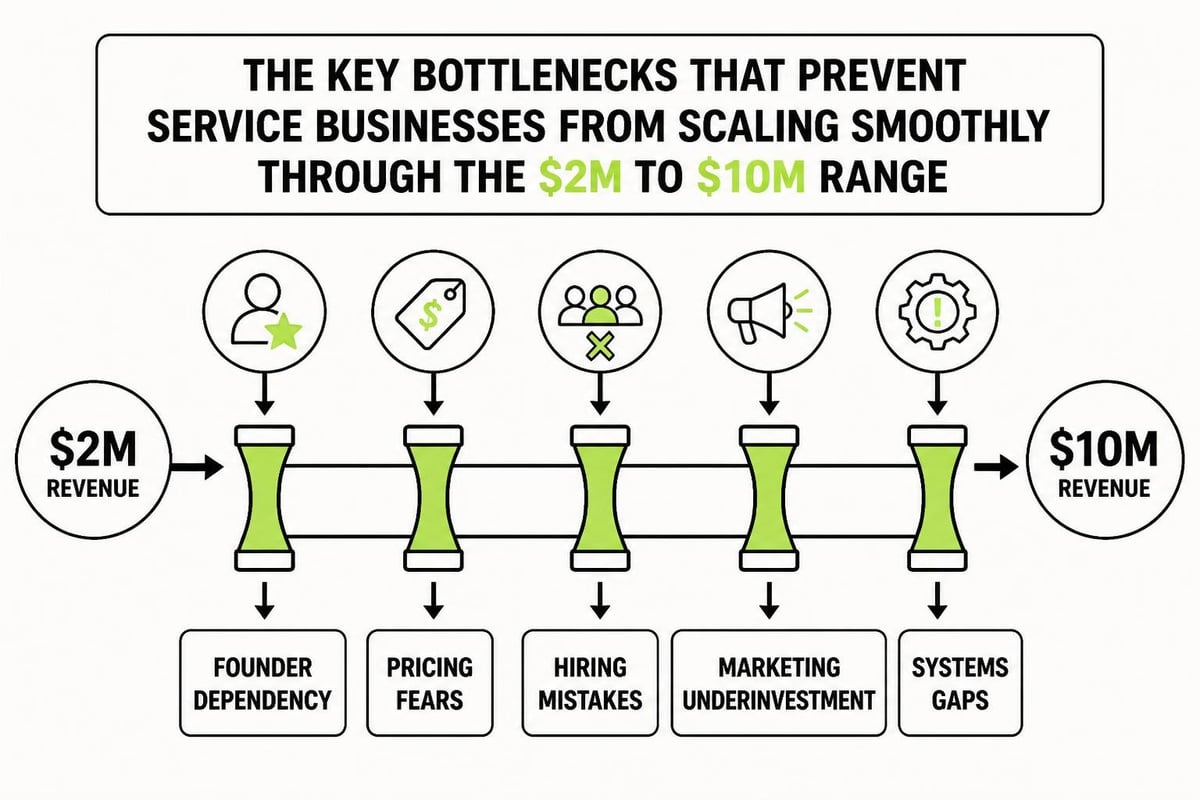
The technical stuff is honestly the easy part. You can hire for skills. What's harder is the mindset shift from operator to owner. From doing the work to building the machine that does the work.
Common traps for 2m to 10m revenue service businesses:
- Staying in delivery too long. You're the bottleneck, and no amount of hiring fixes that if you won't let go.
- Underpricing because you're scared. As you get better systems and better results, your prices should reflect that.
- Hiring friends instead of competence. Cultural fit matters, but competence matters more at this scale.
- Treating marketing as an expense instead of an investment. If you can't measure ROI, that's a you problem, not a marketing problem.
- Avoiding the hard infrastructure work. CRMs, automation, documentation, dashboards. Boring, essential, non-negotiable.
Many businesses in this range also struggle because they lack clear processes for scaling. They grow through heroic individual effort instead of repeatable systems. That works until it burns everyone out.
Building Infrastructure That Scales
The unsexy truth about growing 2m to 10m revenue service businesses is that success comes down to infrastructure. Your website needs to be more than a brochure. Your CRM needs to actually get used. Your marketing needs to feed predictable opportunities into your sales pipeline.
Website and Digital Presence
At $2M, you can get away with an okay website. At $10M, your website is a 24/7 sales and qualification tool. It should:
- Clearly communicate who you help and how
- Capture leads at multiple intent levels
- Integrate directly with your CRM
- Provide self-service resources that reduce sales load
- Display social proof that builds trust before calls
CRM and Automation Infrastructure
Your CRM should do more than store contacts. It should route leads, trigger follow-ups, score prospects, and give you visibility into every opportunity. If someone falls through the cracks, that's a system failure, not a people failure.
Automation priorities by revenue stage:
| Revenue Stage | Automation Focus | Key Workflows |
|---|---|---|
| $2M-$4M | Lead capture and basic nurture | Form submissions, welcome sequences, meeting reminders |
| $4M-$7M | Sales process and qualification | Lead scoring, automated follow-ups, proposal delivery |
| $7M-$10M | Client success and retention | Onboarding sequences, check-in triggers, renewal campaigns |
Marketing Systems That Compound
The evolution of your marketing systems should match your business complexity. Early on, simplicity wins. As you scale, sophistication wins.
Build campaigns that run without you. Create content that ranks and converts months after you publish it. Set up referral programs with actual tracking. Make your marketing a machine that feeds your sales team predictable opportunities.
The Numbers You Need to Know
If you're running a service business in the 2m to 10m revenue range and you don't know these numbers off the top of your head, you're flying blind:
- Customer acquisition cost (CAC) by channel
- Average deal size and how it's trending
- Sales cycle length from first contact to close
- Close rate by lead source
- Client lifetime value (LTV) and how it compares to CAC
- Gross margin by service line
- Team utilisation rate for delivery staff
- Monthly recurring revenue (MRR) if you have retainers
- Pipeline coverage (how many deals in pipeline vs. monthly target)
- Churn rate and why clients leave
These aren't vanity metrics. They're the dashboard that tells you whether you're scaling profitably or just getting bigger and broker.
Some businesses tailor their approach differently once they cross $10M in revenue, but the foundation is the same. Measure what matters, fix what's broken, scale what works.
What the Next Stage Looks Like
Getting to $10M is hard. Getting past it is harder. The businesses that break through typically upgrade every major system before they hit that threshold. They don't wait until things break. They rebuild proactively.
For 2m to 10m revenue service businesses, the goal isn't just to grow. It's to grow in a way that's sustainable, profitable, and doesn't require you to work 80-hour weeks. That means building systems that scale, hiring people better than you, and treating marketing as the predictable demand engine it should be.
The businesses that succeed here are the ones that accept the work is different at each stage. What got you to $2M won't get you to $5M. What got you to $5M won't get you to $10M. You have to be willing to rebuild as you grow.
Scaling a service business from $2M to $10M requires infrastructure, systems, and a willingness to let go of founder-led chaos. Most businesses fail here because they avoid the boring work of building proper marketing systems, CRM automation, and operational clarity. If you're ready to scale with structure instead of just hustle, MDO Digital can help you build the marketing and systems infrastructure that turns attention into predictable, compounding growth.